Skip to content
DevMeme
4579 of 7435
Bell curve of IQ debate: Vim purist vs JetBrains users on both ends
IDEs Editors Post #5024, on Nov 22, 2022 in TG

Bell curve of IQ debate: Vim purist vs JetBrains users on both ends

Why is this IDEs Editors meme funny?

Level 1: Velcro vs Shoelaces

Imagine you have little kids, big kids, and a wise grandparent all getting ready to go outside. The little kid just grabs a pair of easy velcro shoes because they’re simple – you just strap them on and go. The big kid (who’s not that old but wants to seem grown-up) insists, “No! Only shoes with shoelaces are what real grown-ups wear!” They struggle to tie their laces perfectly and proudly refuse to use velcro because they think it’s for babies. Meanwhile, the wise grandparent has seen it all and just picks whatever comfortable pair of shoes is by the door – sometimes that’s even velcro sneakers because, hey, they’re easy and comfy and get the job done. In the end, the youngest and the oldest both choose the simple, comfortable option without any fuss, while the kid in the middle is the only one making a big deal about how to put on shoes.

This is just like the programmer meme: the new programmer and the very experienced programmer both quietly use a comfortable all-in-one tool (the easy velcro shoes, representing the JetBrains IDEs), and the somewhat experienced programmer in the middle insists that to be “a real programmer” you must use the harder, more complicated method (the fancy shoelaces, representing the complex Vim editor). It’s funny because it shows how sometimes the people with the most to prove make things more complicated than they need to be, while the truly wise (and the truly new) are happy to just do whatever works and feels comfortable. In other words, sometimes the simplest way is good enough for both beginners and experts, and only the ones in between feel they must struggle to feel “real.”

Level 2: The Great Editor Debate

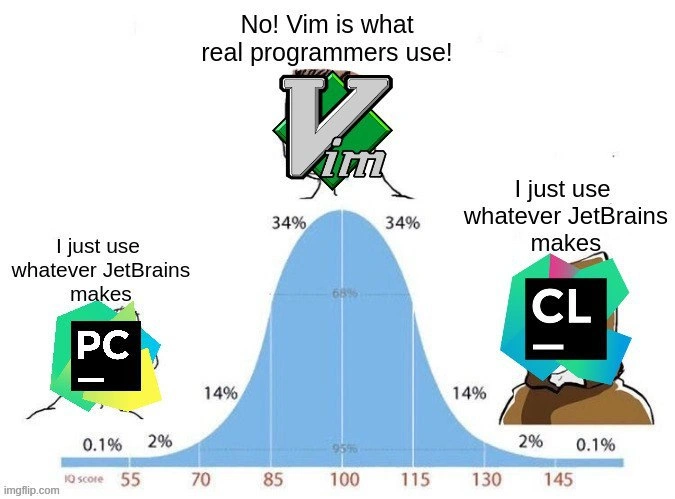
Let’s break down the key pieces of this meme and the concepts behind them, especially for those newer to programming. The image is based on an IQ bell curve – a common chart shape used to show distribution of IQ scores in a population. In this meme, it’s labeled with percentages (0.1%, 2%, 14%, 34%, etc.) along the bottom which correspond to sections of the curve. The far left and far right ends of the curve (the tails) each represent a tiny 0.1% of people, and the big hump in the middle represents the majority (around 68% in the center, 34% on each side of the mean). Internet memes often use this bell curve to joke that the people at the extreme low and extreme high ends of “intelligence” oddly end up sharing the same simple view, while those in the middle think something quite different (often more complicated or pretentious). Here, that idea is applied to the EditorWars – the lighthearted term for debates about programming editors and IDEs.

Now, what are the “JetBrains” and “Vim” things mentioned? JetBrains is a company famous for making IDEs (Integrated Development Environments). An IDE is a software application that provides comprehensive facilities to programmers for software development. It's basically a one-stop shop that usually includes a code editor, a compiler or interpreter, a debugger, and other tools in one package. The meme specifically shows two JetBrains products by their logos:

  • PyCharm – often shown as a green square with PC letters – is an IDE made by JetBrains for programming in Python. PyCharm helps you by highlighting errors, auto-completing code, managing project files, debugging, and many other handy features. It’s popular among beginners and pros alike because it makes Python development smoother.
  • CLion – shown as a turquoise/green-ish square with CL letters – is another JetBrains IDE, used mainly for C and C++ development (the “CL” hints at C-Language). It likewise has lots of features: code analysis, refactoring tools, etc. It’s beloved by many experienced C++ developers because C++ is a complex language and having an IDE catch mistakes or assist with refactoring is a big help.

When the characters in the meme say, “I just use whatever JetBrains makes,” they mean they aren’t picking sides in the editor debate at all – they just choose the JetBrains IDE for whatever language they’re working in. For example, if they code in Java, they’ll use IntelliJ IDEA (JetBrains’ Java IDE); if they switch to Python, they’ll use PyCharm; for JavaScript maybe WebStorm; for C++ it’s CLion, and so on. It implies a sort of easygoing, pragmatic approach: “JetBrains makes a good tool for every language, I’ll just use that and not worry further.” This phrase appears at both ends of the IQ curve in the meme, meaning the meme’s joke is that both very inexperienced programmers and very experienced programmers might say this.

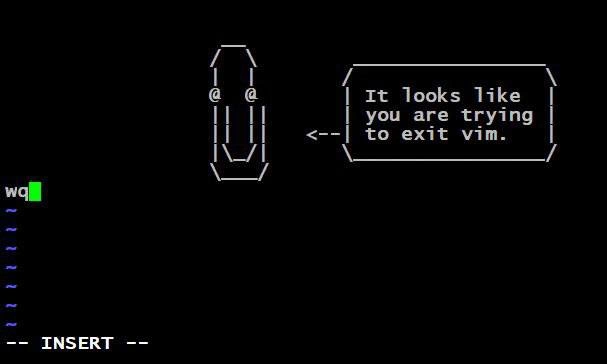
In contrast, Vim is represented by the big green "Vim" logo in the middle (at the top of the bell curve). Vim is a highly configurable text editor that is famous (infamous?) among programmers. It’s actually a descendant of an older editor named Vi (from the 1970s). Vim runs in the terminal/console and is controlled entirely with the keyboard – you switch between modes (like an insert mode for typing text, and a normal mode for issuing commands) rather than using menus or a mouse. Vim is extremely powerful in the hands of someone who knows it well: you can navigate and edit text with lightning speed using just a few key presses. However, it has a steep learning curve. For example, beginners often get stuck just trying to exit Vim because hitting the usual keys doesn’t work – you have to know to type :q or :wq (commands to quit, or write-and-quit). That has even become a running joke in programming: “How do I quit Vim?!” 😀

Because Vim is so minimalist and efficient (once you learn it), some developers absolutely love it and consider it a badge of honor to use it for everything. They might say things like "real programmers use Vim" because historically a lot of veteran programmers and sysadmins do use Vim or other terminal editors. Using Vim can feel like joining a special club: you spend time customizing your ~/.vimrc (Vim’s configuration file), you memorize dozens of shortcuts (like dd to delete a line or gg to jump to the top of the file), and you start to navigate code without ever touching the mouse. It’s actually pretty cool once you get the hang of it! But not everyone goes that route, and it’s definitely not necessary to use Vim to be a “real programmer” – that’s just an old-fashioned saying used humorously (or sometimes gatekeeping-ly).

So in this meme’s middle, the Vim purist stance is, “No! Vim is what real programmers use!” That is meant to represent the attitude of a lot of intermediate programmers who insist that Vim (or sometimes Emacs, another classic editor) is the one true tool for serious developers. They often reject IDEs like the ones JetBrains makes, possibly viewing them as crutches or as “bloated” software that real experts don’t need. The meme exaggerates this attitude for comedic effect, portraying it as the loud opinion of the broad middle of the curve (the 95% around the center, combining the 34%+14%+2% segments on each side of the very center in the graphic). In other words, the joke is that most developers in that middle range of experience are the ones arguing endlessly about editors and saying things like “You’re not hardcore unless you use Vim!”

EditorWars (the tag is a tongue-in-cheek way to label these debates) have been around forever: developers have playfully (and sometimes seriously) argued about IDEs vs TextEditors, or Vim vs Emacs, or more recently Vim/Emacs vs VS Code or JetBrains, etc. It’s basically a preference battle. Some people swear by their lightweight text editors, others love the rich features of full IDEs. There isn’t a universal right answer – it often depends on what you’re doing and personal taste. But what’s important for this meme is understanding that using Vim is often stereotyped as something experienced or “hardcore” programmers do, while using an IDE like PyCharm or CLion is seen as something beginner-friendly or just convenient. The meme flips this stereotype in a funny way by saying: actually, both the newbies and the truly wise old pros use the easy, convenient option (JetBrains IDEs), and it’s the folks in the middle who get snobby about Vim.

To highlight:

  • The left side character (IQ 55 say, which is very low in the distribution, though we’re not really measuring actual IQ here) with the PyCharm PC logo: This represents a new programmer (maybe a student or someone just starting out). They likely use PyCharm because it’s straightforward – they installed Python and PyCharm was recommended, and it helps them by catching mistakes and running code easily. They say “I just use whatever JetBrains makes” in a simple, matter-of-fact way. They might not even know that an editor war exists; they just want to code without hassle.
  • The middle character with the big Vim logo (around IQ 100-115 on the chart, the peak) is an average to intermediate programmer who has learned just enough to feel strongly opinionated. This character loudly proclaims “No! Vim is what real programmers use!” meaning they believe that to be authentic or elite, you should avoid fancy IDEs and stick to the venerable Vim. This likely reflects someone who is perhaps a year or two into coding, has discovered Vim or heard seniors praise it, and adopted it as an identity. They might have struggled to learn it and now are proud of it. The meme implies this group is large (the largest section of the bell curve) – i.e., many developers go through this phase of proudly touting Vim.
  • The right side character (IQ 145, the far right tail) with the CLion CL logo is an expert programmer (think someone who has been coding for many years, seen trends come and go). This wise guru-like figure also says “I just use whatever JetBrains makes,” which is the same line as the newbie on the left. The idea is that after trying everything, the expert has come to a similar simple conclusion: the JetBrains tools are well-made and save time, so why not use them? They have no interest in fighting about it – for them, an IDE is just a means to an end (getting software built). They might well know Vim too (in fact many JetBrains IDE users enable Vim keybindings inside the IDE for the best of both worlds!), but they don’t make it a tribal issue.

So essentially, the meme sets up a contrast between practical convenience vs. hardcore purism. The extremes (both low-experience and super-high-experience) choose practical convenience (JetBrains IDEs for strong Developer Experience (DX)), while the middle chooses hardcore purism (Vim-only, as a matter of principle and pride). This is funny to developers because it reflects reality in a cheeky way. Many of us recall being that person in the middle, or meeting that person, who goes “If you’re not coding in a terminal with Vim, you’re doing it wrong.” And likewise, we know very well-regarded senior engineers who quietly use IntelliJ or PyCharm because it helps them be productive, and they couldn’t care less about the “wars.”

To a junior developer or someone new:

  • Don’t worry: You do not have to use Vim to be a “real programmer.” That statement in the meme is sarcastic. In truth, you can use any editor or IDE that you feel comfortable with. The goal is to write good code and learn; the tool is just a helper.
  • IDEs like JetBrains’ products are excellent for beginners because they offer a lot of guidance (like telling you if your code has errors even before you run it, or letting you navigate to a function definition by a simple click or keystroke). They also remain extremely useful when you become an expert because they have powerful tools (like advanced debugging, profiling, and refactoring capabilities) that even experts benefit from.
  • Vim is a great tool too – it’s light, you can find it on almost any server or computer (useful when you’re remote connecting via SSH, for example), and once you learn it, you can edit files very quickly without your hands leaving the keyboard. Many developers use a mix: for quick edits or working on a remote Linux server, they use Vim, but for large projects on their own machine, they might use an IDE. It’s not an all-or-nothing thing in real life.

The bell_curve_meme context here isn’t literally about IQ or anyone’s intelligence; it’s just a meme format. The message isn’t that Vim users are “mid IQ” in any serious sense – it’s humorously suggesting that being super opinionated about Vim is a phase many developers go through when they know enough to pick tools but maybe not enough to realize every tool has trade-offs. Meanwhile, the very “enlightened” devs realize what matters is productivity and happiness while coding (i.e., DeveloperExperience).

In the end, the Great Editor Debate (IDE vs editor, Vim vs JetBrains) often just comes down to personal preference and context:

  • If you’re a new dev, you might prefer an IDE because it’s welcoming and helpful. (And hey, JetBrains makes great ones – so no shame in using them!)
  • If you’re an intermediate dev looking to broaden your skills, you might try Vim to see what the fuss is about. You might even fall in love with it and become one of those people who want to use Vim everywhere – it can be kind of fun and empowering to learn a tool that deeply.
  • If you’re an experienced dev, you probably have used multiple tools over the years and have settled on what makes you most efficient. Maybe that’s Vim with a bunch of plugins, or maybe it’s a JetBrains IDE, or maybe a combination. You likely don’t feel the need to argue about it too much – you know everyone can have their workflow.

The meme is funny because it exaggerates these stages and pokes fun at the stereotype of the “Vim purist” shouting at everyone in the middle, flanked by the two extremes of folks who are just quietly getting things done with a full-featured IDE. It’s a snapshot of developer culture and the lighthearted DeveloperHumor we share about our own habits and follies. After all, who hasn’t seen a heated online thread about the best editor, or conversely, a senior engineer who just shrugs and uses whatever tool will get the feature out the door? This meme says: we see the pattern, and we’re laughing at ourselves a bit. 😅

Level 3: Enlightenment at the Edges

At first glance, this meme hilariously captures a classic EditorWars trope using the bell-curve IQ distribution. On the left tail (low end of the IQ curve) and the right tail (high end), we see two developers who both say the exact same thing:

"I just use whatever JetBrains makes."

One is a naive-looking stick figure with the PyCharm (JetBrains PC logo) on their head, and the other is a wise robed figure emblazoned with the CLion (JetBrains CL logo). In the middle of the bell curve – the big bulge where 68% of folks fall – a large Vim logo proudly declares:

"No! Vim is what real programmers use!"

This setup parodies the long-running vim_vs_jetbrains debate (and editor wars in general) by implying an inverse relationship between a developer’s experience level and how loudly they champion a tool. The humor comes from the idea that both beginners and the most advanced developers quietly prefer the same pragmatic approach (using whatever JetBrains IDE fits the job) while the mid-level “average IQ” dev is loudly adamant that only Vim is the mark of a “real programmer.” It’s a bell-curve meme embodiment of the joke that novices and masters often agree on simple solutions, while those in the middle complicate things with zealotry.

Why is this so on point? Seasoned developers nod knowingly because many have lived this arc in their own career. Early on, you might just use the recommended tool (perhaps a friendly JetBrains IDE like PyCharm for Python or IntelliJ IDEA for Java) without overthinking it. Then, as you gain confidence, you discover something like Vim – the legendary keyboard-driven text editor that hackers from the ‘80s swore by – and suddenly you feel the need to prove your chops by mastering it. At that middle stage, it’s common to become a bit of a Vim purist: you boast about editing config files in terminal, memorizing dozens of key combos, and smugly sneer “GUI IDEs are for noobs.” This is the peak of the bell curve in the meme – the 34%+34% majority who often insist "real" programmers use barebones tools. It satirizes that middle-of-the-pack overconfidence (a wink at the Dunning-Kruger effect, where a little knowledge feels like absolute expertise). The Vim user at the peak shouts the loudest, much like many intermediate devs on forums claiming moral high ground for using a text editor that doesn’t even have a mouse cursor.

But then, as the years go by, the pendulum swings back. Truly experienced developers (those in that top 0.1% IQ tail, metaphorically) have nothing to prove. They’ve likely used Vim, edited .vimrc configs until 3 AM, maybe even tried Emacs or VSCode, and realized an important truth: the best tool is the one that lets you get work done efficiently and comfortably. In big real-world projects – imagine a huge codebase with hundreds of files – a powerful IDE (Integrated Development Environment) like JetBrains’ products can be a lifesaver. It has advanced code navigation, IntelliSense auto-completion, real-time error highlighting, a built-in debugger, one-click refactoring, and integration with version control. Senior devs often value these DeveloperExperience (DX) boosts because they’ve been burned by wasting time on tedious tasks. They quietly think, “Why manually trace code or struggle with a cryptic plugin when the IDE can just show me the definition or let me refactor in seconds?” Hence the right-end sage figure calmly says, “I just use whatever JetBrains makes.” It’s the same line as the novice on the left, but coming from a place of wisdom and pragmatism. The enlightened master-level coder is essentially saying: I use the tool that gives me the best results and I don’t fuss about ideology. This symmetry is what makes the meme pure DeveloperHumor gold: it roasts the noisy middle for turning tool choice into an identity, while the extremes (both uninitiated and all-knowing) just get on with using convenient tools.

It’s also poking fun at how IDEs_Editors arguments often generate more heat than light. The IDEsAndTextEditors category of debates (from the classic Emacs vs Vi showdown to modern vim_vs_jetbrains spats) has always been less about raw productivity and more about tribal pride and personal preference. The meme’s bell curve implies that those who truly understand the craft (right tail) and those too new to care (left tail) are not interested in holy wars – they simply pick a reliable tool (JetBrains IDEs in this case) and move on. It’s the folks in the middle of their journey who tend to get almost religious about their editor. There’s a kernel of truth exaggerated here: Many of us have encountered that mid-level programmer who’ll spend an entire lunch break preaching about how using only Vim (or only VS Code, or only emacs, etc.) is the path to programmer enlightenment, while the senior dev next to them quietly sips coffee, having written half the codebase in an IDE with code generation and not feeling the need to justify it.

Historically, this pattern repeats. In the late 90s and 2000s, for example, newbies happily used whatever editor came with the compiler or IDE (think Visual Studio or Eclipse). Intermediate devs then discovered Vim or Emacs and went, “Wow, I’m coding like a real UNIX wizard now!” They’d customize color schemes, map crazy shortcuts, and might scoff at anyone clicking a Run button instead of typing :make. Meanwhile, the veterans who maybe did all that in the 80s have moved on to using the best of modern tools, or at least are agnostic—some even use Vim inside an IDE (JetBrains IDEs have a Vim plugin called IdeaVim, the enlightened can truly have it both ways!). The cycle continues today with new generations: newbies might start with PyCharm or VS Code because it’s approachable, intermediate enthusiasts dive into Vim or even Neovim to prove themselves, and experts pick whatever maximizes productivity (which might very well be JetBrains’ IntelliJ platform for its robust features, or a fully tuned Vim if that truly works better for them, but crucially without the need for evangelism).

The bell-curve format itself is a meme that screams “satire ahead.” By labeling the tiny 0.1% ends as having the same slogan and the 68% middle with a grand pronouncement, it caricatures the idea that true wisdom often sounds simple, and loud certainty can be a hallmark of the mid-tier. It’s an iq_distribution_joke — not to be taken as a serious IQ commentary, but as a visual metaphor. The robed figure on the right (with a mystical vibe and the CLion logo) symbolizes the “enlightened” niche of developers who’ve ascended past trivial wars. The stick figure on the left with the PyCharm logo represents the blissful ignorance (or innocence) of a beginner. Both ends share a Zen-like lack of editor angst: “I use whatever JetBrains makes,” as in, I’ll go with a well-crafted tool and not overthink it. The middle, with the Vim logo shouting about “real programmers,” represents the noisy bulk in the middle of the learning curve who have strong opinions on tooling as a rite of passage. It’s making light of that middle-phase developer who often floods Reddit or Stack Overflow chats with diatribes about how using an advanced IDE is cheating or “for weaklings,” while editing in Vim (or even raw nano or Notepad++) is somehow more authentic.

For those of us who’ve been in the industry, the DeveloperExperience_DX reality is that good tools (like JetBrains IDEs) can dramatically improve code quality and speed. But many of us also remember the pride of mastering a hard tool like Vim. The meme humorously implies that the real geniuses (and ironically the total newbies) aren’t caught up in that pride; they just quietly use whatever works best. It’s a playful jab at the tendency of intermediate devs to confuse difficulty for quality – e.g., believing Vim must be superior because it has a steep learning curve and a certain elite cachet (“real programmers use it!”). The enlightened coder knows that productivity and comfort matter more than looking hardcore. And the newbie doesn’t know any of that yet – they just want to code with minimal friction – so both ends converge on the easy, effective solution: JetBrains tools that “just work.”

In summary, this meme uses the bell_curve_meme format to encapsulate a piece of coding culture: the perennial IDEs vs TextEditors debate. It cleverly paints the loud Vim purist as the middling majority and suggests that both the uninitiated and the truly wise simply opt for JetBrains IDEs without fanfare. It resonates because it rings true to the experience gap: the more you know, the less you feel the need to posture about your text editor. And as any battle-scarred senior dev might chuckle, at 3 AM on production release night, nobody cares how you wrote the code – only that it works. Whether you saved the day with a fancy Vim macro or an IntelliJ refactoring, the end result (working software) is what matters. The real “real programmer” is the one who delivers – tool choice be damned. This meme just delivers that insight with a big dollop of sarcastic fun. 😄

Description

The image is an IQ bell-curve meme: a blue normal-distribution chart ranges from 55 to 145 with percentage labels "0.1% 2% 14% 34% 34% 14% 2% 0.1%" beneath each segment. On the left tail, a small stick-figure topped with the JetBrains PC (PyCharm) logo says, "I just use whatever JetBrains makes." At the peak, the large green-and-silver Vim logo proclaims, "No! Vim is what real programmers use!" On the right tail, a robed figure with the JetBrains CL (CLion) logo repeats, "I just use whatever JetBrains makes." The meme pokes fun at long-running editor wars, implying both very novice and very advanced developers quietly choose JetBrains IDEs while the mid-IQ majority loudly champions Vim

Comments

79
Anonymous ★ Top Pick Bell-curve enlightenment: juniors click “Install JetBrains,” mids spend quarters perfecting .vimrc, seniors just take the corporate JetBrains seat and race to untangle the 10-million-line monolith before Finance notices the AWS bill
  1. Anonymous ★ Top Pick

    Bell-curve enlightenment: juniors click “Install JetBrains,” mids spend quarters perfecting .vimrc, seniors just take the corporate JetBrains seat and race to untangle the 10-million-line monolith before Finance notices the AWS bill

  2. Anonymous

    After 20 years in the industry, you realize the real 10x developers aren't the ones who can exit Vim on the first try - they're the ones who ship features while everyone else is still configuring their .vimrc for the perfect colorscheme that will finally make them productive

  3. Anonymous

    The real insight here is that after 20 years of configuring Vim plugins to replicate IDE features, you eventually realize JetBrains already solved the problem - and your .vimrc has become the legacy system you now maintain

  4. Anonymous

    The real 10x trick is letting IntelliJ burn the CPU indexing while you stop maintaining a distributed system called .vimrc

  5. Anonymous

    Senior truth: you either turn Vim into an IDE or JetBrains into Vim; the bell curve just measures how much you trust AST refactors over your macros

  6. Anonymous

    Vim peaks the curve because survivors self-select; JetBrains users are just the 14% who value features over forgetting :wq

  7. @LionElJonson 3y

    jetbrains sw is shit (as a Rider user) *refuses to elaborate* *leaves*

  8. @VolodymyrMeInyk 3y

    nice switch

  9. @thisisluxion 3y

    I genuinely cannot bring myself to use something different from neovim, it's engraved in my brain now

  10. no name 3y

    meme was sponsored by corporate gang

    1. @L2CacheGay 3y

      Consider: piracy

      1. no name 3y

        i mean no one needs this even for free unless they are developing for enterprise

        1. @L2CacheGay 3y

          Speak for yourself lol

          1. Deleted Account 3y

            Yes daddy matt

  11. @l7KiLL 3y

    I mean, you can use MS Code if you don't have money for IDE, but why do u even try to use such software as *vim?

    1. @rusiboonja 3y

      speed of development, lightweight

      1. @l7KiLL 3y

        How does Vim make development faster?

        1. @rusiboonja 3y

          Not leaving your hand from the keyboard, hotkeys, plugins, etc

          1. Deleted Account 3y

            JetBrains design their IDEs the same way. I can't even remember when i have to use mouse to so something in Intellij IDEA while coding.

        2. @asm3r 3y

          Handy editing, made for tree text with braces(for code), not for messaging/ms word doc writing

        3. @CcxCZ 3y

          When you learn all this you will never want to use anything else: https://vimhelp.org/index.txt.html 🥴 Honestly though: quick navigation, convenient macro system & dot (repeat last edit) are hella useful for large one-off edits that it's not worth making some kind of format transformer and/or when the existing refactoring tools do not cut it. To me Vim is more of a sysadmin and data wrangler editor than strictly a programming tool. It's also worth it if you routinely work with DSLs that don't have IDE support or even create new ones. I see it as a very broad and moderately efficient text editing tool, whereas IDEs have rudimentary editing capability and then few very narrow and very efficient refactoring and reformatting tools. So in your usual IDE as long you are doing exactly what you are provided tooling for it's smooth ride but anything outside that starts being painfully tedious. Conversely if you take a good general editor you can usually plug those refactoring and formatting tools straight in (especially since Language Server support exists) but you may find it not worth the effort to even look for them. So YMMV on how much of each you need. Historically Vim was considered not so good for high boilerplate languages such as Java where you often want to algorithmically infer code rathen than to write it. At some point few desperate souls even made Eclipse/Vim integration layer. But as far I know most of the problems with these went away after NeoVim and Vim 8 made waves and made it easy for other tools to call into Vim rather than vice versa. If you want to see the extent of the editing efficiency for complex tasks, look at the challenges at https://www.vimgolf.com/ where people compete in how few keystrokes they can do the required edits.

    2. @gizlu 3y

      The thing I like in vim the most: - it is first class citizen of terminal, not the other way around - I can harmlessly open over 9999 independent instances and forget about them - it doesn't force any particural workflow and tooling (like buildsystem) on me - I have one editor for everything rather than one IDE per lang

      1. @SamsonovAnton 3y

        There are multilingual IDEs out there (I use KDevelop, by the way 😁).

  12. @l7KiLL 3y

    What's the point

    1. @paul_thunder 3y

      Same as bodybuilding - pointless waste of time and resources. But impressive

      1. @l7KiLL 3y

        I dunno, if refactoring code that makes ur life easier like 10 times is pointless I'll just say "ok", IDE is not for you.

        1. @paul_thunder 3y

          I was talking about vim-like software

          1. @l7KiLL 3y

            Oh, sorry then, misunderstanding.

            1. @paul_thunder 3y

              👌 it's fine, I understand

  13. @l7KiLL 3y

    You can extract classes/interfaces by refactor feature, or just fields/vars. You have much of cleanup stuff, like remove unused imports and/or methods etc.

  14. @paul_thunder 3y

    It's pointless, because everything vim can do - modern IDE can do too

  15. @paul_thunder 3y

    If you have enough RAM 😁

    1. @l7KiLL 3y

      Well, if you are not you probably can use something like MS Code, but I'm not sure is it even possible to develop modern app w\o some RAM capacity.

      1. @paul_thunder 3y

        Well.. anything in compare to vim will require lots of RAM. But for me 32gb of RAM is cheaper than wasting my time to adjust to vim or even MS Code. I don't think Ms Code is bad.. but it's still not worth it for me

  16. @l7KiLL 3y

    I mean almost every JS app dev server cost you 500MB+

    1. @paul_thunder 3y

      Yeah. I'm developing for mobile, so native debugging tools require 3-5GB of RAM. Saving few GB using some ancient development tool does not seem the best way to improve performance.

  17. @RichStallman 3y

    Emacs

  18. @Algoinde 3y

    I'm never leaving Sublime

    1. Deleted Account 3y

      Same Notepad or AkelPad for life

      1. Deleted Account 3y

        .

  19. @r1gor 3y

    vscode and jb production must have

  20. @Vedqiibyol 3y

    VS Code is free. leaves

    1. @jor_ban 3y

      notepad is free

      1. Deleted Account 3y

        Exactly

      2. @kandiesky 3y

        Notepad is not actually free as you have to pay for Windows (or crack it) before using the application/binary

    2. @paul_thunder 3y

      Asm is free. Leave now.

  21. @Vedqiibyol 3y

    Indeed, though I find it easier to use plugins/extensions with VS Code... x3 Although one good point, notepad doesn't need 200+MB of RAM, unlike VS Code......

  22. @paul_thunder 3y

    Stop using anything except asm

  23. @paul_thunder 3y

    You don't need higher level tools. Asm can do anything you need

    1. @SamsonovAnton 3y

      Asm is not portable.

      1. @paul_thunder 3y

        Why not?) What is more portable than the closest to machine code language?

        1. @SamsonovAnton 3y

          How do you understand "portable" then? It usually means ability to compile the program for many CPU architectures and OS environments — machine code is nowhere near to this.

          1. @paul_thunder 3y

            Oh I see. You mean portable like universal. Like smth you can use on other platform. I'm sorry to tell this, but any language has to transform it's commands to machine code. The difference is who has to do this: you, or the script written by other people. So basically it all cones to machine code in the end. My point was: if you think higher level ide is bad, use the lowest level you can. The lowest is machine code. Use it. Why not? Some nerds think they are better kind of programmer's because they use lower level tools, but does it really? 🤔

            1. @SamsonovAnton 3y

              Do you still practice writing machine code directly (without using asm compiler) on punch cards? 😁

              1. @paul_thunder 3y

                That's my point - I do not and I believe almost nobody does that for production purposes

                1. @SamsonovAnton 3y

                  Another big problem with asm, even when targeting a single platform, is that it's really hard to write highly optimized code by hand. (Which bothers very few programmers nowadays, though.)

                  1. @ZgGPuo8dZef58K6hxxGVj3Z2 3y

                    Agree

                  2. @paul_thunder 3y

                    Yeah. Same with people using vim etc.. they think they are more productive, but using more capable tool does not mean being more productive. Usually using sharper knife means get injured more often.. and that's it 😁

                    1. @sylfn 3y

                      I heard that most of accidental knife cuts are from NOT sharp knives becuase you need to add more force to it...

                      1. @SamsonovAnton 3y

                        No. I prefer non-sharpened knifes exactly because it's hard to impossible to cut your hands. I would better spend more time cutting than healing my fingers.

                        1. @paul_thunder 3y

                          Then use asm. It's hard to do smth harmful if your code does not compile

                    2. @ZgGPuo8dZef58K6hxxGVj3Z2 3y

                      To be honest it doesn’t matter what tool you use. I use Visual Studio for almost everything and I don’t even use 99.99% of its features… So it clearly doesn’t benefit me by having those

                      1. @ZgGPuo8dZef58K6hxxGVj3Z2 3y

                        (Unless you rely on some fancy sht like IntelliSense)

            2. @ZgGPuo8dZef58K6hxxGVj3Z2 3y

              This is not the whole truth because many languages do not compile at build time but they get translated to machine code at runtime

        2. @Vedqiibyol 3y

          Well x86 and ARM are pretttty different.

    2. @Vedqiibyol 3y

      True that, do I really need 6700 possible segfaults though? 🤔

  24. @Vedqiibyol 3y

    Yes precisely.

  25. @paul_thunder 3y

    Guys.. we all know what we are talking about. The good programmer is the lazy programmer. Do I have to explain this to anybody?

    1. @SamsonovAnton 3y

      But not all lazy programmers are good. 😁

      1. @paul_thunder 3y

        You are definitely not

  26. @WatashiWaSeireidesu 3y

    Using Vim or Emacs is like being an edgy developer

  27. @atom_ix 3y

    I just use whatever Microsoft owns)

  28. @Saeid025 3y

    * Start using Helix

  29. @Saeid025 3y

    You won't regret it - Lightweight as vim (blazingly fast, do I have to say it's written in rust? 😂) - Smart as IDE (using LSP with easy setup (unlike vim), just install the LSP and leave the rest to helix) - Easier to understand and work with thanks to shortcuts that makes sense for non vim users (and having things like space mode) - ...

  30. @Saeid025 3y

    And if you're an GUI fan, give a shot to lapce... Still blazingly fast But be aware it's new and have a long road ahead of it But god damn it's fast compared to all other things

  31. @CcxCZ 3y

    *peeks into comments* War… war never changes.

  32. @nohat01 3y

    Clion on M1 Pro 14'

  33. @nohat01 3y

    I disable conditioning in my house

  34. @nohat01 3y

    Every night

Use J and K for navigation