Skip to content
DevMeme
966 of 7435
When a New Feature Threatens Stable Code
Bugs Post #1089, on Mar 3, 2020 in TG

When a New Feature Threatens Stable Code

Why is this Bugs meme funny?

Level 1: Don’t Poke the Sleeping Lion

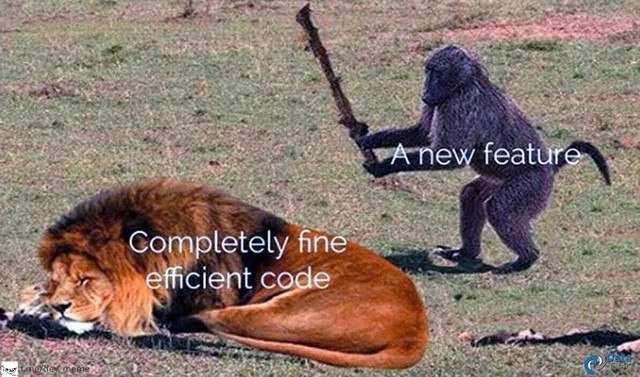
Imagine you have a big, peaceful lion snoozing in the sun. It’s calm, not bothering anyone. That’s like your program when everything is working perfectly — it’s quiet and happy. Now, suppose someone comes along and pokes that lion with a stick. You can guess what happens next: the lion wakes up angry and roaring, and suddenly things aren’t so peaceful anymore! This is a lot like what happens when we mess with something that was working just fine. In the world of coding, if a program is running smoothly, and you add a brand-new feature without being careful, you might stir up a whole lot of trouble. The calm is gone and chaos might follow (bugs and errors popping up, like an angry lion on the rampage).

The meme is funny because everyone knows it’s a bad idea to poke a sleeping lion — it’s just asking for trouble. Similarly, every programmer knows that changing a perfectly good program can lead to big surprises. It’s a little joke saying “hey, be careful with that new idea, or you’ll wake the beast!” Even if you’re not a coder, you get the idea: if something is peaceful and working, you should be gentle and cautious when changing it… or you might end up running away from a very grumpy lion.

Level 2: Ambush in the Codebase

This meme uses a simple animal scenario to explain a classic developer predicament. The sleeping lion represents a piece of code or a system that is running smoothly. In developer terms, it’s our stable, efficient code — code that’s been tested, optimized, and works just right. When code is efficient, it means it uses minimal resources (CPU, memory) and runs fast. Think of an app on your phone that opens instantly and never lags; that’s efficient code at work. The text calling it “completely fine efficient code” suggests we have zero complaints — it’s clean, it’s been possibly refactored for clarity, and might even have a solid suite of tests. It’s basically a developer’s pride, the part of the project where everything is under control.

Now enter the baboon with the stick, labeled “a new feature.” In real software projects, a feature is any new functionality or improvement added to the product. For example, if you have a chat application, a new feature might be “add the ability to send emojis.” It sounds simple, but under the hood it means changing the code: you might need to adjust the message format, update the database, handle new edge cases, etc. This is where the trouble often starts. In the meme, the baboon creeping up on the lion is exactly like a new feature creeping into a stable version of the software. It’s an ambush. The original code wasn’t expecting this change, so it might react unpredictably — just like a lion might wake up angry if startled.

New features often introduce bugs, which are errors or glitches in the program. Imagine our previously perfect chat app: after adding emojis, suddenly normal messages load slower or some messages crash the app. That’s a bug caused by the new addition. It’s common for a seemingly harmless change to have side effects. Developers try hard to avoid this with practices like code reviews and testing, but as every junior developer learns, it’s easier said than done. Maybe you’ve experienced this in a school project: you have a working program, then you add one more requirement the night before the deadline and bam! something that worked before suddenly breaks. It’s frustrating but very common.

This is related to what we call feature creep – when more and more features keep getting added to a software over time, often without proper planning. Each addition can make the code more complex and harder to manage. As features pile on, maintaining that initial efficiency becomes a challenge. The term technical debt comes in here. Technical debt is like a “debt” you incur when you choose a quick-and-dirty solution that you’ll have to clean up later. For instance, rushing to add the emoji feature without thoroughly redesigning parts of the chat app might introduce messy code or hacks. The app still works (if you’re lucky), but now the codebase has some “ugly” parts that will cause headaches in the future (the debt to be paid). It’s akin to putting off cleaning your room for too long — eventually, you have a bigger mess to deal with. New features often add to this mess when they’re not integrated carefully.

The CodeQuality category listed for this meme is about maintaining high standards in code — readability, efficiency, low bug count. The sleeping lion suggests that high code quality has been achieved and everything is calm. But the meme jokes that a brand-new feature can lower that code quality in an instant, like knocking over a perfect stack of blocks. It’s a scenario every developer finds relatable: you finally got things running just right, and then a new ask comes along that jeopardizes it all. The tags like DeveloperHumor and DeveloperPainPoints are there because this situation hits close to home for developers. It’s both humorous and a bit painful because we know the struggle of balancing new features with keeping the code bug-free and efficient.

In the image, the baboon’s raised stick is basically the threat of change. Often, changes are necessary — software can’t stand still, just as products need to evolve. But there’s always a risk. This meme is essentially a friendly warning wrapped in humor: when you introduce something new to a perfectly stable system, do it with caution (or the lion’s gonna roar). It reminds junior devs that even a well-optimized piece of software can be disrupted by a seemingly simple update. It’s why in many teams, adding new features goes hand-in-hand with extensive testing and code review. You’re trying to make sure the “lion” stays happy and doesn’t bite back with a nasty bug.

Level 3: When Features Attack

In the wilds of a codebase, stability is a prized treasure. Our sleeping lion — the “completely fine efficient code” — represents a perfectly tuned system that’s been running smoothly for ages. It’s code that might have been optimized down to the last byte and clock cycle. Perhaps the team spent weeks refining algorithms, eliminating every unnecessary loop, and squeezing out maximum performance. It purrs in production without a hiccup. But then along comes “a new feature,” much like that baboon with a stick, ready to clobber our dozing king of the jungle. The humor here is darkly relatable: every senior developer has watched a seemingly minor feature request smack a stable system upside the head, unleashing chaos. It’s a classic tale of feature creep – each new capability sneaks up on a peaceful product and attacks its performance or reliability when you least expect it.

Why is this so funny (and painful) for experienced engineers? Because it’s true. No matter how efficient or elegant your code is, a brand-new requirement can unravel it. Perhaps that tiny feature wasn’t so tiny after all; maybe it introduces an extra database call inside a tight loop, turning yesterday’s lightning-fast response into today’s sluggish crawl. Maybe it needs a new library that conflicts with existing ones, or it bypasses a carefully planned cache. The meme captures that gotcha moment: the code was optimized, we let our guard down (just like the lion snoozing), and wham! – the new code path clubs our performance metrics into the ground. Seasoned devs chuckle (or groan) because they’ve been on the losing side of that battle many times.

Let’s illustrate the carnage in code form. Imagine our original function was lean and clean:

def process_all(data):
    for item in data:
        process(item)  # Efficient processing, O(n) complexity

This was our lion: simple, fast, and completely fine. Now comes the new feature – say we need to also log each item to a remote server and do some extra checks. We patch it in hurriedly:

def process_all(data):
    for item in data:
        process(item)
        if NEW_FEATURE_FLAG:  # New feature adds extra work
            for record in big_lookup_table:  
                extra_check(item, record)  # Potentially heavy operation

Suddenly our linear loop quietly turned into a nested monstrosity. What was O(n) might now be O(n*m) with that inner loop. The once-efficient code is dragging its paws. This is how a software bug or slowdown creeps in: the new logic (the baboon’s smack) inadvertently breaks assumptions the old code made about execution time or memory use. If that big_lookup_table is huge, performance plummets. And if the code was never designed with that extra check in mind, you might even get incorrect behavior — classic bugs introduced by well-intentioned features.

Beyond raw performance, there’s a deeper engineering tragedy here. That optimized code was likely fragile, like a delicate ecosystem balanced for efficiency. Adding a feature without refactoring is like introducing a new predator into an ecosystem — unpredictable things happen. In real teams, deadlines and pressure often force developers to bolt on features quickly. Maybe the team said, “We don’t have time to redesign this module, just add the request handling here.” The result? Technical debt accumulates. The code becomes harder to maintain and reason about, much as a lion awakened in fury is hard to control. The meme’s dark humor plays on this industry-wide cycle: we know poking a stable system can end badly, but business needs are the stick prodding us anyway. Every experienced engineer has scars from last-minute feature demands that “surely won’t break anything” — famous last words before a 3 AM outage. The lion might represent code quality and pride in a job well done, and the baboon is that seemingly innocent feature request that can send everything to hell. It’s an exaggerated image, but painfully on point.

So when veteran developers smirk at this meme, it’s a knowing smirk. We’ve wrestled with the aftermath of “just one more feature,” watching CPU usage spike or hunts for elusive new bugs begin. CodeQuality isn’t just about writing good code; it’s about keeping it good under constant assault from changing requirements. Like a stealthy attacker, each new requirement can erode the careful optimizations and stability we built. The lion didn’t see it coming, and often, neither do we until it’s too late. The result: a once peaceful production environment now roaring with problems. This meme nails that absurd reality — it’s funny because it’s true, and it hurts because we’ve lived it.

Description

A popular meme format showing a large, majestic lion sleeping peacefully in a grassy field, representing a stable and efficient system. The text overlay on the lion reads, 'Completely fine efficient code'. Behind the lion, a baboon is depicted standing on its hind legs, raising a large wooden club as if to strike the lion. The text overlay on the baboon reads, 'A new feature'. This image humorously captures the anxiety and perceived danger developers feel when they have to introduce new functionality into a well-running, optimized codebase. The sleeping lion symbolizes the delicate equilibrium of a production system, while the baboon with the club represents the disruptive and potentially destructive nature of adding new features, which can introduce bugs, performance regressions, or architectural instability

Comments

7
Anonymous ★ Top Pick Every senior engineer knows that 'adding one small feature' is just a product manager's way of saying 'let's play Jenga with the production database'
  1. Anonymous ★ Top Pick

    Every senior engineer knows that 'adding one small feature' is just a product manager's way of saying 'let's play Jenga with the production database'

  2. Anonymous

    Our cache-warm lion of a codebase naps peacefully - right up until the “just one tiny feature” PR lands with 17 flags, a surprise ORM layer, and a casual note: “requires full reindex.”

  3. Anonymous

    After 15 years in this industry, I've learned that the most dangerous predator in any codebase isn't a memory leak or race condition - it's the PM who says 'just one small feature' right before a stable release. That lion was perfectly content handling 10K requests per second until someone decided it needed real-time WebSocket notifications

  4. Anonymous

    Every senior engineer knows this feeling: you've spent weeks optimizing that critical path to perfection - O(n log n) reduced to O(n), cache hits at 99%, memory footprint minimal - and then Product walks in with 'just a small feature request' that requires adding three new database joins and a third-party API call. The lion never stood a chance

  5. Anonymous

    That “tiny feature” is the distributed-systems version of tapping a sleeping lion: your O(1) hot path now fans out to three services, thrashes the L2, and blows the SLO

  6. Anonymous

    Every “quick feature” is just monkey‑patching the hot path - then we act surprised when the performance lion wakes up and eats our SLO

  7. Anonymous

    Your O(1) lion lookup, clubbed into O(n²) feature frenzy by that 'simple' CRUD endpoint

Use J and K for navigation