Imposter Syndrome: The Unassigned Ticket
Why is this MentalHealth meme funny?
Level 1: Secret Practice
Imagine you have a tough homework problem that you’re not sure you can solve. The teacher is asking for volunteers to tackle it on the board in front of the whole class. You feel nervous – you really want to solve it, but you’re afraid you might mess up and everyone will see. So, what do you do? You quietly try to work out the problem at your desk first, on a scrap piece of paper, without telling anyone. You’re basically checking on your own if you can do it. If your secret try goes well and you get the right answer, then you excitedly raise your hand and say, “I’ll do it!” because now you know you can succeed. But if you get it wrong on the hidden paper, you just pretend you never attempted it, and you don’t volunteer – no one knows you struggled. This meme is laughing about that same idea, but in a software team: a programmer secretly practices solving a task first, because they’re a bit afraid of failing in front of their teammates. It’s funny and a little sweet because it shows that even grown-up coders sometimes feel like that nervous student, wanting to be sure they can do a good job before they step into the spotlight.
Level 2: Off the Record Coding
Let’s break down what’s happening in this scenario in simpler terms. In a software team (especially one following Agile practices), work is managed through tickets on a platform like Jira. A ticket is basically a to-do item: it could be a feature to build, a bug to fix, or any task that needs doing. Normally, a developer will assign the ticket to themselves (or have it assigned by a team lead) before starting work. That way, everyone on the team knows who’s working on what. It’s like putting your name on a task so others know it’s taken. In Agile teams, this transparency is important – it prevents duplicate work and keeps the project organized. There’s even a ritual of daily stand-up meetings where each developer updates the team: “I’m working on Ticket #123 today,” or “Yesterday I finished Ticket #456.” In a healthy environment, if you run into trouble with your ticket, you can ask for help or even unassign it so someone else can take over without blame.
Now, here’s what the meme is describing: a developer starts working on a ticket without officially assigning it to themselves. In other words, they’re doing the task in secret. This means not moving the ticket into the “In Progress” column, not announcing it in stand-up, nothing – it’s hush-hush. Why would someone do that? The key term here is Imposter Syndrome – a common feeling in tech (and many fields) where a person, even a capable one, doubts their own skills. They worry that they’re not as good as others think, and fear being “exposed” as a fraud. For a developer, this might manifest as anxiety about taking on a task and then not being able to complete it. If you’ve ever been new to a codebase, you might recall the nerves around picking up your first real bug fix: “What if I mess it up? What if I get stuck and everyone realizes I have no idea what I’m doing?” Those thoughts are classic imposter syndrome voices in your head.
So, to cope with that anxiety, the developer in this meme chooses a sneaky strategy: try it out first, in private. They essentially perform a personal confidence test. If they can solve the problem, great – then they’ll officially assign the ticket and let the team know “I fixed it!” (thus looking competent because nobody saw the initial uncertainty). If they can’t solve it, they can quietly step away, and no one on the team is the wiser that they even attempted it. It’s like a safety net for their ego and reputation. This approach is humorous and relatable because it’s slightly against the rules of teamwork, yet so many of us have thought about doing it or actually done it. It’s a bit like sneaking into an exam room after hours to check if you can answer the questions, then deciding whether to sign up for the test.
To make the picture even clearer, let’s compare the normal approach to working on a ticket with this secret approach described in the meme:
| Normal Approach (Agile teamwork) | Secret Approach (Imposter syndrome mode) |
|---|---|
| Announce “I’ll take this ticket” and assign it to yourself in Jira. | Start working on the ticket quietly without claiming it. |
| The team sees you’re working on it (full transparency). | No one knows you’re working on it (total secrecy). |
| If you get stuck, you might ask a teammate or even unassign the ticket. | If you get stuck, you abandon the attempt silently – no one ever knew. |
| If you solve it, you push the fix and mark the ticket done. | If you solve it, then officially assign the ticket to yourself and quickly mark it done (ta-da!). |
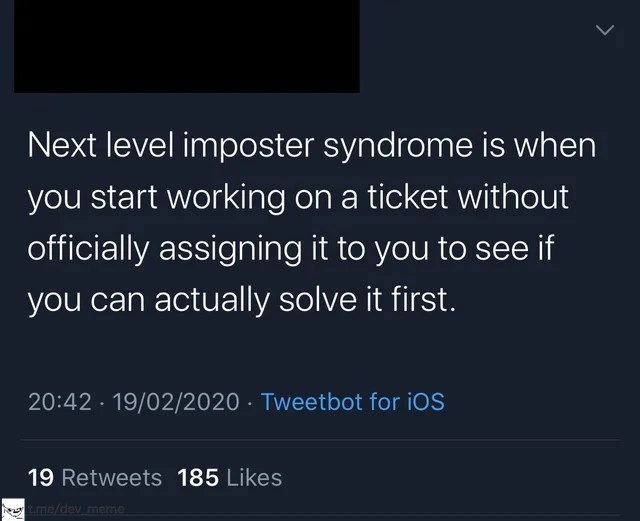
As you can see, the “secret” method is all about ensuring you won’t look bad in case things go wrong. It’s driven by self-doubt. There’s no official term for this in any developer handbook – you won’t find “stealth mode coding” in Jira’s user guide – but it’s something people do when they’re not confident. In fact, the tweet meme format of the image (a screenshot of a tweet with likes and retweets) shows that many developers found this scenario relatable enough to like and share it. The tweet text itself reads like a tongue-in-cheek piece of advice or an admission: “Next level imposter syndrome is when you do X.” It resonated because a lot of folks read it and thought, “Wow, I thought I was the only one who felt the need to do that!” That’s why it falls under RelatableHumor and DeveloperReality – it’s joking about a real feeling that isn’t often discussed openly in sprint retrospectives or team meetings.
Let’s also touch on why this matters in terms of MentalHealth and DeveloperProductivity (the categories given). When a developer feels so insecure that they resort to “shadow work” on tickets, it’s a sign of anxiety. It means the person doesn’t feel safe admitting, “I might need some time or help with this task.” Over time, that kind of self-pressure can contribute to stress and burnout. On the productivity side, it might also slow things down: the developer is essentially doing extra, redundant work. In a perfect world, if they weren’t unsure of themselves, they’d just take the ticket and either complete it or ask for help openly, saving time. Instead, they spend additional hours privately verifying that they’re capable. It’s a bit like writing code twice – once in secret and once “for real” – which isn’t exactly efficient. Still, many new developers (and even seasoned ones) do this when they lack confidence. The term “confidence_testing” in the context tags perfectly describes it: they are testing their own confidence and skills on the side. And the tag “unassigned_backlog_hacking” humorously labels the act of hacking away at an unassigned task. This practice comes from a place of fear, but seeing it turned into a joke helps people realize they’re not alone and perhaps encourages teams to be more supportive.
Level 3: Behind the Backlog Scenes
At first glance, this meme reads like a confession only a developer would make. It highlights a common coping mechanism in software teams: secretly tackling a task off the record due to Imposter Syndrome. The tweet’s text – “Next level imposter syndrome is when you start working on a ticket without officially assigning it to you to see if you can actually solve it first.” – strikes a nerve because it satirizes an unwritten practice that many engineers privately understand. In a typical Agile workflow with tools like Jira, every task (or “ticket”) is supposed to be transparently assigned to someone. Here the developer goes incognito, effectively creating a hidden branch of work that isn’t tracked on the team board. Why? To make sure they won’t fall on their face publicly if the problem is beyond them. It’s the programmer’s equivalent of a dress rehearsal – a shadow ticket work trial run done in the background. Everyone laughs at this meme because it’s painfully relatable: in an industry built on learning and failing fast, we’re still terrified of looking like we don’t know what we’re doing.
On a deeper level, this behavior exposes the silent developer anxiety present even in experienced engineers. It’s an inside joke with a sting: even those who’ve been coding for years aren’t immune to moments of self-doubt. The meme calls it “next level” imposter syndrome because it’s imposter syndrome evolving into a stealth operation. By not officially claiming the task, the developer avoids immediate accountability and the potential embarrassment of later unassigning it or announcing failure. This is essentially an unofficial spike – in agile terms, a time-boxed experiment – but done covertly out of fear rather than as an open, planned exploration. A senior developer reading this might nod knowingly, recalling times they’ve pulled a similar stunt after getting burned by an "easy" ticket that turned out to be a rabbit hole. It’s a clever illustration of how developer reality often diverges from best practices: ideally, we’d communicate and collaborate when unsure, but in reality many of us prefer to quietly verify our ideas first. The unspoken cultural forces at play (like performance pressure or a fear of judgement in code review) push developers into this unassigned backlog hacking. Even the vocabulary here – “ticket”, “assigning it” – hints at the bureaucratic nature of tracking work. The humor comes from bending those rules: working on something without logging it is taboo in a well-oiled Agile team, yet it happens because psychologically, it feels safer.
Consider how this might play out in practice. A developer sees an interesting but intimidating bug report in the backlog. They could raise their hand in the stand-up and say, “I’ll take this one,” but a voice in the back of their mind whispers, “What if I can’t fix it and everyone finds out I’m not as good as they think?” So, instead of dragging the Jira ticket into the “In Progress” column with their name on it, they fire up their IDE and create a local branch to test the waters. It might look like this:
# Developer enters "stealth mode" on the issue
git checkout -b stealth-fix/login-bug
# ...coding furiously without Jira knowing...
# If it works out:
git commit -am "Fix login bug (stealth success!)"
# Later: push and create PR after officially assigning ticket to self
# If it fails:
git checkout main && git branch -D stealth-fix/login-bug
# (quietly pretend this never happened)
In this little snippet, you can almost feel the relief in that branch -D (delete branch) if the attempt flops – no commit, no record, no embarrassment. Only the developer’s heart rate and a few hours of lost evening time are witness to the struggle. This kind of “off the record” coding isn’t taught in onboarding, but many devs do it instinctively. It’s a form of confidence testing one’s own solution before anyone else is invited to scrutinize it. We joke about it precisely because it’s a double-edged sword: it shows dedication to Developer Productivity (extra effort to ensure success) at the cost of personal stress and secretive behavior. Why do smart people keep doing this? Because the incentive structure in many teams (intentionally or not) rewards flawless execution over visible trial-and-error. If your workplace or team culture makes you feel like you must always deliver and never falter, you might prefer a quiet trial run to either cement your confidence or avoid humiliation.
The systemic issue here is a mismatch between how Agile should work versus how humans behave when they’re anxious. Agile methodology preaches transparency, collaboration, and learning from failure. In theory, no one should fear taking a tough ticket; if they hit a wall, the team swarms to help. But the reality (and the source of this meme’s bittersweet humor) is that many developers feel pressure to prove themselves constantly. Especially if you’ve ever been the newbie on a high-performing team, you know that “please don’t let me be the bottleneck” feeling. It’s easier to secretly prototype a fix in isolation than to risk openly saying “I’m on it” and then possibly not deliver. Ironically, even veteran coders can experience this – sometimes the more you know, the more acutely you’re aware of everything you don’t know (a nod to the Dunning-Kruger effect). So imposter syndrome becomes a lingering ghost in the machine, whispering that your last success might have been a fluke. The humor glinting through this tweet is that we all share that ghost to some degree, yet we hide it. Seeing it stated so bluntly – and on a public platform like Twitter – is cathartic. The meme got dozens of retweets and many more likes, a clear sign that developers across the globe read it and went “Oof, I felt that.” It’s funny, yes, but also a gentle call-out: maybe we should talk about these feelings more openly instead of literally coding in the shadows.
Description
This image is a screenshot of a tweet that reads: 'Next level imposter syndrome is when you start working on a ticket without officially assigning it to you to see if you can actually solve it first.' The tweet, posted on February 19, 2020, captures a deeply relatable behavior for many software developers. It describes the act of secretly tackling a task from a project management tool (like Jira) before publicly claiming it. This is done as a low-risk pre-flight check to validate one's own ability and avoid the potential public failure of getting stuck on a task they've committed to. The humor lies in its specificity and accuracy, defining a subtle but common manifestation of imposter syndrome - the pervasive feeling of being a fraud despite one's accomplishments - within the structured workflow of software development

Comments
7Comment deleted
My workflow? I branch off main, solve the ticket, delete the branch, assign the ticket to myself, and then re-solve it. It's not inefficient if it keeps the 'you're a fraud' voice quiet
Senior-level imposter syndrome is spinning up a secret branch at 2 a.m., canary-deploying the fix, watching the SLO stay green - and only then bravely clicking “Assign to me” in Jira
The real senior engineer move is having three unassigned tickets solved locally, waiting to see which one becomes a P0 incident so you can swoop in like you just started looking at it five minutes ago
The senior engineer's paradox: You've successfully architected distributed systems handling millions of requests, but you still need to privately prove to yourself you can fix a CSS alignment issue before claiming the ticket. It's like running integration tests on your own competence before merging to the 'publicly assigned work' branch
The ultimate dev spike: prototype the ticket in stealth mode before the standup forces a commit
Practicing optimistic locking on self-esteem - don’t acquire the assignee lock until you’re sure you can commit
Imposter syndrome at scale: two-phase commit - prepare the fix under a flag, then assign the JIRA to myself only if the canary and CI reach quorum