Skip to content
DevMeme
2825 of 7435
Classy Pooh prefers asking for IP addresses over phone numbers
Networking Post #3122, on May 17, 2021 in TG

Classy Pooh prefers asking for IP addresses over phone numbers

Why is this Networking meme funny?

Level 1: Fancy but Weird

Imagine you’re at school and one of your classmates asks, “Hey, can I get your phone number so we can talk or play later?” That seems pretty normal, right? It’s like saying, “Can we be friends and chat on the phone?” Now imagine another friend comes up wearing a fancy suit like they’re at a big gala, and instead of asking for your phone number, they ask, “Hey, can I have the address of your computer?”

That would feel weird! You might think, “My computer’s address? What do you even mean?” It’s kind of like if someone skipped asking where you live and instead asked for the secret coordinates of your bedroom. The second friend sounds super fancy and smart, but the request is so unusual that you’d probably laugh or be puzzled.

The reason it’s funny is that the fancy friend is treating a computer detail (the IP address, which is like a computer’s home number on the internet) as if it’s the same as a personal detail (your phone number). It’s an odd and silly question because normally people don’t talk that way. It’s as if the friend is a robot or an alien trying to act cool by using big technical words, but it just comes off as goofy.

So, the meme is showing two ways of asking for something:

  • One is plain and common: “Can I have your phone number?” (boring old Pooh bear).
  • The other is overly fancy and nerdy: “Can I have your IP address?” (Pooh bear dressed up in a tuxedo, acting like this is a high-class thing to ask).

It’s like a joke about how computer geeks think. The fancy-dressed Pooh believes asking for an IP address is a clever or classy move, but to most people it’s just a strange request. In simple terms, it’s funny because he’s being so fancy about something so unfriendly and technical. It makes us laugh at how differently people can think: one person asks for a phone number to be nice, the other asks for a computer number and thinks he’s being oh-so-smart. It’s a silly little twist that shows how our techy friend Pooh might need to work on his people skills, even if he’s got great computer skills!

Level 2: Nerdy Icebreaker

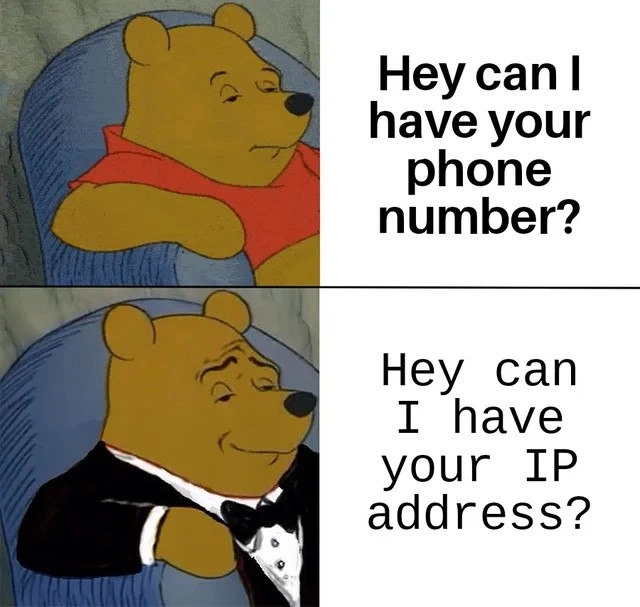
Let’s break down the joke in simpler terms. This meme shows Winnie the Pooh in two different moods. In the first picture, Pooh looks bored and is wearing his usual red shirt. The text next to him says, “Hey can I have your phone number?” That’s a pretty normal question, right? People ask for phone numbers when they want to talk to someone or stay in touch. Now, in the second picture, Pooh has suddenly become very fancy – he’s wearing a tuxedo, looking proud of himself. And what does he ask instead? “Hey can I have your IP address?” in a computer-style font. It’s as if he replaced a normal friendly request with a super geeky one.

What’s an IP address? It stands for Internet Protocol address, and it’s basically the address of your device (computer, phone, etc.) on the internet or any network. Think of it like your device’s home address in the online world. For example, an IP address might look like 192.168.0.42. Just like a postal address tells the mailman where to deliver a letter, an IP address tells internet data where to go. By comparison, a phone number is an address for your phone in the telephone network – like 555-1234 – which tells the phone system how to route a call to you. Both are personal identifiers of a sort, but one is used by people and phone switches, and the other is used by computers and routers.

The meme is funny to developers because it mixes these up. It’s taking a normal social question (asking for contact info) and putting a nerdy Networking spin on it. It’s like if someone at a party decided that, instead of asking “Can I add you on social media?”, they asked “Can I get your MAC address?” (which is another technical identifier for a device). It’s humor that comes from expectation mismatch – nobody expects to trade IP addresses in casual conversation!

Let's clarify a few terms and why they appear in this joke:

  • Networking – In computing, this is all about how devices connect and communicate. IP addresses are a fundamental part of networking. Developers working with networks often ask each other for IP addresses when setting up systems (e.g., “What’s your IP? I’ll grant you access to this server”). It’s routine in a tech environment.
  • Security & Privacy – Usually, you wouldn’t give your IP address to a stranger because it could be a privacy risk. Someone could potentially find out where you are or try to access your device. In fact, hackers use social engineering tricks to get information like this. Social engineering means trying to fool or charm people into giving away secrets or personal data (like passwords, or yes, even IP addresses) by pretending to be friendly or legitimate. In the meme, Pooh in a tux is almost like a social engineer in disguise – acting all polite, but asking for something oddly specific.
  • Communication – This term here is about how we talk or connect. A phone number is for human communication (voice calls, texts between people). An IP address is for device communication (your computer talking to a website or another computer). The meme humorously swaps the human communication detail with a machine communication detail. It’s as if the Pooh in the tux values digital contact over human contact!

Notice how the bottom text is in a monospaced font (each letter taking equal space, like in code or old typewriters). That’s a visual clue shouting “this is tech stuff!” Memes often use that font to represent something a programmer or hacker would say. It’s part of the joke’s presentation: the request for an IP address isn’t just phrased like a normal question – it looks like a line out of a terminal or chat between IT folks. For someone who’s new to programming, just know that monospaced text is heavily associated with code and anything computer-y.

To make the difference clearer, here’s a quick comparison between a phone number and an IP address:

Identifier Purpose Looks Like Shared With
Phone Number Reach a person’s phone via calls/texts in the phone network (PSTN) +1-555-867-5309 Friends, contacts, businesses (common to share)
IP Address Reach a device or server on the internet for data (network routing) 203.0.113.42 Devices, IT systems, servers (rarely shared person-to-person socially)

A junior developer might remember the first time they learned about IPs: perhaps using ipconfig/ifconfig to find their computer’s address, or setting up a home networking project where two computers needed to connect via IP. Discovering that “Hey, I can talk to my friend’s computer if I know its IP!” feels a bit magical. That might be why the meme resonates – it’s taking that esoteric piece of knowledge and jokingly treating it as more elite than a phone number. It’s like a rite-of-passage joke in programming circles.

Also, consider why it’s a bit creepy (and thus funny): Normally, if someone wants to contact you, they ask for something you’re comfortable sharing, like an email or phone number – something meant for personal communication. An IP address, by contrast, is something you typically share only in technical contexts (like to play a LAN game or allow remote debugging). If a random person said, “I want your IP address,” you’d probably respond, “Uh, why?! What are you going to do with it?” There’s an implicit joke that the classy Pooh might be up to no good, or at least being far too forward. It combines PrivacyConcerns (why do you need that info?) with a dash of DeveloperHumor (only a developer would even think to ask that). The meme tags like ip_vs_phone_number and personal_identifiers highlight this exact contrast between normal personal info and nerdy personal info.

In short, for someone newer to tech: the meme is funny because it’s taking a normal friendly request (phone number) and geeking it up (IP address). It shows how an engineer’s idea of being smooth or classy is very different from everyone else’s. It’s a bit of network humor exaggerating how we techies might over-complicate even the simplest social interaction. 😄

Level 3: Address Me Maybe

This meme uses the beloved winnie_the_pooh_meme format – specifically the “Classy Pooh” variant – to poke fun at how developers and network geeks can turn something ordinary into something extraordinarily nerdy. In the top panel, casual Pooh represents a normal person saying, “Hey, can I have your phone number?” with a bored, unremarkable expression. This is everyday small talk, nothing special. In the bottom panel, Pooh dons a tuxedo, smirking with self-satisfaction, next to the monospaced text “Hey can I have your IP address?”. By switching to a monospace font (the kind you see in code or terminal output), the meme emphasizes the techiness of the request. It’s as if Pooh has leveled up from regular flirt to elite network engineer mode – a suave secret agent of the internet asking for a far more sophisticated identifier.

The humor lands because it’s developer humor through and through. Every programmer or sysadmin recognizes the absurdity: asking for an IP address in a social context is both overkill and slightly creepy. It’s the kind of networking pickup line only an overzealous geek might think is cool. We’re laughing at ourselves as IT folks – how we sometimes forget not everyone speaks in TCP/IP. The meme plays on the trope that engineers find deeper meaning in network details. After all, to a developer, a phone number is just an alias that eventually connects through various telecom systems, but an IP address? That’s a direct route to someone’s machine (or at least their router). It’s like saying, “Sure, I could ask to call you, but I’d rather initiate a direct data handshake.”

There’s an underlying commentary about privacy and social engineering here as well. Phone numbers are often given out casually, but an IP address feels more intimate in the tech realm. Seasoned developers know that if a random person online asks “What’s your IP address?”, red flags should go up. It’s akin to someone in a tuxedo suavely asking for your home’s spare key — polite on the surface, but why do they really want it? In security circles, we’re trained to guard information like IPs because they can be misused: identifying your approximate location, targeting your device with exploits, or bypassing restrictions (”Oh, you’re behind that firewall? Let’s see what ports are open…”). The meme winks at this shared paranoia. We laugh because we’ve either a) joked about doing this, or b) cringed knowing someone might actually try it as a misguided show-off move.

Real-world scenarios make it “too real.” Consider a developer on a team call, casually asking a colleague, “Can you drop your IP in chat? I’ll add you to the allowlist so you can hit our dev server.” Within the tech team, that’s normal – just another day of network configuration. But ask the same question at a party to someone you just met, and you’ll get bewildered stares (if not a swift exit). The meme exaggerates this contrast. Networking professionals deal with IP addresses daily; for them, it’s almost like exchanging business cards. To everyone else, it’s either meaningless or vaguely menacing.

The choice of Winnie the Pooh in a tuxedo – the classy_pooh meme – usually signifies an upgrade in sophistication or pretentiousness. Here it suggests that a true connoisseur of communication would prefer the IP layer over something as pedestrian as the phone system. It’s satirizing the engineer mentality where knowing low-level details (like an IP address, subnet, etc.) confers a sense of pride. It’s as if Pooh is saying, “I’m not like other suitors; I communicate on Layer 3 with style.” This is a lighthearted jab at those of us in tech who sometimes get a kick out of behaving too technologically. Communication in human terms is about phone calls and chats, but communication in network terms is about pings and packets. Why ask for a number to call when you can ask for an address to ping?

And indeed, what would our tuxedo-clad Pooh do if someone actually obliged and gave their IP? A senior dev might chuckle and imagine:

# The classy Pooh way to "call" someone on the internet
$ ping 203.0.113.42
PING 203.0.113.42 (203.0.113.42) 56(84) bytes of data.
64 bytes from 203.0.113.42: icmp_seq=1 ttl=56 time=36.7 ms
# Look at that, I can reach you! Packet romance ensues.

Instead of dialing digits on a phone, he’s sending ICMP echo requests to see if their device responds. It’s a nerd’s version of “ringing you up.” 🤵📡 Nothing says “I’m into you” like a successful round-trip ping.

On a more serious note, experienced engineers reading this meme might also think about data privacy. In an era of increasing privacy concerns, even your IP address is something you might not want floating around. Many workplaces consider IPs sensitive; cloud services mask client IPs for anonymity; VPNs and proxies exist to hide your IP from prying eyes. So there’s irony in Pooh’s confidently smug face: he thinks asking for an IP is classy, but he’s actually bypassing a bunch of unwritten rules about personal data. The meme brilliantly compresses all these layers – technical, social, and security – into one simple contrast. It’s funny because it’s a hyperbole of developer behavior and also a tongue-in-cheek reminder: maybe don’t give your IP to strangers in tuxedos.

Level 4: Protocol Etiquette

At the most granular technical level, this meme humorously contrasts two addressing systems: the traditional telephone network and the Internet Protocol (IP) network. In networking theory, an IP address is a numerical label assigned to each device in a computer network that uses the Internet Protocol for communication. It's essentially a device's location on the internet, operating at OSI model Layer 3 (Network Layer). By asking for an IP address, our classy Pooh is invoking the formal protocol etiquette of the internet itself – a far geekier request than a phone number.

From a theoretical standpoint, IP addresses (like 203.0.113.42 in IPv4) are used by routers to perform packet forwarding via routing algorithms (think BGP or OSPF). In contrast, a phone number (e.g. +1-202-555-0142) is part of the global E.164 telephone numbering plan, used by telephone exchanges to route calls through the Public Switched Telephone Network. Both are hierarchical addressing schemes, but they exist in different realms: one in packet-switched data networks, the other in circuit-switched telephony. A developer asking for an IP address is essentially skipping to a lower-level network identifier – it's as if they prefer talking in terms of packets and protocols rather than typical social coordinates.

This juxtaposition tickles those who know the deep mechanics of connectivity. It hints at the elegance of networking theory: every device you talk to on the internet is reached by an IP address under the hood. It’s a bit like asking someone, "Which DNS name points to you?" instead of their street address – an absurdly formal, overly technical approach to a personal question. The humor builds on the idea that in a developer’s aristocracy, knowing someone’s IP might be more useful (or classier) than knowing their phone number.

There’s also a subtle nod to security and data privacy research. In privacy discussions, whether an IP address constitutes Personally Identifiable Information (PII) is a complex question. Under regulations like GDPR, an IP can be considered personal data in many cases, since it can be tied to an individual’s activities or location. By asking for an IP address, Pooh is skipping polite social norms and diving into potential PII exchange. In academic terms, he’s performing a kind of genteel social engineering: an elegant query for data that could uniquely identify someone’s device, if not the person themselves.

On a more historical note, early internet users often did share IP addresses to connect directly. Before modern matchmaking servers and cloud services, gamers would say, “Hey, join my Quake server at 192.168.1.100!” or friends would telnet to each other’s machines for fun. So the meme also brushes against the tech historian’s nostalgia: once upon a time, asking for an IP wasn’t entirely absurd in geek circles – it was how you invited someone to your networked world. Classy Pooh’s refined request taps into this legacy of internet protocol-level socialization, as if exchanging IPs is a ritual from a secret society of computer connoisseurs.

Description

The two - panel Winnie-the-Pooh template is shown. Top panel: a casually dressed Pooh slouches in an armchair with a bored expression, next to bold black text that reads “Hey can I have your phone number?”. Bottom panel: the same bear now wears a black tuxedo and smirks confidently; beside him, monospaced text states “Hey can I have your IP address?”. The meme contrasts an ordinary personal request with a nerdier, network-layer one, suggesting that engineers consider an IP address a more sophisticated or useful identifier. It plays on developer humor around networking knowledge, data privacy, and the subtle creepiness of social-engineering style questions

Comments

34
Anonymous ★ Top Pick “Sure, you can have my IP - just be ready to traverse the triple-NAT, mutual-TLS ingress, and the emotional firewall I spun up after the last 3 a.m. Sev-1.”
  1. Anonymous ★ Top Pick

    “Sure, you can have my IP - just be ready to traverse the triple-NAT, mutual-TLS ingress, and the emotional firewall I spun up after the last 3 a.m. Sev-1.”

  2. Anonymous

    The real power move is asking for their IPv6 address - nothing says 'I'm ready for a long-term relationship' like supporting 128-bit addressing and eliminating NAT traversal issues

  3. Anonymous

    The irony here cuts deep: we'll guard our phone numbers like state secrets but casually expose our IP addresses in every HTTP header, log file, and packet capture. It's the developer equivalent of refusing to share your home address while broadcasting your GPS coordinates in real-time. Though to be fair, at least an IP address can hide behind a NAT gateway - try doing that with your phone number when the PagerDuty alerts start rolling in at 3 AM

  4. Anonymous

    Phone numbers are Layer 7 chit-chat; IPs go straight to Layer 3 reconnaissance

  5. Anonymous

    Asking for an IP is cute until they give you 10.0.0.5 and NAT reminds you relationships aren’t routable between private address spaces

  6. Anonymous

    Real romance: share your IP (and every X-Forwarded-For hop) so I can whitelist you, curse CGNAT, and watch DHCP rotate it before the rule even takes effect

  7. @FLIPFL0P_T 5y

    Sure, here you are: 10.0.0.9

  8. @aysommer 5y

    access_token, please

  9. @FLIPFL0P_T 5y

    Do you also want my subnet mask?

    1. @RiedleroD 5y

      and network ID please

  10. @drangemwille 5y

    192.168.43.1

  11. @feskow 5y

    127.0.0.1

    1. @drangemwille 5y

      0.0.0.0

      1. @feskow 5y

        is that even valid

    2. @alhimik45 5y

      it's fallback for case when you meet nobody

      1. @feskow 5y

        thanks, didn't know that

  12. @SuperiorProgramming 5y

    127.0.0.1/24

    1. @neopulsar 5y

      Wrong subnet and network id .

      1. @SuperiorProgramming 5y

        What is the correct one?

        1. @neopulsar 5y

          127.0.0.0/8 (RFC 5735)

          1. @SuperiorProgramming 5y

            Thanks for the info.

            1. @neopulsar 5y

              That's quite sad. Whole big chunk of ip's used for literally freaking nothing while our world wide exceeds amount of ipv4 addresses and providers started to use NAT for their custoners

              1. @SuperiorProgramming 5y

                Loopback reserved

                1. @neopulsar 5y

                  But nobody really use more than 127.0.0.1 loopback address . :(

                  1. @SuperiorProgramming 5y

                    Ya the saddest story.

  13. @saidov 5y

    Can I make packet injection into your network

    1. @SuperiorProgramming 5y

      Let it rain packets.

  14. @FLIPFL0P_T 5y

    Sadly, an IP will nor really help you to truly locate the person, only partly (city, district...). Only if you have some information about wireless networks nearby (MAC), you could use triangulation to get more details about their location

  15. @alhimik45 5y

    "8 guys do UDP flood to the innocent network watch free without registration"

  16. @Roman_Von_Szklaruk 5y

    big braine

  17. @VlP_AI_TG 5y

    127.0.0.1😎

  18. @VlP_AI_TG 5y

    It's big brain time)

  19. @ZgGPuo8dZef58K6hxxGVj3Z2 5y

    Can I have your mac adresses/s

  20. @AmindaEU 5y

    ::1

Use J and K for navigation