Skip to content
DevMeme
2824 of 7435
When a programmer interprets grocery instructions like a strict if-statement
CS Fundamentals Post #3121, on May 17, 2021 in TG

When a programmer interprets grocery instructions like a strict if-statement

Why is this CS Fundamentals meme funny?

Level 1: Following Instructions to the Letter

Imagine your friend tells you, "Go grab a bowl of ice cream, and if they have chocolate sprinkles, get ten." Most people would understand this as: one bowl of ice cream, and if chocolate sprinkles are available, put ten sprinkles on it (or maybe get a pack of sprinkles). But if you followed the words exactly without understanding the intent, you might do something silly like come back with ten bowls of ice cream! 🤣 This meme is funny for the same reason: the wife (or the woman) gave an instruction that could be taken in more than one way. A person with common sense knows she meant "six avocados." But the way it was phrased, a goofy robot or a very literal person might mix it up and think she meant six cartons of milk.

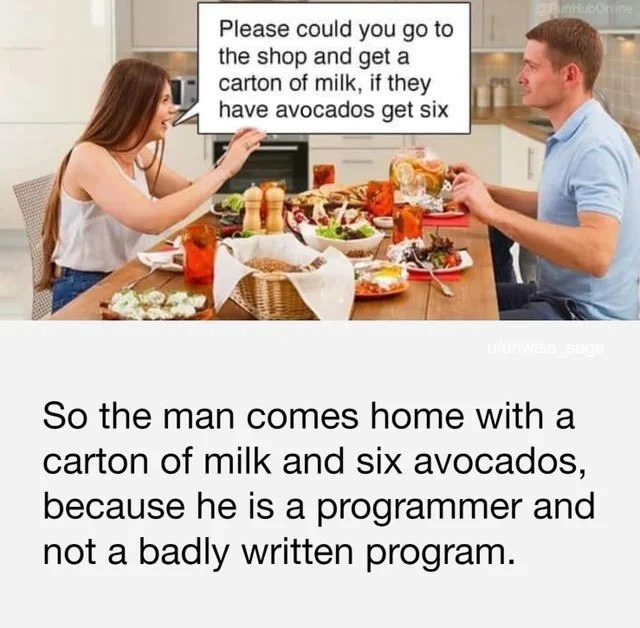
The picture shows a normal everyday situation – someone asking their partner to pick up groceries. The joke is that programmers are known for being very exact and logical. The husband in the meme is a programmer, so he's used to writing very precise instructions for computers. He recognizes the sentence could be read like a computer program. Instead of getting confused, he does the sensible thing: he brings back one milk and six avocados (because the store had avocados). The text below jokes "because he is a programmer and not a badly written program." That just means he acted like a reasonable person, not like a robot following broken code.

In simple terms, it's like when someone jokes about a genie in a fairy tale twisting your wish: if you're not specific, you might get something wild that you didn't really want. Here, the wife’s request wasn’t super specific, but thankfully the husband is not a mischievous genie or a dumb robot – he's a regular guy (albeit one who thinks about these things because he codes for a living). So he understood what she meant. We laugh because we can imagine how wrong it could have gone if someone (or something) took the instruction literally. It’s a fun way to show that how you say something matters, especially if the listener has a very literal mindset.

Level 2: Missing Else Clause

Let's break down the technical joke for a newer developer or someone early in their coding journey. The core idea revolves around an if statement and an implied else that was not stated. In programming, an if-statement is a way to make decisions:

  • If a condition is true, then do something.
  • Often there's an else part: if the condition is false, do something else (or simply do nothing).

In the meme, the instruction is: "Go to the shop and get a carton of milk, if they have avocados get six." A programmer reading this hears an if-statement in everyday language. The condition is "if they have avocados" and the action is "get six." But six of what? In normal conversation, the listener is supposed to understand it means six avocados. However, a computer or a very literal reading might get confused here. It sounds a bit like pseudo-code without a clear reference for the number six or an else-case for when avocados aren't available.

Let's map it to code step by step in a straightforward way:

  • Always get 1 carton of milk.
  • If avocados are available, then get 6 avocados (in addition to the milk).
  • Else (if no avocados), just get the milk.

If we wrote that in plain English, it would be unambiguous: "Get a carton of milk. If they have avocados, get six avocados." The original sentence merged those actions together, assuming you'd know the "six" applies to avocados. In programming, you can't assume the computer knows what you left unsaid — you have to be explicit. That’s why this scenario is funny to developers: it’s a natural_language_spec (an instruction given in normal English) that isn't perfectly clear by coding standards.

A junior developer might be familiar with how forgetting an else or misplacing brackets can lead to logic errors. Imagine a beginner writing something like:

let milkCount = 1;
if (store.has("avocado")) 
    milkCount = 6;
getItems("milk", milkCount);

They intended to say "default 1 milk; if avocados, then also get six avocados," but what this code actually does is: default to 1 milk, and if avocados are present, change that to 6 milks! The code has no instruction to get avocados at all. The mistake here is treating the number 6 as if it belonged to milk instead of avocados — all because of how the logic was structured. This is equivalent to misinterpreting the sentence. A well-written program (or a careful programmer) would instead have separate commands: one to always add milk, and a second to add avocados if available. No variables stepping on each other.

Now, consider the human side: the meme shows a woman asking her partner to go shopping and a man returning with a carton of milk and six avocados. Why is that punchline? Because developers often joke about taking instructions literally. In real life, of course, a person (especially a programmer who is used to logic) will interpret the context correctly — they know "six" refers to avocados. The meme explicitly says "because he is a programmer and not a badly written program." That line drives home that a human programmer uses common sense, whereas a dumb program might do something ridiculous if coded poorly. It's a playful jab at how computers need ultra-clear instructions.

For a junior dev or someone learning coding, the meme is a lighthearted example of why clarity in requirements matters. It's relatable dev experience distilled into a funny story: requirements from non-engineers can be ambiguous, and it's on the developer to figure out what was meant. This could also serve as a gentle lesson: when you write code (or even write documentation or specs), make sure there's no confusion like this. Otherwise, the computer might literally do something you didn't intend – much like bringing home 6 cartons of milk when you actually wanted avocados!

In summary, the top image's text is essentially a conditional (an "if" statement) in plain language, and the bottom text reveals the outcome when processed with programming logic in mind. Conditional logic in coding has to be much more precise than in casual speech. The humor clicks when you understand that difference. It's a classic case of miscommunication turned into a joke, one that both showcases the need for precise instructions and pokes fun at how a programmer's brain can default to "code mode" when hearing everyday requests.

Level 3: Clause and Effect

At the highest level, this meme riffs on programmatic precision vs natural language ambiguity. It's highlighting a subtle bug in requirements: the request "get a carton of milk, if they have avocados get six" lacks an explicit else clause and has an ambiguous reference for "six". In code, a developer would naturally wonder: six of what? The woman intended six avocados, but the phrase isn't formally constrained. In everyday English, we drop words and assume context will fill the gap (an implicit "six avocados" is understood). But a program (especially a poorly coded one) might misinterpret that. This scenario is a tongue-in-cheek nod to the classic programming joke where a literal-minded computer (or an overly literal coder) misreads an instruction.

Think of it like a small-scale specification problem. The instruction is effectively a conditional:**

  • Condition: "if they have avocados" (check store inventory)
  • Action: "get six" (intended: get six avocados)

The humor comes from treating that sentence as if it were source code subject to a logical bug. In a strict programming sense, one might accidentally write a snippet that doesn't capture the intended meaning. For example, consider a naïve implementation:

milk_quantity = 1
if store.has("avocados"):
    milk_quantity = 6   # bug: now getting 6 milks instead of avocados!
store.buy("milk", milk_quantity)

Here a misplaced assignment turns the conditional into a shopping assignment bug. If the store has avocados, this flawed code would end up buying 6 cartons of milk (since milk_quantity was overwritten to 6) 😅. This is analogous to a badly written program misinterpreting the spoken request. In contrast, a correct implementation (or a human with common sense) would keep the branches separate: always buy 1 carton of milk, and in addition buy 6 avocados if available. In pseudo-code, that’s:

store.buy("milk", 1)
if store.has("avocados"):
    store.buy("avocado", 6)

No ambiguity there! Each outcome is explicitly handled, and the quantity "six" is correctly tied to avocados. Notice the difference: the correct code treats the avocado clause as an optional additional step, whereas the buggy code treated it as a modification of the milk order due to a missing else or mis-scoped variable.

This ambiguity in requirements is very relatable. Many of us have seen real software specs or user stories where a crucial detail was implied rather than stated. Seasoned developers have learned to ask clarifying questions (like, "Six of what, exactly?") whenever they spot an iffy instruction. The meme exaggerates what happens when you don't clarify: it imagines the program (or person acting like a program) doing exactly what was literally asked, resulting in a laughable outcome. It's poking fun at the communication breakdown between how humans give instructions and how computers (or overly literal engineers) interpret them.

Historically, this joke is a staple of developer humor. It’s often told with milk and eggs or similar items to illustrate how a programmer’s mindset differs from a non-programmer’s. We think about edge cases and exact meanings. The phrase "if they have avocados get six" triggers a mental parser in the programmer’s brain. We can't help but break the sentence into logic: IF condition THEN action. And if the grammar is even slightly off, our inner debugger flags a potential bug. This particular meme even has a meta-twist: the man comes home with the right groceries (milk + six avocados) because he is a programmer and not a badly written program. In other words, a real programmer knows how to handle ambiguous specs in real life — by intuitively adding the missing piece of logic (in this case, understanding that "six" refers to avocados). A poorly written piece of code, however, might have taken that instruction far too literally, leading to a classic literal spec interpretation fail.

So, at this senior perspective, the meme highlights a fundamental CS_fundamental: the exactness of conditional logic in code versus the imprecision of everyday language. It’s a wink to those of us who have been burned by an unclear requirement. We laugh because we've been on both sides — we've written the confusing instruction and we've coded it. And we appreciate that bridging the gap between natural language specs and code logic is both an art and science. The industry has plenty of tales where missing an "else" or misreading a clause caused real bugs. This meme is just a lighthearted, avocado-flavored example of that eternal clause-and-effect struggle.

Description

Meme split into two parts. Top: a stock-photo kitchen scene where a woman (face blurred) gestures toward a man (face blurred) across a dinner table filled with dishes; a text box over the image reads, "Please could you go to the shop and get a carton of milk, if they have avocados get six." Bottom panel is plain white with black text: "So the man comes home with a carton of milk and six avocados, because he is a programmer and not a badly written program." The humor relies on classic conditional-logic interpretation - treating the phrase "if they have avocados get six" as "IF avocados exist THEN buy six avocados AND one milk," instead of the author’s intended implicit else-clause. It highlights how programmers apply precise control-flow semantics to ambiguous natural-language requirements, exposing common communication gaps between spec writers and developers

Comments

44
Anonymous ★ Top Pick 15 years designing idempotent APIs and I still treat “grab milk - if they have avocados, get six” as: BEGIN; INSERT milk; IF EXISTS(avocado) LOOP 6 TIMES INSERT avocado; END; COMMIT; marital rollback pending
  1. Anonymous ★ Top Pick

    15 years designing idempotent APIs and I still treat “grab milk - if they have avocados, get six” as: BEGIN; INSERT milk; IF EXISTS(avocado) LOOP 6 TIMES INSERT avocado; END; COMMIT; marital rollback pending

  2. Anonymous

    This is why we spent three sprints refactoring the grocery list microservice after the "six milk cartons incident" - turns out natural language parsing is harder than distributed consensus

  3. Anonymous

    This is the eternal struggle between natural language specifications and formal logic - the programmer correctly evaluated the conditional but failed the integration test with the stakeholder. In production, this would be a P0 incident where the acceptance criteria were technically met but the user story was fundamentally misunderstood. Classic case of 'works as coded, not as intended' - perhaps we need a requirements review process that includes semantic analysis and stakeholder intent validation, or at minimum, some unit tests for grocery shopping logic

  4. Anonymous

    English isn’t a spec; without parentheses, the quantifier leaks scope - hence bots return six cartons of milk, while seniors request clarification before leaving checkout

  5. Anonymous

    Short-circuit eval nailed: milk() always; if(hasAvocados()) avocados(6); no early returns or null milks

  6. Anonymous

    Natural language lets “get six” bind to the wrong variable; that’s why our household tickets are in Gherkin and grocery runs go through CI

  7. @affirvega 5y

    dafuq

  8. @affirvega 5y

    admins, can you block this incest story

    1. @UQuark 5y

      Lol admins don't trust him it's just a story bout true love

      1. @nuntikov 5y

        From a genuine bot account? Sure

        1. @UQuark 5y

          True love between cousins

  9. @rekechynskyi 5y

    Get out, freaking bot

    1. @JPx86 5y

      Wow, you're from Ukraine too)

      1. @rekechynskyi 5y

        Yes) Nice to meet you, bro

        1. @p4vook 5y

          Khokhol listing here?

          1. @rekechynskyi 5y

            Exactly, katsap

  10. @UQuark 5y

    SWEET HOME ALABAMA

  11. @LanaRC 5y

    wait... what's wrong? She did ask him to buy a milk and avocados... What am I missing?

    1. @dugeru42 5y

      Usually this anecdote have different ending -wife, i got you six packs of milk as you asked. -why six? -cos they had avocados I hope you get it, cos it is funny, haha, programmers are always silly like that

  12. @LineDiscipline 5y

    How many google-translates this meme have pass through? My bet is at least 2

  13. @dugeru42 5y

    This is good meme cos it helps relieve some stress And i heard that programming under stress can damage your ability to memorize things

    1. @clockware 5y

      I definitely heard that too

    2. @AmindaEU 5y

      I wonder where you might have heard something like that

      1. dev_meme 5y

        Mystery 🤔

      2. @dugeru42 5y

        me too, but i hope i am not repeating myself again there

        1. @AmindaEU 5y

          😼

  14. @ZgGPuo8dZef58K6hxxGVj3Z2 5y

    if (avocados.count > 0) { avocados.count -= 6; } else { print("No avocados left."); }

  15. @ZgGPuo8dZef58K6hxxGVj3Z2 5y

    Loool

  16. @thesparksof 5y

    Six carton of milk

  17. @JPx86 5y

    Where are you from?

  18. @JPx86 5y

    Odeska obl., Bolgrad district

  19. @JPx86 5y

    I'm 17 y. o. and I'm going to enter the KPI

    1. @rekechynskyi 5y

      Kyiv KPI?

  20. @JPx86 5y

    Osuzhdayu

  21. @JPx86 5y

    Yup)

    1. @rekechynskyi 5y

      Best wishes) I'm here, 2nd course, ICT faculty (ФІОТ)

      1. @JPx86 5y

        Wow

      2. @JPx86 5y

        I hope to meet you there)

  22. @JPx86 5y

    which specialty?

  23. @rekechynskyi 5y

    121, budget

  24. @JPx86 5y

    How much ZNO points have you scored?

  25. @rekechynskyi 5y

    Got average score 195.3

    1. @JPx86 5y

      аээаэаэаэаэаээаэаэа wow... brilliant score

  26. @azizhakberdiev 5y

    Prove ur not robot Get carton of milk, if they have avocados get six

Use J and K for navigation