ML Math: The True Rite of Passage for Developers
Why is this AI ML meme funny?
Level 1: From Monsters to Math
Imagine a dad telling his little kid, "Someday you'll be a big grown-up and you won't be afraid of the dark." The kid might protest, "But I'm already not a baby!" and then Dad gently points out, "Yes, but you still ask me to check for monsters under your bed." In this meme, the "monsters under the bed" are the super-hard math problems behind machine learning. The son is 23 (a grown-up by age), but the dad teases that he's not truly grown up until he stops freaking out about those tough equations. It's a funny way of saying that sometimes we hold onto our old fears from school (like scary math) even after we become adults — just like a kid might hold onto a fear of monsters under the bed even after they've gotten older.
Level 2: Crunching the Numbers
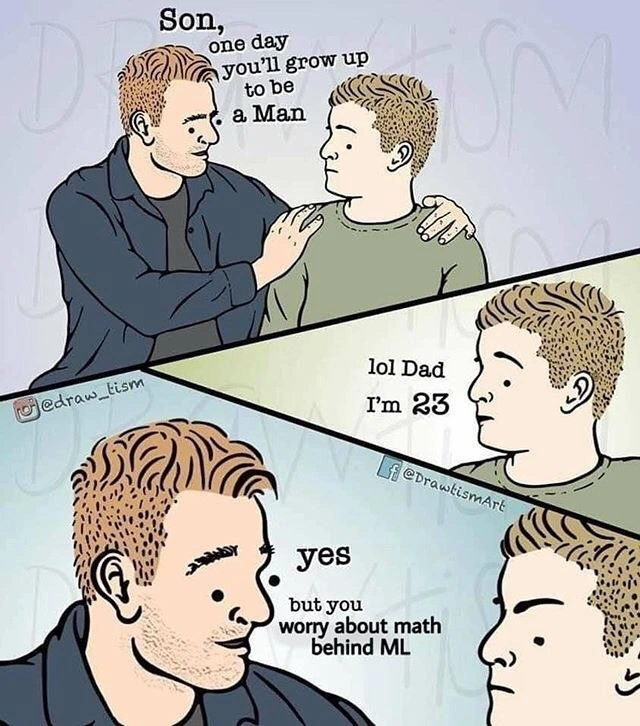
This meme is poking fun at a real situation for many tech folks: being an adult in life, yet still stressing like a student over complex math in your field. In the cartoon, a dad is giving his grown-up son a classic "life lesson" talk. He says, "One day you'll grow up to be a man," meaning someday you'll be truly mature. The son, who's 23 years old, laughs and says, "lol Dad, I'm 23" – basically, I am an adult already! But the dad replies with a friendly tease: "Yes, but you worry about the math behind ML." In other words, the son might be adult-aged, but he's still fretting over technical, homework-style stuff (the kind of intense math you study in school for machine learning). It humorously suggests, "You're not fully grown-up until you stop losing sleep over those equations."
Why would a 23-year-old developer worry about the math behind ML in the first place? Well, Machine Learning (ML) is a branch of AI where computers learn from data, and it involves a lot of math under the hood. When we talk about "the math behind ML," we mean things like linear algebra and calculus that make these learning algorithms work. Linear algebra is the math of vectors and matrices (basically lists of numbers and grids of numbers). ML models often use huge matrices to represent data and perform calculations. For example, if an algorithm is trying to recognize pictures of cats, it might represent each image as a long list of numbers (pixels) and then do tons of matrix operations on those numbers to find patterns. And then there's calculus, especially a process called back-propagation. Back-propagation (or "backprop") is how a neural network learns from its mistakes: the algorithm figures out how wrong its prediction was (the error) and then works backward to adjust each little internal parameter (weight) in the model to do better next time. This uses calculus to calculate those adjustments – basically finding the slope (gradient) that tells us how to change each weight to reduce the error. All this math can look pretty intimidating if you haven't mastered it yet.
For someone new to ML or still learning, it’s easy to get anxious about whether you understand these formulas. Imagine reading a tutorial or paper filled with big sigma signs ($\Sigma$) and funky symbols like $\partial$ (partial derivatives) – it can feel overwhelming. Many young engineers and students experience this kind of ml_anxiety, worrying that they're not smart enough or that "everyone else gets it except me." They might fear that real experts have all this math down cold, and if they don't, they’re somehow a fraud. In reality, even a lot of experienced developers find the math challenging and often rely on software libraries or simpler explanations to get by. But when you're early in your career (like 23 and maybe fresh out of school), you might put a lot of pressure on yourself to grasp every detail. It's like being the new person at a job and feeling you have to prove you know everything.
The term adulting basically means doing the responsible things that adults do – paying bills, keeping a job, taking care of yourself. So, "adulting in tech" means being a professional developer, not just writing code but also having the perspective that comes with experience. The dad in the meme is joking that part of being an adult in the tech world is not freaking out about complicated math all the time. From his perspective, a mature programmer knows when to let the computer or a library do the number-crunching heavy lifting. It's a playful exaggeration, of course. In truth, it is valuable to understand the math if you can – that knowledge can make you better at ML. But the comic exaggerates to make us laugh: the father figure is basically saying, "You'll know you're truly grown up in this field when the math behind ML no longer keeps you up at night." It’s a lighthearted reminder that even if those equations seem scary now, as you gain more experience and confidence, they’ll start to feel more manageable (and a lot less monster-in-the-closet).
Level 3: Overfitting vs Adulting
For seasoned developers, the humor hits close to home. The father-son exchange is a playful jab at how even grown professionals can feel like kids when grappling with cutting-edge tech knowledge. In the comic, the father initiates a heart-to-heart ("Son, one day you'll grow up to be a Man") as if imparting life wisdom. The son replies with a meme-worthy retort, "lol Dad, I'm 23," using texting slang to underline that he’s already an adult in the literal sense. This generational quip sets the stage for the father’s punchline: "yes... but you worry about math behind ML." It’s a classic bait-and-switch structured for laughs, aimed squarely at the MachineLearningHumor crowd: we expect advice about jobs or family, but instead the father calls out ml_anxiety as the thing keeping his adult son from true "manhood." The panel layout even tilts and zooms dramatically to accentuate this punchline, delivering a slice of tech humor with perfect timing.
Why is this funny to those in AI/ML? Because it rings true. Many developers have hit adulthood with solid jobs and real responsibilities, yet still feel immature in their career whenever someone mentions a complex equation or theoretical concept they haven't mastered. It's a lighthearted take on imposter syndrome. You might be handling production systems by day, but mention something like "eigenvectors" or "Bayesian priors" and suddenly you feel like that confused college student again. This meme taps into that feeling: being 23 (or 30, or 40) doesn't spare you from fretting over whether you really understand the guts of machine learning.
On one level, the dad in the comic represents the pragmatic senior engineer (or just the voice of practicality) reminding us that obsessing over every little theoretical detail isn't always what makes you effective in the real world. Sure, the math_behind_ml is important – it's the foundation of how models work – but a seasoned pro might joke that true adulthood in tech means focusing on building things rather than deriving equations on a whiteboard. In other words, a mature developer knows when to rely on libraries like TensorFlow or scikit-learn to handle the heavy math, instead of staying up all night deriving gradients by hand. It's like the dad is teasing: "Real adults use model.fit() and get on with it." The contrast is comical because the son is a competent adult in every other sense (he's 23, after all), yet his dad jokingly implies he's not a "Man" until he stops overfitting overthinking the math.
This relatable humor resonates across the tech community. We've all met that colleague (or been that person) who worries they're not "real" machine learning engineers because they rely on high-level frameworks or get shaky on a gnarly formula from a research paper. The meme says: hey, you're not alone – even grown-ups in tech secretly worry about the theory! By framing it as a father-son life lesson, the joke exaggerates the situation to absurdity. The father essentially says, "Maturity means not losing sleep over linear algebra," poking fun at how we sometimes equate academic mastery with professional maturity. It's an AI humor gem because it satirizes the culture of constant learning in tech: no matter how old or experienced you are, there's always a new math concept that can make you feel like a newbie again. In short, the comic uses a family trope to highlight a very modern developer problem – being an adult on paper but feeling like a kid inside whenever the discussion turns to the math behind ML.
Level 4: Chain Rule Rite-of-Passage
At the highest level of technical insight, this meme spotlights the rigorous mathematics underpinning modern AI/ML. Under the hood of a typical machine learning model (especially a deep neural network) lies a world of linear algebra and calculus that would make any math professor proud. Training a model isn't magic at all – it's a giant optimization problem in a high-dimensional vector space. Every time you train a neural network, you're essentially performing massive matrix multiplications and solving calculus equations.
Linear algebra is everywhere in ML: data is represented as vectors, model parameters as matrices, and operations like computing predictions or hidden layer activations are just matrix multiplications and dot products. Even something as conceptually simple as a neuron involves a weight vector and an input vector producing a single number via a dot product (z = w · x). Stacking hundreds or thousands of such operations yields the complex behavior we call "intelligence." But to a computer, it's all just crunching numbers across matrices and vectors.
Multivariate calculus is the other pillar. The learning process – often using algorithms like stochastic gradient descent – relies on taking derivatives of a model's loss function with respect to each parameter. This is where the infamous back-propagation comes in. Backprop is essentially an application of the chain rule from calculus across many layers. It computes how a change in an individual weight $w_{ij}$ will affect the final loss $L$ by systematically decomposing that effect through each intermediate step. For example, if $a_j$ is the activation of a neuron and $w_{ij}$ is one of its incoming weights, the chain rule lets us find $\frac{\partial L}{\partial w_{ij}}$ by multiplying partial derivatives along the path $w_{ij} \to a_j \to \text{output} \to L$:
$$ \frac{\partial L}{\partial w_{ij}} = \frac{\partial L}{\partial \text{output}} \cdot \frac{\partial \text{output}}{\partial a_j} \cdot \frac{\partial a_j}{\partial w_{ij}} $$
These dense formulas and Greek letters (hello $\partial$ and $\Sigma$!) are exactly the math behind ML that the son in the comic is so preoccupied with.
This theoretical side of AI can feel daunting. Concepts like gradient vectors, Jacobians, or ensuring your weight initialization doesn't lead to vanishing gradients can keep a developer up at night. It's no wonder many engineers experience ml_anxiety when diving into research papers filled with lemmas and proofs. Fully growing up in the AI field – mastering the math as well as the tooling – can feel like a rite of passage. In fact, conquering the chain rule and linear algebra is like earning a badge of honor in machine learning. So when the father dryly notes the son "worries about math behind ML", he's referencing this deep well of theoretical complexity. The joke’s twist is that understanding these equations is portrayed as the last step to adulting_in_tech – as if solving integrals and eigenvectors is the final boss battle before one truly becomes a mature engineer.
Description
A three-panel comic strip illustrates a conversation between a father and his son. In the first panel, the father, a man with brown hair and a blue jacket, places his hands on his son's shoulders and says, 'Son, one day you'll grow up to be a Man'. The son, a younger man with similar features, looks back with a neutral expression. In the second panel, the focus is on the son, who replies, 'lol Dad I'm 23'. The final panel shows a close-up of the father's face as he clarifies, 'yes but you worry about math behind ML'. Watermarks for '@draw_lism' on Instagram and '@DrawtismArt' on Facebook are visible. The meme's humor stems from the idea that in the tech world, traditional markers of adulthood like age are superseded by the intellectual burdens of the profession. The father suggests that true maturity for a developer, specifically in machine learning, is measured by the weight of understanding complex theoretical concepts like advanced calculus, linear algebra, and probability theory that underpin ML models. This resonates with senior engineers who appreciate that surface-level coding is trivial compared to grasping the deep, foundational mathematics

Comments
7Comment deleted
You're not a real grown-up until you've stared at a wall for an hour contemplating whether your model's failure is due to vanishing gradients or just a simple off-by-one error in your tensor dimensions
Real adulthood is when the matrix that keeps you up at night isn’t the Hessian - it’s the Excel sheet where finance asks why your GPU cluster’s spend looks like a small nation’s GDP
The real rite of passage isn't turning 18 or getting your first job - it's finally understanding why your neural network converged after years of just trusting Adam optimizer and crossing your fingers during hyperparameter tuning
The real rite of passage isn't turning 18 or 21 - it's the moment you realize that calling fit() on a model doesn't absolve you from understanding why stochastic gradient descent converges, or why your loss function looks like a Jackson Pollock painting. Welcome to adulthood: where you can architect distributed systems but still wake up at 3 AM wondering if you truly understand the chain rule
The technical debt no monorepo refactor can pay down: math prereqs for ML
ML adulthood is when “we beat the benchmark” makes you nervous and you start interrogating the loss surface, priors, and condition numbers - because a well‑regularized lie still passes the test set
You know you’re senior when random_state=42 stops feeling scientific and you derive the gradient because prod drift ate your lunch