Skip to content
DevMeme
972 of 7435
The Illusion of Programmer Logic
Bugs Post #1095, on Mar 4, 2020 in TG

The Illusion of Programmer Logic

Why is this Bugs meme funny?

Level 1: Tripping Myself Up

Imagine you’re building a tall tower out of toy blocks. Everyone says you must be really good at balancing things because you’re a “master builder.” Now, you’re almost done with your tower and you decide to put one more big block on a tiny block near the bottom. What happens? The tower becomes wobbly and the whole thing collapses! You fall on your butt, your blocks scatter everywhere, and you’re sitting there puzzled, saying, “Hey! That was supposed to make my tower even better!”

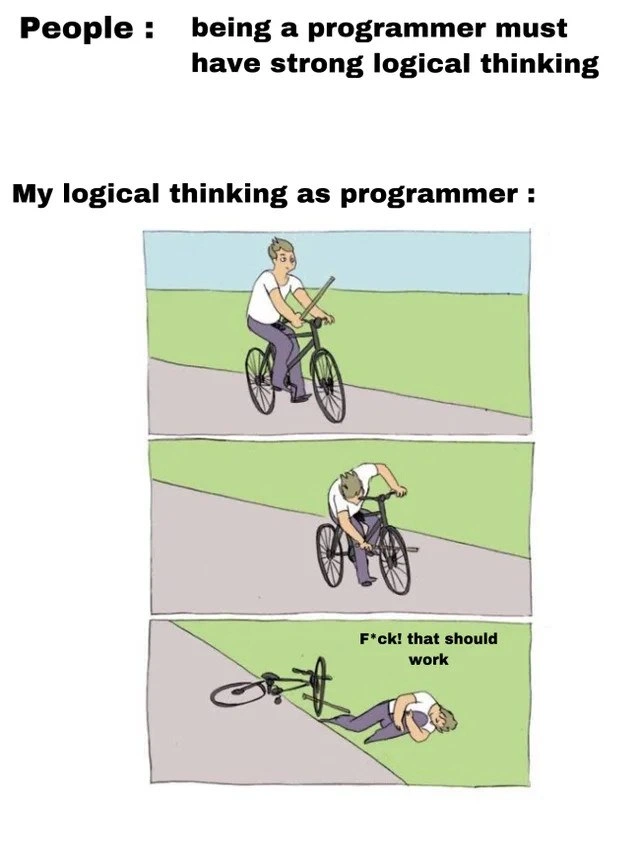
This is exactly what’s happening in the meme, but with a programmer writing code. People expect programmers to use perfect logic all the time, like an expert block-builder who never makes mistakes. But in reality, sometimes the programmer accidentally knocks over their own tower. In the picture, the guy on the bike is like the programmer, and the stick he puts in his wheel is like a mistake he puts into his code. He crashes his bike because of that mistake — just like a program crashing due to a bug — and then he’s confused and upset, saying “It should have worked!”

The reason this is funny is because it’s so human. We all do things like this. It’s like pouring salt into your soup thinking it will taste better, but you pour too much and ruin it, then being surprised that your soup tastes bad. We cause our own problem and then go “ouch, why did that happen?!” The meme makes us laugh because it shows that even smart programmers can be like the rest of us: sometimes we trip ourselves up, then scratch our heads wondering why things fell apart.

Level 2: But It Should Work!

Now let’s dial it down for a newer developer or someone learning to code. The meme’s scenario is a perfect example of a bug, which in software means an error or flaw that makes a program behave unexpectedly or crash. In the image, the programmer’s “logical thinking” is represented by the cyclist deliberately self-sabotaging: he sticks a branch in his own bike wheel. In coding terms, that branch is a piece of bad code the programmer wrote — essentially introducing the bug into an otherwise working program. The result? The program comes tumbling down (just like the cyclist), and the developer is left on the ground holding their knee, wondering why it broke. The caption over the fallen cyclist, “Fck! that should work,”* is something every coder has thought at least once. We write a piece of code, fully expecting it to run correctly, and when it doesn’t, we’re genuinely perplexed: “But it should work!”

Why is this so relatable? Because debugging (finding and fixing bugs) often starts with disbelief. You run your code and it crashes. You think there must be something else wrong, because my logic is sound… right? It’s like being absolutely sure you tied your shoelaces, then tripping and looking down to see them untied. In programming, a logical error is when your code doesn’t do what you intended, even though it might be written in valid syntax. The computer isn’t being quirky or “dumb” here – it’s doing exactly what we told it to do, even if we told it the wrong thing! So when the developer in the meme says “that should work,” it’s a moment of confusion – he did think it through, but perhaps missed a case or made a wrong assumption.

Let’s connect the panels to a real coding workflow:

  • Panel 1 (Riding normally): This is the programmer writing code for a new feature or fix. Everything seems straightforward. For example, maybe they’re adding a new function or a condition that they believe is correct.
  • Panel 2 (Stick in wheel): This represents the act of unintentionally injecting a bug. Maybe the programmer wrote a wrong comparison (>= where it should have been >), or they forgot to handle a possible error scenario. It could be as simple as a typo in code or a mistaken assumption like “this variable will never be null here”. This one slip-up is the stick going into the “wheel” of the program’s logic.
  • Panel 3 (Crash and confusion): The program crashes or produces a wrong result (the bike flips, the developer gets hurt). The programmer is frustrated and surprised, exclaiming “It should have worked!” Now begins the troubleshooting: digging through code, logs, or error messages to figure out what went wrong. Eventually, they’ll realize that the cause of the crash was that little bug they themselves introduced in panel 2. It’s a facepalm moment.

For a junior coder, it’s important to know this happens to everyone. You might spend hours trying to fix your code, only to discover the issue was a single misplaced character or a misunderstood requirement. For instance, maybe you wrote a loop that accidentally runs one time too many, causing an error, or you used the wrong variable name somewhere so a value was never updated correctly. These are common DebuggingFrustration moments: you feel silly when you find it, but you also learn to double-check the “obvious” logic next time.

The meme also touches on the stereotype that programmers have superhuman logical thinking abilities. Yes, writing software does require logical problem-solving, but that doesn’t mean programmers are infallible Vulcans. Our logic can fail, especially when we’re tired, rushed, or dealing with complex systems. CodeQuality is about habits that catch these slip-ups: things like writing tests for your code or having another developer review it. Those practices are like wearing a helmet and knee pads while biking – they won’t stop you from ever falling, but they can prevent a small mistake from turning into a disaster. In the absence of those, it’s easy for a simple oversight to bring your program down.

In short, the line “My logical thinking as programmer” above the comic is poking fun at the difference between how people think we work (with flawless logic) and how we often actually work (making goofy mistakes and then scratching our heads). The "should have worked" feeling is so common in coding that it’s basically a running joke in DeveloperHumor circles. This meme is a lighthearted way to say: Don’t worry, if you’ve jammed a stick in your code’s wheels before and crashed, you’re not alone — we’ve all been there! It’s a RelatableDeveloperExperience for sure.

Level 3: Bug in the Wheel

At the highest technical level, this meme highlights a classic self-inflicted bug scenario. The top caption contrasts the expectation that programmers are masters of logical thinking with the harsh reality of everyday coding. In practice, even senior developers often introduce a bug (an error in the code) through an overconfident change or a tiny oversight, much like the cyclist jamming a stick into his own wheel. The humor is that the programmer believes their logic is sound — “that should work!” — yet their code crashes immediately, analogous to the biker instantly eating pavement. This speaks to debugging frustration: that exasperated feeling when your program breaks and you’re staring at your own code thinking, “I swear this made sense a minute ago.”

From a seasoned developer’s perspective, the meme is painfully accurate. Many of us have been that cyclist. We confidently deploy code on Friday evening, only to be paged at 3 AM after it crashes production. The comic’s second panel is essentially a developer merging a pull request with a subtle flaw (the “stick” a.k.a. the bug) that brings the whole system down (the crash). The third panel’s caption “Fck! that should work”* perfectly captures the Debugging_Troubleshooting mindset: first, utter disbelief that our carefully crafted logic failed, then a dawning realization that we did this to ourselves. It’s a form of DeveloperSelfDeprecation – we poke fun at our tendency to create our own problems.

Let’s unpack why this happens in technical terms. Often, a piece of code that seems logically correct can hide an error that only becomes obvious when the program runs (or crashes!). For example, consider a simple off-by-one mistake in C++:

int arr[10];
// The developer thinks this loop is fine, but it writes one element too far!
for (int i = 0; i <= 10; ++i) {
    arr[i] = 42;  // Bug: when i = 10, this writes beyond the array's bounds, likely causing a crash.
}

Here the programmer might confidently say “it’s a small loop, that should work,” yet the code will corrupt memory or crash because of a logical error (<= 10 instead of < 10). This is the coding equivalent of sticking a branch in your own wheel. The developer’s logic was flawed, but not obviously so at first glance. Only when the program tumbles (a segmentation fault, an exception, or just wrong behavior) does the painful truth emerge. In hindsight it’s clear: the bug was right there in front of us, placed by our own hands.

The meme resonates because it satirizes an industry-wide rite of passage: realizing that writing code is as much about handling mistakes and edge cases as it is about pure logic. CodeQuality practices like code review, unit testing, and static analysis exist precisely because even “logical” programmers slip up. A colleague or a test can catch that you effectively “jammed a stick” into the code’s wheels before it ships. But when those processes fail or are skipped (tight deadlines, anyone?), the result is often an embarrassing faceplant in production.

On a deeper level, there’s a nod to expectation_vs_reality: outsiders assume software follows strict logical steps (and it does, at runtime), but programming is a human activity prone to BugsInSoftware from our wrong assumptions. A program will do exactly what you told it to do — even if what you told it to do is fundamentally wrong. Computers are ruthlessly literal. This unforgiving truth means a single logical slip (like using AND when you meant OR, or iterating one time too many) is the stick that wrecks the whole ride. The meme’s dark little joke is that coding humor often comes from these self-sabotaging moments. It’s both funny and humbling to realize that the code crash wasn’t an unpredictable glitch — it was our own logic betraying us. Seasoned devs laugh (perhaps a bit cynically) because we’ve all muttered “Works on my machine” or blamed a mysterious system bug, only to discover the culprit in our own lines of code. The pain is real, but so is the camaraderie: nothing unites programmers like the sheepish confession of a dumb mistake that seemed perfectly rational before it caused a meltdown.

Description

A meme contrasting public perception with a programmer's reality, using the three-panel 'Bicycle Fall' comic strip. The top text reads, 'People: being a programmer must have strong logical thinking'. Below this, 'My logical thinking as programmer:'. The first panel of the comic shows a man on a bicycle deliberately inserting a stick into the spokes of the front wheel. The second panel depicts the immediate consequence: the wheel locks, and he is thrown over the handlebars. The final panel shows him lying on the ground next to the fallen bicycle, exclaiming, 'F*ck! that should work'. This meme humorously illustrates the self-inflicted pain common in programming. It satirizes the moments when a developer, with complete confidence in their 'logical' solution, introduces a change that breaks the entire system, and then expresses shock and frustration at the entirely predictable negative outcome. It's a relatable commentary on the often counter-intuitive and frustrating nature of debugging and working with complex codebases

Comments

7
Anonymous ★ Top Pick The compiler is just a suggestion, right? My logic is flawless until the segmentation fault proves otherwise
  1. Anonymous ★ Top Pick

    The compiler is just a suggestion, right? My logic is flawless until the segmentation fault proves otherwise

  2. Anonymous

    Spent two quarters hardening the microservice mesh, then slipped a quick ‘|| true’ into the health-check script - cluster face-plants, and I’m on the ground mumbling, “But the architecture looked bulletproof in the deck.”

  3. Anonymous

    After 20 years in tech, I've learned that the most dangerous phrase in software development isn't 'we've always done it this way' - it's 'theoretically, this should work.' That's the exact moment before your perfectly logical microservices architecture discovers that network partitions exist and your elegant event sourcing pattern meets its first out-of-order message in production

  4. Anonymous

    This perfectly captures the moment right after you confidently push to production thinking 'the logic is sound, I've traced through it three times' - only to watch your carefully reasoned solution faceplant harder than a null pointer exception in a critical path. Turns out strong logical thinking and reality have about as much in common as your local environment and production

  5. Anonymous

    Like C undefined behavior: logically straight path, crashes into segfault oblivion

  6. Anonymous

    Logic is fine until mutable global state, a stale cache, and a feature flag become the stick in the spokes - works in dev, faceplants in prod

  7. Anonymous

    People think programmers are logical; my logic: fix a race with a global flag, jam the stick in the wheel, then insist “it should work” - it did on single

Use J and K for navigation