Skip to content
DevMeme
3721 of 7435
When Azure ‘chaos tests’ the entire internet on a Tuesday
Cloud Post #4060, on Dec 18, 2021 in TG

When Azure ‘chaos tests’ the entire internet on a Tuesday

Why is this Cloud meme funny?

Level 1: Turning Off the Internet

Imagine if a giant company controlled a big part of the internet – kind of like how a power company supplies electricity to your whole town. Now picture that one Tuesday, right in the middle of the day, they just turn off the power to see what happens. All the lights in houses go out, TVs stop working, traffic lights quit – basically chaos! Everyone would definitely notice immediately. People would be finding flashlights, checking their fuse boxes, and calling the power company asking “What’s going on?!”

That’s what this joke is like, but with the internet. Microsoft Azure is one of the companies that keeps lots of websites and apps running (it’s like an electricity provider but for online services). The meme says Azure switched itself off on purpose just to see if anyone would notice. The funny (and obvious) part is: of course we notice when the “internet’s lights” go out! Engineers who keep websites running act kind of like firefighters or security guards. The moment things go dark, their alarms go off and they rush to fix it. The meme makes us smile because it’s a silly idea – like a prank – and it pokes fun at how such a big important service could ever go offline. It’s basically comparing a huge cloud outage to someone playing a joke by unplugging the world’s computers for a moment, and everyone running around yelling “Hey, who turned off the internet?!”

Level 2: Who Pulled the Plug?

Let’s break down the basics of this meme for those newer to the cloud and on-call world. Microsoft Azure is one of the big “cloud” providers (like Amazon’s AWS or Google Cloud). When we say “cloud,” we really mean huge data centers full of servers that companies rent to run their websites, apps, and services. Azure going offline means that a lot of those servers or critical Azure services stopped working. If Azure has a major outage, many websites and apps that run on Azure will suddenly stop responding. It’s as if a giant power switch was flipped to “off” for a chunk of the internet.

Now, the meme references this idea of a “chaos test.” In real life, Chaos Engineering is a practice tech companies use to make sure their systems are robust. They intentionally turn off parts of their system or cause minor failures to see if the system can survive it. Think of it like fire drills for software: you light a small controlled fire (shut down a service) to ensure the fire alarm and sprinklers (backups and failovers) all work correctly. Companies like Netflix popularized this by randomly turning off servers on purpose using a tool fancifully called Chaos Monkey. But important point: these tests are usually controlled and targeted, not “turn off everything” surprises.

The tweet in the meme jokes that Azure, the cloud provider itself, goes offline just to see if anybody notices. It’s poking fun at the idea that Azure might be doing its own extreme chaos test – basically turning off a whole lot of services intentionally as an experiment. Of course, if Azure truly did that, tons of people would notice because their applications would break! The humor comes from treating something painful (Azure outages) in a tongue-in-cheek way, as if it were done on purpose as a prank. The little emoji at the end of the tweet (which looks like a concerned or eye-roll face) underscores that playful sarcasm.

OnCallDuty is mentioned as a category, which hints at the life of engineers who carry a pager or phone to respond if something goes wrong with a live (production) system. If you’re “on call,” you might be sleeping or having dinner when suddenly an alert comes in that your website is down. This meme is very much about that experience. When Azure goes down, any engineer on call for a service hosted in Azure would get alarm notifications from their monitoring systems (part of what we call Observability and Monitoring – tools like logs, uptime pings, and dashboards that track if everything is working). Imagine your phone buzzing with messages like “ERROR: Cannot connect to database” or “ALERT: 0% of user requests are succeeding!” If it’s an Azure outage, multiple alerts from different parts of your application all start failing at once. A junior engineer might initially think, “What did I deploy wrong? Did our app crash everywhere?” But a more experienced reaction is, “Hmm, nothing changed on our end… could Azure be down?”

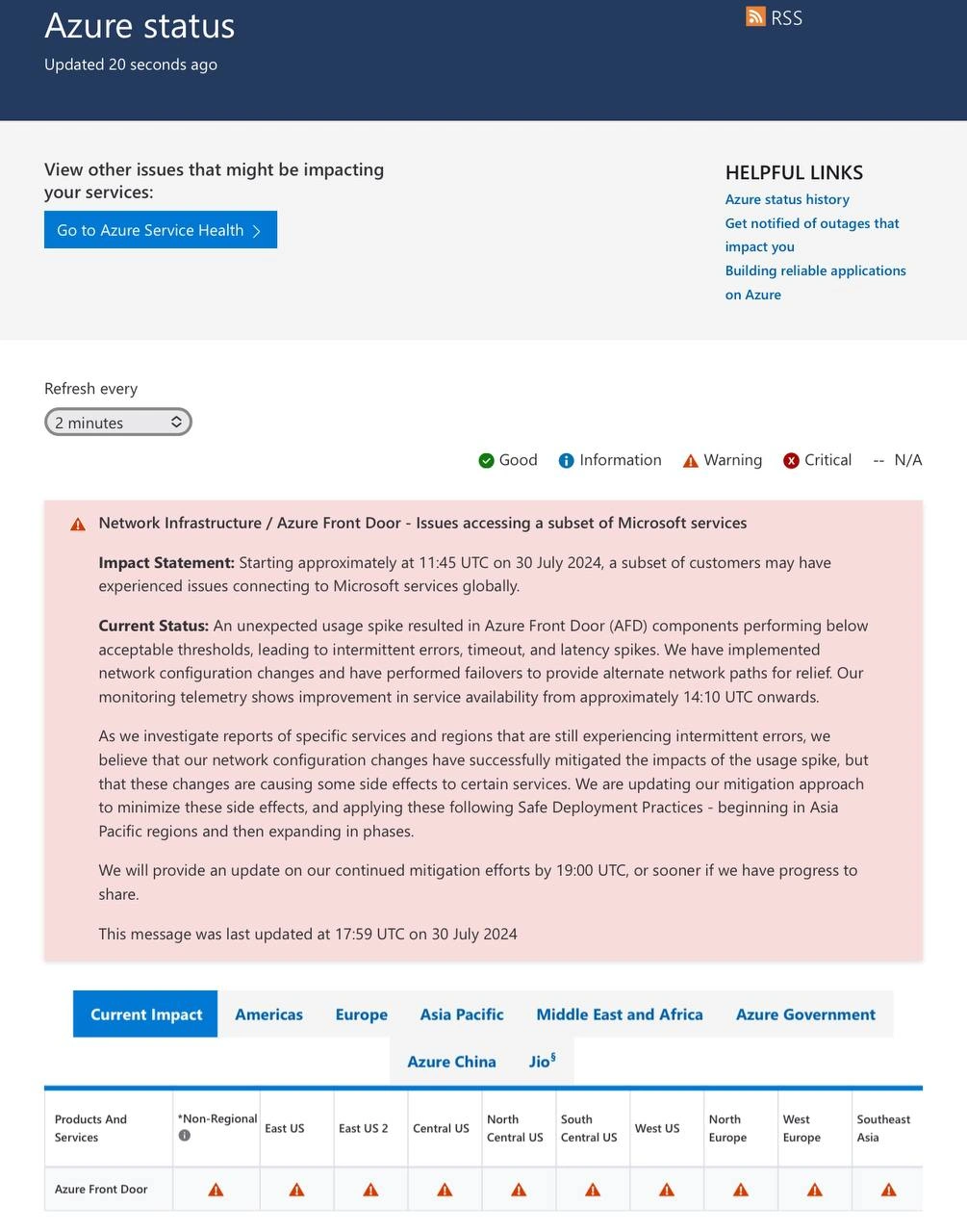
ProductionIssues and ProductionOutage refer to problems happening in the live environment (as opposed to a test environment). A “production outage” is basically downtime – your app or service isn’t working for real users. That’s a big deal. If Azure has an outage, you as a developer or company owner might be dealing with a production outage that’s actually outside your control. The first step is often to check the Azure status page on Microsoft’s site, which lists if any Azure services are having trouble. Sometimes, you’ll also hop on Twitter or forums to see if other developers are screaming about Azure at the same time – a quick way to confirm it’s not “just you.” That’s what the meme means by “see if anybody notices” – trust me, when a major cloud goes down, everybody notices and they usually start tweeting about it within minutes! There are even websites like DownDetector where you can see spikes of user reports when something like Azure or Facebook isn’t working.

The term VendorLockIn in the tags is about relying heavily on one vendor (like Microsoft Azure for all your computing needs). Many companies choose one cloud for everything because it’s simpler that way. But the downside is, if that one vendor has an outage, you’re completely stuck. It’s like having all your home’s electricity come from one company – if their grid fails, your whole house is dark. Some big enterprises try to mitigate this by being on multiple clouds (Azure and AWS, for example), so they have a backup. But that’s tough to manage and not very common for smaller teams. So, most folks ride or die with one cloud provider. The meme jokes about Azure “testing” the internet – if you’re locked into Azure, that test is going to hurt you because your stuff goes down along with Azure.

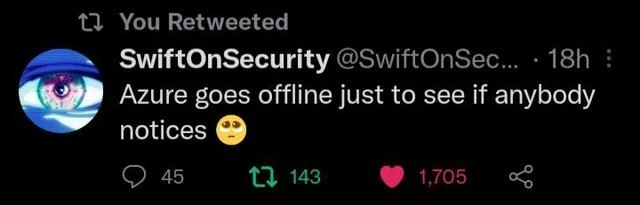
Also, a bit about the format: this meme is shown as a Twitter screenshot. The account SwiftOnSecurity (with that neon-blue eyeball avatar) is a popular tech Twitter personality known for clever quips about IT and security. The fact that it says “You Retweeted” at the top means the person capturing this image found it so relatable they shared it on their own timeline. The engagement numbers (45 replies, 143 retweets, 1,705 likes) indicate a lot of people found it funny or true. That’s the developer humor echo chamber: if you’ve been paged at 2 AM due to Azure or AWS being down, this tweet is pure gold. The “pixelated square censoring a mild expletive” in the tweet text suggests SwiftOnSecurity originally included a tiny curse word at the end of the joke (something like “Azure goes offline just to see if anybody notices, [censored]”). They obscured it in the screenshot presumably to keep the meme safe-for-work. It’s representing the frustration – when you’re in the thick of an outage, you might drop a spicy word or two out of sheer stress. Censoring it playfully keeps the meme humorous without actually swearing.

So for a junior engineer or someone new to this, the meme is basically saying: “Imagine Microsoft Azure (which powers lots of internet services) just shut everything down on purpose as a stunt to see how we’d react. Of course we’d notice – all our apps would break and we’d be getting calls and alerts non-stop!” It’s exaggeration comedy. In reality, Azure doesn’t intentionally cause customer outages just for kicks. But outages do happen, and when they do, it can feel so random and painful that it might as well have been a prank. The meme is a lighthearted way of commiserating about those experiences. Now you know: cloud outages are a thing, on-call engineers deal with them using monitors and a good dose of caffeine, and everyone has a little laugh (after the fact) at how absurd it is when a huge platform fails in the middle of a workday. Tuesday, not so boring after all.

Level 3: Status Page Déjà Vu

For seasoned engineers, this meme hits like a flashback to the last big cloud outage that ruined a perfectly good afternoon. The tweet from SwiftOnSecurity jokes, “Azure goes offline just to see if anybody notices”, capturing that familiar, exasperated humor of on-call veterans. Why is this combination of elements so funny (and painful)? Because it’s too real. In the world of on-call SREs and senior developers, we’ve seen Azure, AWS, and other cloud giants mysteriously blink out, turning our applications into toast until the vendor fixes their mess. The meme imagines Azure deliberately pulling the plug as a prank or “chaos test.” It’s obviously a joke – Microsoft isn’t actually toggling off data centers on a whim – but it feels plausible in those frustrated 3 AM moments when nothing is working and you’re doom-scrolling the Azure Status Page that still insists “All systems operational” (that’s the status-page optimism we’ve come to know and loathe). Déjà vu indeed: you’ve been here before, frantically refreshing for updates, knowing full well the pattern by heart.

The humor lives in that shared pain: on-call engineers have a grim running joke that major outages are some kind of twisted “drill” from our cloud overlords. It’s gallows humor born of watching your entire production stack blow up because a cloud service in some obscure region failed. When SwiftOnSecurity quips about Azure doing it “just to see if anybody notices,” every engineer who’s been paged at midnight to troubleshoot a ProductionOutage smirks. We notice, all right. We notice immediately – our phones explode with alerts, Slack channels turn into fire alarms, and the observability dashboards light up like a Christmas tree all in red. There’s an instant recognition: Oh no, not again. Is it the code or is Azure down? After you’ve been through a few of these incidents, you develop a sixth sense: if multiple unrelated systems break at once, your app hasn’t suddenly gone crazy – it’s probably the cloud provider having an oopsie. That’s why the meme resonates with senior devs: we’ve wasted precious time troubleshooting our own services, only to finally discover via a buried vendor update or a flood of Twitter posts that “#AzureOutage” is trending. Cue the facepalm.

This meme also satirizes corporate dysfunction and the absurdity of certain “best practices.” Chaos engineering is a legitimate practice (Netflix’s Chaos Monkey will randomly kill instances to test resilience), but no one in their right mind does that wholesale in production across all customers without warning. Yet, when Azure or AWS goes down, the experience is indistinguishable from an unannounced chaos experiment on everyone. The veteran perspective here is a mix of sarcasm and resignation: “Oh, Azure’s offline again? Sure, let’s call it a test. 😒 We’re just lab rats in their grand experiment.” The included 🙃 unamused emoji (or in the screenshot, a weary eye-roll emoji) underscores that jaded tone. We’ve seen it so often that all we can do is roll our eyes and push another pot of coffee.

Let’s not forget the numbers shown: 143 retweets, 1,705 likes – that’s a lot of weary engineers nodding their heads in unison. The tweet struck a nerve. It speaks to an industry pattern: vendor lock-in and over-reliance on a single cloud magnify these incidents. Many companies (perhaps begrudgingly) put all their eggs in the Azure basket – databases, VMs, authentication, you name it. The upside is convenience and integration; the downside is exactly this kind of all-or-nothing risk. When Azure hiccups, it’s not just one app or one customer affected; it’s thousands of businesses simultaneously having a bad day. We’ve essentially outsourced our single points of failure to the cloud. Senior architects know the theory: diversify, have failovers, maybe span multiple regions or even multiple providers. But in reality, true multi-cloud resilience is hard and costly – so most of us cross our fingers and trust Azure’s SLA. And then Tuesday comes and… well, you know the rest. This joke also hides a bit of schadenfreude: if you’re an AWS or Google Cloud user, you might chuckle that Azure is the one in hot water today (until it’s your cloud’s turn next). Cloud engineers share a collective understanding that no cloud is immune – today Azure, tomorrow AWS.

The “status-page déjà vu” phrase hints at how these outages often play out. The moment things go south, you check the official Azure Status Page. Often it’s behind the curve – showing all green check marks while Twitter and internal monitors are blaring sirens. You think, “Are we the only ones seeing this?” Minutes later, a little orange exclamation appears on the status site, confirming what the trenches already knew: yes, Azure is having an incident in region X. By then, everyone’s already noticed. It’s a ritual dance: engineers notice first, cloud vendor acknowledges grudgingly, and the waiting game begins. During that limbo, team chats fill with the usual refrains: “Anyone else having issues connecting to SQL Azure?” “Can’t reach our blob storage, is Azure down?” – as if we need confirmation beyond the 500 errors flooding in. We also see the meme reflecting prod firefighting culture: that readiness to drop everything and enter emergency mode because an upstream provider went dark.

And of course, being a tweet screenshot meme, it’s meta – SwiftOnSecurity is a well-known InfoSec personality on Twitter renowned for witty sysadmin humor. If anyone’s going to drop a cloud outage zinger, it’s them. Other tech folks see SwiftOnSecurity’s tweet in their feed (hence the “You Retweeted” in the image) and think “Ha! Exactly what it feels like.” The mild expletive in the tweet (pixelated out in the image) shows the mix of annoyance and informality – we’re all thinking that little censored word when Azure randomly fails at the worst time. It’s a camaraderie of exasperation.

So the senior perspective on this meme is a knowing laugh with a side of scars. It’s funny because we’ve all been there: the entire internet (or so it seems) crashing because one big cloud platform had issues, and we’re left to wonder if maybe the cloud is just testing our pager endurance. It pokes fun at the fragile trust we place in these systems and the coping humor we use to survive yet another on-call nightmare. As any grizzled engineer might quip: “Cloud going down in the middle of a workday? Must be chaos testing... either that or someone tripped over a power cord again.”

In fact, veteran teams often keep a tongue-in-cheek Outage Bingo card for these incidents:

  • It’s always DNS: When in doubt, blame DNS. A misconfigured DNS zone in Azure could make everything unreachable.
  • Certificate expired: Cloud services love to die when an SSL/TLS certificate renewal is missed. Oops, Azure AD’s token signing cert expired – time to break the internet!
  • Deployment gone wrong: Pushing updates on Tuesday? Bold move. A buggy configuration change or a bad patch can cascade through Azure’s services and take out heaps of dependent systems.
  • Network black hole: One bad BGP routing update or firewall rule and suddenly Azure might as well be on Mars, cut off from the world.

Seasoned devs joke about these because they’ve read the root cause analysis one too many times. The meme condenses all that institutional knowledge into a single ironic one-liner. Azure going offline “to see if anybody notices” is the kind of dry humor you develop after the third time you’re jolted awake by an outage that wasn’t your fault. It’s a coping mechanism and a critique rolled into one. We laugh because otherwise we’d cry – and we double-check that our monitoring is truly working, just in case the cloud is secretly testing us.

Level 4: Chaos Kong Goes Rampage

At the extreme scale of cloud computing, chaos engineering isn’t just monkeys pulling random plugs – it grows into rampaging gorillas. In reliability theory, companies like Netflix embraced this with tools like Chaos Monkey, Chaos Gorilla, even Chaos Kong to simulate entire data center failures. The meme joking that “Azure goes offline just to see if anybody notices” imagines Microsoft’s cloud unleashing a Chaos Kong-level event on a random Tuesday. In distributed systems terms, this is a forced failure injection on a global scale – akin to knocking out an entire availability zone or region to test resilience. But here it’s dialed up to eleven: the entire Azure cloud blinks out.

Let’s put that in context of distributed system fundamentals. Azure’s infrastructure spans multiple regions and availability zones by design, aiming for fault tolerance. Normally, a single data center can go dark without taking down user applications if they’re architected for high availability. Architects speak of designing for failure – using redundancy, regional failover, and eventually consistent data replication. However, when the cloud provider itself intentionally (or accidentally) introduces a massive outage, it’s the ultimate chaos test of the internet’s resilience. We’re bumping into the harsh reality of the CAP theorem here: if Azure’s global network partitions itself from users (Availability = zero), no amount of clever consistency models or consensus algorithms (Raft, Paxos, etc.) can save the apps solely hosted there. In practice, such a total outage is like a giant partition event – all services behind that partition become unreachable. Theoretically, distributed algorithms handle partial failures (even Byzantine faults) with grace, but the joke scenario is an absolute failure – an off switch – which is beyond the normal tolerance models.

It’s also a commentary on monoculture risk in tech: the internet is supposed to be decentralized, yet millions of apps lean on a few big cloud vendors. This centralization means a single provider outage has systemic consequences, reminiscent of the old single point of failure we tried to eliminate. Computer scientists and engineers have long warned of this: a cloud platform effectively becomes part of critical infrastructure, much like a power grid. When it hiccups, the ripple effect can be enormous. The humor here has a dark edge: Azure doing a “chaos test” on the entire internet is absurd, but it highlights that in reality, major cloud outages do feel like someone flipped a master switch. Advanced observability tools (distributed tracing, anomaly detection) might detect early warning signs deep in Azure’s fabric – perhaps a sudden spike in error rates across independent services hinting at a core dependency collapse. But for end-users and even client engineers, the theoretical nuance collapses to one blunt fact: everything is down, and no clever microservice circuit-breaker or quorum algorithm can magically restore service if the underlying platform isn’t reachable.

Historically, large-scale outages often stem from surprisingly subtle causes that propagate through complex systems. A misconfigured BGP route advertisement can knock Azure’s networking off the internet, similar to past incidents where one wrong prefix update cascaded globally. Or consider an identity service failing: if Azure’s authentication (like Azure AD) breaks due to an expired token or a buggy update, suddenly every app relying on Azure can’t verify users – effectively a total outage from the user’s perspective, even if servers are technically up. These scenarios reflect deeper truths in distributed computing: small local flaws can cause emergent global failures, a key study point in system reliability research. So, the meme’s hyperbolic premise of Azure “testing” an outage points to the very real complexity and fragility inherent in today’s internet infrastructure. It’s a wink to those versed in chaos engineering and fault tolerance theory: we do these crazy failure simulations in labs – imagine if the cloud did it for real! The laugh (or groan) comes from recognizing the underlying principle that everything fails, and at scale, everything fails spectacularly.

Description

A dark-mode Twitter screenshot shows the retweet banner "You Retweeted" at the top, followed by the account SwiftOnSecurity (@SwiftOnSec…) with a stylized neon-blue eye avatar. The tweet text reads: "Azure goes offline just to see if anybody notices" and ends with a pixelated square censoring a mild expletive. Beneath the tweet are the usual icons: 45 comment bubbles, 143 green retweets, 1,705 red hearts, and a share glyph. The humor riffs on sudden cloud-vendor outages and the weary vigilance of engineers who rely on Azure, hinting at the all-too-common production firefights and status-page déjà vu experienced by senior SREs and architects

Comments

7
Anonymous ★ Top Pick Azure’s new chaos-engineering strategy: pull the plug during business hours and watch the status page - hosted on AWS - still insist everything is green
  1. Anonymous ★ Top Pick

    Azure’s new chaos-engineering strategy: pull the plug during business hours and watch the status page - hosted on AWS - still insist everything is green

  2. Anonymous

    The real chaos engineering is when Azure implements 'Schrödinger's Availability' - the service is both up and down until someone checks their monitoring dashboard and collapses the wavefunction into a P1 incident

  3. Anonymous

    Azure didn't go offline - it just failed over to the region where nobody deployed

  4. Anonymous

    Azure's playing hide-and-seek with production workloads again - because nothing says 'enterprise-grade reliability' quite like a cloud provider testing the blast radius of their single points of failure. At least when your on-prem datacenter goes down, you know exactly whose door to knock on at 3 AM. With Azure, you just refresh the status page and watch your SLAs evaporate into the same cloud that's supposed to be hosting your services

  5. Anonymous

    Not an outage - just Microsoft running a global GameDay; if your multi-cloud was DNS pointing at Azure Front Door, your error budget just disappeared

  6. Anonymous

    Azure vanished and none of our alerts fired - turns out our “independent” monitoring, status checks, and SLO math were all running in the same region; 99.9% availability, 0% awareness

  7. Anonymous

    Azure's chaos engineering at scale: nuke a region, trace the customer rage metrics

Use J and K for navigation