Skip to content
DevMeme
1042 of 7435
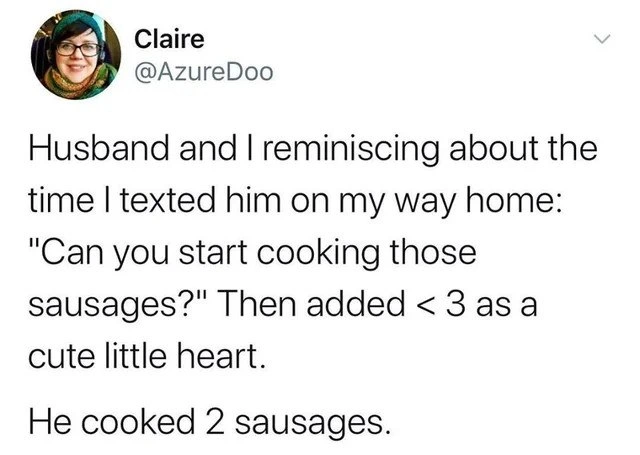
When romantic '<3' gets parsed as an integer comparison in real life
Communication Post #1172, on Mar 25, 2020 in TG

When romantic '<3' gets parsed as an integer comparison in real life

Why is this Communication meme funny?

Level 1: Heart or Math Sign?

Imagine you draw a little heart for someone, but your friend thinks that heart is actually a number sign meaning “less than 3”. This is what happened here, and it turned out pretty funny. The wife thought she was sending a heart to her husband to be sweet. But the husband saw those characters <3 and thought it meant “less than 3” like a math problem. So when she asked him to cook some sausages and put “<3” at the end, he thought she was telling him “cook less than 3 sausages.” That means he only cooked 2 sausages! It’s like if your mom said you can have <3 cookies and you only took 2 because you read it as “less than 3”. The funny part is one person was speaking in love language (using a heart), and the other person accidentally listened in math language. In the end, they both laughed because it was just a cute mix-up. The heart was supposed to mean “lots of love”, but he treated it like a little math sign. It shows how even a tiny symbol can be misunderstood if you don’t realize what the other person meant — and that mix-up made a silly, happy memory for them.

Level 2: Less Than vs Love

At its core, this meme is about a misunderstood text message between a wife and husband, caused by the husband’s programmer-like literal thinking. The wife texted: “Can you start cooking those sausages?” and then added "<3" which she intended as a heart symbol (meaning love or affection). In texting and everyday language, "<3" is commonly used to represent a heart emoji. It’s like saying “love you” or adding a warm fuzzy feeling to the message. So she was basically sweetly signing off her request with love.

The husband, however, read that "<3" in a completely different way – he saw it as the mathematical or programming expression “less than 3”. In programming and math, the symbol < is the “less than” operator, which checks if one number is smaller than another. For example, if we say 5 < 10, that is a true statement meaning 5 is less than 10. Seeing <3 by itself, a coder might instinctively think of it as part of a comparison: something < 3 (something is less than 3). The text didn’t explicitly say what was less than 3, so the husband subconsciously filled in the blank with the context: sausages. In other words, he thought his wife’s message was telling him to make sure the number of sausages is less than three. This literal parsing of the message led him to conclude that he should not cook 3 or more sausages. So what’s a number of sausages that is less than 3? He chose 2.

This misunderstanding is a classic example of a communication gap that can happen when one person is thinking in terms of code and the other in normal language. The wife meant “I ❤️ (heart) those sausages” (implying she’s excited for them or just adding love), but the husband treated the <3 as an instruction or condition: “cook <3 (less than three) sausages.” It’s both funny and cute because it shows how the same string of characters can mean two very different things. Developers often joke about reading I <3 you as I less-than-3 you. It’s a form of syntax humor or literalism in tech culture. Here, the husband took a piece of text syntax (<3) at face value. That’s why we call it literal parsing: he read the exact symbols and applied his logical brain without translating the intended meaning.

Let’s break down a few terms and concepts from this scenario:

  • < (Less-Than Operator): In most programming languages (and in math), this symbol means “is less than”. It’s used in comparisons. For example, x < 3 means “x is smaller than 3”. It’s a fundamental operator in many languages to make decisions (like if (sausages < 3) { ... }). The husband saw <3 and thought of this operator.
  • <3 as Heart: Outside of code, especially in texts or chat, people use <3 to visually represent a heart. If you look at it sideways, < looks like a pointy side of a heart and 3 looks like the curved side – together they form a heart shape. It’s a quick way to type “heart” or “love” in ASCII. It doesn’t literally mean any number; it’s just a cute symbol. Many messaging apps even automatically turn <3 into an actual ❤️ emoji.
  • Misinterpretation: The humor comes from the misinterpretation – the husband interpreted the heart as something else. This is a form of miscommunication where each person had a different understanding of the same symbols.
  • Literal vs. Figurative: The wife was being figurative (using <3 to stand for love), while the husband took it literally (as a strict “less than three” instruction). Programmers are known to sometimes take things too literally because in code you must be literal and precise.
  • Edge Case (Sausage Edge Case): An edge case in programming is a scenario that’s unusual or outside the normal expected use. Here, reading <3 as a number is definitely an edge case – most people wouldn’t do that! It’s a boundary case of understanding. Typically, you’d expect everyone to get that <3 means a heart, but in the programmer mindset, there was this one odd interpretation. The result (2 sausages instead of presumably 3 or an unspecified amount) is like hitting a funny bug due to an unlikely input interpretation.
  • Operator Overloading (in a jokey sense): In programming, operator overloading means giving an operator (like + or <) a new meaning for a custom type or context. C++ for example allows you to redefine what + means for your own objects. In our story, the <3 sequence has two overloads: one in normal life (meaning love), and one in the programming world (meaning “less than 3”). The husband applied the wrong overload here! That’s a little tongue-in-cheek way to describe the mistake.

So what was the end result? The husband literally cooked 2 sausages. He thought he was following instructions to the letter (or to the number, in this case). The wife likely expected all the sausages or at least didn’t mean to limit the number. When she got home, she probably said, “Why only 2?” and he would reply, “Because you said less than 3!” – leading to the realization and a good laugh. It’s a relatable dev experience because many of us in tech have had moments where we or someone we know interpreted a casual statement way too literally. It teaches a lighthearted lesson: context matters! And sometimes our techie brains need to switch off the code compiler mode when reading loving texts. In the end, no harm done – they just had a little chuckle (and perhaps a little less to eat 😂). It’s the kind of wholesome, nerdy misunderstanding that both programmers and non-programmers can enjoy, once it’s explained. After all, it’s not every day that emoji parsing errors lead to culinary outcomes!

Level 3: Operator Overload IRL

For experienced developers, this meme is instantly relatable and downright hilarious. It shows how a programmer’s brain can turn a sweet romantic gesture into a strict logical instruction. The wife texted her husband, “Can you start cooking those sausages? <3”, intending that <3 as a cute little heart (i.e., “love you”). But the husband read that "<3" like code, literally as “less than 3”. So instead of feeling the love, he thought his wife was specifying a quantity: “cook fewer than three sausages.” He proceeded to cook exactly 2 sausages. In coding terms, he interpreted the heart as an operator and hit an off-by-one sausage error in real life! This twist is a classic piece of coding humor – the kind where everyday language accidentally collides with programming language mentality.

Why do developers find this so funny? Because many of us have been there in one way or another. When you spend all day reading symbols with precise meanings (<, >, {} etc.), it’s hard to turn off that part of your brain. We instinctively parse text for syntax. The string "<3" leaps out to a coder as syntax, not just stylized art. It’s like an involuntary reflex: see <3, read “less than three.” This tweet encapsulates that nerdy reflex perfectly. It pokes fun at the communication gap between how something is intended and how a literally-minded techie might read it. The wife’s message was in plain English with a dash of emoji-slang, but the husband applied language-syntax precision to it as if it were source code. It’s a relatable dev experience because mixing up natural language and code is something we joke about often. There’s a well-known programmer joke, for example, where someone’s spouse says: “Buy a loaf of bread, and if they have eggs, buy a dozen.” The programmer comes home with 13 loaves of bread – interpreting the instructions in the most literal, buggy way. The sausage story is cut from the same cloth: taking an if clause or symbol much too literally.

The humor also lies in how trivial and innocent the outcome is. He only messed up by one sausage – no production servers went down, no real bug occurred, just an extra (or missing) piece of dinner. This low-stakes “failure” is something we can laugh at without stress. It highlights a common miscommunication in tech couples or teams: one person speaks normally, the other hears code. In a work context, similar things happen when non-technical stakeholders say something and engineers interpret it in an overly technical way (or vice versa). Here it’s magnified to absurdity: a heart symbol misinterpretation becomes a mini cooking snafu. It’s essentially an edge case in human communication – 99% of people see <3 and think “heart”. But the one programmer in the wild interprets it as an inequality. That unexpected interpretation is what makes it so comically absurd and yet strangely plausible to us.

This meme also riffs on the idea of operator overloading in a joking sense. In programming, we might overload operators to handle custom behaviors (like using + for string concatenation as well as addition). In real life, we “overloaded” <3 to mean love. The husband essentially reverted it back to its original operator meaning. It’s like he didn’t get the latest update in the language of love 😂. For developers, recognizing this dual meaning is satisfying. We appreciate the wordplay: "<3" is both a romantic symbol and a snippet of code. The punchline “He cooked 2 sausages” lands because we quickly do the mental math: less than 3? That means 2. It’s a moment of “I see what you did there”. It’s the same kind of clever literalism as writing I <3 YAML and a programmer reading it aloud as “I less-than-three YAML” instead of “I heart YAML.” We laugh because we know we’re guilty of this kind of thinking, too.

In essence, this meme is about a human compiler gap – the husband acted like a strict compiler or interpreter, while the wife was speaking a more fluid, high-level language of emotion. It’s endearing and funny to see love get translated into logic and then into sausages. For seasoned devs, it’s a light-hearted reminder (pun intended) that not everything is meant to be parsed literally. And it’s a great example of how our developer humor often comes from these collisions of worlds: the logical and the sentimental. It underscores the importance of context in communication. Even a tiny symbol like <3 can mean vastly different things depending on your “language setting.” In this case, a romantic request inadvertently became a code snippet in the husband’s mind. The result was a perfectly cooked demonstration of the phrase “to a man with a hammer, everything looks like a nail” – or rather, to a person with a programming mindset, every <3 looks like a comparison operator. And honestly, that’s what makes this joke so deliciously well-done.

Level 4: Context-Free Romance

This meme hilariously highlights the clash between formal syntax parsing and human communication. In programming, a sequence like "<3" isn’t a cute heart at all – it’s interpreted as a relational expression. A compiler (or a programmer’s brain acting like one) sees the < character as a less-than operator that needs two operands, and the 3 as the number three. There’s no built-in notion of “heart” in code; meaning comes strictly from grammar rules. In effect, the husband’s brain performed a kind of lexical analysis on the text message. He treated the "<" as a token meaning “less than” and 3 as a numeric literal, essentially reading the message as “cook fewer than 3 sausages.” The poor guy unknowingly applied a context-free grammar (like a programming language’s grammar) to a context that was meant to be romantic.

This is a textbook example of the difference between natural language and programming languages. In a natural language message, "<3" relies on context and convention – here it’s a sideways heart meaning “love”. But a computer (or a very literal-minded developer) has no built-in emotional context, only rules. Formal languages (like code) are often defined by context-free grammars that don’t consider the emotional or situational context: < always means a comparison. Human language, on the other hand, is loaded with implied meanings and relies on shared understanding. When the husband parsed the text literally, he effectively ignored the higher-level semantic context (a loving sign-off) and defaulted to a lower-level interpretation (a logical condition). It’s a case of a human compiler gap – the human sender assumed a warm emotional subtext, but the “human compiler” on the other end enforced strict syntax.

We can even frame the result as a tiny logical puzzle: the instruction became “Start cooking those sausages (constraint: number of sausages < 3).” The husband solved this like a coding problem, picking the largest whole number that satisfies n < 3. Naturally, that yields n = 2. In software terms, one might call this an off-by-one error – he was off by one sausage from the intended three because he treated the heart as a boundary condition! This boundary-check mindset is something programmers know well: inclusive vs. exclusive limits can cause bugs if misunderstood. Here, the boundary of “3” was misinterpreted as exclusive (< 3 means 2 or fewer) rather than inclusive (♥ meaning love, implying no numeric limit at all). The humor hits on that classic edge case scenario, where an assumption flips the outcome.

There’s also a bit of history and culture behind the symbol "<3". In the early days of text messaging and ASCII communication, people improvised emoticons using keyboard characters. <3 emerged as a makeshift heart symbol long before Unicode ❤ emoji were commonplace. It’s an example of operator overloading in real life – repurposing a mathematical symbol combination to convey an emotional meaning. Normally in code, operator overloading means giving an operator like < a new meaning for custom types. Here, society “overloaded” <3 to mean love. But our protagonist husband reverted to the original numeric meaning. Essentially, his brain didn’t load the social library that maps <3 to a heart; it fell back to the default operation. The result? A literal parsing of the SMS that leads to a deliciously geeky misunderstanding. It’s a perfect storm of language ambiguity: a love message compiled into a logical statement. This deep dive into parsing and semantics is what makes the joke so satisfying for those of us fluent in both code and human. In the battle of compiler vs cupid, the compiler momentarily won – and dinner ended up with one fewer sausage than love intended.

Description

The image is a cropped screenshot of a tweet displayed on Twitter’s white interface with black, left-aligned text. A small, blurred avatar appears beside the display name “Claire” and the handle “@AzureDoo.” The tweet reads: "Husband and I reminiscing about the time I texted him on my way home: 'Can you start cooking those sausages?' Then added < 3 as a cute little heart. He cooked 2 sausages." The humor derives from reading the string "< 3" literally as the logical operator 'less than three' rather than as a heart emoji, causing an off-by-one sausage incident. For developers, it pokes fun at how programmers instinctively interpret symbols with language-syntax precision, highlighting communication gaps between natural language and code semantics
Comments

6
Anonymous ★ Top Pick Post-mortem: spec said "sausages <3"; the kitchen microservice took the comparator literally and shipped exactly two. Next sprint: enforce UTF-8 hearts and add unit tests for sausage counts
  1. Anonymous ★ Top Pick

    Post-mortem: spec said "sausages <3"; the kitchen microservice took the comparator literally and shipped exactly two. Next sprint: enforce UTF-8 hearts and add unit tests for sausage counts

  2. Anonymous

    This is why we need strict type checking in marriage - when your spouse interprets emoticons as comparison operators, you're one misplaced semicolon away from sleeping on the couch

  3. Anonymous

    Classic off-by-one error in production: when your partner's brain defaults to strict inequality evaluation instead of Unicode rendering. Should've used `sausages >= 3 ? cook_all() : romantic_gesture()` for proper edge case handling. At least he didn't throw a NullPointerException when the sausages array was undefined

  4. Anonymous

    Sent "<3" as a heart; he parsed it as sausages < 3 and shipped exactly 2 - spec-compliant, romance threw NotImplementedException

  5. Anonymous

    Natural-language interface without a type system: she meant a heart, he implemented the inequality - dinner shipped with two sausages and 100% spec compliance

  6. Anonymous

    Wife's <3 heart compiles to husband's strict parser as false - classic impedance mismatch, one sausage short of affection

Use J and K for navigation