Skip to content
DevMeme
1043 of 7435
Lockdown rules? Programmers have been training for this their whole lives
RemoteWork Post #1174, on Mar 25, 2020 in TG

Lockdown rules? Programmers have been training for this their whole lives

Why is this RemoteWork meme funny?

Level 1: At-Home Advantage

Imagine two kids, Alice and Bob. Alice absolutely loves playing video games in her room, and Bob absolutely loves playing outside with his friends. Now suppose it starts to rain heavily for a week and everyone has to stay inside. Alice is excited – she gets to do her favorite thing (play games at home) all day long and no one will bug her to go outside. Bob, on the other hand, is miserable – he can’t do what he loves (run around outdoors) and he feels cooped up. This meme is just like that story. The “lockdown rules” were kind of like the rain: they forced everyone to stay home, not travel, and not meet friends for a while. For most people (like Bob), it was sad and boring, and they felt like the crying person in the top picture. But for programmers (like Alice, who loves her indoor hobby), it was actually easy and even fun – they felt like the laughing people in the bottom picture. In real life, a lot of programmers already enjoy staying in with their computers, writing code or playing with technology, so when the world said “you must stay inside,” it was almost like telling a kid to stay in a candy store. The joke is that something hard for most folks was actually a treat for programmers, because they were already used to living in that “stay-at-home” way.

Level 2: WFH Starter Pack

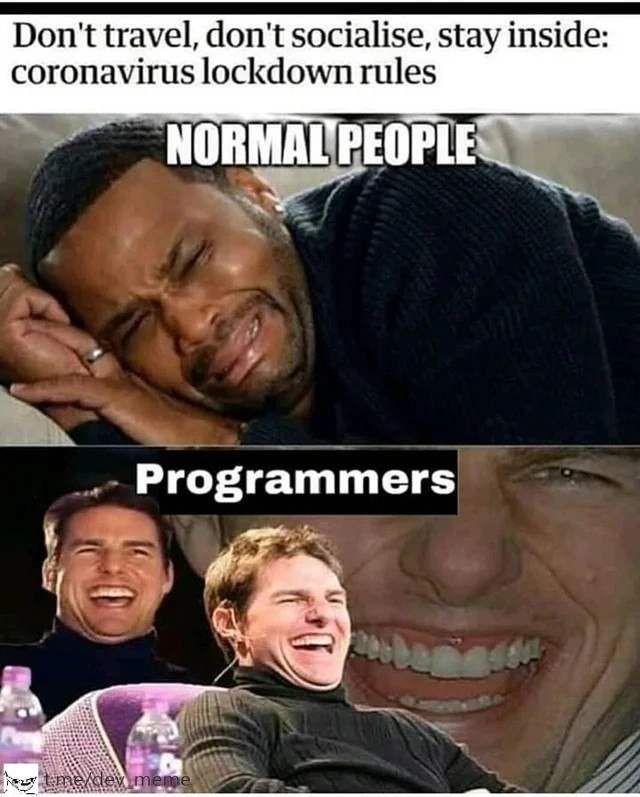
The meme contrasts two groups during quarantine: “normal people” who are miserable about staying home, and “programmers” who are completely at ease (even happy) with it. Why would coders react so differently? Let’s break it down in simpler terms. RemoteWork or WorkFromHome (WFH) means doing your job from your house instead of going into an office, usually by using the internet, email, and video calls to stay connected. In March 2020 when COVID-19 caused lockdowns, almost everyone had to work and socialize remotely all of a sudden. Lockdown rules like “don’t travel, don’t socialize, stay inside” were intended to stop the virus from spreading, but they also forced people to give up normal outings and face-to-face interactions. Many folks found this very hard – they felt bored, lonely, or restless because they couldn’t go to the office, gym, or hang out with friends. These are the “NORMAL PEOPLE” in the meme’s top half: represented by a man on a couch crying dramatically, as if he’s saying “I can’t take being cooped up!”. That image is a humorous exaggeration of how extroverted or outdoorsy people felt under quarantine.

Now look at the bottom half labeled “Programmers.” Instead of crying, the people (in fact a famous meme of actor Tom Cruise laughing) are leaning back and grinning ear-to-ear. The text that was partially cut off likely read “Programmers” in full. Why are they so happy? The joke is that programmers love these rules because it’s how they normally live. In developer culture, there’s a running stereotype that programmers are introverts who prefer quiet, uninterrupted time at their computers. An introvert coder often enjoys staying in, working on personal tech projects, playing video games, or chatting online rather than going out to big social events. So the meme suggests that while an average person might be crying from boredom at home, a programmer is smiling because nothing really changed – except now nobody is bothering them about not going outside! It’s like the world finally aligned with the programmer’s preferred lifestyle. This contrast between programmer_vs_normal is a common format in developer humor: it highlights how developers can be different from other people in funny ways.

Let’s talk about some real aspects of the developer lifestyle that make this joke ring true. Many developers already had a home office setup or at least a personal computer rig that they love spending time on. Coding is typically a task you can do anywhere as long as you have a computer and internet. In fact, a lot of software companies and open-source projects have been using remote collaboration tools for years. For example, teams use Slack (a text chat app) or Microsoft Teams to communicate, and they track their work with tools like JIRA or Trello. Version control systems like Git (with platforms like GitHub or GitLab) allow programmers to contribute code to a project with colleagues around the world without ever meeting in person. So when everyone had to stay home, developers just kept using those same tools – only now everyone was using them. Coworkers who used to pop by a developer’s desk to talk suddenly had to send a message or set up a Zoom call, which is something many devs actually prefer because it cuts down on random interruptions. Essentially, the whole professional world had to learn the remote work habits and dev community practices that programmers were already comfortable with. No commuting, flexible hours, working in pajamas – these were perks developers often enjoyed occasionally, now becoming the daily norm. It’s easy to see why a lot of developers joked that they had been “training” for lockdown: writing code for long stretches at home prepared them well for full-time quarantine life.

This meme is very relatable to many in the tech community (relatableDeveloperExperience is all about sharing experiences other devs nod their heads at). During quarantine, social media was full of developers joking, “I’ve been self-isolating in front of a screen since college, so I’ve got this!”. They often already socialized through online forums, Discord chats, or multiplayer games. Their hobbies, like tinkering with electronics, learning new programming languages, or binge-watching sci-fi, are all indoor activities. Compare that to someone who gets their energy from daily in-person interactions or outdoor exercise — that person can feel really down when stuck inside. So in simple terms: normal people had to adapt from going out to staying in, while programmers were largely just continuing their usual routine, minus the commute. The meme exaggerates it (most programmers did miss some outside things, of course) but it’s funny because it captures a real difference in how two groups experienced the same lockdown rules.

In summary, the meme uses an obvious visual contrast to explain a concept: one picture of a man crying to show “This is how most people feel about staying in”, and one picture of laughing programmers to show “This is how coders feel – they’re actually okay with it!”. It riffs on pandemic_humor by taking a tough situation (quarantine) and pointing out a light-hearted truth: those nerdy, indoor-inclined programmers might just be the quarantine all-star team. The caption “Programmers have been training for this their whole lives” is tongue-in-cheek, implying that years of late-night coding, marathon gaming, and living on the internet have inadvertently prepared developers to handle being stuck at home better than anybody else.

Level 3: Social Distancing: Already Implemented

In early 2020, the world told everyone: don’t travel, don’t socialize, stay inside. For many software engineers, that sounded like the usual Monday. This meme plays on the contrast between normal people chafing under quarantine and programmers who’ve practically been in training for it. The top panel lists strict lockdown rules from the COVID-19 pandemic, which read like a Work From Home (WFH) policy memo. Regular folks saw these rules as harsh confinement, but developers? We just saw our daily routine codified into law. It’s a piece of classic developer humor highlighting an unwritten truth of developer culture: a lot of us were introvert coders long before it was mandated. We’ve been quietly “social distancing” from noisy open offices and random interruptions for years by slipping on headphones and disappearing into code. Finally, in March 2020, our developer lifestyle became the norm, and you can almost hear the collective giggle from every home office.

Real-world tech teams actually had a head start here. Long before the pandemic, globally distributed dev communities thrived via chat, version control, and issue trackers without ever meeting in person. We use git push instead of pushing paper, and we resolve merge conflicts on GitHub instead of in conference rooms. So when offices worldwide shut down, engineers simply kept committing code from their living rooms. Stand-up meetings moved to Zoom and Slack, but the workflow hardly changed. Managers scrambling to set up remote VPNs and video calls were basically just catching up to what devs and open-source maintainers have done for ages. It’s relatable developer experience in action: the tools and habits that make remote collaboration possible — distributed version control, cloud build servers, ticket systems — are second nature to programmers. We’ve been remote-first in practice, if not always in name.

The humor hits home because of the absurdly perfect alignment between pandemic rules and programmer tendencies. “Don’t travel”? Many devs have preferred virtual conferences or watching recorded tech talks on YouTube over expensive business trips. “Don’t socialise”? We’ve mastered the art of saying “I’m debugging, can’t talk” on Friday nights. “Stay inside”? Our most productive coding sessions happen in the comfort of a chair at 2 AM with only the glow of multiple monitors for company. In other words, the stay_inside_comfort level for programmers was already maxed out. The meme exaggerates, of course – not every coder is a hermit – but it taps into the stereotype that programmers are happiest holed up with a PC. It’s funny because it’s almost true: the conditions that make extroverts stir-crazy just make a lot of developers extra cozy. We turned isolation into our developerLifestyle long before “shelter in place” was a phrase. No wonder the bottom image shows tech dudes (famously actor Tom Cruise laughing in a meme) practically in hysterics; they’re loving this “new” status quo that keeps everyone online and undisturbed.

To seasoned engineers, there’s also a darkly comic subtext in how smoothly development work continued despite the crisis. Projects didn’t suddenly stop because folks went home — if anything, some devs finally got uninterrupted stretches to code. Offices always worried remote work would hurt productivity, but the pandemic proved what senior devs suspected: if you give an engineer a fast internet connection and a backlog of features, it doesn’t matter where they are, they’ll bash out code. The meme’s punchline, “Programmers have been training for this their whole lives,” hints that a career in coding is like lifelong prep for permanent lockdown. Years of late-night hacking, marathon gaming sessions, and preferring the glow of a CLI over sunshine turned out to be excellent quarantine preparation.

And yes, the images chosen amplify that punchline. The “NORMAL PEOPLE” section uses a popular reaction image of someone crying dramatically into a couch pillow – representing extroverts or just anyone going stir-crazy stuck at home. In stark contrast, the “Programmers” section shows laughing, confident faces (a well-known shot of Tom Cruise cracking up, a meme shorthand for ridiculous laughter). The juxtaposition says it all: what’s misery for others is a joke to us. It’s pandemic humor done right – taking a stressful global event and, without belittling the real suffering, pointing out an ironic silver lining for one niche group. Programmers weren’t just okay with lockdown rules; many were thriving. We finally had an excuse to do exactly what we love with zero guilt. No awkward networking events, no “let’s grab a drink after work” – just pure, uninterrupted keyboard time. To an experienced dev, the meme elicits a knowing smirk because we’ve lived that reality. As far as lifestyle adjustments go, lockdown_rules barely made us flinch. In configuration terms, the world simply flipped all the right booleans to true for us:

const lockdownRules = {
  travel: false,
  socialise: false,
  stayInside: true
};
// Programmers had already been following this configuration by default

In summary, the humor here plays on a common programmer_vs_normal trope. It winks to the veterans who remember pulling all-nighters at a keyboard while roommates or family begged them to go outside. Now the whole world had to live like that, at least for a while. Suddenly, the nerdy indoor lifestyle wasn’t just accepted – it was government mandated. This meme celebrates that bizarre moment when programmers collectively thought, “Welcome to our world!” and had a good laugh at how the tables turned.

Description

Two - panel meme with white top banner reading “Don’t travel, don’t socialise, stay inside: coronavirus lockdown rules.” Under it, bold-white text “NORMAL PEOPLE” captions a photo of a person lying on a couch, eyes closed, appearing bored and uncomfortable. The bottom half starts with partially visible caption “Program…” (implying “Programmers”) and shows two casually dressed people on a conference panel, leaning back in chairs, smiling confidently and enjoying themselves. The visual joke contrasts normal people chafing under pandemic isolation with developers who already thrive indoors at their computers. Technically, it riffs on remote-work culture and the stereotype that software engineers are introverted homebodies for whom quarantine restrictions simply formalized their usual coding lifestyle
Comments

6
Anonymous ★ Top Pick Lockdown just meant the whole planet joined me in a personal Docker container - no exposed ports, volumes mapped to ~/code, and a strict HEALTHCHECK: `curl -fs localhost || brew coffee`
  1. Anonymous ★ Top Pick

    Lockdown just meant the whole planet joined me in a personal Docker container - no exposed ports, volumes mapped to ~/code, and a strict HEALTHCHECK: `curl -fs localhost || brew coffee`

  2. Anonymous

    Finally, a government mandate that aligns with our incident response playbook: isolate the problem, minimize human interaction, and work from a secure environment until the issue is resolved

  3. Anonymous

    When the entire world was forced into remote work and social isolation during the pandemic, developers finally got the validation they'd been seeking for decades: proof that their preferred lifestyle of staying home, avoiding meetings, and communicating primarily through Slack wasn't antisocial - it was just ahead of its time. While everyone else panic-bought toilet paper, developers were already stocked up on mechanical keyboards and noise-canceling headphones

  4. Anonymous

    The lockdown read like an SRE runbook - isolate services, reduce cross‑talk, and watch throughput rise - finally a compliance policy that optimizes my cache hit rate

  5. Anonymous

    Lockdown: the rare global event reducing our distributed systems to blissful single-node localhost deployments

  6. Anonymous

    Lockdown was the first time the rest of the world tried our preferred architecture: isolated nodes, async comms, and a flaky video RPC layer

Use J and K for navigation