Skip to content
DevMeme
1022 of 7435
The Overconfidence Before the 900GB JSON File
BigData Post #1149, on Mar 17, 2020 in TG

The Overconfidence Before the 900GB JSON File

Why is this BigData meme funny?

Level 1: Elephant in a Shoebox

Imagine you have a tiny shoebox and you try to put an entire elephant inside it. 🐘📩 What do you think would happen? The box would break, the elephant would definitely not fit, and it would be a huge mess, right? This meme is joking about a similar idea, but with computers: somebody tried to pack way too much information into one file (like putting all your toys into one small box until it bursts). It’s such a silly overstuffing that even the computer’s hard drive (where data is stored) starts “screaming” in pain, kind of like you’d scream if you tried to lift something super heavy. In simple terms, the joke is saying: everything is cool and easy until you do something ridiculously oversized, then it all falls apart. Even people who work with computers find this funny, because it reminds them of times they saw a computer struggle when asked to handle too much. It’s a fun way to learn that there’s a limit to how much you should put in one place – whether it’s toys in a box or data in a file – before it just doesn’t work anymore.

Level 2: Big JSON, Big Problems

Let’s break this down for a newer developer or someone just learning about data formats and storage. The meme states: “Everybody Gangsta until the JSON file is 900GB.” This uses playful slang – “gangsta” meaning “tough” or “cool” – to say everyone feels confident until they encounter a 900 GB JSON file. In simpler terms: handling data is easy until you try to handle way too much in the wrong way.

First, what is JSON? It stands for JavaScript Object Notation. It’s a popular data format that stores information as text in a structured way (using {} curly braces, [] brackets, with keys and values). For example, a small JSON might look like:

{
  "name": "Alice",
  "age": 30,
  "isDeveloper": true
}

JSON is great because it’s human-readable (you can open it in a text editor and understand it) and widely used for things like web APIs and configuration files. It’s a form of serialization – meaning we take data (like objects or records in memory) and serialize it (turn it into a format for storage or transmission). There are many DataFormats for serialization (XML, CSV, binary formats, etc.), and JSON is one of the most convenient for moderate-sized data.

Now, 900 GB is an extremely large amount of data for a single file – that’s what we’d call Big Data. To give a sense of scale: 1 GB (gigabyte) is about 1024^3 bytes, roughly a billion bytes. So 900 GB is 900 billion bytes of information. In more everyday terms, a high-quality movie might be around 1 to 2 GB. So 900 GB could store about 450 full-length HD movies. It’s huge. Most personal computers don’t even have 900GB of free space readily available (many laptops have 256GB or 512GB drives total). So storing a 900GB file means you need a very large disk (or an external drive, server storage, etc.). DiskSpace is a big concern here – you’d fill most of a 1TB (1024 GB) hard drive with just this one file!

Why is a 900GB JSON file a problem? For a few reasons:

  • Memory (RAM) limits: To work with a JSON file, programs often read it into memory. Think of memory as the working area where programs manipulate data. A typical laptop might have 8GB or 16GB of RAM. Even a strong server might have 64GB or 128GB of RAM. 900GB simply won’t fit into memory. If you try to load it, the program will either crash or start using disk as “virtual memory” (which is very slow and can grind the whole system to a halt). So, you can’t just open it like you would a small file. Some libraries can stream read it (processing a bit at a time), but that’s more complex and still extremely slow.

  • Disk I/O (Input/Output): This term refers to reading from or writing to the storage disk. A file that’s 900GB will take a long time to read from disk. Imagine a really fast transfer speed, like copying a movie file on a good drive – maybe ~100 MB/s. Even at that rate, one would take 900 GB / (100 MB/s) = 9000 seconds to read fully – that’s about 2.5 hours of continuous reading! And many disks (especially older hard drives) are slower, plus JSON parsing needs CPU time too. So processing this file could tie up the computer for many hours. During that time, the disk is working so hard that it might get very hot or (if it’s a hard disk drive) make loud whirring/clicking noises. That’s what we jokingly call “the disks screaming.” It’s like the computer going “I can’t handle this load!”.

  • Software limitations: Most text editors or simple programs can’t handle such a large file. For instance, if you tried to open this latest-all.json in a code editor like VS Code or an IDE, it would likely freeze or refuse. Even the operating system’s file explorer (as shown in the meme image, which looks like a German locale file manager) struggles to even show the file properties. Standard JSON parsers (like the one in Python’s json module or Node’s JSON.parse) would try to load everything and would fail. There are specialized tools for big files, but using the common tools on this will lead to PerformanceIssues or outright failures.

  • Data redundancy and inefficiency: JSON, being text, isn’t space-efficient for huge data sets. For example, every record in JSON might repeat field names. If you have an array of a million user records, every user entry might include "name": ..., "age": ..., "isDeveloper": ... etc. repeated over and over. This makes the file much larger than it needs to be. Other data formats could store that more compactly by not repeating the field names for every entry (for instance, a binary format might have one descriptor saying “this field is age” and then just the values 30, 25, 40, ... in sequence). With 900GB of JSON, there’s probably a lot of wasted space just from these structural characters and repeated text.

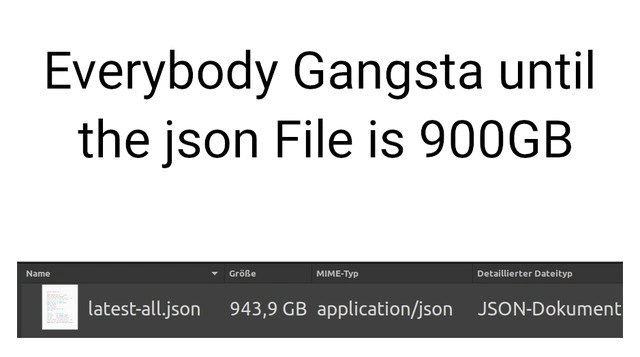
Now, let’s interpret the meme image details. The top text says “Everybody Gangsta until the json File is 900GB”. This is using a common meme phrase. It implies that developers might be pretty confident (gangsta = gangster, slang for someone who’s cool or fearless) using JSON for data – because JSON is easy and popular – but that confidence disappears when the JSON file gets ridiculously large (900GB). It’s like saying “JSON is fine and all, until it absolutely isn’t and then you panic.”

Below that text in the meme, there’s a screenshot (with a white background above and a dark file listing below). In that screenshot:

  • Name: latest-all.json – this appears to be the filename. The name suggests it could be some “latest dump of everything” because of the words “latest-all”. Perhaps it’s an export of a whole database or a complete data set in one file.
  • GrĂ¶ĂŸe: 943,9 GB – The interface is in German. “GrĂ¶ĂŸe” means “Size”. So yes, the size is 943.9 GB (using a comma instead of a decimal point, as is common in Europe). That’s nearly 944 GB. For context, 1024 GB is 1 TB (terabyte), so it’s just shy of a terabyte.
  • MIME-Typ: application/json – This indicates the file type by content. MIME type application/json confirms it’s recognized as a JSON file. MIME types are labels used by systems to know what kind of file something is (application/json is the standard for JSON files).
  • Detailierter Dateityp: JSON-Dokument – This is German for “Detailed file type: JSON document.” It’s basically reiterating that the system knows it’s a JSON document. Possibly the OS giving a human-friendly type description.

So, the image is essentially showing a real (or staged) example of a JSON file that is 943.9 GB in size. That visual drives home the joke: normally JSON files are maybe a few kilobytes or megabytes for config or small data sets. Seeing one that’s nearly a terabyte is jarring and absurd.

Why would someone even have a 900GB JSON file? It could be a poorly planned data export (like someone did SELECT * FROM huge_table from a database and dumped the output to JSON). Or it could be data that should have been in a data warehouse, but instead was collected in a log file. In professional DataEngineering, if you have such a huge dataset, you’d handle it differently – maybe store it in a cluster or break it into partitions. Dumping it into one text file suggests a lack of scalability considerations.

This is where BigData practices come in. The field of big data deals with data sets that are so large or complex that traditional methods (like one file or a single database on one server) won’t work well. Tools like Apache Hadoop or Apache Spark exist to process large data by distributing the work across many machines. They also store data in special distributed file systems (like HDFS) and formats (like Parquet, ORC, Avro, etc., as mentioned). These systems might split a 900GB dataset into hundreds or thousands of smaller chunks behind the scenes, so no single chunk is unmanageable. They also often compress the data and allow querying parts of it. The goal is to avoid exactly what this meme shows.

For a junior developer, the lesson or insight here is: Be mindful of your data formats and sizes. Using JSON is fine for smaller data, but as your data grows, you need to consider efficiency. There’s a whole world of tools in data engineering designed to handle large datasets. If you ignore those and just stick to naive methods, you’ll hit a wall. The wall, in this case, is your disk and RAM screaming in agony because they can’t handle what you’re asking.

Also, you learn that “dump” is a term for exporting data. A “JSON dump” means someone output a bunch of data into a JSON file. Usually, dumps are meant for backups or transferring data between systems. But best practice is to compress dumps or chunk them to multiple files if they’re huge. A single file data dump of 900GB is highly unusual and impractical.

The humor carries an element of schadenfreude (finding amusement in someone else’s trouble) – we laugh because we either have experienced this pain or can imagine the facepalm moment when someone realizes what they’ve done. It’s a “relatable pain” in tech. The meme is essentially saying: “We were all feeling cool and in control of our data, until reality hit in the form of a 900GB JSON, and then it’s panic time.”

To sum up, at a junior level understanding:

  • JSON is a text-based data format, easy for moderate data but not efficient for extremely large data.
  • 900 GB is an enormous size for one file, likely causing standard tools to fail.
  • Big data requires special handling (like splitting data or using other formats), and ignoring that leads to performance issues (“disks screaming” is a fun way to say the computer hardware is struggling).
  • The meme uses a popular phrase to highlight a common mistake in a funny way. It teaches, with humor, why we should not treat massive data dumps the same way as small config files.

If you ever find yourself with a file that large, you now know it’s time to read up on big data tools or databases – because opening that JSON in Excel or your favorite editor is not going to cut it! The meme will hopefully come to mind as a friendly warning sign.

Level 3: Serialization Overkill

When a developer sees the phrase “Everybody gangsta until the JSON file is 900GB,” it immediately triggers flashbacks to Big Data nightmares. This meme perfectly captures a scenario of serialization overkill: using a human-readable JSON text file for nearly a terabyte of data. In the image, a file named latest-all.json is a whopping 943.9 GB. To seasoned engineers, that’s an absurdly monolithic data dump – practically a crime against DataEngineering best practices. Why? Because JSON (JavaScript Object Notation) is great for small, convenient data exchange, but at 900+ GB it becomes a ticking time bomb for any system that touches it.

Think about what happens under the hood. A JSON parser trying to ingest a 900GB file will likely choke. Most libraries attempt to load the entire structure or at least large chunks into memory. Even high-end servers don’t have 900GB of RAM just lying around for one file, so you’re looking at immediate MemoryError or swapping to disk. Parsing such a behemoth means disk I/O through the roof. On a spinning hard drive, you might literally hear the disk thrashing – hence the meme’s hyperbole about “disks scream.” It’s a humorous way to say the storage hardware is under extreme stress (picture a disk drive making grinding noises as it desperately tries to read/write that torrent of data). Even on an SSD (no moving parts so no sound), the system would grind to a halt for hours. Reading 900GB sequentially at a decent 100 MB/s would take about 2.5 hours just to read the raw bytes, not counting the CPU time to parse JSON text into objects. Any slight inefficiency, and you’ve got a server pegged at 100% disk and CPU for half a day – a recipe for PerformanceIssues and missed SLAs.

The humor here also lies in the contrast: “Everybody’s tough until
” is a popular meme format implying that people act confident (“gangsta”) until they encounter an extreme challenge. In our context, developers might feel pretty confident handling data – until they meet a 900GB JSON file and all that swagger evaporates. It’s a relatable horror story in tech circles. Many of us have war stories like a rogue process generating a multi-GB log or a misguided team exporting an entire database as one giant JSON. The result is always the same: programs crash, systems slow to a crawl, and an innocent DataFormats choice turns into an emergency. The meme poignantly exaggerates a real pain point: treating nearly terabyte-scale data as one human-readable file is asking for trouble.

From a senior perspective, this scenario screams “lack of proper data engineering”. In modern BigData pipelines, you’d never store 900GB in one text file. Instead, you’d employ chunked storage and compression. For example, you might partition the data into many smaller files (perhaps by date or category). Or better, use a storage format designed for large-scale analytics: columnar formats like Apache Parquet or ORC that are highly compressed and support selective reading. A 900GB JSON, if converted to Parquet, could potentially shrink to a fraction of that size on disk and allow query engines to read only the needed parts. Even plain compression like gzip or bzip2 on the JSON could reduce the size by ~10x (because JSON has a lot of repetitive text), though you’d still have the problem of having to decompress ~90GB and parse it. The point is, JSON is not meant to be a data lake. It’s a lightweight data serialization format for convenience, not a scalable storage solution for massive datasets. The meme highlights the absurdity by showing the file manager identifying a “JSON-Dokument” of 943.9 GB – something that in theory is possible, but in practice is a nightmare to work with.

Let’s talk real-world implications: a single 900GB JSON dump would wreak havoc on most systems. Version control (like git) would be out of the question (imagine trying to git diff a 900GB JSON!). Loading it in an interactive tool or IDE? Forget it – even opening a 1GB log file can crash editors; 900GB is beyond ludicrous. Many operating system utilities would struggle; even listing such a file might be slow. If this file is part of a pipeline, perhaps as an export from one system to another, it’s going to be incredibly inefficient. It might also indicate a lack of Storage planning – if you only have a 1TB disk and you make a 943GB file, you’ve nearly filled the disk, leaving little room for anything else (and possibly causing the OS to complain or the disk to run out if the file grows further). No wonder the disks (and the on-call engineers) would be “screaming.”

The meme resonates especially with backend engineers and data folks because it’s a shared joke about scaling gone wrong. We’ve all seen someone do a naive data dump to JSON or CSV that balloons out of control. It usually starts innocently: JSON is human-readable and easy to produce (just call toJson() on your object – done!). But at high volumes, that human-readability becomes a liability. Each record carries overhead of curly braces {}, quotation marks for keys, etc., repeated millions of times. The file becomes bloated, and parsing it means scanning character by character for those structures. Contrast that with a binary format where data is stored in a compact, schema-defined way; the size is smaller and you can jump to offsets quickly.

In essence, this meme is a tongue-in-cheek PSA: if your JSON file is pushing gigabytes, you’re doing it wrong. The “everybody gangsta” phrasing adds a layer of attitude and humor, as if to say, “Yeah, we thought we were cool using JSON for everything
 until reality hit hard.” It’s the developer equivalent of “biting off more than you can chew.”

To avoid ending up in this situation, seasoned devs would employ strategies like streaming the data or breaking it up. For example, if you absolutely had to use JSON, you might use a streaming JSON parser (which reads one piece at a time) or a line-delimited JSON approach where each line is a JSON record (allowing you to process the file incrementally). But even that can be arduous at 900GB. More often, one would reach for a database or distributed system for such data. You’d store the data in a cluster and query it, rather than having one poor machine read a colossal file.

In summary, the meme humorously underscores a serious engineering lesson: choose the right tool for the job. JSON is fine for config files or exchanging data between services — but when you reach BigData levels (hundreds of gigabytes), you need industrial solutions, not a single text file. It’s a laugh born from pain, because many of us have learned this the hard way. The next time someone says, “We’ll just dump the data to JSON, no problem,” you can remember this meme and maybe reconsider before the disks start screaming.

  • One Giant File vs. Many Small Files: Instead of one 900GB monster, split the data into smaller chunks (say 1000 files of ~0.9GB each). Smaller files are easier to handle, you can process them in parallel, and if one file is corrupt, you haven’t lost everything.
  • Use Binary or Columnar Formats: Formats like Avro, Parquet, or ProtoBuf are built for big datasets. They store data in compact binary form (so 900GB of JSON might become a few hundred GB or less) and allow partial reading. A columnar format (like Parquet) lets you read just the columns you need (great for databases and analytics) without parsing the whole file.
  • Compress Text Data: If you must use JSON, at least compress it (e.g., latest-all.json.gz). Compression algorithms can drastically shrink repetitive text. Your 943.9GB JSON might compress down to tens of gigabytes. It will still be slow to process, but at least it saves DiskSpace and I/O strain.
  • Proper Data Stores: Often the correct solution is not a file at all but a database or data lake. For example, loading the data into a SQL/noSQL database, or an Hadoop/Spark cluster, means you can query and analyze it without ever handling one huge text blob. The data sits in storage designed for it, and you pull out only what you need.

Each of these points reflects knowledge that experienced engineers (especially those in DataEngineering) hold dear. The meme’s joke lands because someone clearly ignored these principles, and now “everybody’s tough” bravado has turned into “everybody’s terrified” as they face a 900GB JSON Godzilla. It’s a humorous exaggeration, but one that carries an underlying truth about scalability and the pitfalls of convenience over proper design.

import json
with open("latest-all.json") as f:
    data = json.load(f)  # đŸ˜± This will likely crash or freeze with a 900 GB JSON file!

Above is a quick Python snippet representing what not to do. Calling json.load on a file that size would try to read the entire file into memory and parse it at once – an almost guaranteed failure. The code comment is the kind of bemused horror a developer might add when encountering such a situation (the emoji is basically the face you make when you realize why the server is on its knees). In reality, you’d need a very different approach to handle even a fraction of that data.

Ultimately, the senior-level insight is: Don’t be the “gangsta” who dumps 900GB of data into JSON. The cool swagger of using easy tools can backfire disastrously at scale. As the meme suggests, everything is easy and fun in tech until you hit that wall of extreme case – then it’s time to drop the swagger and engineer a proper solution.

Description

A two-part meme. The top part features large black text on a white background that reads, 'Everybody Gangsta until the json File is 900GB'. The bottom part is a screenshot of a file explorer window with a dark theme, displaying a single file. The columns in the file explorer are 'Name', 'GrĂ¶ĂŸe' (German for Size), 'MIME-Typ', and 'Detaillierter Dateityp' (German for Detailed File Type). The file shown is named 'latest-all.json', and its size is listed as '943,9 GB'. The MIME type is 'application/json', and the detailed type is 'JSON-Dokument'. The meme uses the 'Everybody Gangsta' format to humorously contrast a developer's confidence with the daunting and often system-breaking reality of encountering an unexpectedly massive data file. A nearly 1TB JSON file is impractical to handle with standard text editors or parsers, which would likely crash due to immense memory consumption, turning a simple data task into a significant data engineering challenge


Comments

7
Anonymous ★ Top Pick That's not a JSON file; it's a denial-of-service attack on your IDE. You don't open it, you stream-process it with a cluster you provisioned just for the occasion
  1. Anonymous ★ Top Pick

    That's not a JSON file; it's a denial-of-service attack on your IDE. You don't open it, you stream-process it with a cluster you provisioned just for the occasion

  2. Anonymous

    latest-all.json, 943 GB: that magical point where “self-describing data” becomes “self-destructing cluster” and even the NoSQL evangelists start begging for Parquet partitions

  3. Anonymous

    That's the file where someone stored the entire company's data lake because "JSON is human-readable" and now the only thing reading it is a cluster of crying EC2 instances

  4. Anonymous

    When your 'latest-all.json' hits 943GB, you've transcended from REST API to REST IN PEACE API. At that point, you're not parsing JSON anymore - you're archeologically excavating it with streaming parsers, praying your heap doesn't become a crime scene, and seriously reconsidering every architectural decision that led to dumping your entire production database into a single serialized object. This is what happens when someone takes 'denormalization for performance' a bit too literally

  5. Anonymous

    latest-all.json at 943GB: at that size, JSON is just Parquet in denial

  6. Anonymous

    Data engineer's 'quick JSON dump of everything' - now featuring 900GB and zero schemas

  7. Anonymous

    A 900GB JSON turns cat | jq into a self‑inflicted DDoS on your laptop; that’s when “human‑readable” means “only after converting to Parquet and partitioning by date.”

Use J and K for navigation