Skip to content
DevMeme
1023 of 7435
Threat Model: Every Nation State
Security Post #1150, on Mar 17, 2020 in TG

Threat Model: Every Nation State

Why is this Security meme funny?

Level 1: Too Many Locks

This is like putting four different locks on your front door because you are worried every lock company might secretly have a key. It feels safer at first, but now opening the door is complicated, fixing the door is harder, and you still have to trust that the house itself is not full of open windows. The funny part is that the plan is both paranoid and weirdly logical.

Level 2: Firewall Stack

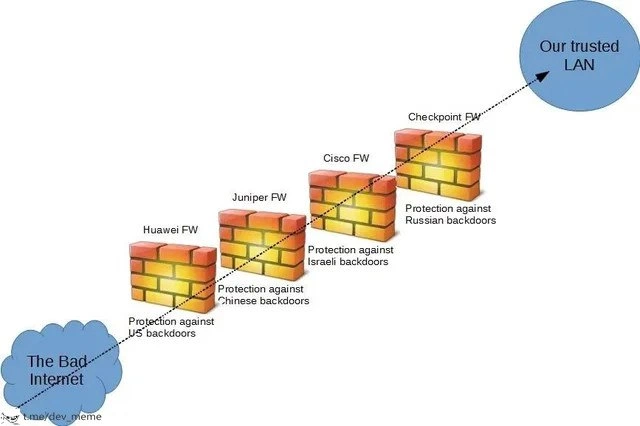
A firewall is a network security device that decides which traffic is allowed to pass. It can block traffic by address, port, protocol, application behavior, or more advanced inspection rules. In the image, the traffic path goes through several firewalls before reaching the internal network.

A threat model is a structured guess about what you are defending against. For a small website, the threat might be spam, credential stuffing, or basic vulnerability scanning. For a bank, government agency, or infrastructure company, the threat model may include professional attackers with money, time, and political goals.

The joke is that this network tries to defend against everyone at once. Each firewall is imagined as protecting against a different country’s backdoors. In real life, a backdoor means a hidden or unauthorized way to access a system. Security teams worry about backdoors because network devices often have deep access and are difficult to inspect completely.

For a junior engineer, the useful lesson is that “more security tools” does not always mean “more secure.” Every added tool needs configuration, maintenance, alerts, updates, and people who understand it. Otherwise, the system becomes harder to reason about, and confusion becomes part of the attack surface.

Level 3: Diplomatic Packet Filtering

The diagram sends a dotted traffic path from:

The Bad-Internet

through four firewall blocks labeled:

Huawei FW
Juniper FW
Cisco FW
Checkpoint FW

and finally into:

Our trusted LAN

Each firewall is paired with a different geopolitical fear: protection against US backdoors, Chinese backdoors, Israeli backdoors, and Russian backdoors. The post message sharpens it:

When your threat model is all the nation states

The humor comes from taking threat modeling to its absurd endpoint. A serious threat model asks: who might attack us, what do they want, what capabilities do they have, and what controls are worth the cost? This meme answers, “Yes.” Every vendor is treated as potentially compromised by some state-aligned interest, so the organization stacks products from different ecosystems as if suspicion itself were a load-balancing strategy.

There is a real security pattern hiding under the joke: defense in depth. Multiple independent controls can reduce the chance that one failure compromises the whole network. But independence is doing heavy lifting there. If four appliances are chained together without a clear policy boundary, operational model, monitoring plan, and failure analysis, the design may simply multiply complexity. Now the trusted LAN depends on four configurations, four update streams, four logging formats, four support contracts, and four places where someone can accidentally write any any allow at 2 AM.

The meme also pokes at software supply chain security and vendor trust. Security appliances are privileged by design: they inspect traffic, terminate tunnels, enforce policy, and often sit directly between hostile networks and sensitive systems. If you distrust the appliance vendor deeply enough, adding more appliances from more vendors may feel comforting, but it does not automatically prove safety. It can turn the network into geopolitical lasagna: many layers, unclear ownership, and eventually someone asks why DNS is broken.

The sharpest part is the phrase trusted LAN at the end. The diagram implies that after traffic survives four suspicion gates, the inside can be trusted. That is the old corporate-network dream: dangerous outside, safe inside. Modern security keeps learning, usually through incident reports with very expensive fonts, that trust is not a location. A LAN becomes trustworthy through identity, segmentation, patching, least privilege, monitoring, and response discipline, not just by placing enough brick walls before it.

Description

A network diagram shows a dotted path from a blue cloud labeled "The Bad Internet" through four brick firewall icons into a blue oval labeled "Our trusted LAN." The firewalls are labeled "Huawei FW" with "Protection against US backdoors," "Juniper FW" with "Protection against Chinese backdoors," "Cisco FW" with "Protection against Israeli backdoors," and "Checkpoint FW" with "Protection against Russian backdoors." The joke is that a paranoid organization stacks firewall vendors to defend against every possible state-aligned supply-chain backdoor, turning defense in depth into geopolitical dependency management.

Comments

1
Anonymous ★ Top Pick By the fourth firewall, your threat model has become a diplomatic incident with packet loss.
  1. Anonymous ★ Top Pick

    By the fourth firewall, your threat model has become a diplomatic incident with packet loss.

Use J and K for navigation