JavaScript's Unique Approach to Basic Arithmetic
Why is this Bugs meme funny?
Level 1: A Tiny Bit Off
Imagine you have a special calculator that isn’t great with certain fractions. If you ask it “What’s 1/3 of 3?” you expect the answer 1, right? But since 1/3 is 0.333... (with 3 going on forever), a not-so-perfect calculator might give you 0.999 (because it rounded each 1/3 to 0.33). Now 0.999 is almost the same as 1, just a tiny bit less. In the same way, when the computer multiplies 1.1 by 3, it gets almost 3.3, but just a teeny bit more: 3.3000000000000003.
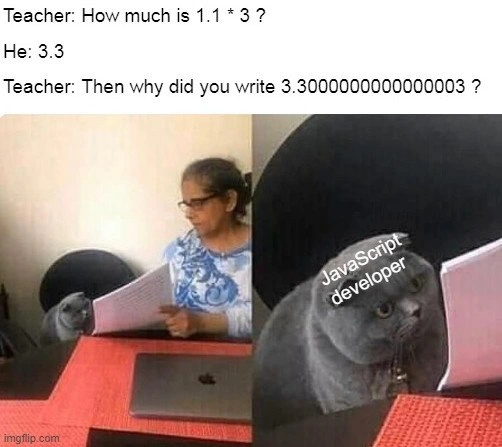
For a normal person, writing 3.3000000000000003 is overkill — it’s like giving an answer with way too many decimal places for no good reason. That’s why in the meme the teacher is confused and a little annoyed: "Why did you write this crazy long number instead of 3.3?" The joke is that the developer (the cat in the picture) wrote that long number not because they’re bad at math, but because the computer told them that was the answer! The poor cat developer looks embarrassed, as if saying, "I know it looks weird, but that's what I got."
So, the funny part of this meme is like when a very precise tool gives an answer that’s technically right but looks wrong to everyone else. It’s a tiny misunderstanding between the computer’s way of doing math and our way of doing math, and it makes for a silly classroom scene that anyone who’s dealt with quirky calculators or computers can laugh at!
Level 2: A Lesson in Precision
Let's break down the meme in simpler terms. We have a two-panel image. In the first panel, a teacher asks a student, "How much is 1.1 * 3?" The student (whose face we don’t really see clearly, but there's a grey cat peeking out next to him) answers "3.3". That's the normal math answer, of course. But then the teacher says, "Then why did you write 3.3000000000000003?" In the second panel, we zoom in on the round grey cat, who now is labeled "JavaScript developer" across its forehead. The cat has this hilarious, guilty stare, as if caught doing something wrong.
The joke here is that the JavaScript developer (represented by the cat) gave an answer with a bunch of extra digits, and the teacher is baffled. In a regular classroom, writing 3.3000000000000003 for that question would look totally incorrect. It’s as if the student added a ton of unnecessary detail or made a weird mistake. But if you’re a programmer, you realize the student wrote that because that’s exactly what the computer would output for 1.1 * 3 in JavaScript!
Here's what's happening: JavaScript (like many programming languages) uses something called double-precision floating-point numbers for all its numeric calculations. That's a fancy way of saying it represents numbers in binary (ones and zeros) in a fixed amount of memory, and it can handle a wide range of values (very large or very small), but not every number can be perfectly precise. Specifically, numbers with decimals (like 1.1) are often just a tiny bit off when the computer stores them. It's because in binary (the base-2 number system computers use), a number like 1.1 (which is 1 + 1/10) doesn't have a neat representation.
Think of it like trying to write 1/3 in normal decimal: you get 0.333333... and it goes on forever. You can't write it with complete accuracy using a finite number of digits. Similarly, 1.1 in binary goes on forever in a pattern, and the computer just chops it off at some point. That tiny chopping off causes a teeny error. So when the computer multiplies 1.1 by 3, the result is not exactly 3.3 but 3.3000000000000003. The computer isn't "messing up" in a big way — the result is extremely close to 3.3, just with a teeny tiny extra 0.0000000000000003 added.
If you open a browser console or a Node.js environment and actually run the code, you'll see this:
console.log(1.1 * 3);
// → 3.3000000000000003
That output is exactly what the meme is referring to. The teacher (and anyone unfamiliar with this) is thinking, "Why on Earth would you write such a strange answer?" But the JavaScript developer (the cat) wrote it because that's what the program produced. This is a well-known language quirk of not just JavaScript, but any system using binary floating-point math. We call it a floating-point precision issue or error. It's one of those subtle bugs that aren't actually the result of a coding mistake; it's more about how the computer represents numbers.
To put it plainly, the computer did multiply 1.1 by 3 correctly, but it rounded the result a tiny bit differently internally. The computer's "best guess" for 3.3 in its binary language turned out to be 3.3000000000000003. Seasoned developers know about this, so it makes them chuckle to see a teacher-character demand the student-developer explain himself. The poor cat developer is like, "I swear I know 1.1 * 3 is 3.3, but that's what came out!"
In real life, if we were writing a program that dealt with money or something requiring exact decimals, we'd handle this by rounding the number to a reasonable decimal place before showing it to a user. For example, in JavaScript you might do let result = (1.1 * 3).toFixed(1); which would give you a string "3.3" as the formatted result. That way, the teacher (or user) would just see 3.3, nice and clean. The key insight is that the computer isn't actually doing bad math; it's just using binary math. There's even a famous Stack Overflow question and lots of jokes about how JavaScript supposedly can’t do math because of examples like this. But again, it's not just JavaScript – it's pretty much any language using floating-point. JavaScript just makes it very obvious because it prints the full number.
This meme is a funny way to highlight a CS fundamental concept: the difference between how humans do math (in decimal, with perfect precision for numbers like 1.1) and how computers do math (in binary, with tiny rounding errors). It also shows a common subtle bug that many new coders stumble upon. The tags like FloatingPointPrecision and SubtleBugs really capture it — this is a little precision hiccup that can surprise you if you're not expecting it. And the fact it's a cat as the developer just makes it extra humorous, because the cat looks just as confused and alarmed as a new programmer would be when they first encounter this problem! It's a classic piece of developer humor that also teaches a lesson: always be mindful of how your tools (in this case, the programming language and its number system) actually work under the hood.
Level 3: IEEE-754 Strikes Again
Any seasoned programmer who sees an output like 3.3000000000000003 will likely crack a knowing smile. It's a classic rite of passage in development: the moment you realize computers sometimes handle simple numbers in very weird ways. This meme perfectly captures that moment using a teacher-student confrontation. The teacher asks a straightforward question and expects the neat answer "3.3", and the student (the JavaScript developer, embodied by a very concerned grey cat) has written down what the computer actually spit out: 3.3000000000000003. The humor comes from how absurd that looks in a normal context. In a math classroom, writing all those extra zeros and that 3 at the end would seem like the student has lost their mind or doesn't understand rounding. But in the programming world, we immediately recognize that the student is not wrong — it's the computer being overly "correct" in its own quirky way.
This scenario highlights a fundamental quirk of our industry: floating-point precision issues. It's the kind of thing that every developer eventually bumps into. There's even an almost legendary example many of us joke about: ask a programmer what 0.1 + 0.2 equals and you'll likely hear, "0.30000000000000004" with a knowing groan. We've all been there. In practice, these tiny errors have caused plenty of headaches. I've personally seen numeric_precision_bug reports where a financial app would display something like $19.999999999999 instead of $20.00, or a physics calculation would yield 0.99999999 when it should be 1.0. Such glitches are subtle – you might not catch them in casual testing – but they can confuse users or cause logic checks to fail. Seasoned devs know to code around them: for instance, never rely on direct equality checks with floating-point numbers (if (total === 3.3) is a no-no), and always format or round the results before presenting them to a user.
The meme’s teacher-student format exaggerates a situation every developer dreads: having to justify to a non-developer why 3.3000000000000003 is actually the correct output from the computer's point of view. The cat's wide-eyed, guilty expression says it all: "I know this looks bad, but it's not my fault!" 😅. It's funny because we've been that cat. Maybe it was a project manager or a client asking why their invoice total had an extra 0.0000000000000003 tacked on, and we had to launch into an explanation of binary fractions. It's a tough sell! You end up saying something like, "Um, it's not a bug really—more like a feature of how computers do math." Often the response is a blank stare, much like the teacher in the meme giving that disapproving look.
As experienced devs, we often chuckle about JavaScript being "bad at math," but the truth is this isn’t actually JavaScript-specific. Java, Python, C, C# – you name it – if they use IEEE-754 double precision (and most do by default for floats), they'll produce the same kind of result. JavaScript just tends to get meme-ified more because, well, JavaScript has a lot of quirky behaviors and it's easy to demonstrate in the browser console. Plus, JavaScript historically had only one number type for a long time (no distinct integer type for general use until the recent addition of BigInt), so these issues pop up even when doing something like currency math that other languages might handle with integer cents or decimal types. The community has turned these oddities into running gags: you'll hear jokes like "JavaScript can’t do math" or see screenshots of weird results. But behind the jokes, every experienced dev knows the real cause: our old friend IEEE-754.
From an engineering perspective, we've learned to live with it. We use workarounds:
- If it's currency or something where 3.3000000000000003 would be unacceptable, we might use a decimal library or big integers to represent cents.
- Or we call formatting functions like
total.toFixed(2)to round off to, say, "3.30" before showing results. - In unit tests, instead of checking for exact equality with floats, we check if the difference is below a tiny threshold (an epsilon), to account for these rounding hiccups.
These practices are practically doctrine in programming now. We've institutionalized them because we've all been burned by that one failing test or that one baffled end-user asking why something as simple as 1.1 * 3 didn't come out to 3.3. It's a shared piece of developer lore, and that's why this meme hits home for so many. The teacher’s question "Then why did you write 3.3000000000000003?" is literally what a QA tester or project manager might ask in real life. And the only answer we can give is, "Because that's what the computer calculated." At least it's not a real catastrophe (or should I say cat-astrophe? 🐱) — it's just one of those little technical oddities that we learn to explain and resolve. In the end, the meme is laughing at the contrast between the purity of grade-school arithmetic and the messy reality of computer arithmetic. Every senior engineer recognizes that mix of embarrassment and nerdy amusement reflected in the cat’s eyes, thinking, "Yes, it's 3.3000000000000003... Let me tell you why."
Level 4: Double Precision, Double Trouble
Under the hood, JavaScript uses the IEEE-754 double-precision floating-point standard for all its numeric calculations. This means numbers are represented in binary (base-2) scientific notation within 64 bits of space (1 bit for the sign, 11 bits for the exponent, and 52 bits for the fraction or significand). It's a fast and universally adopted system, but it comes with a fundamental trade-off: not all decimal fractions can be represented exactly in binary form.
Let's take 1.1 as an example. The decimal 1.1 (which is 11/10) in binary becomes an infinite repeating fraction. In fact, $1.1_{10}$ equals $1.0001100110011..._{2}$, where the pattern 0011 repeats forever in base-2. Why? Because $\frac{1}{10}$ (0.1 in decimal) has no finite representation in binary (just like $\frac{1}{3}$ is 0.333... in decimal). An IEEE-754 double can't store an infinite sequence of bits, so it has to cut it off at 52 bits of precision and round to the nearest representable value. This means the value that actually gets stored for 1.1 is a touch different than 1.1 exactly – it's approximately 1.10000000000000008881784197001252 in decimal (a tiny bit higher than 1.1).
Now multiply that stored approximation by 3. In exact math, $1.1 \times 3 = 3.3$. But our stored 1.1 was really 1.1000000000000000888..., slightly over. If you triple that, you get about 3.3000000000000002664... (a bit over 3.3). Again, that result will be rounded by the 64-bit representation (though in this case it's so close that it ends up with the binary pattern corresponding to 3.3000000000000003 when converted back to decimal notation). Therefore, when JavaScript (or any IEEE-754 compliant system) prints the result of 1.1 * 3, it shows 3.3000000000000003. The language isn’t trying to be funny – it’s actually showing the most accurate value it has for the calculation. In fact, JavaScript's Number.toString() (which is used in console.log by default) outputs just enough digits so that if you were to paste that output back into JavaScript, you'd get the exact same binary number internally. Printing "3.3" would be slightly misleading because the actual stored value isn't exactly 3.3. Those extra zeros and that final 3 are the computer's way of being precise about its imprecision, if that makes sense!
To illustrate the breakdown of what's happening step by step:
| Operation | Ideal Math Result (Decimal) | Actual Stored Value (Decimal approximation) |
|---|---|---|
| Represent 1.1 | 1.1 exactly | 1.10000000000000008881784197001252... |
| Compute 1.1 * 3 | 3.3 exactly | 3.30000000000000026645352591003757... |
| Final Output | "3.3" (what we expect) | "3.3000000000000003" (closest 64-bit representable) |
Table: Even though 3.3 is the true result, the 64-bit binary approximation yields a value just a hair above 3.3. JavaScript displays that full precision value as 3.3000000000000003.
Crucially, none of this is a bug in JavaScript at all; it's a consequence of how binary floating-point math works. The IEEE-754 standard (in place since 1985) was carefully designed by computer scientists to balance performance with precision. It guarantees that the result we got is the closest possible to the real answer 3.3 given the 52-bit limitation. In fact, this phenomenon is so well-known that there’s a famous paper titled “What Every Computer Scientist Should Know About Floating-Point Arithmetic” that explores these kinds of issues in depth. The bottom line is that any time we use binary floating-point to represent decimal numbers, we have to accept tiny rounding errors. The humor in this meme comes from the disconnect between mathematical truth and machine representation: the calculation is logically correct, but the way computers store the number makes the answer look a lot stranger than expected.
Description
This meme uses the 'Woman Showing Paper to a Cat' format. The top part of the image contains a text exchange: 'Teacher: How much is 1.1 * 3 ?', 'He: 3.3', 'Teacher: Then why did you write 3.3000000000000003 ?'. The bottom panel shows a woman looking at a paper with a small grey cat, and a zoomed-in image of the cat looking stressed and guilty. The cat is labeled 'JavaScript developer'. The humor stems from a well-known quirk in JavaScript (and other languages using IEEE 754 floating-point arithmetic) where simple decimal calculations result in precision errors. The expression `1.1 * 3` evaluates to the long decimal because of how these numbers are represented in binary. The meme personifies this language flaw as a developer being caught making a fundamental math error, perfectly capturing the frustrating and often comical nature of floating-point inaccuracies
Comments
28Comment deleted
This is why we have a `===` operator. One equals is for the value, one is for the type, and the third is to check if the floating-point representation is having an existential crisis
PM: “Can we stop showing 3.3000000000000003 on the invoice?” Me: “Sure - just budget a sprint to replace IEEE-754, every browser VM, and probably a few laws of physics.”
After 20 years in the industry, you learn that the real skill isn't avoiding floating-point errors - it's explaining to the finance team why their quarterly reports are off by 0.0000000000000003 cents and convincing them it's actually the computer being mathematically correct
Every JavaScript developer has had that moment explaining to a stakeholder why their financial calculations are off by 0.0000000000000003. 'It's not a bug, it's IEEE 754!' we cry, while frantically googling decimal.js libraries and wondering why we didn't just use integers and store everything in cents like the backend team suggested three sprints ago
I didn’t fail math - I passed IEEE‑754: 3.3 is a UI concern; 3.300000000000003 is the backend truth
In JavaScript, 1.1*3 equals an IEEE‑754 footnote, a decimal library, and an awkward finance call
Because JS multiplies like microservices: distributed accuracy with consistency eventually
why exclusively js? Comment deleted
Yes Comment deleted
https://0.30000000000000004.com/ Comment deleted
brilliant Comment deleted
When you hate JS for 0.1+0.2 != 0.3 you should in the same way hate Rust, C++, python, Haskell, your CPU and at last William Kahan) Comment deleted
+1. Comment deleted
Floating point errors are really something Comment deleted
is there a language where 1.1*3 is actually 3.3? Comment deleted
haskell and lisp Comment deleted
they use fractions and floats Comment deleted
and how are there 1.1*3=3.3? Comment deleted
common lisp (sbcl) * (* 1.1 3) 3.3000002 haskell Prelude> 1.1 * 3 3.3000000000000003 Comment deleted
if you do the 11 % 10 Comment deleted
? Comment deleted
represent 1.1 as rational Comment deleted
* (float (* (rationalize 1.1) 3)) 3.3 Comment deleted
ye like this it's gonna produce trash Comment deleted
Sbcl: (/ 3 10) 3/10 Comment deleted
Even IRL 1.1*3 can be 3.2999(9) Comment deleted
python kek Comment deleted
fukkk whyyy Comment deleted