For Loops: The Foundational Breakfast for Every Developer
Why is this CS Fundamentals meme funny?
Level 1: Eating & Repeating
Imagine you wake up and every single morning you eat the exact same cereal for breakfast. Day after day, bowl after bowl, it's always "For Loops" cereal. Sounds a bit silly (and maybe a little boring), right? Well, this meme is joking that learning to code is a lot like that. When you start programming, the first thing almost everyone learns is a simple for loop – which is basically a set of instructions that says "do this action over and over again." It's like a teacher saying, "Take one spoonful of cereal, then another, then another until the bowl is empty." A for-loop in code does the same thing: "do this task, then again, then again, until you've done it for every item or a certain number of times."
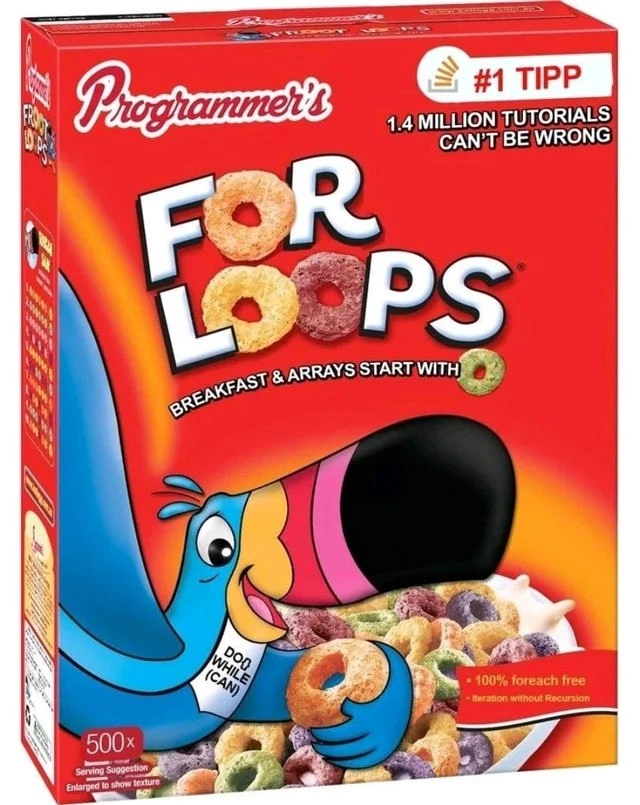
So in the picture, they've turned "Froot Loops" (a famous colorful cereal) into "For Loops." The box is bright and happy, with a toucan bird, just like a kid's cereal, to really drive home that this is the basic stuff you get at the start of your day (or start of your coding journey). All the little phrases on the box are goofy mix-ups of cereal talk and coding talk. For example, "1.4 million tutorials can't be wrong" – that's like saying "Lots of people have this for breakfast, so it must be good!" In coding terms, it means "Every beginner tutorial teaches this, so it must be important!" And "100% foreach free – iteration without recursion" sounds like a nutritional label (like "sugar-free" or "gluten-free"), but here it's just humorously saying "this cereal only uses the basic loops, nothing fancy like other kinds of loops or techniques." In plain speak: only simple repetition here, no tricky stuff.
The reason this is funny is that it exaggerates something true: when people first learn to code, they really do practice loops a lot, just like kids might eat a lot of cereal. It’s taking an everyday thing (eating breakfast cereal) and comparing it to learning programming. Even a child can get the basic idea – it's like being told to do the same chore over and over, or practicing the same piano scale repeatedly. That’s what a loop is! And because every new coder does it, the meme imagines if that experience were a cereal, it'd be the most popular breakfast in the coding world. So the picture is basically a big, colorful joke saying, "Hey, coders, remember how we all started with the same simple stuff over and over?" and it makes us smile because it's true. Just like you might chuckle at the idea of a cereal named after homework, programmers laugh at a cereal named "For Loops" – it's taking the ordinary start of the day and turning it into the ordinary start of coding. In short, the meme makes learning to code look as simple (and as fun) as eating a bowl of rainbow cereal every morning, poking fun at how repetitive and common those first lessons really are.
Level 2: Looping 101
So what exactly is this meme talking about, technically? It’s jam-packed with references to basic programming concepts that every new coder encounters. Let’s break down the "ingredients" of this cereal box joke:
For Loops: A for loop is a fundamental control structure that allows a set of instructions to be repeated multiple times. Imagine you have an array (a list of items, like
[apple, banana, cherry]) and you want to print each item. Instead of writing three separate print statements, you can use a for loop to iterate through the array and handle each element in turn. In many languages (C, Java, etc.), a for loop has a syntax with three parts – initialization, condition, and increment:// Example of a basic for loop in C/Java syntax for(int i = 0; i < fruits.length; i++) { printf("%s\n", fruits[i]); // print each fruit }This loop starts at
i = 0(often arrays start at index 0 in CS fundamentals), runs whilei < fruits.length(meaning it stops after the last index), andi++increments the counter by 1 each time. The effect is that the code inside{ ... }runs once for each element in the array. Array iteration like this is one of the first tasks new programmers learn. The meme’s slogan "Breakfast & arrays start with for loops" is riffing on this idea that to go through an array (like to eat your breakfast cereal), you start at the beginning and use a loop to go through each item/bite.Foreach loops: Some languages provide a simpler loop called a foreach loop (or a for-each loop) which directly gives you each element of a collection without needing an index variable. For example, in Python you might do:
for fruit in fruits: print(fruit)or in Java:
for(String fruit : fruits) { System.out.println(fruit); }This is more convenient because you don't manually deal with
ior array lengths. The meme proclaims "100% foreach free", meaning "this product contains no foreach loops." Why boast about that? Well, it's poking fun at the idea that they're sticking to the basics – the classicforloop – perhaps implying a kind of old-fashioned purity. In reality, foreach loops are just as valid; the meme is being facetious, as ifforeachis some modern indulgence that this old-school cereal doesn't have. If you've ever heard debates like "should beginners learn C loops with indices or just use Pythonic loops?", this aligns with that culture of teaching fundamentals first (even if they're a bit more verbose).Recursion: The other thing the box advertises is "iteration without Recursion." Recursion is another technique to repeat tasks, where a function calls itself to break a problem down into smaller pieces. For instance, you could sum the numbers in an array either by looping through them or by using recursion (have the function sum the first element plus the sum of the rest by calling itself on the sub-list, and so on). A simple recursive example in pseudo-Python:
def sum_array(numbers): if len(numbers) == 0: return 0 return numbers[0] + sum_array(numbers[1:])Here
sum_arraycalls itself to gradually total the array. Recursion can be elegant, but it’s often considered a bit advanced for absolute beginners because it involves thinking in terms of function calls and base cases. The cereal box proudly excluding recursion ("0% recursion, all iterative!") is making fun of how basic programming lessons tend to avoid recursion at first, sticking to loops. It's similar to a cereal box saying "no artificial colors"; here it's "no fancy recursion," only straightforward loops. Iteration just means looping, so "iteration without recursion" translates to "we do looping the simple way, not by writing recursive functions." If you’re new: don't worry, recursion is something you typically learn once you're comfortable with loops and functions. It’s like learning a slightly more complex trick after you’ve mastered the basics.Do...while loop: The toucan’s sign "DO() WHILE I CAN" is referencing a do-while loop. In many languages, a
do { ... } while(condition);loop will execute the code inside thedo { }at least once, and then repeat it while the condition at the end is true. For example:int x = 0; do { System.out.println("x is " + x); x++; } while(x < 3);This would print x is 0, x is 1, x is 2 — and then stop because after that
x < 3becomes false. The key is the check comes after the first run, so the loop always runs at least one time. The meme plays on the common phrase "do it while you can," sneaking the programming syntax in. It's highlighting another kind of loop construct, showing the meme isn't just about for-loops; it's giving a nod to all basic loop types (for, foreach, while, do-while) you encounter in a CS 101 class. But notice, they specifically wroteDO() WHILEwith parentheses, mimicking how you'd write a function call or loop condition in code.Arrays: Mentioned in "Breakfast & arrays start with...", an array is simply an ordered collection of elements (like a row of cereal loops in a bowl, each at a specific position). If you're a new programmer, picture an array as a tray with numbered slots, where you put items. Arrays are a fundamental data structure; you use loops to access or modify each slot one by one. The meme ties "arrays" to the breakfast theme because in many coding tutorials, once you learn a basic loop, the next thing you do is loop through an array of values. It's such a common pairing (loop + array) that it's become almost cliché – hence making it part of the cereal slogan. DataStructures like arrays/lists are introduced early, and loops are how you work with them, so the meme is basically an advertisement for beginner-level coding practices.
Tutorial Overload: The "1.4 million tutorials can't be wrong" is humorous hyperbole but not far from reality. There really are a huge number of tutorials and guides for beginners on topics like "how to use a for-loop." If you search online, you'll indeed be greeted by an overwhelming number of similar examples and explanations. Newcomers often go through multiple sources learning the very same loop concept from scratch in slightly different flavors (one tutorial prints numbers 1-10, another iterates over an array of car names, yet another walks through an array of cereal flavors!). This abundance is both a blessing and a bit of a joke – which the meme captures by presenting it as a marketing point, as if quantity of tutorials = quality of the concept. It's a playful poke at developer learning culture: newcomers sometimes feel like they're eating the same meal every day (loops for breakfast, lunch, and dinner) because every course or book starts with the same basics. This meme has rolled all those basics into a single “product.”
Visual Puns: Even the design elements carry double meanings. The two O's in "FOR LOOPS" are drawn as multicolored cereal rings, directly linking a code term ("loops") with the edible "loops" you find in Froot Loops cereal. The box shows a bowl brimming with rainbow-colored loops (like an array of colorful data, perhaps!). The small print "500× Serving Suggestion – Enlarged to show texture" is there to parody real cereal box fine print. It's just a joke about how the cereal (and metaphorically the code concept) is blown up for illustration purposes. A beginner tutorial will often zoom in on every little detail of a
forloop (what each part means, how the braces work, etc.) just like the box zooms in on the cereal pieces. So it’s emphasizing the educational exaggeration: teaching tools often magnify simple things to make sure you get it. The "#1 TIPP" badge looks like a gold award; maybe it's implying "#1 Tip for Programmers," or could just be mimicking a random cereal award. (It's possible "TIPP" is a playful misspelling of "TIP", adding an extra 'P' to be quirky.)
In summary, this meme is a crash course in coder humor about learning fundamentals. It uses a cereal box – something instantly recognizable – to frame programming concepts in an absurdly relatable way. If you're a junior developer or just learning to code, understanding the meme means understanding that for loops, while loops, do-while loops, arrays, foreach, and recursion are all basic building blocks of programming. The joke is that these basics are so commonly taught (and maybe over-taught) that they've become like eating the same breakfast every day. Every element on the box is a wink at a concept you either have learned or will learn early on:
- For loop: your daily bread (or daily cereal) in coding – do something repeatedly with an index.
- Foreach loop: a slightly fancier breakfast – but this cereal doesn't serve that.
- Recursion: a gourmet technique (like flipping pancakes in the air) – not on the menu here, we keep it simple.
- Do-while: a special variation – included as a punny tagline by the mascot, reminding you it exists.
- Array: the bowl of items you’re looping over – the cereal bowl itself.
All these are part of the learning menu of an entry-level coder. The meme manages to wrap all those definitions in one colorful, funny picture. Once you decode the jokes, you're actually reviewing your Programming 101 concepts! It's both a satirical advertisement and a light-hearted study guide cover for CSFundamentals. Now you know: when coders joke about "eating for loops for breakfast," they’re referencing that ubiquitous early coding experience where loops are literally the first thing on the plate.
Level 3: Infinite Tutorial Loop
On the surface, this meme spoofs a cereal box, but seasoned developers recognize a clever commentary on CS fundamentals and the often endless loop of beginner tutorials. The bright red box labeled "Programmer's FOR LOOPS" is a parody of Kellogg's Froot Loops, and it's loaded with inside jokes. The title itself replaces "Froot Loops" with "For Loops," elevating the humble for loop to a breakfast staple. This immediately signals a jab at how foundational the for loop is in every programmer's diet of learning – practically the "breakfast of coders." The tagline just below, "BREAKFAST & ARRAYS START WITH," completes the pun: "Breakfast & arrays start with for loops." This suggests that just as a healthy day starts with breakfast, a healthy coding journey (and iterating through an array) starts with mastering the for-loop. It even cheekily hints at zero-based indexing (many arrays start at index 0) without explicitly saying it. It's a playful nod to fundamental CSFundamentals: before you can tackle algorithms or DataStructures, you cut your teeth on loops.
Look closer at the top-right badge: "#1 TIPP" and "1.4 MILLION TUTORIALS CAN'T BE WRONG." This is a tongue-in-cheek reference to the LearningCurve all developers climb. Virtually every intro-to-programming resource includes a section on loops – there are hordes of blog posts, YouTube videos, and coding class modules titled "Introduction to Loops." By claiming 1.4 million tutorials, the meme exaggerates the sheer volume of beginner content focusing on for loops. It's as if the cereal is the top-rated choice by consensus – "#1 tip" for new coders is always "learn your loops!" Seasoned devs smile (or groan) at this because they've seen the repetition: countless tutorials rehashing the same basic loop examples (printing numbers, iterating an array of fruits, etc.). The meme is effectively saying, "We have an overabundance of tutorials on loops – and they all insist it's the greatest thing since sliced bread (or since sliced bananas on cereal)." The hyperbolic slogan "can't be wrong" satirizes that herd mentality in tutorial-land where if everyone is teaching it first, it must be super important. DeveloperHumor often pokes fun at this kind of tutorial overload – think of it as the tutorial hell many newbies experience, looping through similar lessons ad infinitum.
Now, the mascot: a familiar blue toucan, clearly inspired by Toucan Sam from Froot Loops, is holding a colorful cereal ring (a "loop") and smiling. Around his neck is a golden tag that reads "DO() WHILE I CAN." This is a multi-layered pun sure to delight experienced coders. First, do { ... } while(condition); is the syntax for a do-while loop in languages like C, C++ or Java – a loop that will execute its block at least once before checking a condition at the end of each iteration. The phrase "do while you can" in plain English means "do something as long as you're able to," so the toucan’s motto combines the everyday phrase with code. It's as if the cheerful mascot is saying, "I'm going to keep looping (eating these loops?) as long as I can!" For a senior developer, there's humor in seeing a less commonly used loop construct (the do/while loop) get a shout-out. In many beginner tutorials, you see for loops and while loops, but do-while is like the quirky cousin that's often omitted in the first chapter. By including it, the meme nostalgically nods to the fact that yes, there are other loop types too, even if 1.4 million tutorials don't spend much time on them. The toucan's tagline is practically saying, "I'm looping at least once, no matter what!", which is exactly what a do-while does (executes once before any condition check). It’s a little CodingHumor treat for those in the know.
Moving further down, a bold green banner proclaims: "100% foreach free – iteration without Recursion." This part is gold for experienced devs because it parodies the way products brag about being "100% X free" (like gluten-free or sugar-free on cereal boxes) by using programming jargon. Here, the "ingredients" being omitted are foreach and recursion – two other approaches to looping or repeating actions in code. By saying "100% foreach free," the box implies "none of those fancy high-level loops here – only classic for-loops used!" In real programming terms, a foreach loop (sometimes called enhanced for loop or for-in loop) is a construct that lets you iterate over elements of a collection directly, without managing an index. Many modern languages (Python, Java, C# etc.) have foreach loops for convenience. Seasoned devs recognize that bragging about not using foreach is deliberately absurd – foreach is generally a good thing (cleaner, less error-prone iteration). But this cereal box is proudly old-school, almost like a cranky veteran coder who says "Back in my day, we manually indexed our arrays with for-loops, none of this fancy foreach nonsense!" It's poking fun at a certain purist attitude and also the fact that beginner lessons often start with manual index loops before introducing the nicer abstractions.
The phrase "iteration without Recursion" similarly mocks a purist stance: it implies this cereal (and by metaphor, this approach to learning) contains only iterative solutions, and absolutely no recursion. Recursion – where a function calls itself to solve a problem – is another fundamental concept, but it's typically considered a bit more advanced for newbies because it requires a different way of thinking (and can melt a beginner’s brain like too much sugar if introduced too early!). Many intro courses avoid teaching recursion until after loops, because conceptually, loops are easier to grasp initially. By advertising "iteration without recursion," the meme caricatures those ultra-traditional lessons that treat recursion like some scary ingredient to be left out of the beginner's recipe. Experienced developers see the irony: in truth, recursion is a powerful tool and not evil at all, but here it's treated like an allergen the cereal is free from. We can almost hear the implied slogan: "No recursion added – safe for new coders!" Moreover, seasoned programmers know that any recursive algorithm can be converted to an iterative one (and many compilers do tail-call optimization which turns recursion into iteration under the hood). So there's a wink here: we don't need recursion because we have loops for everything. It evokes those endless debates (foreach vs for, recursion vs iteration) that happen in programming culture. The meme manages to parody both the educational practice (omitting advanced concepts early on) and the almost tribal loyalty some coders have to one approach over another, all with one cereal-themed joke.
Even the fine print "500× Serving Suggestion – Enlarged to show texture" contributes to the humor. This mimics real cereal box disclaimers — typically they say something like "Enlarged to show texture" next to a zoomed-in cereal image, but usually at maybe 2× or 3×, not 500×! The absurd 500× magnification is a playful exaggeration, much like how beginner tutorials often magnify and over-explain the simplest code. It's hinting that these basic coding examples are sometimes blown way up (step-by-step, line-by-line, spoon-fed detail) to make sure newbies can see the "texture" of what's happening. For a seasoned dev, recalling those over-explained loop tutorials can be amusing – it's like explaining how to pour cereal with a 10-page instruction booklet. This tiny detail is just another layer of the satire: the meme is enlarging the concept of a for-loop tutorial to ridiculous proportions, just as the cereal box shows a giant loop for effect.
All together, this meme operates on multiple levels of CodingHumor. At its core, it satirizes how learning programming often starts in an almost cookie-cutter way: you do "Hello World," and then you do for-loops to iterate through an array of, say, numbers or strings. It's a rite of passage. The cereal metaphor nails this by comparing fundamental knowledge to a daily nutritional staple. Experienced programmers laugh because they've not only been through it themselves, they've possibly taught it to others or seen wave after wave of newcomers repeat the same learning cycle. The phrase "1.4 million tutorials can't be wrong" might even evoke their memory of googling something like "Java for loop tutorial" or seeing countless articles named "Top 10 coding tips: #1 Use a for-loop!" floating around. It's both a tribute to and a roast of the Learning culture in development.
Most of all, a veteran coder reading this gets a nostalgic chuckle: it reminds them of simpler times writing basic loops, but it also gently ribs the fact that as an industry we sometimes can't stop rehashing the basics. In fact, there's a meta-joke: the concept of being stuck in a repetitive cycle is itself a loop. The meme depicts an infinite loop of beginner content — a self-referential irony not lost on senior devs. It's as if the developer community is iterating over the same tutorial content for each new generation of coders, forever. And just like an infinite loop in code, it's both absurd and oddly satisfying. The DeveloperHumor here comes from recognizing that truth and laughing at ourselves: we’ve created a world where "for loops" are canonized, emblazoned on a cereal box, and fed to every newcomer as their first meal. And honestly, 1.4 million tutorials can't be wrong... right? 😉
Description
This meme is a clever parody of a Froot Loops cereal box, rebranded for programmers. The box is bright red and titled 'Programmer's For Loops', with the 'O's in 'LOOPS' replaced by images of cereal. The mascot, a blue toucan reminiscent of Toucan Sam, is featured prominently. The box is littered with programming jokes and references: '#1 TIPP' and '1.4 MILLION TUTORIALS CAN'T BE WRONG' poke fun at the ubiquity of loop tutorials for beginners. A key joke, 'BREAKFAST & ARRAYS START WITH 0', highlights the fundamental concept of zero-based indexing. The toucan has a tag on its wing that reads 'DO { WHILE (CAN) }', a pun combining the 'toucan' mascot with a 'do-while' loop structure. Other humorous claims include '100% foreach free' and 'Iteration without Recursion'. This meme humorously packages core, entry-level programming concepts into a familiar, nostalgic format, making the mundane fundamentals of coding feel like a fun, essential part of a developer's daily routine
Comments
20Comment deleted
It's the only breakfast where you have to explicitly declare the bowl, initialize the milk at 'full', and have a condition to stop eating before a stack overflow
FOR LOOPS cereal: O(n) calories with an off-by-one sugar crash - seniors know you can vectorise the entire bowl and finish breakfast in one SIMD chew
After 20 years in the industry, I've learned that '1.4 million tutorials can't be wrong' is exactly how we ended up with 500 different ways to center a div, each one deprecated by the time you've implemented it in production
After 1.4 million tutorials, developers still debate whether to use for, forEach, map, or reduce - but at least we all agree breakfast starts at index 0. The real question is: does this cereal come with a package manager, or do I need to manually resolve the milk dependency?
Finally, a cereal that guarantees O(n) spoonfuls and no stack overflows - 'foreach-free' so the GC doesn't wake up before your caffeine does
I eat For Loops for breakfast - zero-based servings, fencepost optional, and more predictable than a foreach quietly smuggling an iterator into your hot path
1.4M tutorials preaching for loops: because nothing builds character like hand-managing indices before foreach stole the elegance
Zaloops Comment deleted
У кого что болит Comment deleted
ForEachProcessorFactory.obtain(items).process(item -> System.out.println(item)); А то шо мы не как джависты энтерпрайзные-то Comment deleted
EEEE.e(e).e(e -> e.e.e(e)); Comment deleted
when you decompile that sketchy "free minecraft 2017" app you found Comment deleted
mineshafter Comment deleted
js? Comment deleted
e Comment deleted
have fun learning promises and regex Comment deleted
regex is awful Comment deleted
Regex is great once you understand it Comment deleted
+ Comment deleted
it can be very slow Comment deleted