The User-Driven Testing Strategy
Why is this Testing meme funny?
Level 1: Cooking Without Tasting
Imagine a chef who cooks a brand-new soup recipe but never tastes it and doesn’t ask anyone in the kitchen to try it either. Instead, he just pours it into bowls and serves it to the restaurant customers immediately. The chef is basically using the customers to find out if the soup is good or if something’s wrong with it. Maybe it’s too salty or not cooked enough – but he only discovers those issues after people have already started eating and complaining. This scenario is exactly what the meme is joking about, just with software instead of soup. Normally, you’d want someone to check your work (like taste-testing the soup) before you show it to the world. Skipping that step might let you serve dinner faster, but it also means the first people who try it are the ones who discover any mistakes. That’s why it’s funny: the developer in the meme is bragging about doing this to an interviewer, which is a bit like a chef proudly saying, “I don’t need taste-testers; I’ll just let my customers tell me if I messed up!” It highlights the silly idea of rushing something out and letting the audience find the problems – which is both humorous and a little uh-oh at the same time.
Level 2: Testing in Production
Let’s break down the joke in simpler terms. Software teams usually have testers or a QA (Quality Assurance) process to catch bugs before real users ever see the software. A tester’s job is to use the app in various ways and report anything that’s broken or doesn’t work right. Typically, when developers make changes, those updates go to a testing environment (also called a staging server) where QA can verify everything. Only after passing checks does the update go to production – “production” means the live version of the app or website that all the users are interacting with.
Now, what happens in a rapid-change environment (like a fast-paced startup using Agile methods)? Code is being updated and deployed all the time – maybe new versions of the app are released every day or even multiple times a day. It becomes really challenging for testers to keep up with every single change. Imagine if you had to re-check an entire game or website every hour because new features keep getting added; you’d never catch up! In theory, teams try to deal with this by writing automated tests (scripts and tools that automatically click through the app and check that results are correct) to speed up the QA process. But writing and maintaining good automated tests takes time, and they might not catch every problem. So when schedules are tight, sometimes corners get cut and not everything gets tested thoroughly before release.
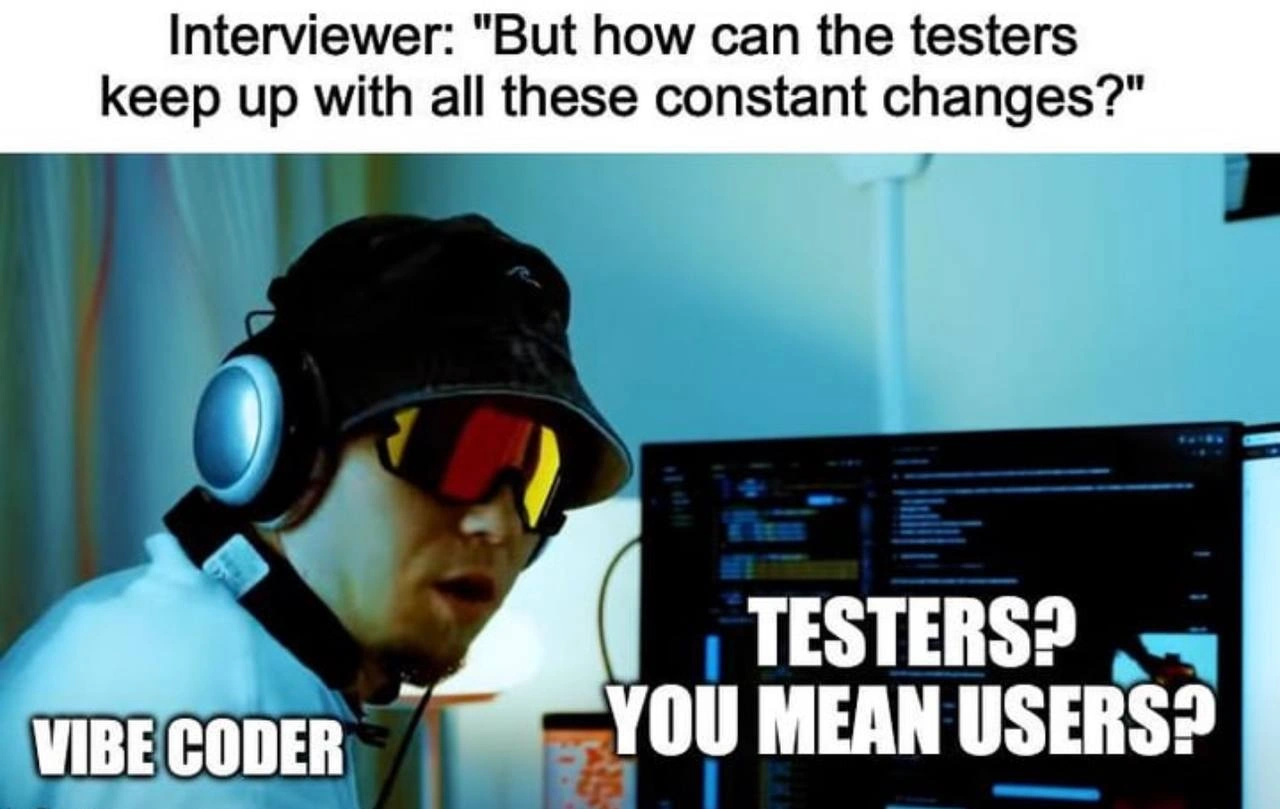
This meme’s text sets up an interview scenario: the interviewer asks, “How can the testers keep up with all these constant changes?” They’re concerned about how the team maintains quality when things are changing so quickly. The meme’s answer from the developer is, “Testers? You mean users?” This implies that the team doesn’t really have a separate group of testers checking each change. Instead, they push updates straight to the real users and figure that if there’s a bug, a user will eventually notice it and report it. In plainer terms, the first people to test the new changes are the customers themselves, not an internal QA team. So when he says “you mean users,” he’s basically calling the users the testers.
Why is that funny or surprising? Because it’s a pretty risky and unconventional way to do things. We have a joking phrase for it: “testing in production.” That means you’re trying out code on your actual users and seeing what breaks, rather than catching issues in a controlled setting first. The phrase “move fast and break things” (famous from Facebook) captures this idea of prioritizing speed over caution – you roll out changes quickly and deal with any broken stuff later. The image in the meme shows a relaxed-looking programmer with big headphones, captioned as "VIBE CODER," which suggests he’s just casually coding away in his zone. He doesn’t look worried at all. By saying “Testers? You mean users?” he’s portraying that laid-back attitude of a developer who ships updates rapidly and isn’t too concerned about formal testing. In a real job interview, admitting that you rely on users to find bugs would probably raise eyebrows, because it sounds like there’s no proper QA process. But among developers, this scenario is recognizable as a joke about the reality in some rush-rush projects: sometimes new software updates basically get tested by the users, whether we plan it that way or not.
Level 3: We'll Do It Live
This meme strikes a chord with any experienced developer who’s lived through rapid deployment culture. The interviewer’s question is perfectly reasonable: in a project with constant changes (think dozens of code pushes a day), how does the QA process keep up? The punchline: it doesn’t – at least not in the traditional sense. The developer in the image — rocking a bucket hat and headphones (the meme even labels him "VIBE CODER") — smirks out the answer: “Testers? You mean users?” In other words, they’ve dispensed with a formal testing phase; new code goes straight to production and real users discover the bugs. It’s the ultimate “move fast and break things” mentality, distilled into one savage interview answer.
Why is this funny (and a little painful)? Because it lampoons a real industry anti-pattern. In theory, Quality Assurance (QA) should catch issues before customers ever see the software. But in many fast-paced Agile or startup environments, there’s immense pressure to release features continuously. Traditional QA teams and processes can’t always keep up when you deploy ten times before lunch. So some teams end up effectively using the production environment as their QA sandbox. It’s akin to saying: “We don’t do dedicated QA testing; we crowdsource it to whoever hits the update first.” This scenario is basically testing in production in action: pushing code out and letting the real world shake out the bugs. Here, the users are effectively the testers.
For seasoned devs, this situation triggers war stories. Maybe you’ve merged a last-minute change at 5 PM on Friday (embracing the YOLO deploy lifestyle) and then spent your weekend fielding angry user reports because, surprise, no tester had time to catch that issue. Or perhaps you’ve been the on-call engineer awakened at 3 AM by an alarm — which essentially means a user encountered a crash in the new release and the system is screaming for help. It’s both hilarious and harrowing to recall these situations. In a way, the meme works as InterviewHumor because no sane candidate would bluntly admit “we have no real QA” in a serious interview — unless they know the interviewer also lives in that wild west of rapid releases. It’s a form of gallows humor among developers: we’re joking about the fact that sometimes our customers find our bugs before we do.
There’s also a nod to broader tech culture. Facebook, for instance, famously used the motto “move fast and break things.” That mindset trades off quality for speed, trusting that quick fixes are possible if something breaks. Plenty of us have worked at places where a new feature goes live to thousands of users the same day it was written, with minimal testing beyond “well, it works on my machine.” The meme’s developer character, looking smug and too cool for process, embodies that cavalier approach. When pressed about testers struggling to keep up, he basically shrugs and implies, “What testers? We just let the users tell us when something’s wrong.”
It’s funny but also a bit cringe-worthy because it’s a shared secret in the industry: under intense deadline pressure, teams sometimes cut corners on quality. Everyone in software has heard the tongue-in-cheek excuse, “It’s not a bug — it’s a feature,” when a user points out a flaw. (In other words, pretending a mistake was intentional until it can be fixed.) That’s exactly the vibe here. By the end of the meme, we’re left with a comical reminder of what happens when “release first, test later” becomes the norm. The Quality Assurance role essentially gets passed on to the end-users, which is both amusing and a cautionary reality of moving too fast in software development.
Level 4: Halting Problem of QA
In theoretical computer science, ensuring a program is completely bug-free is akin to solving an unsolvable puzzle. There’s even a famous concept, the Halting Problem, which implies you can’t have a general algorithm to perfectly predict any program’s behavior in all cases. Similarly, achieving absolute Quality Assurance for every possible user interaction in a complex system is practically impossible. We have formal methods (like mathematically proving code correctness through formal verification or model checking), but these are incredibly costly and only used where failure is not an option (think spacecraft software or pacemakers). In fact, computer science legend Edsger Dijkstra famously remarked:
“Program testing can be used to show the presence of bugs, but never to show their absence.” — Edsger W. Dijkstra
In other words, no matter how many tests you run, you can’t prove a non-trivial program has zero bugs. The number of potential input combinations and states in a modern application grows exponentially with each new feature or change — try testing every possible scenario in a web app and you’re facing a combinatorial explosion. For example, just 20 independent features toggling on/off yield $2^{20}$ (over a million) combinations; add different user data, timing variations, and environment configurations, and you see why exhaustive testing is a pipe dream.
Because complete pre-release testing is theoretically intractable, modern Agile and DevOps practices focus on risk management over perfection. This is where concepts like Continuous Deployment and observability come in. If you can’t test everything beforehand, you deploy rapidly in small increments and closely watch what happens. Advanced teams use techniques like canary releases (deploying new changes to a small subset of users as guinea pigs) and feature flags (turning features on/off dynamically) to limit the blast radius of bugs. They also invest heavily in detailed logging, metrics, and alerting — so when an issue slips into production, they catch it quickly. (To a grizzled engineer, “observability” is sometimes just a fancy word for “keeping an eye on production and hoping nothing catches fire.”) There’s even a notorious mantra: “testing in production.” It’s half tongue-in-cheek, half pragmatic strategy. Instead of a lengthy QA phase, teams treat the live environment as the final exam for their code. It’s a bit like running science experiments on your real users: carefully measure outcomes, and quickly roll back or fix forward if something goes wrong. While a theoretical purist might cringe at this approach, in practice it’s an adaptive response to the inherent complexity of software systems. The meme’s scenario is basically a darkly comic shortcut of all this: skip straight to letting actual users find what your pre-release process inevitably missed. In a grimly humorous way, it acknowledges that when change happens faster than testers (or test suites) can keep up, the end-users inadvertently become the last line of testing.
Description
A meme featuring text at the top and an image below. The top text, in a simple black font, reads: 'Interviewer: "But how can the testers keep up with all these constant changes?"'. The image below shows a person in a dark room, illuminated by a computer monitor. This person, labeled 'VIBE CODER', wears a bucket hat, large futuristic sunglasses, and headphones, looking intently at the screen. Overlaid text on the right side of the image provides the coder's response: 'TESTERS? YOU MEAN USERS?'. The meme satirizes a development culture that forgoes a formal quality assurance (QA) or testing phase, instead relying on end-users to discover bugs in the live production environment. This 'testing in production' approach is often associated with a 'move fast and break things' mentality, prioritizing development speed over stability, a mindset sometimes found in startups or projects where rapid iteration is valued above all else
Comments
16Comment deleted
We have a robust testing environment; we call it 'production'. Our users are the most dedicated QA team, and their bug reports are... passionately detailed
Our QA strategy? Ship behind a feature flag, let 1 % of users consume the new code, watch the error budget vaporize in Grafana, then flip it to 100 % and call it “tests passed in production.”
After 20 years in the industry, you realize the most honest architecture diagram is just a straight line from git push to production, with a tiny dotted box labeled 'hope' where QA used to be
Ah yes, the classic 'continuous delivery to production' strategy where your monitoring dashboard is actually user support tickets, and your test coverage is measured in angry tweets. When the interviewer asks about your CI/CD pipeline, they don't realize the 'CD' stands for 'Customers Debug' - because why maintain a QA environment when you have millions of unpaid beta testers with real data? It's not a bug, it's an unannounced A/B test with a 50% error rate
Testers? We shifted so far left it wrapped into prod - feature flags, canaries, and an error budget; marketing calls it “early access,” users call it Tuesday
The ultimate SRE optimization: offload QA to a distributed user cluster - infinite scale, zero headcount, and they fund your infra bills
Our QA plan is feature flags, 1% canaries, and a generous error budget - when it backfires, marketing rebrands it as “open beta” and calls it customer engagement
100 commits in 2 days Comment deleted
Me but fighting with CI Comment deleted
Vibe coders: testing? Don't you mean pushing to prod? Comment deleted
I've tried adding tests to some open source projects before only to be told "we don't need tests, if there was a bug our users would tell us" I immediately back off the project when that happens, and remove my local deployments. Comment deleted
Your pfps made me worried Comment deleted
Bro is morse code Comment deleted
Haha I have a bot that changes it to sleeping when I'm asleep, but it doesn't always clean up the old ones Edit: tidied up the duplicates now Comment deleted
Wait, is that real ?! He's now one of us?🤯🤯🤯 Comment deleted
Yall don’t even understand. We used to live edit PHP in prod. Testing? Who the fuck needs that? Comment deleted