From Spaghetti to Fettuccine: A Refactoring Story
Why is this Refactoring meme funny?
Level 1: Still Just Pasta
Imagine you have a really messy room – toys and clothes thrown everywhere, so tangled up you can’t even walk without stepping on something. This messy room is like “spaghetti code.” Now, you decide to clean it up. You spend all day organizing: you pick up that pile of toys and line them up, fold the clothes neatly, maybe put some things into new boxes. After all that work, you step back. Is the room clean? Well, it’s a bit better. You can see the floor in some spots now. But you still have all the same stuff in the room, just rearranged. It’s like you moved the clutter into different corners. It’s easier to find some things, sure, but the room still feels crowded and complicated. In the end, it’s still the same amount of mess, just in a new order.
That’s exactly what this meme is joking about, but with computer code. Turning “spaghetti” into “fettuccine” is like changing one messy thing into another shape of messy thing. Spaghetti and fettuccine are both noodles – just shaped differently. The skeleton lifting weights is like a tired programmer who worked really hard to tidy up a messy program. He “lifted” the code from one form to another. The funny (and a little sad) part is that even after all that effort, the code is still a big bowl of pasta. In simple terms: sometimes you try to fix something complicated, and after lots of work, it’s still complicated – just a different kind of complicated. But hey, at least we can laugh about it!
Level 2: Refactoring Reps
To break this down in simpler terms: the meme compares messy programming code to pasta, and shows a developer (the skeleton) working hard to improve it. In programming slang, “spaghetti code” means code that is one big jumble – like a bowl of tangled spaghetti noodles. It’s the kind of code where everything is intertwined in confusing ways, making it really hard to follow or change. Newer developers often encounter this in legacy code (old projects that have been worked on by many people over time). When you first open a legacy project and see functions calling other functions in a labyrinth with no clear structure, you’ve got spaghetti code on your plate. 🍝 Why “spaghetti”? Because the flow of execution twists and turns unpredictably, as if the program’s logic were a heap of noodles all mixed together. This is considered poor CodeQuality because such code is error-prone and hard to maintain. It’s also a classic code smell – a term for hints that something may be wrong with the code’s design. Spaghetti code is basically a big stinky garlic-and-tomato smell in the kitchen of your codebase.
Now, how do developers deal with spaghetti code? Through refactoring. Refactoring means cleaning up the code’s structure without changing what the code actually does for the user. Think of it like tidying your room: you’re organizing what’s inside without getting new stuff. The goal is to make the code more readable, easier to work on, and less likely to break in the future. When a project accrues a lot of messy code (often due to rushing features or not planning ahead), we say it has a lot of technical debt – like a debt you have to “pay off” by devoting time to cleanup and improvement later. Refactoring is one way to pay that debt: you go in and restructure the messy parts. Usually this involves steps like renaming confusing variables, splitting giant functions into smaller ones, removing duplicate code, and establishing clearer separations between different parts of the program. Each of these tasks is like doing a rep (repetition) in the gym – hence Refactoring Reps. You do many small clean-up actions repeatedly to strengthen the codebase. It’s not a one-time thing; just as you regularly exercise to stay fit, developers regularly refactor to keep the code healthy.
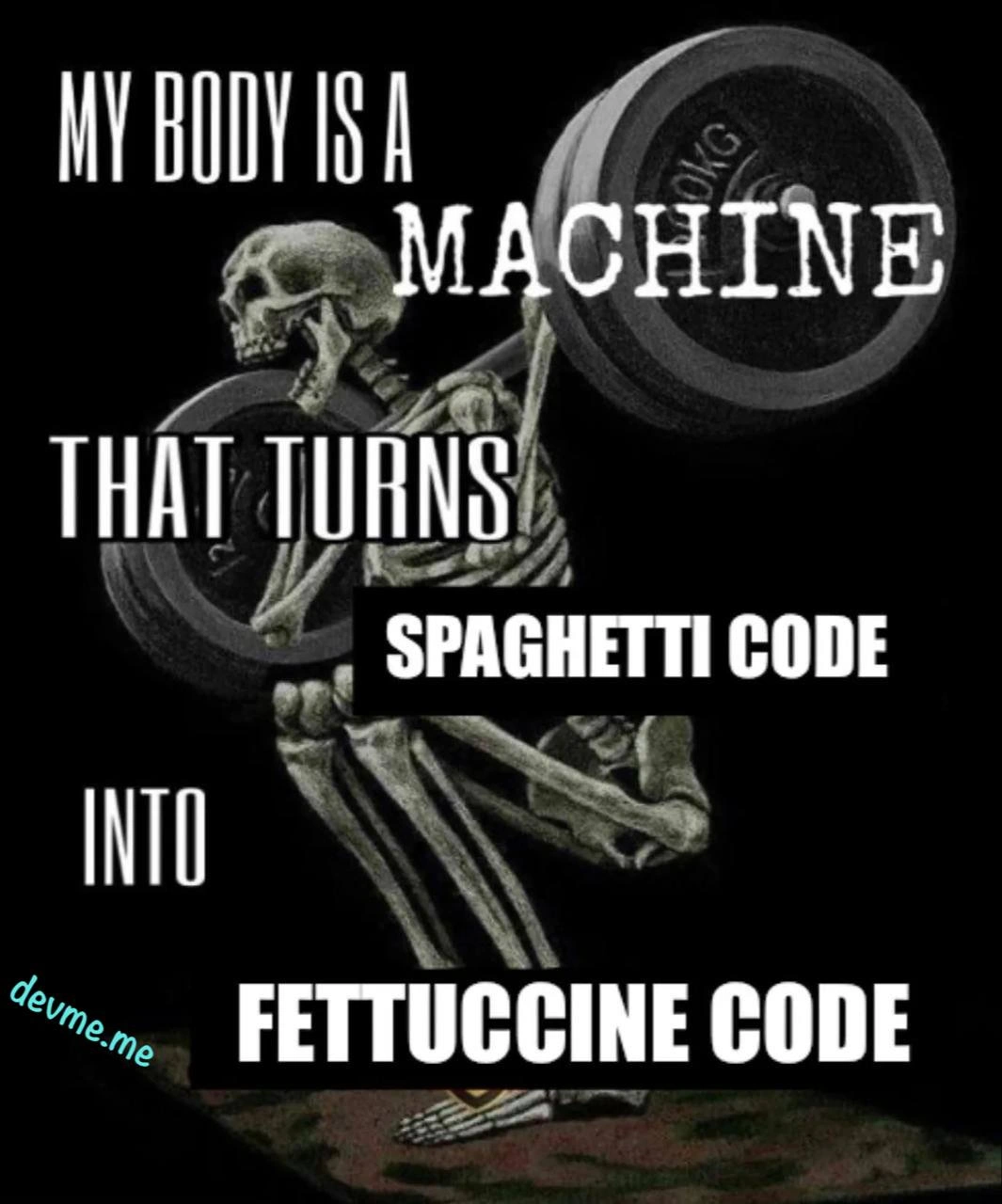
In the image, we see a skeleton doing a barbell squat. This represents a developer working hard (maybe past the point of exhaustion – hence looking like a skeleton!) to lift the quality of a codebase. The text emblazoned on the meme says:
“My body is a machine that turns spaghetti code into fettuccine code.”
This is the big joke. It’s structured like a boastful statement, as if the programmer is some kind of magical machine or unstoppable force. Normally, programmers joke “I turn coffee into code,” meaning they consume caffeine and produce software. Here, that format is parodied: instead of coffee into code, it’s spaghetti code into fettuccine code. We’re talking about code-to-code conversion – specifically, bad code into (supposedly) better code. “Fettuccine code” is not an official term you’ll find in textbooks; it’s a made-up phrase for the meme. Fettuccine is another type of pasta – flatter and wider than spaghetti. By saying spaghetti code is turned into fettuccine code, the meme suggests that after all the effort to refactor (to rewrite the ugly code), the result is still pasta. In other words, the code is still kinda messy or complex, just in a different format.
Let’s put it into context with a relatable scenario. Imagine you join a project as a junior dev and find a function that’s 1000 lines long doing everything from database calls to UI updates – classic spaghetti code. You and your team decide to refactor it. You break that monster function into ten smaller functions, group some of them into a new class, and maybe you eliminate some redundant logic. Now the code is organized into sections (perhaps each section corresponding to a step in the process). It’s like taking a big knot of spaghetti and laying it out into several parallel strands. This is an improvement! Each piece is easier to understand on its own. That’s your spaghetti-to-fettuccine conversion. But from a high level, someone new might look at the ten smaller functions and still feel it’s complex – now they have to jump between functions or files to follow the program logic. The overall complexity might be only slightly reduced. The key parts of the logic are all still there, just spread out (and hopefully named better). You did multiple refactoring reps, and you certainly made the code cleaner than before (whew!), but it’s not a completely different dish – it’s just better-presented pasta. The skeleton in the meme proudly (and sarcastically) proclaims this as if it’s a superpower: turning one kind of messy code into a slightly more refined messy code. And trust us, for a junior dev witnessing their first big refactoring, this is a kind of superpower to aspire to – just know that even heroes have limits.
Level 3: Still Noodling Around
For the battle-worn senior developer, this image hits like a protein shake laced with irony. We’ve got a skeleton doing a deep squat with big 20kg plates labeled (in spirit) as code. It screams “heavy legacy code lift”. The text declares: my body is a machine that turns spaghetti code into fettuccine code. This is a riff on a familiar programmer brag (“I turn coffee into code”) — but here it’s twisted into a cynical CodeQuality joke. The dev (depicted as a literal skeleton, likely dead inside from wrestling with horrific legacy systems) proudly claims to refactor nasty SpaghettiCode into something better… only to admit it’s basically still pasta. 😂
Why is that so relatable? Because anyone who’s slogged through a TechDebt swamp of legacy code knows that big refactoring efforts often feel like a gym session for your brain: painful, sweat-inducing, and only yielding incremental gains. The meme exposes a shared dark humor: you spend weeks untangling a convoluted 5,000-line GodFunction hoping to achieve pristine architecture, but in the end you’ve just shuffled the mess into classes and modules that mostly make sense — yet the system is still fragile and overly complex. You turned thick spaghetti strands into flatter fettuccine strips; maybe the code is a bit more linear or readable, but it’s still all carbs (still bloated with intricacy). As a cynical veteran might quip, “Nice, we traded one pasta code smell for another – Michelin star progress right there.”
The visual metaphor nails it: a skeleton weightlifter doing squats at the “dev gym” is essentially a developer undertaking a massive code cleanup. Refactoring is the process of reorganizing and improving internal code structure without changing what the code actually does. It’s heavy lifting work. Here the skeleton’s barbell could be seen as the codebase – one plate labeled SPAGHETTI CODE (the pre-refactor chaos) and the other FETTUCCINE CODE (the post-refactor result). The poor skeleton is straining under the weight of all that crappy code. In workout terms, he’s trying to PR his code quality squat. In dev terms, he’s trying to lift a legacy project’s maintainability from “utter disaster” to “just slightly less horrifying.” The joke is that despite this herculean effort, the outcome is only a marginal improvement. It’s fettuccine-level refactor: maybe the functions are a bit more modular (flat strips) compared to the tangled monolith, but it’s still the same overall volume of confusion — just re-packaged.
This hits on the reality that improving a gnarly system is often a slow evolution, not a miraculous transformation. The phrase “fettuccine code” isn’t standard jargon; it’s invented here for comic effect. In real dev-speak, we have terms like lasagna code (many-layered architecture) or ravioli code (lots of little self-contained objects that can still create a mess if not managed). By introducing fettuccine, the meme-maker is basically saying: “I did all this work, and okay, the code’s a little better structured – but let’s not kid ourselves, it’s still a pile of pasta.” The seasoned crowd chuckles (or maybe groans) because we’ve seen grand refactoring initiatives yield underwhelming results plenty of times. Maybe the code runs a bit faster or is somewhat easier to read, but it still has weird coupling, global state hiding under the bed, or logic that’s only marginally clearer. The RefactoringNeeded was dire, the team went to war with the codebase, and yet the end state still triggers facepalms in code review, just different-shaped ones.
In essence, Level 3 highlights the pasta_refactor_metaphor at the core of the humor. The meme is poking fun at our eternal struggle to improve messy systems. It’s developer humor born from experience: the triumphant feeling of finishing a refactor, immediately followed by the humbling realization that you’ve got more work to do. It’s a techie spin on “the more things change, the more they stay the same.” You’ve restructured the code — great — but under pressure or deadlines, it might still be one big tangle when viewed from afar. As the skeleton’s grin suggests, sometimes all you can do is laugh (or cry) at how RelatableHumor in coding is often a tad morbid. At least you got a good mental workout from lifting that codebase — and maybe next sprint you’ll be back in the dev gym, turning fettuccine into penne. 💀💪
Level 4: Conservation of Complexity
At the most theoretical level, this meme nods to a fundamental truth: you can restructure a chaotic system, but you can’t magically reduce its inherent complexity. In software engineering, there’s an almost law-of-physics vibe here – call it a conservation of complexity. The skeleton powerlifting code is a darkly comic metaphor for how refactoring works in practice. Sure, you can take tangled spaghetti code (unstructured, interwoven logic flows) and recompose it into a new shape. The famous structured programming theorem (Böhm-Jacopini, 1966) even guarantees any tangle of goto spaghetti can be rewritten with neat loops and conditionals. However, that theorem doesn’t promise the result will be simple – it might just be a different tangle in disguise (hello, fettuccine code). In other words, the total logical complexity – the number of decisions, interactions, and edge cases – remains constant or even increases as you refactor. You’ve essentially flattened round noodles into wide noodles, but you still have a plate full of carbs. 🍝
This relates to Fred Brooks’ classic warning of essential complexity: certain complexity in a system is inevitable, no matter how you slice (or flatten) it. We often talk about technical debt in these situations – the idea that quick-and-dirty coding decisions accumulate “interest” in the form of complexity that must be paid down later. The meme’s punchline is like an academic irony: you paid off some debt by refactoring, yet the debt re-emerges in a new form. It’s reminiscent of the Big Ball of Mud pattern (Foote & Yoder’s not-so-flattering name for a haphazardly structured software architecture) – even if you chip away at a mud ball, you might just end up with a flatter mud pancake. Any seasoned architect knows that achieving a clean design from a mess isn’t as easy as running a magical code transformer; it’s a grind that often obeys a “no free lunch” principle. You can move complexity around (split classes, add interfaces, reorder logic), but you can’t just delete it from the universe. The machine in the meme (our skeletal lifter) can only convert one form of complexity into another. In short, from a high-level standpoint, this meme wryly illustrates the Software Thermodynamics of refactoring: Complexity can neither be created nor destroyed, only changed in form.
Description
A black and white image of a skeleton weightlifter straining to lift a heavy barbell with large weights. Superimposed over the image in a bold, white, sans-serif font is the text: "MY BODY IS A MACHINE THAT TURNS SPAGHETTI CODE INTO FETTUCCINE CODE". A small, cyan watermark for "devme.me" is visible in the bottom left corner. The image evokes a sense of extreme effort for a specific transformation. This meme humorously critiques the process of code refactoring. "Spaghetti code" is a common pejorative for code that is unstructured and difficult to follow. "Fettuccine code," while not a standard term, cleverly implies that the refactoring effort only resulted in a superficially different but structurally similar outcome - like changing one type of pasta for another. The joke resonates with experienced developers who understand that true architectural improvement is complex, and many refactoring efforts only yield marginal gains, essentially reorganizing the mess rather than fixing the root problems
Comments
13Comment deleted
My last refactoring project turned spaghetti code into lasagna code. It had layers, but good luck changing anything at the bottom without the whole thing collapsing
Six months of “refactoring sprints” and the monolith isn’t spaghetti anymore - it’s fettuccine microservices: thinner strands, triple the sauce, same post-release indigestion
After 15 years of refactoring legacy systems, you realize the real transformation isn't spaghetti to clean code - it's spaghetti to artisanal hand-rolled fettuccine with the same architectural debt but now with better variable names and a false sense of accomplishment
The real tragedy isn't turning spaghetti code into fettuccine code - it's when you realize you've been refactoring the same legacy monolith for so long that you've essentially become a pasta factory with a CI/CD pipeline. At least fettuccine is wider, so technically you've increased the surface area for bugs to attach to. Ship it
Senior refactor: turning spaghetti into fettuccine - same complete graph of dependencies, thicker abstractions, now branded “enterprise-grade.”
Refactoring legacy: spaghetti in, fettuccine out - LOC doubles, merge conflicts halve, stakeholders none the wiser
We called it modernization: cyclomatic complexity unchanged, but now it’s al dente and behind a feature flag
As an Italian I agree Comment deleted
Tralalero tralala or bombardiro crocodilo Comment deleted
Tung tung tung tung sahur I would say Comment deleted
Do you call merge requests "risorgimento"? Comment deleted
Nah look at it logistically and boneka ambalabu has it Comment deleted
Fagottini developer Comment deleted