The Inevitable 'Test in Prod' Moment
Why is this Testing meme funny?
Level 1: Practice vs Performance
Imagine you have a big school play coming up. You’re supposed to practice on the rehearsal stage with nobody watching so you can fix mistakes. But instead, you go out and start trying new lines and moves during the actual live performance in front of everyone. Your friend nervously asks, “You didn’t skip the rehearsal and jump straight to the live show, did you?” You just grin, which basically means… yup, you did exactly that. Now everyone in the audience might see if you mess up.
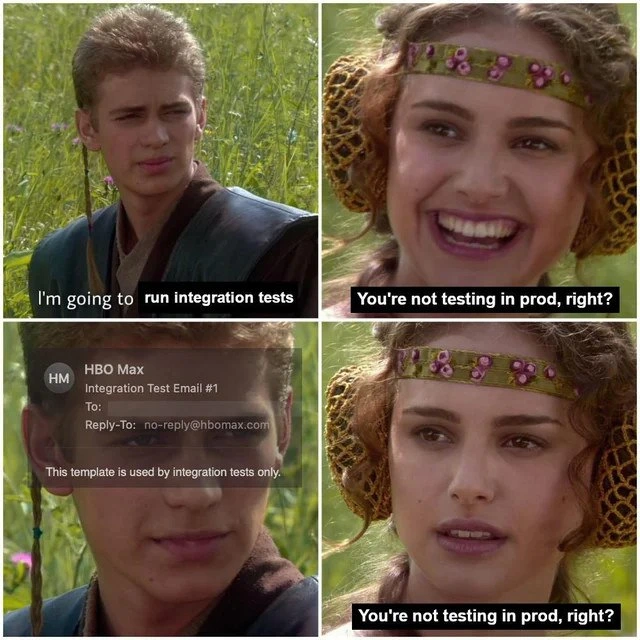
This meme is funny for the same reason: the developer is supposed to test his code in a safe place (like practicing backstage), but he’s actually testing it in front of the whole world on the real app (like performing live with no practice). The girl asking “You’re not testing in prod, right?” is like a friend saying “You’re not doing the risky thing for real… right??”. The boy’s cheeky smile tells us he is doing that risky thing. It’s the mix of fear and hilarity – we’re worried for what might go wrong, but we also laugh because we can see the mistake happening. It’s like watching someone try a new skateboard trick for the first time during the big competition; you can’t help but cringe and chuckle at the boldness. In simple terms, the meme jokes about being careless and doing something in the worst possible place, and that’s why it’s both scary and amusing, even if you’re not a developer.
Level 2: Prod vs Test 101
Let’s break down the joke for those newer to the field. The meme uses Anakin and Padme from Star Wars to act out a common developer situation. Integration tests are a type of software test where you check if different parts of your application work together correctly. For example, you might test that your web app can actually talk to the real database and handle real data, not just fake data. These are more comprehensive than unit tests (which test tiny pieces of code in isolation). Running integration tests usually requires a special environment that’s set up like the real thing but isn’t actually the real thing. Common environments include development (dev), QA/testing, or staging. A QA_environment or staging is basically a dress rehearsal stage for your software – it looks and acts like the real production system but no actual customers use it, so it’s safe if something goes wrong.
Now, production (often just called “prod”) is the live environment used by real users. It’s like the official game or live concert where everything should be polished. Testing in production means you are running experiments or unverified code on the live site/app that people are currently using. This is generally a big no-no because any mistakes will directly affect real users (think of users receiving weird emails or the website crashing). In the meme, Anakin says he will run integration tests. Padme immediately gets suspicious and asks, “You’re not testing in prod, right?” – she’s basically saying, “You are going to run those tests on the staging server or somewhere safe, NOT on the actual live app... right?”
The humor is that Anakin doesn’t answer – he just smiles. In the Star Wars meme format, that silent smile is a guilty admission. The next image even shows an email notification: “HBO Max – Integration Test Email #1... This template is used by integration tests only.” This was a real example of testing_in_production gone wrong: an internal test email that should have stayed in a test environment accidentally went out to millions of real HBO Max customers! So in context, Anakin did run tests in prod, and Padme (and the audience) realize it with dread. She asks again, more urgently, “You’re not testing in prod, right?” hoping for a different answer, but it’s too late.
For a junior developer or someone new to all this: the meme is poking fun at the temptation (or sometimes the pressure) to skip proper procedures. Maybe a developer doesn’t have access to a good test environment or they’re in a rush, so they run their code on prod “just this once.” It’s like skipping all the safety checks. Env_misuse here means using the wrong environment for the task – production instead of test. This is funny to developers because it’s a very recognized mistake. It’s both scary and comical: scary because doing this can cause real outages or send embarrassing emails (as seen here), comical because it usually happens when someone is overconfident or corner-cutting.
Key terms to know:
- Integration Test: A test to see if multiple parts of the application work together (for example, your code saving a record in a real database and then retrieving it).
- Production (Prod): The real, live environment/server that customers use. If something breaks here, actual users are impacted.
- Staging/Test Environment: A copy of production used for testing changes safely. Breaking things here doesn’t hurt real users.
- Testing in Prod: Running tests or experiments directly on the production environment. Sometimes jokingly referred to in developer humor because it’s risky.
- Best Practices: These are guidelines that professionals agree on. Best practices in testing say you should use a staging or test environment, not prod, for integration tests. When someone ignores that, others rib them for it – that’s what Padme is doing.
So, the meme is essentially one developer (Anakin) caught red-handed doing something every mentor warns against. Padme’s worried face = every experienced teammate or manager who has to double-check, “You’re NOT about to do this on the live site... right?” The reason it’s relatable developer humor is because many of us have experienced a situation where either we or someone on our team accidentally did something in prod that was meant for testing. The consequences range from minor funny blips (like a silly test email to customers) to serious ProductionIssues like downtime. This meme captures that situation in a simple, cheeky way.
Level 3: The Dark Side of QA
At first glance, this Star Wars Anakin–Padme meme sets up a classic scenario: a developer cheerfully announces “I'm going to run integration tests” and a wary colleague asks “You're not testing in prod, right?” The punchline is Anakin's guilty smile and silence, implying he is running tests against the production environment. This triggers a mix of laughter and PTSD for experienced devs. Why? Because it satirizes that worst practice we all fear: testing in production. In the software world, integration_tests are supposed to run in a safe sandbox or QA environment, never directly on the live system with real users. Yet here we are – Anakin has embraced the dark path of deploying unproven code on prod, and Padme (like any good QA engineer or sensible team lead) is horrified.
This meme wouldn’t hit so hard if it weren’t so relatable. Production is the live system where real customers interact with your software, and it's sacred ground – a place for stable, vetted code. Conducting tests there is a best_practices_violation akin to playing with live explosives. The humor lies in that shared industry experience: we all have a story (or know someone’s story) of a so-called integration test accidentally running on prod. In fact, the meme even nods to a real event – the text “HBO Max Integration Test Email #1” in panel 3 references an infamous incident around June 2021 where a streaming service accidentally sent out a blank test email to millions of subscribers. That was essentially an internal test script firing off in production – oops! The entire dev community cringed in unison, not at the intern who triggered it (we’ve been there), but at how easily env_misuse can happen even at big companies.
From a senior developer perspective, the panels encapsulate a Prod vs Test showdown: Anakin’s naive confidence versus Padme’s dawning realization. This is comedic gold for those of us who have managed ProductionIssues at 3 AM due to someone running what they thought was a harmless script. It highlights the gap between what we say (“of course we have a testing environment, we’d never touch prod!”) and what sometimes actually happens under pressure. The silent smirk from Anakin is chillingly accurate – it’s the face of a dev who knows they cut a corner. Maybe deadlines were tight, maybe the test environment wasn’t an exact mirror of prod so they “just quickly ran it on prod to be sure.” The meme nails that unspoken truth: sometimes RelatableDeveloperExperience means admitting that the only environment that truly behaves like prod... is prod itself. And while everyone says “we don’t test in production,” the uncomfortable laughter comes from knowing that, intentionally or not, it does happen.
Technically speaking, integration tests are meant to verify that different modules or services work together correctly – for example, your code can actually talk to the real database, API, or microservice, not just dummy stubs. These tests often need a system that’s configured like production (same database schemas, similar data, real service calls). Seasoned developers ensure this happens in a staging or QA_environment – a nearly prod-like setup that’s isolated from real users. But maintaining a perfect clone of production is hard and costly, so many teams cut corners. The dark humor here is that Anakin might not even have a staging setup; perhaps management said “just test it in prod, what’s the worst that could happen?” (Answer: everything).
The meme also hints at the cognitive dissonance in developer culture: we champion UnitTesting and automated CI/CD pipelines to catch bugs early, yet in reality, things slip through, and someone ends up doing a “quick test” on live servers. A grizzled veteran dev will chuckle (or groan) at Padme’s repeated question “You're not testing in prod, right?” because it echoes countless code reviews and deployment meetings. We’ve all eyed a colleague and essentially asked, “Promise me you’re not about to do something foolish in prod.” And when that colleague just gives a cheeky grin, your heart skips a beat.
In summary, this meme resonates on multiple levels: it’s a funny TechHumor take on the rebellious act of using prod as your personal playground, it references a real-life oopsie that many companies have experienced, and it underscores the unwritten horror movie rule of DevOps: if you’re going to test in prod, at least don’t brag about it … and may the Force be with you, because you’ll need it.
Description
A four-panel meme using the 'Anakin and Padmé' format from the Star Wars prequel movies to illustrate a common software development failure. In the first panel, Anakin Skywalker confidently states, 'I'm going to run integration tests'. In the second panel, a smiling Padmé Amidala asks hopefully, 'You're not testing in prod, right?'. The third panel pivots to a real-world screenshot of an email with the subject 'Integration Test Email #1' from HBO Max, which includes the text 'This template is used by integration tests only.' This reveals that a test was indeed run in the production environment and sent to actual users. The final panel shows Padmé's face again, now with a look of deadpan horror and disappointment, as she repeats, 'You're not testing in prod, right?'. The meme hilariously captures the gap between development best practices and the messy reality of production environments. It highlights a notorious incident where a major tech company made a public mistake, a scenario that is both a nightmare and a source of dark humor for experienced engineers who understand the fragility of environment separation and the potential for configuration errors
Comments
9Comment deleted
Staging is just a suggestion, but production is where you get real-time, unfiltered user feedback on your test emails
If your “integration” namespace shares the same RDS cluster and IAM roles as prod, congrats - you’ve implemented Schrödinger’s environment: simultaneously safe and on fire until the pager collapses the waveform at 3 a.m
The best part about the HBO Max incident wasn't the test email going to millions - it was watching senior engineers collectively realize their 'it can't happen here' confidence was just untested hubris waiting for its own integration test email #2
The classic 'feature flag is just a boolean' moment - when your integration tests confidently assert against prod because someone set `ENVIRONMENT=production` in the .env.test file. Nothing says 'we have a mature CI/CD pipeline' quite like HBO Max subscribers receiving 'Integration Test Email #1' at 3 AM. At least they used a proper no-reply address - that's what we call 'defense in depth' in the post-incident review
At our scale, 'integration test' translates to a 1% canary behind three feature flags because staging is a cosplay of prod; the pager is the assertion
Prod integration tests: because nothing mocks an email pipeline like a million real subscribers' inboxes
Staging is just prod with a different CNAME and weaker SLOs - “integration tests” are the five minutes before PagerDuty decides they were really load tests
Yeah, fuck bugs Comment deleted
It takes a lot of time to fix them Comment deleted