Git Explained with Simple Abstract Mathematics
Why is this VersionControl meme funny?
Level 1: Basically Rocket Science
Imagine you’re trying to do something that should be simple, like tying your shoes, and you’re really struggling with it. You say, “Ugh, I just can’t get this!” Now picture a friend patting you on the back and saying with a smile, “Oh, tying your shoes is easy — once you understand advanced knot theory and the multidimensional geometry of shoelace fibers.” 😜 That’s a pretty goofy thing to say, right? Instead of helping, they used a bunch of big, fancy words that make the task sound even harder — like you’d need to be a scientist to do this everyday thing. You’d probably burst out laughing because it’s such an over-the-top, ridiculous piece of “advice.”
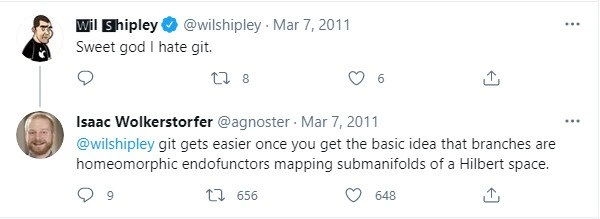
That’s exactly what’s happening in this meme. A person complains “I hate Git” (Git is a tool that helps people keep track of changes in code, but don’t worry about the details). It’s something that can be confusing, just like tying shoes can be for a little kid. In response, another person jokes, “Git gets easier once you realize it’s basically like super fancy math and space stuff.” In other words, “Sure, it’s easy — you just need to understand something as hard as rocket science!” It’s a playful, sarcastic joke.
The reason this is funny is because the “helpful advice” is purposely not helpful at all. It uses big words from advanced math (the kind you’d maybe learn in a PhD program) to describe a tool people use every day. That’s like using rocket science to explain why your video game isn’t working. It’s silly and exaggerated. Even if you don’t know what those big words mean, you can tell they sound ridiculously complicated.
So the emotional core of the joke is this: frustration turned into humor. The first person is frustrated (“Sweet god I hate git”), and the second person responds with an absurd statement that basically says, “Yup, it’s that complicated.” They’re both kind of agreeing, in a funny way, that the thing is hard to understand. If you’ve ever felt frustrated learning something and a friend made a joke to cheer you up, you know that feeling. It’s comforting and funny because it exaggerates the problem to the point of absurdity.
In simple terms, this meme is like someone saying, “This thing is so confusing, it’s like you’d have to be a genius to get it,” and everyone who has struggled with that thing before just laughs and nods. You don’t really need to be a genius, of course — the joke is in the exaggeration. It makes us smile because we’ve all been there, scratching our heads, feeling like a task is way harder than it should be. And sometimes the best way to deal with that feeling is to laugh at it, with a totally over-the-top comparison. After all, if we can joke that using Git is “practically rocket science,” then maybe it makes our real-life confusion a little easier to handle. It’s a funny reminder that if something feels hard, you’re not alone — and it’s okay to chuckle at how insanely hard it feels in the moment.
Level 2: No Math Required
Let’s step back and explain the joke in plain tech terms. Git is a popular version control system that developers use to track changes in code. It lets multiple people work on a codebase at the same time and keeps a history of every change. One of Git’s core concepts is the branch. A branch is like an independent line of development — you can think of it as a timeline of commits (snapshots of the project) that starts from an earlier point. For example, you might have a main branch where your stable code lives, and create a feature branch to try out a new idea. The feature branch starts as a copy of main (at some commit) and then you can add commits to it without affecting the main branch. Later, you can merge the branch back into main, incorporating those new changes.
Behind the scenes, Git doesn’t treat branches as separate copies of your files, but rather as pointers within a graph of commits. Every commit knows its parent commit (except the first commit in a repo). If we draw this out, it’s a little like a family tree of code versions (except each commit can have multiple children when branches split, and multiple parents when branches merge). This structure is called a directed acyclic graph (DAG) – “directed” because each commit points to its parent, and “acyclic” because if you follow the parent pointers you can’t loop back to a commit again (no cycles). It’s a one-way street going back in time. Here’s a tiny example of a commit graph with a branch:
o--o--o (main branch)
\
o--o (feature branch)
In this diagram, each o is a commit. The main branch has a sequence of three commits. At some point, a feature branch was created, which diverged with its own commits. The lines show how commits connect (parent -> child). A branch name like “feature” or “main” in Git simply points to the latest commit on that line of development. When you make a new commit on a branch, the branch pointer moves to that new commit.
Now, why is the meme funny? The first tweet “Sweet god I hate git.” expresses frustration that many beginners (and even seasoned devs) have felt when dealing with Git, especially with branching and merging. Git’s commands and behavior can be confusing until you internalize how the commit graph works. Common newbie woes include being unsure what “HEAD” means, accidentally committing to the wrong branch, or feeling lost in the history. So it’s not unusual to feel like “I hate this tool, it’s so confusing!”
The reply, however, is total comedic overkill. It says Git gets easier once you understand something about “homeomorphic endofunctors mapping submanifolds of a Hilbert space.” These are massive, scholarly words from higher mathematics and they sound wildly out of place in a conversation about coding. Let’s decode those terms in simpler language:
- Algebraic topology & homeomorphic: Algebraic topology is a branch of math that uses algebra to study shapes and spaces. Homeomorphic basically means “equivalent in shape” — you can stretch or bend one object into the other. It’s like saying two puzzles are the same if you can reshape one without breaking it. Totally overkill for explaining Git branches!
- Category theory & endofunctor: Category theory is a super abstract math field that deals with objects and arrows (relationships between objects). A functor is like a function that maps objects and relationships from one category to another. An endofunctor specifically maps a category to itself, sort of like taking a structure and transforming it internally. In normal programming, the only time you hear about functors is maybe in advanced contexts like Haskell or C++ templates – definitely not in everyday Git usage.
- Hilbert space & submanifold: A Hilbert space is like an infinite-dimensional space used in advanced math and physics (quantum mechanics lives here!). A submanifold is just a fancy term for a subset of a space that is nicely enclosed (imagine a surface on a doughnut shape – that surface is a submanifold of the doughnut object). These concepts are way beyond the scope of version control. They’re mentioned purely to be absurd.
So the reply tweet is effectively a satire: it pretends to give helpful advice, but the “advice” is ridiculously complicated. It’s as if someone asked, “How do I learn to ride a bike?” and got the answer, “Oh, it’s easy once you grasp the Lagrangian mechanics of a rotating rigid body in a non-inertial reference frame.” Technically sounding, but utterly unhelpful!
The humor works on a couple of levels. First, it acknowledges the steep learning curve of Git. When you’re new, terms like checkout, rebase, HEAD, origin/master can already feel like a foreign language. The tweet jokingly implies you might need advanced math just to cope, which is a playful exaggeration. Second, it pokes fun at how experts sometimes explain things. We’ve all met that senior engineer or read that blog that offers an “explanation” which only makes you more confused. By using buzzwords from mathematics, the replier (@agnoster) mimics an overly academic expert, to the point of absurdity. And for those in on the joke (people who know those math terms), it’s doubly funny because it’s such a gross exaggeration. It’s like using a nuclear bomb to crack a peanut — total overkill for a simple task.
In reality, you absolutely do not need to know about topology or Hilbert spaces to use Git. (Phew! 😅) The vast majority of developers manage branches just fine with a basic mental model: branches are like parallel universes of your code that can later merge into one. The tweet’s dense wording is deliberately nonsensical in context — it’s humor by contrast. Git’s complexity is real, but it’s still grounded in practical computer science (graphs and hashes), not crazy infinite-dimensional math. By referencing “minor in algebraic topology” (as the meme title jokes), we’re laughing at the feeling that a simple tool sometimes seems to demand impossible expertise. It’s a shared joke: “Yeah, Git was so hard to learn, I felt like I needed an advanced math minor!”
To a junior developer or someone outside the field, reading that tweet might be bewildering — which is exactly the point! It puts you in the shoes of a newcomer all over again. But the key is: everyone finds Git confusing at first, you’re not alone, and that tweet is a playful nod to that fact. The categories and tags for this meme (like VersionControlHumor and git_learning_curve) all revolve around this intersection of tech and comedy: using big academic concepts to underscore how a tool can make us feel lost. It’s a reminder that it’s okay to laugh at the tough parts of learning. In summary, Git’s branching isn’t magic — it’s simpler than the joke explanation — but it sure can feel magical (or tragic) when you’re figuring it out. And that’s why this meme brings out knowing chuckles from developers.
Level 3: The DAG Dilemma
For experienced developers, this meme hits home because it humorously exaggerates a real sentiment: Git can be conceptually hard to grok at first. The original tweet, “Sweet god I hate git,” is a cry many of us have made after wrestling with a messed-up merge or a head-scratching rebase. Git’s power comes from its flexibility, but that flexibility is built on a complex directed acyclic graph (DAG) of commits. In a Git repository, each commit points to one or more parent commits, forming a network of changes. A branch in Git is essentially just a movable pointer to one of these commits, often the tip of a series of changes. Simple in theory, but in practice, visualizing and manipulating this graph (with commands like git merge, git rebase, etc.) can feel daunting.
Seasoned devs know that the trick to mastering Git is to understand its mental model: commits are nodes in a graph, and branches/tags are just labels pointing to those nodes. However, reaching that “Aha!” moment can be a struggle. In fact, a common piece of actual Git advice is, “Once you get the basic idea that a branch is just a pointer to a commit, Git gets easier.” Notice how the reply tweet mimics that reassuring tone — “git gets easier once you get the basic idea…” — only to swerve into absurdity with “branches are homeomorphic endofunctors…”. This subverts the typical senior-to-junior guidance by pretending the “basic idea” is something mind-bendingly abstract. It’s senior-level humor: we’re laughing because we remember being juniors utterly baffled by branches, and the last thing we needed was an explanation that made us feel even dumber!
The specific combination of terms in the reply is a nod to common pain points and insider humor in programming culture. The reference to functors hints at functional programming (where concepts from category theory like functors and monads famously bewilder learners). By dropping that term in a Git context, the meme merges two notoriously challenging areas of tech learning into one glorious Frankenstein of confusion. It’s like saying, “Oh, you find Git confusing? Try throwing some category theory on top — that’ll help!” Cue the collective groan and laughter from the audience of battle-hardened coders.
This tweet actually went viral in developer circles (evidenced by those 656 retweets and 648 likes in the screenshot) because it resonated with so many. It’s a shared cathartic laugh: we’ve all seen overly complex explanations and wished for simpler ones. Many of us picked up Git in the early 2010s (around the tweet’s date, 2011, when Git was rapidly supplanting older version control systems like SVN). Back then, it often felt like every expert who tried to help would either hand-wave “just a DAG, easy!” or inadvertently flex their Computer Science vocabulary. This reply by @agnoster parodies that by cramming as many big math words as possible into one sentence. It’s simultaneously poking fun at Git’s learning curve and at the tendency of some tech folks to over-complicate explanations.
From a senior dev perspective, the genius of the humor is that Git, in reality, does NOT require learning abstract algebra. In fact, Git’s design is quite elegant once you grok it: you can explain it with simple concepts like linked lists of snapshots and pointer references. So describing branches as if they live in some high-dimensional vector space is hilariously off-base. The laughter comes from the juxtaposition of trivial advice format with nonsensical high-level content. It’s the classic nerd humor of taking something simple and “clarifying” it with an analogy that’s exponentially more confusing.
Also, on a meta level, this joke reflects how developers sometimes cope with frustration: with satire and hyperbole. When you’ve been on call at 3 AM struggling with a broken CI/CD pipeline, or untangling a Git history that a teammate mangled, you earn the right to laugh at absurd comparisons. Git’s not actually magic — no Hilbert space or endofunctor lurks in its C code — but when you’re in the weeds, it feels about that inscrutable. This meme bonds the community through the shared relief: “Phew, it’s not just me; Git felt like rocket science to them too!”
And just to be clear (in case any new dev reading is panicking): you do NOT need a math degree to use Git. 😉 Seasoned engineers chuckle because we remember being baffled, and it’s funny to exaggerate that bafflement to academic proportions. After all, humor is a great stress relief. Next time git inexplicably tells you “fatal: detached HEAD” and you’re tearing your hair out, remember this meme and have a little laugh — at least you’re not actually solving homeomorphic endofunctors in Hilbert space, right?
Level 4: Hilbert Space Odyssey
At the deepest theoretical level, this joke plunges headlong into abstract mathematics to lampoon Git. The reply tweet is deliberately packed with high-level math jargon — specifically algebraic topology and category theory terms — to exaggerate Git’s complexity. Let’s unpack a bit of that academic word salad:
- Homeomorphic: In topology, two shapes are homeomorphic if one can be continuously deformed into the other without cutting or gluing. Think of a coffee mug and a donut; topologists joke they're the same because you can mathematically morph one into the other. By dropping "homeomorphic" into the Git conversation, the tweet evokes the idea of preserving shape or structure when mapping one thing to another.
- Endofunctor: In category theory, a functor is like a translator between two categories (abstract collections of objects and relationships). An endofunctor is a special case: it maps a category to itself. This is already esoteric stuff — the kind of mathematics that rarely leaves graduate textbooks or theoretical computer science discussions. Here it’s used tongue-in-cheek as if a Git branch were a complex self-referencing transformation.
- Submanifolds of a Hilbert space: A Hilbert space is a complete, infinite-dimensional space often used in advanced mathematics and quantum physics. A submanifold is essentially a subset that is a nicely behaved space of its own (like a surface on a shape). So this phrase conjures an image of tiny infinite-dimensional worlds embedded in even bigger ones. It’s hilariously over-the-top: Hilbert spaces belong to quantum mechanics and functional analysis, not everyday version control!
By mixing these terms, the tweet creates a pseudo-scientific “explanation”: “branches are homeomorphic endofunctors mapping submanifolds of a Hilbert space.” This is tongue-in-cheek mathematical hyperbole. It reads like something out of a dense research paper, certainly nothing you’d find in the Git handbook. The humor lies in using arcane theory to describe a developer tool, pushing the analogy to absurdity.
Ironically, there’s a grain of truth hiding in this nonsense. Git’s model can be described with math — usually graph theory (commits and branches form a directed acyclic graph). But nobody in their right mind models Git operations with Hilbert spaces and functors; that’s the point of the joke. It’s riffing on the fact that sometimes programming discussions (especially in functional programming or advanced CS) get needlessly academic. Seasoned engineers might recall talks where simple concepts are framed with intimidating math terminology (e.g., explaining a List in terms of monoids and endofunctors). Here the tweeter cranked that habit to 11 for comedic effect.
This mashup of category theory and version control is a wink to the well-educated nerd: if you actually recognize words like “functor” or “Hilbert space,” you immediately realize how ridiculously grandiose this “explanation” is. And if you don’t recognize them, well, that’s exactly how confusing Git can feel to a newcomer — as if you do need a PhD in math to understand it. The meme exquisitely parodies the steep Git learning curve by framing it in the most convoluted academic terms imaginable.
Description
A screenshot of a now-famous Twitter exchange from March 7, 2011, that has become a classic developer meme. The first tweet is from Wil Shipley (@wilshipley), who bluntly states, 'Sweet god I hate git.' In reply, Isaac Wolkerstorfer (@agnoster) offers a sarcastically unhelpful piece of advice: 'git gets easier once you get the basic idea that branches are homeomorphic endofunctors mapping submanifolds of a Hilbert space.' The humor stems from the extreme absurdity of 'simplifying' a notoriously complex tool like Git by using esoteric, high-level jargon from abstract mathematics, specifically category theory and topology. For experienced engineers, this joke is a perfect encapsulation of gatekeeping, the steep learning curve of certain technologies, and the kind of overly academic 'explanations' that are more about intellectual flexing than actually helping

Comments
17Comment deleted
Some people explain Git with graphs and pointers. Others, with homeomorphic endofunctors. The rest of us just copy-paste from Stack Overflow and pray
If your mental model of Git involves homeomorphic endofunctors, congratulations - you’ve finally unified algebraic topology and ‘git rebase --onto’ into one terrifying graduate seminar
The beauty of this tweet is that it perfectly captures how Git documentation feels - like someone explaining version control using category theory when all you wanted was to undo your last commit. After 15 years in the industry, I've realized the real homeomorphism is between 'git reflog' and job security
Ah yes, Git becomes trivial once you realize that a merge conflict is just a non-commutative diagram in the category of directed acyclic graphs, where the pushout doesn't exist because your coworker force-pushed to main. Simple topology, really - though explaining this to your PM might require mapping their understanding through a few more homeomorphisms first
Git branches as homeomorphic endofunctions? Explains why rebase feels like enforcing diffeomorphism on a knotted manifold
Git is easy: it’s just a distributed, append-only DAG where rebase is a noncommutative monoidal functor and force-push is chaos engineering for your history
Git is just a DAG with movable refs; if someone explains branches via homeomorphic endofunctors on Hilbert submanifolds, audit their force‑push permissions immediately
i do not understand - homeomorphic - endofunctors - submanifolds - Hilbert space Comment deleted
me too Comment deleted
i do not understand - git Comment deleted
git gud scrub Comment deleted
what is this guy talking about Comment deleted
I bet He has no idea too. Comment deleted
no idea too *either. I’d bet on that too Comment deleted
That's how scientific articles in Wikipedia are usually written: "Number 8 is simply an infinity symbol with rotation transformation by Pi/2 applied to it" - thanks, Cap, now it"s much easier to understand! Comment deleted
replace "infinity symbol" with "lemniscate", and you're correct Comment deleted
more specifically: The number 8 (eight) is commonly being denoted as a vertically oriented lemniscate. It is not to be confused with the symbol for infinity, which is usually, but not always, depicted with a horizontally oriented lemniscate.[citation needed] Comment deleted