Skip to content
DevMeme
2971 of 7435
The Most Interesting Production Test in the World
Testing Post #3281, on Jun 18, 2021 in TG

The Most Interesting Production Test in the World

Why is this Testing meme funny?

Level 1: When Practice Goes Live

Imagine you're learning how to send a group text. You type out a silly message that says, "This is just a test, please ignore," just to see how it looks. You only mean to save it or send it to yourself for practice. But oops – you accidentally sent it to all your friends and family! Everyone’s phone buzzes, and now they're reading your goofy test text and feeling confused.

This meme is joking about that kind of accident. A company meant to do a quiet test, but instead they sent out a real email to all their customers by mistake. It’s like someone rehearsing on stage and accidentally leaving the microphone on – everyone heard the practice when they weren’t supposed to. It’s funny because it was harmless, but also a bit embarrassing. The company basically had to say, “Oops, that was just a test message!” to everyone. We laugh because we all know that uh-oh feeling when something meant to be private suddenly goes public. It's a big goof, but one we can all understand.

Level 2: Who Needs Staging?

Let’s break down what’s happening here for those newer to the game. In software development, we use different environments to keep things separate:

  • Development (dev): where programmers write code and run it on their own machines.
  • Staging (test/QA): a safe copy of the production setup used for final testing. Think of it as a dress rehearsal stage.
  • Production (prod): the real deal – the live app or service that actual customers use.

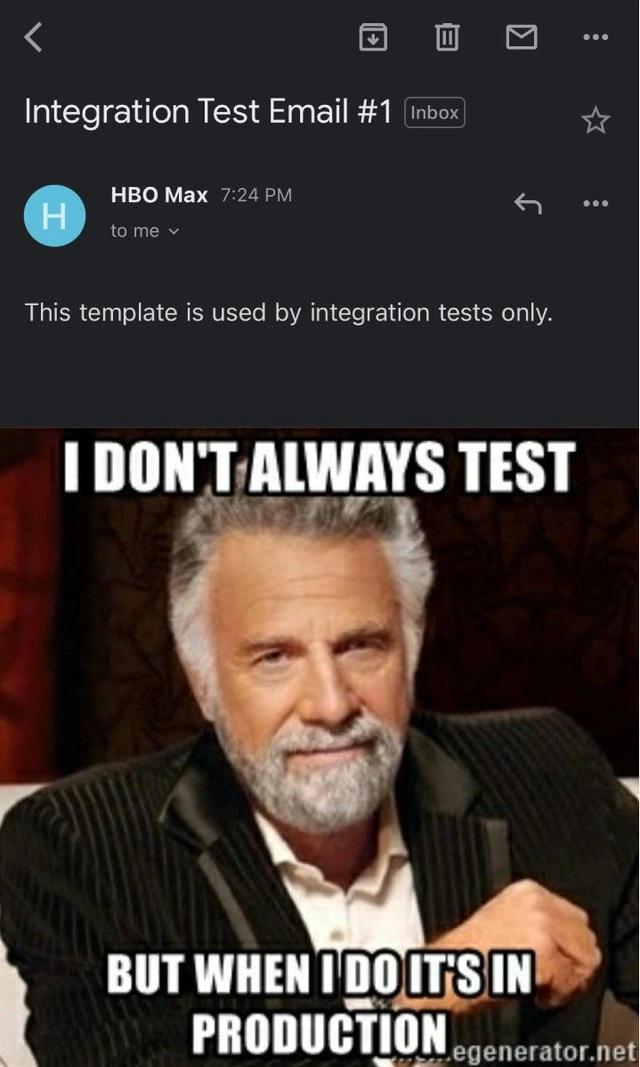
An integration test is a test where multiple parts of an application work together exactly as they would in real life. These tests often involve realistic actions – like sending an email – but they’re supposed to run in a controlled setting (on staging or with fake data). The email in the meme has the subject line “Integration Test Email #1” and body text “This template is used by integration tests only.” Clearly, that message was never intended for real users. It's basically labeled, "For testing only. If you see this in production, something’s wrong!" Such emails might be used internally to verify that an email feature works or that templates look correct, without confusing customers.

The big oops is that this email escaped the test confines and landed in a real user’s Inbox. When we say it "leaked", we mean it was sent outside the intended environment. This typically happens because of a configuration mistake or oversight:

  • Perhaps the staging environment was accidentally wired to the real email server.
  • Or the code didn’t check which environment it was in before sending, so it went by default to actual customers.
  • It could even be that someone ran the integration tests against the production database or settings by accident (using production credentials when they shouldn’t have).

Software teams normally put email guards in place for tests – simple switches or settings that say, “if we’re not in production, don’t actually send emails to real people.” Many frameworks and services allow a "test mode" where emails are captured to a log or sent to a dummy mailbox instead of to real users. Another common practice is to use fake addresses (like [email protected] or [email protected]) for any test data. In this case, the lack of proper guards meant the test used the HBO Max production mailing list (i.e. real subscriber email addresses!). So actual HBO Max users saw a weird test message from the company and likely went, “Huh? That’s odd.” The company then had to explain that it was an internal test email and apologize for the confusion.

Now, about that image with the distinguished gentleman: it’s using the famous Dos Equis meme format. The man in the picture (from a well-known beer ad) usually says, “I don’t always drink beer, but when I do, I prefer Dos Equis.” People on the internet adapted this to joke about all sorts of things. Here, he’s made to say: “I DON’T ALWAYS TEST, BUT WHEN I DO IT’S IN PRODUCTION.” This is a tongue-in-cheek way of saying: Proper testing is so rare here that when it finally happens, they do it in the one place you absolutely shouldn’t — the live system. Of course, in reality developers try to test a lot and avoid impacting users. The joke exaggerates to make a point: someone messed up by doing their “experiment” on the live audience.

For a junior developer or someone new to all this, the meme is a funny warning. It highlights a very relatable mistake – sending out something meant to be private or internal by accident. It shows that even huge companies can slip up with their testing and production setup. This is the kind of story that fuels classic developer humor while also being a prime example of a real production bug. The term integration pain just means this was a glitch caused during integration testing that turned into a headache in production. And it’s relatable because many of us have had close calls or minor incidents of pushing the wrong thing to the wrong place (maybe not to millions of people, but the same idea!).

The takeaway for newer devs is: always double-check which environment you’re working in. Keep your test code and test data far away from real users. Think of staging as the playground and production as the sacred stage in front of the audience. You don’t do wild experiments on the actual audience. And if you ever do make a mistake like this, well… at least you’ll have a great war story (and a meme) to share!

Level 3: Integration Test Invasion

Picture this: you open your real inbox and see an email titled "Integration Test Email #1" from a major streaming service (hello, HBO Max at 7:24 PM). The body says, "This template is used by integration tests only." If you're a seasoned developer, you immediately facepalm. Why? Because this email never should have left the sandbox. It's a textbook example of a testing artifact breaching the production environment, turning real users into unwitting QA participants. The meme highlights this blunder with the classic Dos Equis parody:

"I DON’T ALWAYS TEST,
BUT WHEN I DO IT’S IN PRODUCTION."
This caption drips with dark irony. In theory, teams never test on live users — in practice, someone somewhere inevitably does, and everyone in the industry groans in familiar agony.

So how does an integration test email leak into production? The likely culprit is a misconfigured environment or a missing "email guard". Large applications usually have multiple environments (development, staging, production), each with separate settings. Best practice is to ensure test code and test emails stay in their lane. For example, integration tests might use a dummy SMTP server or send all emails to a whitelist (like a special [email protected] inbox) instead of actual customer addresses. But here, something went wrong:

ENV = os.getenv("APP_ENV", "production")  # Default to 'production' if APP_ENV is unset (what could go wrong?)
if ENV != "production":
    email_service.send("[email protected]", test_email_template)   # Send to a safe dummy address
else:
    email_service.send(user.email, test_email_template)  # Oops, this sends the test email to a real user!

Somewhere in the deployment pipeline, a script like this likely ran with ENV mistakenly set to production. The result? That "Integration Test Email #1" blasted out to actual subscribers. It’s the kind of bug that makes developers break into a cold sweat — an integration test accidentally treating production as its playground.

The humor here stems from shared pain. The saying "production becomes the staging environment" is both a joke and a nightmare scenario. It suggests the company effectively used their live system as the testing ground, intentionally or not. Experienced devs chuckle because they've seen similar facepalm incidents: maybe a debug mode left on in a live app, or a database script meant for staging executed against the production database. This situation is classic testing humor as a coping mechanism. We laugh because otherwise we’d cry, remembering our own close calls with production bugs.

Funnily enough, this meme popped up in mid-2021 right after HBO Max accidentally emailed millions of users with a dummy template – they even publicly blamed an "intern" for the mistake. Seasoned engineers know that even if an intern hit the button, the real issue was a failure of process and safeguards. Any robust system should have checks: flagging outbound emails in test runs, or requiring extra confirmation before anything blasts to all users. The absence of those guard rails turned a routine integration test into a PR blunder.

In essence, this meme highlights an integration pain we all dread: tests that aren't properly isolated. It’s a cautionary tale that even big companies sometimes skimp on fully separating staging from prod. The Dos Equis meme format underscores the absurdity with that familiar boastful structure. Translation of the joke: testing is rare in this scenario (bad practice), and when it does happen it's done in the worst way possible (testing directly in prod – very bad practice). For senior devs, it’s a wry nod to every relatable dev experience where a "simple test" went haywire. No matter how advanced our pipelines and DevOps tooling get, human error and misconfiguration are always lurking, ready to remind us that nobody is immune to a good old "tested in production" fiasco.

Description

This is a two-part meme that combines a real-world tech incident with a classic meme format. The top half is a screenshot of an actual email sent by HBO Max to its subscribers. The subject line reads 'Integration Test Email #1' and the body simply says, 'This template is used by integration tests only.' The sender is 'HBO Max'. The bottom half features the 'The Most Interesting Man in the World' meme, a well-dressed, suave-looking older man with a beard. The overlaid text in the classic impact font reads, 'I DON'T ALWAYS TEST' at the top, and 'BUT WHEN I DO IT'S IN PRODUCTION' at the bottom. The meme leverages the notorious HBO Max blunder as a perfect, real-world example of the cavalier attitude joked about in the meme template. For senior developers, this isn't just about a simple mistake; it's a humorous nod to the systemic failures that can lead to such a public gaffe, such as inadequate environment separation, broken deployment pipelines, or misconfigured secrets. It's a relatable nightmare that underscores the importance of robust testing protocols and safeguards

Comments

7
Anonymous ★ Top Pick Staging is where you test if your code works. Production is where you test if your monitoring, your incident response team, and your LinkedIn profile are up to date
  1. Anonymous ★ Top Pick

    Staging is where you test if your code works. Production is where you test if your monitoring, your incident response team, and your LinkedIn profile are up to date

  2. Anonymous

    We finally achieved 100% staging-parity - turns out reusing the prod SMTP key means the only thing isolated now is our reputational damage budget

  3. Anonymous

    The real integration test is discovering your test harness has been faithfully integrating with production all along - at least now you know your email delivery pipeline has five-nines reliability, even if your environment isolation doesn't

  4. Anonymous

    When your integration tests are so thorough they validate the entire production email delivery pipeline, including customer inboxes. At least you know the email service works flawlessly - your monitoring just got a lot more... personal. This is why we have environment variables, folks, and why 'test in prod' should remain a joke, not a deployment strategy

  5. Anonymous

    Prod integration tests: the ultimate distributed systems benchmark, where flakiness propagates faster than your rollback script

  6. Anonymous

    If an 'integration test' email reaches a customer's inbox, you don't have staging - you have prod with a different DNS entry

  7. Anonymous

    If your integration suite emails real users, congratulations - you’ve pioneered ‘continuous incident response’ while Marketing calls it deliverability testing and Legal calls it scope creep

Use J and K for navigation