Skip to content
DevMeme
498 of 7435
The Integer Overflow Bug That Went Nuclear
Bugs Post #573, on Aug 17, 2019 in TG

The Integer Overflow Bug That Went Nuclear

Why is this Bugs meme funny?

Level 1: When the Balloon Pops

Imagine you're blowing up a balloon. You feel confident and tell everyone, "I’ve got it under control, it won’t pop!" You keep blowing and blowing, thinking the balloon can handle just a little more air. Then suddenly BANG! – the balloon explodes with a loud pop, and you jump out of your skin. 🎈💥 In this meme, the developer is like that over-confident person with the balloon. They said, "I covered all the tricky parts, nothing can go wrong now." They believed nothing would overflow or go beyond the limit. But the bug was like the unexpected pop. It’s shown as a huge cartoonish nuclear explosion to make it funny and dramatic – like the biggest "pop" ever because a number in the program got too big. The joke is that the developer’s confidence was misplaced: they missed a small detail (like adding one breath too many to the balloon), and it led to a big boom. We find it funny because we’ve all been a bit too sure of ourselves at times, only to have a small mistake blow up in our face. It’s a silly way to say, "Don’t celebrate too soon – or you might get a surprise explosion!"

Level 2: Edge Case Overload

Let's break down the situation in simpler terms. The developer claims they've handled all the edge cases – that means they've tried to think of all the weird or extreme scenarios that could happen, especially ones at the "edges" of normal operation. A corner case (similar to edge case) might be an input or situation that's unusual, like a very large number, an empty input, or a sequence of actions that almost never happens. Covering corner cases is a big part of testing: for example, if you're writing a program to count oranges, a corner case might be "what if there are zero oranges?" or "what if there are a billion oranges?" The developer in the meme is basically saying, "I've thought of all those odd situations, so an integer overflow bug can't happen now."

Now, what's an integer overflow? An integer in programming is a numeric variable type that holds whole numbers. But it has a fixed size. Think of it like a storage box for numbers: it can only fit numbers up to a certain size. For a common 32-bit integer type, that limit is 2,147,483,647 (around 2.14 billion). If you try to go past that – say you add 1 to 2,147,483,647 – the number wraps around in a strange way. It's like a digital odometer: going one past the maximum makes it loop back into a negative number (specifically -2,147,483,648 in this case) because the computer runs out of digits and "rolls over". This is what we call integer overflow: the value exceeded the maximum the type can represent. Instead of giving an error, many systems just wrap the number around (or sometimes cut off higher bits). Imagine a cup that can hold exactly 100 mL of water; if you pour in 101 mL, that extra 1 mL spills out. The cup can't represent more than 100, so any extra just overflows out and is lost. In programming, that "spill" often effectively makes the number something completely different (and usually nonsense in context).

For example, consider a simple C program:

#include <stdio.h>
#include <limits.h>  // for INT_MAX

int main() {
    int x = INT_MAX;      // x is the largest 32-bit int: 2147483647
    int y = x + 1;        // this causes an overflow
    printf("%d + 1 = %d\n", x, y);
    return 0;
}

If you run this, you might see output like:

2147483647 + 1 = -2147483648

Notice how adding 1 to the largest int gave us a negative number! 😮 That's integer overflow in action. The computer doesn't magically give an error for this in C; it just wraps around the number (because internally the bits rolled over from all 1s to 0s in binary, flipping the sign bit). In a language like Python, you wouldn't see this (it would just give you 2147483648 as a bigger integer, since Python ints can grow arbitrarily large). But many languages (including C, C++, Java, JavaScript, etc.) have fixed-size integers that will overflow silently like this.

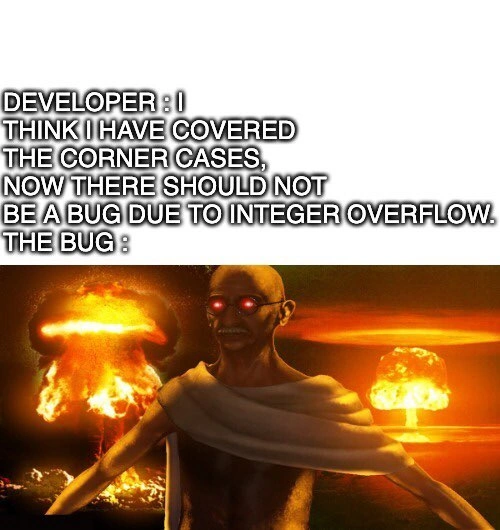
So in the meme, the developer thought they had prevented any possibility of such an overflow. They likely wrote code to handle big numbers or put checks in places they thought were necessary. But apparently, the bug still found a way. The phrase "the bug went nuclear" is a figurative way to say the bug's impact was explosive and disastrous. The meme dramatizes this by showing nuclear explosions and a crazed-looking Gandhi figure in the bottom panel. That's referencing a famous gaming bug (often called "Nuclear Gandhi") from the original Civilization game. In that game, due to an overflow/underflow issue, Gandhi (meant to be a very peaceful leader) would suddenly become ultra-aggressive with nukes. It's an extreme example of an edge-case bug: a value that was supposed to never go beyond a limit did, and it completely flipped the behavior from one extreme to another.

Now, imagine being the developer: you confidently deploy your code, sure that you've handled all those tricky edge cases. Then a user does something you never predicted – maybe they input an uber-large number or perhaps a counter in your program ticks one step further than you expected. Suddenly, the software starts behaving absurdly. It might crash, or data might become corrupt (like scores turning negative or health values jumping to astronomically high numbers). You scratch your head debugging, only to realize an overflow happened. It's a coding mistake that everyone from juniors to seniors makes at some point: not fully guarding against those out-of-bound values. The result is plenty of DebuggingFrustration: tracking down why the program is misbehaving, then facepalming when you discover it was a number that got too large.

This meme is a bit of coding humor exaggeration. In reality, an integer overflow bug might not literally cause a nuclear explosion 😉, but it can feel that way for the project or the user experience. Things break in a big way. In software terms, we sometimes call it "going nuclear" when a tiny mistake causes a giant failure. It's funny to developers because we use dramatic metaphors to cope with the stress. The top text is basically the developer bragging or feeling relieved ("phew, no overflow bug now!"), and the bottom is the universe (the bug) laughing in response, "Oh really? Watch this!" accompanied by chaos.

For someone new to coding: take this as a lesson. Always consider your input ranges and extreme values. If your program counts something, ask "what if it counts more than I ever expect?" If you use an int type, be mindful of its limits. Many beginners first encounter this when a program that was working fine suddenly starts giving weird results for big numbers. That's when they learn about data type limits and overflow. And if you ever hear older programmers joke "It's always the edge case you miss" or "No one expects the integer overflow," it's exactly the situation this meme depicts. It's both a joke and a tiny cautionary tale: edge cases have a way of sneaking up on you, and one missed case can make your program act nuts.

So, in summary, the meme uses an over-the-top image (nuclear blasts with evil Gandhi) to represent an overflow bug's impact. The developer said "no more bugs from that!" and fate answered, "here's a big one." It's a lighthearted reminder in the realm of DeveloperHumor that you should never get too comfortable – those corner cases can strike when you least expect, and the fallout (at least figuratively) can be massive.

Level 3: Pride Before the Fallout

The meme sets up a classic scenario of developer hubris versus unforgiving reality. In the top panel, our confident developer proclaims: "I think I have covered the corner cases, now there should not be a bug due to integer overflow." – Famous. Last. Words. 😏 Every experienced engineer reading that chuckles (or cringes) because we’ve all been there. A dev triumphantly runs all their tests, sees green across the board, and declares the code bulletproof... only for production to promptly reveal a bug that sneaked through. Here, that unseen bug is an integer overflow, and the meme delivers the punchline with the bottom panel: "THE BUG:" followed by a nuclear explosion and a sinister, red-eyed Gandhi figure with arms outstretched amid the blasts. In one image, it captures how a small unchecked arithmetic error can escalate into a catastrophic failure. It's a perfect illustration of corner_case_hubris: the dev assumed they thought of everything, but reality found that one pesky scenario they missed. The contrast is hilarious and painful at the same time – a textbook case of DebuggingFrustration turning into dark DeveloperHumor after the fact.

Why Gandhi with glowing eyes and nukes? This is a nod to the infamous "Nuclear Gandhi" bug from the original Civilization game – a legendary BugsInSoftware story every seasoned dev eventually hears. In that game, the developers made Gandhi almost abnormally peaceful (lowest aggression value). But due to an integer underflow glitch, when Gandhi became even more peaceful through a late-game democracy bonus, his aggression value wrapped around to the highest possible value, turning him into a genocidal maniac who immediately started launching nuclear weapons. The meme leverages this iconic example to symbolize the integer overflow bug: something that was supposed to be benign (a low aggression value or a safe arithmetic operation) suddenly flips to an extreme deadly state because of a missing edge-case check. So the bottom image basically screams: "Surprise! That tiny oversight just went nuclear on your system." It's an exaggerated visual metaphor, but not far from how it feels when a production bug wreaks havoc.

Seasoned developers find this funny because it's so true. The more confident someone is that "there should not be a bug," the more the universe seems to enjoy proving them wrong. It's practically a rite of passage in software development. We write code, we write tests, we swear we've handled all inputs... and then an end-user (or QA, or fate) finds a combination we never considered. Maybe we assumed a counter would never reach 10,000, but an overnight batch job increments it to 10,001 and boom – overflow. Perhaps we relied on data always fitting in a 16-bit integer, until one day it doesn't and memory corrupts. Murphy's Law for programmers states: “If a bug can happen, it will happen (especially right after someone says it won’t).” The coding humor here is that the developer practically invited disaster by tempting fate.

In this scenario, an integer overflow bug is depicted as the worst-case fallout. And indeed, such bugs can cause serious issues: negative values where only positives make sense, endless loops, crashes, or security vulnerabilities. It's the kind of bug that might pass all typical tests, then surface in the wild when a variable exceeds expectations. Picture a warehouse inventory system that never expected more than 32,767 items of a product (fits in a 16-bit int). Everything works great, until a popular item hit 32,768 in stock and suddenly the count wraps to -32,768. The system freaks out, maybe ordering a nonsensical number of new items or denying sales because it thinks there's negative inventory. Catastrophe ensues, all from one unchecked edge. This is why senior devs harp on "Did you test the extremes?" and still sometimes miss it – because covering all edge cases is really hard in complex systems.

The meme is also poking fun at the optimism of a developer vs. the reality of the bug. The dev confidently asserts control, while the bug is anthropomorphized as this almost villainous figure (Gandhi turned supervillain) unleashing chaos. In real life, debugging such an issue can feel like battling a sneaky villain: the logs might show absurd values ("Why do we have -42 users online?"), and you realize an overflow happened somewhere. Hunting it down might involve painstakingly tracing through arithmetic operations to find where a value exceeded its limit. And of course it always happens at the worst time – say, late Friday night on production – reinforcing that dark humor: "there should not be a bug... (but here we are, watching the metaphorical mushroom cloud)."

This scenario is developer humor gold because it's equal parts exasperating and comically absurd. The phrase "Now there should not be a bug" is something you almost never want to say out loud – it's like jinxing yourself. Every senior engineer has learned the hard way that absolute confidence in code means you've probably missed something. The meme resonates especially in debugging and troubleshooting circles because it captures that feeling when you realize an overlooked detail caused everything to blow up. It’s a mix of schadenfreude (laughing because we've survived similar mistakes) and empathy (we feel the pain behind the joke). In summary, the senior perspective sees this meme and thinks: "Yup, classic case of overconfidence – and the bug is laughing at you while everything burns." We laugh, we wince, and we double-check our own code’s edge cases after seeing it.

Level 4: Two's Complement Fallout

Under the hood, an integer overflow is a direct consequence of how computers represent numbers in binary. Most programming languages use fixed-size integers (like 32-bit or 64-bit), meaning they have a maximum (and minimum) value they can hold. When you add 1 to a 32-bit signed integer at its max value (which is 2,147,483,647 for a 32-bit int), the binary bits wrap around like an old odometer going from 999999 to 000000. In two's complement arithmetic (the system almost all modern CPUs use for signed integers), this means 0x7FFFFFFF + 1 becomes 0x80000000 – the largest positive number overflows into the most negative number (-2,147,483,648). Essentially, the arithmetic rolls over mod 2^N (where N is the number of bits). If that sounds a bit abstract, think of it as numbers on a clock: if you go past 12, you wrap back to 1. Here, if you go past the max integer, it wraps to a negative or zero without warning. The result? The software might suddenly see a huge positive count turn into a huge negative count without any error, unless the language/runtime explicitly checks for overflow.

In low-level languages like C or C++, signed integer overflow is actually forbidden undefined behavior by the language standard – meaning anything can happen (the program might continue with a wrapped value, or theoretically even crash or optimize away the overflow check entirely). However, on actual hardware using two's complement, what really happens is a silent wraparound. So in practice, INT_MAX + 1 usually becomes a very large negative number. Unsigned integers (which can only represent positive values) typically wrap around from their max back to 0. For example, an 8-bit unsigned value goes from 255 back to 0 (256 distinct values in mod 256 arithmetic). This is why an old story from the game Civilization is so eye-opening: they gave Gandhi a peace rating of 1 (very peaceful) in an 8-bit variable. Later in the game, an event tried to subtract 2 from his aggression (making him even more peaceful), but 1 - 2 underflowed that 8-bit value to 255 – the maximum aggression! In pure binary terms, 0000 0001 (1) minus 0000 0010 (2) became 1111 1111 (255) due to wraparound. The outcome? The famously pacifist leader suddenly had a 255/255 aggression score and started nuking everyone. It’s a legendary example of how bit-level overflow flips a scenario on its head.

This behavior isn't just a quirk of games – it's baked into computer arithmetic. Processors have finite bits of storage, and when a calculation exceeds that, it discards the overflowed bits like carrying a digit that falls off a fixed display. There’s even a hardware overflow flag in CPU registers to indicate when this happens, but if software doesn’t check that flag (and most high-level code doesn’t), the program carries on cheerfully with the wrong value. Different languages handle this differently: Java and C# will also silently wrap on overflow of their fixed-size ints (no crash, just bad math), while Python is more like a magician – it automatically expands integers to avoid overflow (at the cost of more memory). Some languages or compiler settings can inject runtime checks to throw an overflow error (e.g. Swift or Rust in debug mode will panic on overflow, Ada can raise exceptions), but performance-minded code often turns these checks off. So if a developer thinks they've "covered all corner cases" but hasn't accounted for hitting those numeric limits, the machine will still produce a result – just an absurdly wrong one. The laws of mathematics (and binary representation) are unforgiving: 2 + 2 can equal 5 if an overflow bug decides it should (to paraphrase Orwell).

The reason bugs like this are so pernicious is that they often lurk until you hit an extreme condition. All normal tests pass, but one day a counter reaches a billion when you expected it never would, and suddenly it flips negative and everything goes haywire. Those extreme values are exactly what edge cases are about. Fundamentally, it's a lesson in computer architecture and software design: ignoring numeric limits is flirting with chaos. Even safety-critical systems have fallen victim to this. A notorious real-world example is the Ariane 5 rocket explosion – a $7 billion European rocket that literally blew up on launch (1996) because a 64-bit value was cast to a 16-bit integer and overflowed, causing a cascade of failures. In essence, the software experienced an integer overflow that the developers thought would never happen during normal operation. But it did happen, and the rocket self-destructed. When we say an overflow bug "goes nuclear," sometimes we're only half joking – the fallout can be very real. So, at the deepest level, this meme is poking fun at the immutable low-level reality of computing: if you have a fixed-size container for numbers and you overfill it, expect overflow (and possibly mushroom clouds) as a result.

Description

A two-panel meme contrasting a developer's confidence with a catastrophic bug. The top panel contains text on a white background: 'DEVELOPER : I THINK I HAVE COVERED THE CORNER CASES, NOW THERE SHOULD NOT BE A BUG DUE TO INTEGER OVERFLOW. THE BUG :'. The bottom panel features the 'Nuclear Gandhi' meme, showing a depiction of Mahatma Gandhi with glowing red eyes, standing calmly in front of two massive nuclear explosions. This meme is a direct reference to a famous bug in the original 'Civilization' video game. Gandhi's aggression level, an 8-bit unsigned integer set to 1 (the lowest), would underflow to 255 when democracy was adopted (which reduced aggression by 2), turning the famously pacifist leader into a nuclear warmonger. The meme perfectly captures how a seemingly small oversight, like an integer underflow, can lead to the most extreme and unexpected system behavior, a lesson many senior developers have learned the hard way
Comments

7
Anonymous ★ Top Pick Some bugs just change a value from true to false. Others cause Gandhi's 8-bit pacifism to underflow and achieve enlightenment through nuclear fire
  1. Anonymous ★ Top Pick

    Some bugs just change a value from true to false. Others cause Gandhi's 8-bit pacifism to underflow and achieve enlightenment through nuclear fire

  2. Anonymous

    Turns out subtracting 1 from an unsigned “aggression” byte doesn’t make the AI calmer - it just wraps to 255 and reenacts Civ-I Gandhi’s nuclear diplomacy in prod

  3. Anonymous

    The one time you actually write unit tests for integer overflow, it turns out the real bug was in the code that checks for integer overflow

  4. Anonymous

    Ah yes, the classic 'I've tested the corner cases' confidence - right before discovering that your carefully validated user input of 2,147,483,647 + 1 just wrapped around to -2,147,483,648 and granted admin privileges to everyone. It's the Civilization Gandhi bug all over again: you think you've covered your bases with boundary checks, but then integer overflow turns your peaceful application into a thermonuclear catastrophe. Nothing quite humbles a senior engineer like realizing that despite years of experience, you still forgot that in C, signed integer overflow is undefined behavior, and the compiler just optimized away your safety checks entirely

  5. Anonymous

    “I covered the corner cases; no integer overflow.” - then -O3 treats signed overflow as UB, deletes the checks, and vectorizes the mushroom cloud

  6. Anonymous

    Edge cases checked? Adorable - like Civ Gandhi's aggression: democracy underflow to 255, nukes for all

  7. Anonymous

    Nothing says we covered all corners like a 32-bit counter wrapping to -2147483648 in prod and turning exponential backoff into a self-DDoS; classic diplomacy-stat wraparound energy

Use J and K for navigation