Solving P vs. NP with One Weird Trick
Why is this CS Fundamentals meme funny?
Level 1: One and Done
Imagine you have a giant puzzle that no one in the world has ever solved, and there’s a $1,000,000 prize for solving it. Now picture a little kid who doesn’t really understand the puzzle. He hears the puzzle’s title has the number “N” in it, so he says, “Easy! I’ll just make N equal to 1.” It’s like being asked to clean up all the toys in a huge messy room and the kid picks up just one toy and proudly announces, “There, room is clean!” Clearly, he didn’t really tackle the real challenge – he just found a cheeky shortcut that avoids it. The meme is funny because the kids think they solved a really hard problem with a trick that’s way too simple. It’s a bit like finishing a big 1000-piece jigsaw puzzle by saying “Well, if the puzzle had only one piece, it would be done! So I guess we’re done.” Everyone else knows that’s not how it works, and that’s why we crack a smile. The kids’ solution is “one and done” – using the number one to make a huge problem instantly disappear – and it’s just adorably wrong.
Level 2: Kidding About Complexity
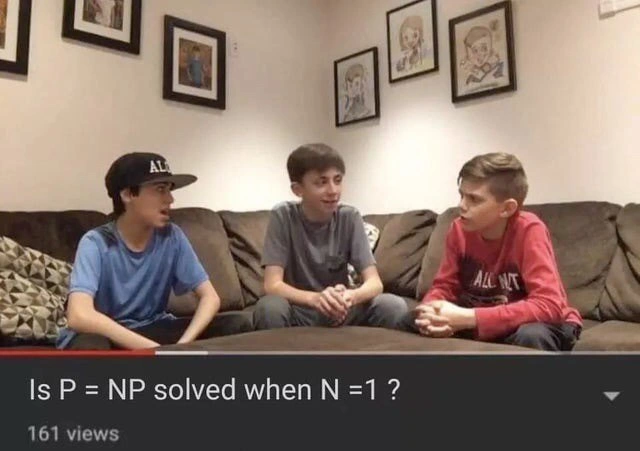
Let’s break down the joke for those newer to computer science. The meme shows three boys sitting on a couch, set up like they’re in a casual interview or a YouTube discussion panel – picture a low-budget talk show featuring kids. On screen, there’s a fake YouTube-style caption that reads, “Is P = NP solved when N = 1?” and it shows only 161 views. This whole setup is intentionally silly: it’s using kids and a YouTube meme format to lampoon a very brainy topic from CS fundamentals. The kids are essentially asking, “Hey, if we just choose the number N to be one, does that make P equal NP?”
Now, what do they mean by that? P vs NP is a famous question in computer science and math. In simple terms, imagine P as all the problems that a computer can solve quickly (in polynomial time, which basically means the running time is something like proportional to $n$, $n^2$, $n^3$, etc., where n is the size of the input). NP is a set of problems that a computer can check quickly, if given a candidate solution; solving them from scratch might be much slower. A classic example: solving a large Sudoku puzzle from scratch is hard (we don’t know a quick method for any puzzle size – this is NP), but if someone gives you a completed Sudoku, checking that it’s correct is pretty quick (that’s within NP verification). The big unsolved question is whether those two sets (solvable quickly vs. checkable quickly) are actually the same set of problems or not. If P = NP, it would mean every problem where a solution can be verified quickly could also be solved quickly. That would be revolutionary – many currently intractable tasks would suddenly become easy, and as a side effect a lot of our cryptography (which relies on some problems being hard) would break. Because nobody knows the answer yet, P vs NP is one of the Millennium Prize Problems with $1,000,000 offered for a proof, which is why the poster quips “Time to get 1m$.”
So why is the kids’ question funny? They are treating P = NP like a basic algebra equation. In the caption, “N = 1” sounds like they think NP means “N times P” or something similar. It’s as if they saw the letters NP and assumed N is a number you can plug in. By setting N = 1, the equation “P = 1 * P” is obviously true, so ta-da, solved! Of course, this is a misunderstanding_complexity_classes at a fundamental level. NP is not a multiplication of N and P; it’s shorthand for a concept (“nondeterministic polynomial time”). The joke is that only a child (or someone totally new to these terms) would think it works like that. It’s the equivalent of solving an unsolvable riddle by changing the wording of the riddle. The kids basically reduce a hugely complex question to a trivial scenario.
To put it another way, imagine someone asks, “Can every super difficult puzzle be solved quickly?” and a kid answers, “Yes, if the puzzle only has one piece, then it’s easy!” It’s true but completely misses the point. In algorithm terms, if your input size is N = 1, any problem is easy to solve because there’s almost nothing to compute – that’s why this is a trivial solution meme. The humor is in the oversimplification. It highlights a kid-level logic: solve a hard problem by making it extremely small or simplistic. All the serious details about what P and NP really stand for are thrown out the window in favor of a one-liner that sounds like a solution but isn’t.
The visual of three boys in a living room, with that YouTube overlay, drives home that this is not a serious discussion – it’s a parody. The boys’ faces are blurred (a common practice to protect privacy or add meme anonymity), and behind them are some innocent kid-esque decorations (framed caricature drawings on the wall). They’re seated like panelists debating a profound topic on a couch, which is already a goofy contrast. The low view count (161 views) is a wink to the fact that no one actually believes this solves P vs NP, but it’s being presented dramatically as if it’s a big question. It’s playing on tech humor: only people who know about P vs NP will get why setting N=1 is a facepalm-worthy answer. In other words, it’s solid nerd humor – if you’ve had an introductory algorithms course or just hung around programming discussions, you likely know this is a huge open problem, and you’ll instantly see why the kids’ “solution” is comically naive.
Level 3: Million Dollar Misconception
This meme perfectly captures a bit of algorithm humor that senior engineers and CS majors smirk at: the million-dollar misconception that an insanely hard problem can be “solved” with a kindergarten-level trick. P vs NP is legendary – it’s the ultimate unsolved question in computer science, one so important that proving P = NP (or P ≠ NP) nets you a one-million-dollar prize and instant fame. Every experienced developer or computer scientist remembers learning about NP-complete problems like the Traveling Salesman or Sudoku solver and being told, “nobody knows a fast way to solve these for all cases.” So seeing a group of kids on a couch proudly ask “Is P = NP solved when N = 1?” is hilariously absurd. It’s like watching someone claim they cracked an impossible code by flipping a single switch.
The humor comes from the trivial_solution_meme format: they’ve taken a monumental challenge and “solved” it by willfully misinterpreting it. Seasoned folks recognize this as a joke about naïveté: you can’t just redefine a hard problem to make it easy unless you’re a kid on YouTube. In real engineering, we often joke about those who try to simplify a hard problem without fully understanding it – here it’s taken to the extreme. It’s reminiscent of junior devs saying “Oh, that performance issue? Just run it on a smaller dataset, problem solved!” – treating a symptom as if it were a solution. We've all been in meetings where someone suggests an overly simplistic fix to a complex issue, and this meme distills that feeling into one line. The boys in the picture are literally having a kid_panel_discussion, mimicking a talk show or a YouTube Q&A (complete with a fake YouTube screenshot style overlay showing 161 views). That detail — only 161 views — adds to the joke: it implies this “groundbreaking discovery” isn’t exactly convincing the wider world. The framing screams amateur hour, which is exactly what the kids’ “solution” is.
For those well-versed in Big O notation and computational complexity theory, the phrase “when N = 1” jumps out. It’s such a misunderstanding of complexity classes that it feels intentionally goofy. In complexity analysis, N usually denotes the size of the input. Setting N = 1 means you’re looking at the tiniest possible input, a constant-size problem. Sure, any NP problem (finding a Hamiltonian path, coloring a graph, etc.) is absolutely trivial for N=1 – there’s almost nothing to compute! But that doesn’t tell you anything about N=100 or N=1000, where these problems blow up in difficulty. The meme basically satirizes someone skipping to the easiest case and declaring victory. It pokes fun at the idea of ignoring the hardness of general-case NP-complete problems.
Experienced devs also catch the play on symbols: NP is not “N times P,” but the kids treat it like an algebraic expression. It brings back memories of those early student mistakes or quips like thinking NP-hard means “really hard because NP stands for Not Possible” (nope, it’s nondeterministic polynomial). It’s classic nerd humor – you need to know the context to get why it’s ridiculous. And the kicker? The post message: “Time to get 1m$.” That’s the cherry on top, referencing the million-dollar prize. As a senior engineer, you chuckle because these kids think they’ve just casually earned the Clay Institute check by doing essentially nothing. It’s a playful jab at how real breakthroughs are hard-won, while armchair “geniuses” (or cheeky kids) might claim glory with a shortcut that misses the point entirely.
Level 4: Base Case Illusion
At the highest reaches of computational complexity theory, this meme riffs on the infamous P vs NP problem by proposing a tongue-in-cheek "solution." Formally, P is the class of decision problems solvable in polynomial time (think algorithms with time complexity like O(n^3) or even O(n)), whereas NP is the class of problems whose solutions can be verified in polynomial time. The grand question P = NP? asks if every problem that can be quickly checked (NP) can also be quickly solved (P) – a millennium prize problem in mathematics and computer science. In complexity terms, it’s asking whether finding a solution is as easy as verifying one. This is a foundational question in algorithm complexity analysis and has stumped researchers for decades.
Now enter the childlike twist: “Is P = NP solved when N = 1?” The meme’s kids have hilariously misinterpreted “NP” as if it were the product of two variables (literally N times P). They’re treating the statement P = NP like an algebra equation where setting N = 1 yields P = 1*P, i.e. trivially P = P. It’s a classic misunderstanding of complexity classes – conflating the symbolic name “NP” with a multiplication. In formal terms, NP stands for “Nondeterministic Polynomial time”, not “N times P”! Substituting N = 1 has no meaning in the actual theory, but it seems to “solve” the equation in a naive arithmetic sense. Essentially, the kids have addressed one specific (and utterly trivial) case – the base case where input size n = 1 – and proclaimed the entire problem solved. This evokes the base case of an induction proof without the inductive step: they proved the trivial case and skipped the hard part (the general case). In complexity theory, focusing only on the $n=1$ case is meaningless, because Big O notation and complexity classes compare how algorithms scale as n grows large (tending towards infinity). Every NP-hard problem is easy at size 1 by definition – one city traveling salesman, one variable SAT, one item knapsack are all trivial – but that doesn’t magically make the general problem easy. The humor here is that from a deep theoretical perspective, their “solution” is as valid as saying every exponential algorithm runs in constant time if your input is of size one. Technically true, but fundamentally irrelevant to the grand question.
For seasoned computer scientists, there’s rich irony in this computational_theory_joke. It lightly mocks how some novices (or overly optimistic outsiders) might claim a breakthrough by seizing on a misunderstanding. It’s reminiscent of those occasional wild claims on forums or YouTube like “I solved P vs NP, here’s a 5-minute video,” which inevitably hinge on a logical fallacy or trivial case. In serious research, partial results about P vs NP involve deep concepts like NP-completeness (thanks to Cook–Levin’s theorem in 1971) and even relativizations (Baker–Gill–Solovay showed there are oracles that make P≠NP, hinting it’s a tough nut). The contrast between that profound complexity and the kids’ naive approach is the core nerd humor. The meme’s format – a low-view-count “kid panel” video – plays into this, parodying the idea that a million-dollar problem in CS fundamentals could be cracked by a bunch of schoolboys on a couch. If only the Clay Mathematics Institute would accept “just let N = 1” as a proof! Alas, in the real world of theoretical CS, such a trivial solution is worth as much as solving a 1000-piece puzzle by declaring it solved after fitting two pieces: it gets a laugh, but not the $1,000,000 prize.
Description
The image is a screenshot of what appears to be a YouTube video, featuring three young boys sitting on a brown couch and engaged in a serious discussion. The setting is a living room with framed pictures on the wall behind them. A dark grey overlay at the bottom, typical of a video player interface, displays white text posing a question: 'Is P = NP solved when N = 1 ?'. Below this title, '161 views' is visible. The humor stems from a fundamental and comical misunderstanding of the P versus NP problem, one of the most famous unsolved problems in computer science. The 'N' in 'NP' stands for 'Nondeterministic,' not a variable representing input size. The question hilariously conflates these two distinct concepts, proposing a trivial case (an input size of 1) as a solution to a profound question about computational complexity classes. For senior developers, this is a perfect example of Dunning-Kruger in action and a humorous take on how complex theoretical concepts can be wildly misinterpreted
Comments
7Comment deleted
Someone should tell them that if P=NP, the next video they should make is 'Generating all RSA private keys from public keys in polynomial time'
Congrats kids, you’ve proven P = NP for N = 1 - now ship the constant-factor “fix” to prod where N ≈ 10¹² and the SLO’s still 100 ms
This is exactly how junior devs approach production issues - technically correct solutions that completely miss the actual problem while senior engineers watch their Datadog bills skyrocket from the resulting infinite loops
When you're debugging a production incident at 3 AM and realize the entire distributed system works perfectly when N=1, but the architect who designed it for 'web scale' never actually tested with more than one node. Technically, P does equal NP when your problem space is trivial - just like how every algorithm is O(1) when you hardcode the answer
P=NP settled: just architect your system for eternal N=1, and watch the stakeholders celebrate 'infinite scalability'
At N=1, P=NP; CAP is “yes” and microservices are a monolith - aka every POC demo
Sure, P=NP at N=1 - just like our O(n!) scheduler benchmarks as O(1) during the exec demo with a single row