Skip to content
DevMeme
497 of 7435
When 64GB of RAM Becomes the Last Line of Defense
Bugs Post #572, on Aug 17, 2019 in TG

When 64GB of RAM Becomes the Last Line of Defense

Why is this Bugs meme funny?

Level 1: Spaghetti Avalanche

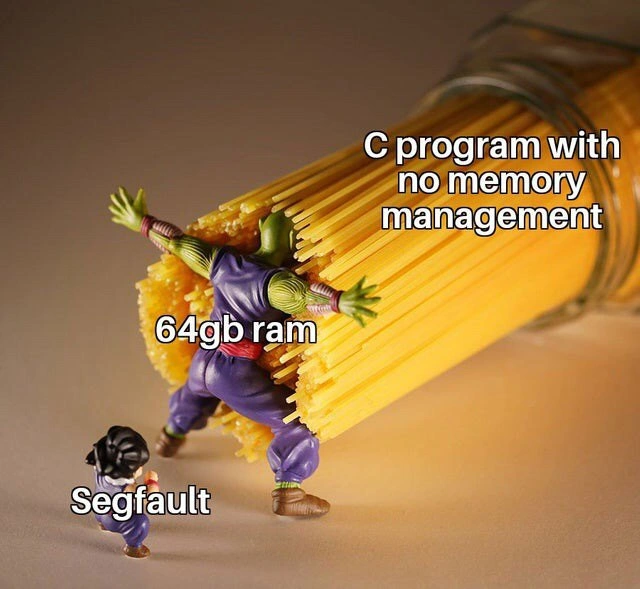
Imagine you have a giant jar of spaghetti that starts tipping over. A strong toy figure tries to hold all the noodles in, spreading his arms wide to catch them. But there’s just too much spaghetti – it slides and spills everywhere anyway. In the end, you get a big mess on the floor. The joke here is like saying: no matter how big or strong you are (even if you could lift a ton of spaghetti!), if you’re dealing with something super messy and out of control, you can’t stop the spill. It’s funny because we see this big action hero struggling with something as goofy as a spaghetti explosion, and a tiny onlooker doll labeled “Segfault” is watching it happen. In plain terms, it means even a really powerful helper (like a computer with a lot of memory) can’t save a sloppy situation from ending badly. It’s a silly way to show that just having more resources won’t fix a fundamental problem – just like having a huge bowl won’t matter if you keep dumping endless spaghetti into it. The feeling it gives is a mix of “oh no!” and “haha, of course that would happen!” – we laugh because we know that poor hero never stood a chance against that spaghetti avalanche.

Level 2: Manual Memory Mayhem

Let’s break down the meme in simpler terms. In C programming, MemoryManagement is manual, meaning the programmer must take care of allocating and freeing memory. Unlike languages with a garbage collector (like Java or Python), C won’t clean up for you. If a C program keeps grabbing more memory and never releases it, that’s called a memory leak. Imagine filling a jar with spaghetti continuously without ever taking any out – eventually it overflows. Even if your computer has a huge amount of memory (like 64 GB RAM, an extremely large amount that only high-end PCs or servers tend to have), a MemoryLeak can eventually use it all up. On the flip side, if the program messes up pointers (the variables that hold memory addresses) and tries to use memory incorrectly – say writing past the end of an array or using memory after freeing it – you get a segmentation fault. A SegmentationFault (a.k.a segfault) is a crash that happens when your program tries to access memory it’s not allowed to. It’s the computer’s way of saying “STOP! You’ve gone somewhere you shouldn’t.”

Now, the meme uses a clever visual analogy. The spaghetti spilling from the jar represents the tangled, unmanaged memory usage of a “C program with no memory management.” Spaghetti is notoriously messy and hard to contain once it’s everywhere – just like a C program’s memory when you’ve got bugs like leaks or buffer overflows. In programming lingo, “spaghetti code” is a term for code that is tangled and unstructured. Here that concept is applied to memory: a chaotic heap of noodles symbolizing chaotic memory state.

The green action figure holding back the spaghetti is labeled “64gb ram.” This is referencing a character named Piccolo from the Dragon Ball anime series – he’s known for being powerful and at one point heroically shielding someone from danger. In our context, 64 GB of RAM is a huge amount of memory, and it’s depicted as this hero trying to hold back the mess. The idea is that having a lot of RAM (the strong figure) might delay problems or cope with a bigger load of spaghetti (memory), but it can’t truly stop a badly written C program from crashing. The spaghetti pile (“C program with no memory management”) is simply too much; it’s overflowing and pushing forward relentlessly.

Finally, the small figure at the bottom, labeled “Segfault,” represents the segmentation fault error itself. In the scene, this little character is observing or waiting. In the actual Dragon Ball scene being mimicked, Piccolo is protecting a child from harm. Here, that child is humorously tagged as the segfault, the very thing we don’t want to happen. The joke is that despite 64 GB RAM’s best efforts to hold back the chaotic spaghetti memory, the dreaded segfault is still going to occur – it’s inevitable. The small size of the “Segfault” figure is ironic: it might be small or seem minor, but all it takes is that one event to bring down the entire program.

In summary, the meme is saying: even if you have tons of memory, a C program that doesn’t manage memory (doesn’t free allocations, or messes up with pointers) will eventually crash with a segmentation fault. LowLevelProgramming in C gives you great power over the machine, but also the responsibility to manage memory correctly. If you don’t, you get bugs that no hardware upgrade can fix. It’s a common scenario in Debugging_Troubleshooting: a developer might hope that just adding more RAM will avoid the crash (for example, hoping a memory leak will take longer to exhaust memory), but a Segfault isn’t about quantity of RAM – it’s about incorrect memory access. The meme uses the dramatic, funny visual of an action figure trying to hold back an avalanche of spaghetti to drive home that point. The dragon_ball_reference and spaghetti_analogy make it geeky and playful, but the lesson is clear for any programmer: more memory is not a solution to memory bugs!

Level 3: When Pointers Byte Back

For seasoned developers, this meme hits a nerve because it exaggerates a familiar disaster scenario. We’ve all seen someone try to brute-force a software bug with hardware: “The app keeps crashing? Throw more RAM at it!” 😅. But in C (and other CFamilyLanguages like C++), a segmentation fault isn’t a performance issue – it’s a bug biting back. The image humorously casts a beefy 64 GB RAM (that’s a ton of memory, even by 2019 standards) as Piccolo, the Dragon Ball Z character heroically bracing against a tidal wave of uncooked spaghetti. That spaghetti stands in for a “C program with no memory management,” basically a program that’s leaking memory or scribbling over memory it doesn’t own. In real life, a memory leak means the program keeps grabbing heap memory via malloc (or new) and never freeing it – like endlessly pouring spaghetti out of a jar. You might think having 64 GB of RAM would let you hoard noodles for a long time, but eventually you’ll overflow the pot (i.e. consume all memory or hit an invalid address). Likewise, if the program is corrupting memory (say writing past the end of an array, a classic buffer overflow), it’s akin to spaghetti strands flying everywhere chaotically. SegmentationFault is labeled on the tiny figure watching, implying that a crash is looming inevitably, just waiting for that heroic RAM to slip up. The humor here is that even a Namekian-level amount of RAM (Piccolo is a pretty tough dude in the anime) can’t save a fundamentally flawed C program from itself.

This resonates with developers who have wrestled with Debugging_Troubleshooting of nasty crashes. A huge server with loads of memory won’t matter if your code calls free() at the wrong time or uses uninitialized pointers. The program will still dump core and print Segmentation fault (core dumped) faster than you can shout “It’s over 9000!”. Why is this so funny and painful? Because it mocks a common anti-pattern: relying on hardware muscle instead of fixing the Bug. Picture a panicked team at 3 AM: the app keeps crashing due to a pointer bug, and someone suggests upgrading the RAM or increasing swap space. Seasoned engineers facepalm 🤦‍♂️ because they know that’s as futile as Piccolo trying to single-handedly stop an avalanche. The manual memory management in C gives us rope to hang ourselves – if you don’t meticulously manage allocations and deallocations, you end up with either MemoryLeaks that eventually exhaust even 64 GB, or worse, wild writes that immediately blow up. We call C “UnsafeCode” for this reason: it trusts you to get things right, and when you don’t, even mighty hardware can’t shield you.

In the meme, the dense bundle of spaghetti looks comically unwieldy. This is a nod to spaghetti code, a term for tangled, messy programs where the flow is as convoluted as a plate of pasta. Here it’s specifically spaghetti memory: a heap so tangled and overflowing that no amount of strength (RAM) can contain it neatly. The Dragon Ball Z reference adds a layer for the geeky folks: in the show, Piccolo once nobly sacrifices himself shielding Gohan (a child) from a lethal attack. In our context, 64 GB RAM is nobly (or futilely) shielding the tiny figure labeled “Segfault”. It’s an inversion of roles – normally you’d want to shield the program from a segfault, but here the segfault is portrayed as the onlooker, perhaps chuckling because it knows it will get the last laugh. The Segfault is inevitable, much like an anime villain saying “this isn’t even my final form” before wrecking our hero.

From a LowLevelProgramming perspective, this comedic image screams “logic errors trump hardware.” The experienced devs are nodding because they’ve been in trenches where an app crashed despite servers with absurd RAM and CPU. Maybe they optimized a game or server software to use huge memory buffers, but a stray *ptr = value at address zero still instantly KO’d the process. Or they’ve inherited a legacy C codebase with PointerArithmetic mistakes and spent days chasing a segfault with tools like gdb and core dumps, only to find a single i <= MAX bug causing writes one byte past the buffer – a tiny code mistake causing a crash on a machine with gigabytes to spare. It’s the classic tale of a tiny villain (one rogue pointer) defeating a giant (64GB of memory).

In summary, at the senior level this meme humorously reminds us: no hardware upgrade can cure a software memory bug. It’s highlighting the folly of treating symptoms (out-of-memory crashes) by adding RAM, instead of addressing root causes (memory mismanagement). The result? A segfault still happens – like gravity taking over when that jar of spaghetti tips. The shared laughter comes from knowing that in C, if you don’t handle memory responsibly, not even a supercomputer’s resources will prevent the program from hitting the proverbial wall. Piccolo can try with all his might, but a segmentation fault will still blast through, sending our program to the next dimension (i.e., process terminated). It’s funny because it’s true: 64 GB RAM can’t save you from yourself!

// Even with lots of RAM, this C code will crash 
#include <stdlib.h>
int main() {
    int *arr = malloc(5 * sizeof(int));
    // Bug: writing beyond allocated length (valid indices 0-4)
    for (int i = 0; i <= 5; ++i) {  
        arr[i] = 42;  // at i==5, writes out of bounds -> segfault likely
    }
    // (Even 64 GB of RAM doesn't help if we write where we shouldn't!)
    free(arr);
    return 0;
}

Level 4: Anatomy of a Segfault

At the hardware and OS level, a segmentation fault isn’t just a quirky error – it’s a fundamental protection mechanism. When a C program mismanages memory (for example, by writing outside the bounds of an allocated array or dereferencing a wild pointer), the Memory Management Unit (MMU) and operating system step in like strict gatekeepers. The process is only allowed to access memory it has properly allocated; reach beyond that, and the CPU raises an exception. Historically, this kind of error was named for memory segments – sections of address space. In modern systems, it’s about invalid pages in virtual memory. The OS immediately sends a SIGSEGV (Segmentation Violation) signal, halting the program. No amount of physical RAM can override this memory protection. Even with 64 GB of RAM, if your pointer lands in the wrong place – say address 0xDEADBEEF instead of a valid heap address – the program will crash just as hard as if you had only 256 MB. In other words, massive hardware resources can’t magically make undefined behavior safe. This is the gritty truth of LowLevelProgramming in C: manual memory management is a double-edged sword. It gives you raw power over memory, but one misstep (like a buffer overflow or use-after-free) and your program is instantly off to neverland. The meme’s absurd scenario of a lone hero (64 GB RAM) holding back an avalanche of spaghetti perfectly illustrates an OS invariant: no matter how much memory you have, invalid memory access triggers an immediate fail. It’s like an immutable law of physics in computing – you can’t bribe or muscle past the CPU’s safety checks. This principle has been etched into computing lore from the earliest days of C on PDP-11s to today’s 64-bit architectures. It’s the reason tools like Valgrind and AddressSanitizer exist: to catch these memory misuses that raw RAM can’t prevent. Behind the humor is a reminder of this technical pedigree – memory must be respected, and even superhuman hardware (or Namekian warriors 😜) bow to the reality of pointer errors.

Description

This meme uses the 'Piccolo Protecting Gohan' format from the anime series Dragon Ball Z. A figurine of the character Piccolo, labeled '64gb ram', is shown struggling to hold back a large, overflowing bundle of uncooked spaghetti spilling from a glass jar. The spaghetti is labeled 'C program with no memory management'. In front of Piccolo, a much smaller figurine of the character Gohan, labeled 'Segfault', crouches, seemingly shielded from the spaghetti. The scene is set on a plain, light-brown surface with a warm, focused light source. The technical joke here is about poor programming practices being masked by excessive hardware resources. In C programming, manual memory management is required, and failing to do so properly leads to memory leaks. These leaks consume RAM until the program eventually crashes, often with a segmentation fault ('segfault'). This meme humorously suggests that having a massive amount of RAM (64GB) can delay the inevitable crash, with the RAM acting as a powerful but ultimately temporary barrier against the consequences of a badly written program, much like Piccolo defending Gohan
Comments

7
Anonymous ★ Top Pick The year is 2025. We have 1TB of RAM, and C programs now just leak memory until the heat death of the universe. Segfaults have become a theoretical concept, much like closing Vim
  1. Anonymous ★ Top Pick

    The year is 2025. We have 1TB of RAM, and C programs now just leak memory until the heat death of the universe. Segfaults have become a theoretical concept, much like closing Vim

  2. Anonymous

    Adding 64 GB of RAM to a C codebase with no frees is just autoscaling the leak - you’re only buying overtime for the segfault

  3. Anonymous

    Successfully allocated 64GB of heap memory just to dereference a pointer I freed 10,000 lines ago - proving once again that in C, having infinite resources just means you can fail infinitely harder

  4. Anonymous

    Having 64GB of RAM in a C program without proper memory management is like giving a toddler a flamethrower - sure, you have abundant resources, but the inevitable segfault isn't a question of 'if,' it's a question of 'how spectacularly.' No amount of RAM can save you from dereferencing that NULL pointer or freeing memory twice. As Bjarne Stroustrup might say, 'C makes it easy to shoot yourself in the foot; with 64GB of RAM, you can blow off your entire leg before the OS even notices.'

  5. Anonymous

    64GB RAM in C: vast pastures where dangling pointers graze freely until segfault roundup

  6. Anonymous

    Adding 64GB RAM to a C program with no memory management is treating use-after-free as a capacity problem - you’re just buying a longer walk to the same SIGSEGV

  7. Anonymous

    Throwing 64GB at a SIGSEGV is classic enterprise remediation - turns out the only garbage collector C ships with is your pager

Use J and K for navigation