AI Pioneers Judging Your NumPy Struggles From the Afterlife
Why is this AI ML meme funny?
Level 1: Real House vs LEGO House
Imagine your great-grandpa built an entire house from the ground up with his own two hands – chopping wood for the frames, hammering every nail, wiring the electricity by hand. Now imagine you’re in your modern fully-equipped workshop, trying to put together a simple LEGO house kit, and you keep messing up the instructions. In the sky, great-grandpa is peeking out from a cloud, watching you. He has a little smile, like he’s half proud of you for trying but also a bit amused that you’re finding it hard even though you have all the pieces and instructions right there.
In this story, great-grandpa building a house from scratch is like the early experts who had to create neural networks using real wires and hardware. You struggling with the LEGO kit is like a new developer today struggling to write a small piece of code using powerful tools like NumPy. It’s funny because clearly building a real house is much harder than assembling a pre-made LEGO set – just like those old engineers had a much harder job than we do now. Yet, sometimes the easy things still trip us up when we’re learning. Great-grandpa isn’t angry; he’s kind of chuckling and saying, “I did the hard stuff, and now you have it easy – you’ll get it, just keep at it!” The humor makes us smile because we recognize it’s true: things that seem simple once you know them can feel tricky at first, and thinking of our ancestors watching us fumble with modern conveniences is a silly, playful way to appreciate how far things have come.
Level 2: From Solder to Software
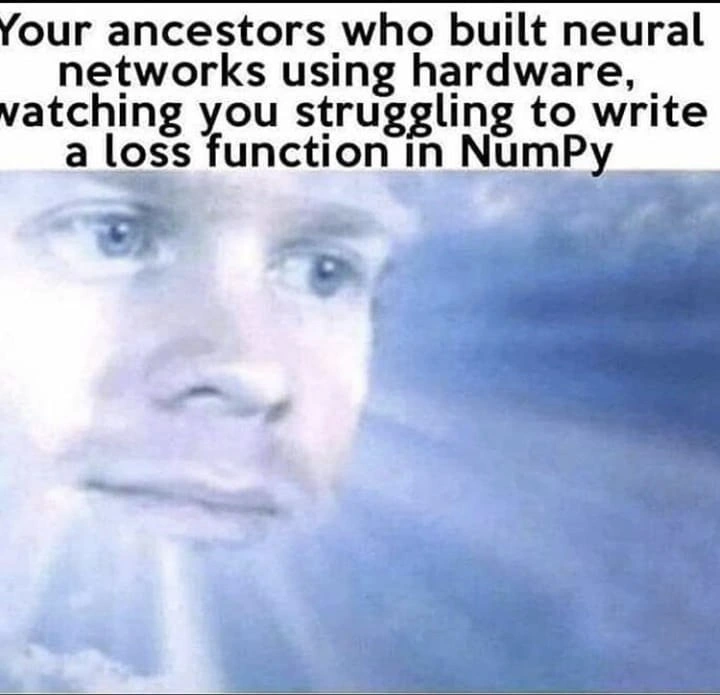
“Your ancestors who built neural networks using hardware, watching you struggling to write a loss function in NumPy.”
Let’s break down what’s happening in this meme. The caption sets the scene: your tech “ancestors” – the early inventors and researchers in artificial intelligence – are looking down from the heavens, seeing you wrestle with writing some code in Python. They literally built working neural networks with electronic components (no software at all!), and now they’re watching you have a hard time coding a simple part of a neural network using modern tools. The image reinforces this: it shows a face up in the sky with beams of light, like a wise old ancestor or pioneer peering down from the clouds. This is a popular meme format to depict ancestors judging their descendants. The rays of sunlight and the slightly disappointed/apathetic face communicate a mix of pride and pity: pride in how far technology has come, pity (or humor) in seeing someone struggle with something that should be easier now.
Now, what do we mean by “built neural networks using hardware”? Today, when we talk about a neural network, we usually mean a program – code that runs on a computer (often using libraries like TensorFlow or PyTorch) which simulates a bunch of interconnected mathematical neurons. But the early pioneers of AI, back in the 1940s-1960s, sometimes actually constructed physical devices to model neurons. For example, they would use circuits with resistors, capacitors, and sometimes even vacuum tubes or transistors to create an analog system that behaves like a simple neural network. In these systems, voltages and currents flowing through wires represented the signals and weights of the network. This was analog neural hardware – essentially a hardware version of what we do in software now. It was like building a custom calculator dedicated to neural network computations. Doing this was very complex: you needed to know a lot of electronics, and if you wanted to change the “model”, you might have to rewire the circuit or change component values by hand (imagine tuning a knob to set a weight value). These folks are the “ancestors” in the meme: the old-school engineers and scientists who tackled AI problems with slide rules, soldering irons, and a lot of ingenuity.
On the other side, we have you, the modern developer, working with Python and NumPy. Python is a high-level programming language often used in AI and data science because it’s easy to write and has great libraries. NumPy is one of those libraries – it’s short for Numerical Python. NumPy lets you work with arrays (grids of numbers, like vectors and matrices) very efficiently. When you use NumPy, operations that deal with whole arrays (like adding two arrays, multiplying them, computing functions on each element, etc.) are typically implemented in fast C code under the hood. This means you’re supposed to write your math in a way that takes advantage of these vectorized operations – that is, operations that handle an entire array or large chunk of data at once, in compiled code, rather than looping in pure Python.
Vectorization is a key concept here. In programming, especially with NumPy, vectorization means you try to express your computations as operations on whole arrays (vectors) rather than writing explicit loops in Python. For example, if you have a list of numbers and you want to square each number, a newcomer might write a for loop in Python that goes through each number one by one. A vectorized approach would be to take a NumPy array of those numbers and just do array ** 2 in one shot – NumPy will automatically apply the squaring to every element internally in fast C code. Vectorized code is not just more concise; it’s often much faster because it exploits low-level optimizations and avoids the overhead of the Python interpreter in a loop. However, if you’re learning and not used to thinking that way, it can be a struggle to “vectorize” your code. It requires a shift in mindset to use array operations and understand things like array shapes and broadcasting (how NumPy handles arrays of different sizes).
The meme specifically mentions “struggling to write a loss function in NumPy.” A loss function in machine learning is basically a calculation that tells you how far off your model’s predictions are from the actual correct values. It’s a measure of error – lower is better. Common loss functions include Mean Squared Error (for regression tasks) or Cross-Entropy (for classification tasks). Writing a loss function in NumPy means you’re probably implementing a formula like mean squared error by hand using NumPy arrays. For instance, say you have an array of predicted values from your model, and an array of the true values. The mean squared error formula is: average of the squares of differences between prediction and true value. In NumPy, a clean implementation would look like loss = np.mean((predictions - targets) ** 2). This one line subtracts the two arrays (producing an array of differences), squares each difference (that’s the ** 2 part, which NumPy applies element-wise to the array), and then takes the mean of all those squared differences. It’s elegant and takes full advantage of vectorization.
If someone is “struggling to write” that, it likely means they’re not sure how to manipulate the arrays or they’re trying to do it with Python loops and maybe getting it wrong. It’s a very relatable scenario for beginners in ML: maybe you accidentally sum up without squaring, or you divide by the wrong number, or you just have a hard time figuring out how to do it in one line and resort to an unnecessary complicated approach. Meanwhile, to an experienced eye, this is a straightforward use of NumPy.
So the joke is essentially: with all these powerful, high-level tools at your disposal, you are finding it hard to do something that is conceptually simple – and the great engineers of the past, who had none of these tools and had to do everything the HARD way, are watching you and kind of shaking their heads (albeit with a smile). It’s a form of developer humor about the learning process. We’ve all been that struggling developer at some point, and we can imagine how ridiculous our struggles might look to someone from another era who had it ten times harder. It’s as if a master blacksmith from ancient times sees a modern person who has an automatic forge and power tools but still can’t craft a basic object – a humorous juxtaposition of past and present challenges.
The mention of “ancestors” and the heaven imagery (clouds and light beams) also gives the meme a lighthearted, slightly self-deprecating tone. It’s not mean-spirited; it’s more like the community collectively laughing at itself. People in AI/ML love to recall the roots of their field, and there’s a lot of respect for those early pioneers. By invoking them, the meme also nods to the history of the field (AI_ML history is actually full of interesting detours, like analog neural nets, symbolic AI, etc.). But we’re doing it in a tongue-in-cheek way: we honor them enough to picture them watching us, but we also joke about how they’d react to our modern stumbling.
In summary, this meme uses the ancestors meme format (wise ancestors in the sky judging current folks) in an AI/ML context. It contrasts analog neural network hardware of the past with a very common present-day coding hurdle (learning to use NumPy arrays effectively). The humor clicks because of the absurd contrast: they built actual working neuron circuits with copper wires, and here we are debugging one line of Python. It’s a playful reminder of how easy we have it — and yet how we still struggle — as we learn and grow in our capabilities.
Level 3: Hardwired vs High-Level
This meme strikes a chord with anyone in machine learning who’s ever struggled early on with code that experts find “basic.” It contrasts the old-school AI pioneers – who had no choice but to implement neural networks with raw electronics – against a modern developer scratching their head over a simple NumPy operation. The humor comes from exaggeration and shared experience: of course those pioneers aren’t literally watching from the sky, but it feels like it when you’re stuck on something trivial and imagine how the giants of the past would judge you. It’s a classic ancestors are judging you setup, often seen in memes as ghostly figures in the clouds bestowing a mix of pride and disappointment. Here, the ancestors have the halo of sun rays and sky beams, a visual shorthand for "wise old forefathers observing from above." The large translucent face peering through the clouds looks gently mocking. It’s as if the forefathers of AI are saying, “Really? With all your fancy Python and high-speed computers, you can’t implement a simple loss function?”
The senior developer perspective embedded in this meme points out the huge abstraction gap between then and now. Back then, “debugging a network” meant checking physical connections and maybe smelling for burnt components. Today, it might just be an IndexError in your Python stack trace or a shape mismatch in your matrix multiplication. The developer struggles are real but have shifted: we fight software bugs and misused APIs, not loose wires. The meme satirizes a common learning hurdle: mastering NumPy vectorization. Seasoned Python devs know that using vectorized operations (operating on whole arrays/tensors at once in optimized C) is crucial for performance. Newcomers to numerical computing often start by writing explicit loops in Python for things like computing a loss function or updating neural network weights, which is notoriously slow. They eventually get that sarcastic code review comment or that mentor who says, “You know, you could do this whole thing without a loop – just use NumPy operations!”
Consider the specific example implied: “struggling to write a loss function in NumPy.” A loss function in machine learning, say Mean Squared Error for a set of predictions vs. true values, can be expressed in a very succinct vectorized form. For instance:
import numpy as np
# Suppose predictions and targets are NumPy arrays
# with shape (N,) for N data points.
predictions = np.array([2.5, 0.5, 2.1, 1.6])
targets = np.array([3.0, 0.0, 2.0, 1.0])
# A newbie might do it with an explicit loop:
loss = 0.0
for i in range(len(predictions)):
error = predictions[i] - targets[i]
loss += error ** 2
loss = loss / len(predictions)
print("Loop-based MSE loss:", loss)
# A vectorized approach using NumPy:
vectorized_loss = np.mean((predictions - targets) ** 2)
print("Vectorized MSE loss:", vectorized_loss)
A beginner might struggle with this at first – perhaps writing the loop version and wondering why it’s slow, or messing up array shapes trying to do it in one go. Meanwhile, an experienced dev (or those venerable ancestors) know that np.mean((predictions - targets)**2) is the idiomatic solution, leveraging optimized C code under the hood. The loop approach will work, but it’s inelegant and won’t scale. It’s like driving a Ferrari (NumPy) in first gear because you don’t know how to shift – the car is powerful, but you’re not harnessing it.
The meme’s comedic tension also lies in the implied disappointment from the masters. The folks who built neural nets from scratch had to know the mathematics and electronics inside-out. They didn’t have automatic differentiation, high-level libraries, or even basic interactive debugging. Everything was manual and hard-fought. From that perspective, watching someone today struggle with a higher-level problem (like coding the algebra of a loss function correctly) is both funny and a tiny bit pathetic. It’s a form of imposter syndrome humor that many developers recognize: you imagine that the great engineers of the past (or even just more experienced colleagues) would mock your silly mistakes.
There’s also an element of AI humor here about how far removed modern practitioners can be from the fundamentals. Many people today use machine learning libraries (TensorFlow, PyTorch, scikit-learn) as black boxes. They might build a complex image classifier by calling a few high-level functions, without fully understanding the linear algebra or the hardware acceleration behind it. When they do have to implement something from scratch with NumPy arrays – even just a simple formula – it can be surprisingly challenging. Meanwhile, the ancestors in the sky, who literally built neural network hardware transistor by transistor, are symbolically rolling their eyes.
The meme gently pokes fun at the learning curve in AI/ML development. It’s an encouragement wrapped in a joke: “Hey, don’t feel bad – even if it seems simple, everyone struggles at first with these concepts. Just remember, if our predecessors could do this with soldering irons and vacuum tubes, you can handle a bit of Python syntax!” There’s a shared camaraderie in this humor. Every experienced machine learning engineer remembers the first time they tried to vectorize something and got it horribly wrong (maybe summing along the wrong axis or broadcasting incorrectly). We’ve all been the person writing a loop only to realize later it could have been one elegant line. The ancestors aren’t truly angry – if anything, they’re smiling through that disappointment, knowing that eventually, we’ll get it. After all, these modern tools are incredibly powerful; once you master them, you’re doing in seconds what took the pioneers weeks or months.
In essence, the meme highlights the contrast between hardwired solutions and high-level scripting solutions. It captures a bit of developer humor about how easy we have it today in terms of tools, coupled with how easy it still is to mess up if you haven’t learned the “tricks” or underlying concepts. There’s a subtle nod to the idea that while technology evolves, the struggle to learn new abstractions remains a constant. And if we could hear those AI ancestors, maybe they’d give us a pep talk: “We struggled with analog neurons, you’re struggling with NumPy – different battles, same spirit. Keep at it!”
Level 4: Vacuum Tube Vectorization
Long before Python or np.dot, early pioneers of AI were literally wiring neural networks by hand. In the 1950s, researchers like Marvin Minsky and Frank Rosenblatt built some of the first "learning machines" using analog hardware. Minsky’s 1951 invention, the SNARC (Stochastic Neural Analog Reinforcement Calculator), was a room-sized contraption of vacuum tubes and capacitors simulating 40 artificial neurons. Each "neuron" was an analog circuit, and wires carried signals that summed up like continuous voltages – a physical form of vectorized operations! Rosenblatt’s famous Mark I Perceptron (1958) had an array of photo-sensors and adjustable resistors for weights, effectively implementing a one-layer neural network in circuitry. These ancestors didn’t code their networks – they soldered them. Weighted connections weren’t Python objects; they were potentiometers tuned with screwdrivers. When they wanted a neuron to “learn”, they might physically swap a component or adjust a dial, not run a training loop.
This era of analog neural hardware was essentially doing linear algebra with electrons flowing through resistors. A weighted sum in a neural network (like w1*x1 + w2*x2 + ...) could be performed by Kirchhoff’s current law: join wires with different resistances and the currents sum analogously to a dot product. In a way, those massive panels of wires and vacuum tubes achieved parallel computation inherently – all summations happened simultaneously as currents merged. It was hardware-level vectorization. There was no concept of a Python for loop iterating one element at a time; the physics itself did the loop-less computation.
However, building and reconfiguring such circuits was painstaking. Debugging a neural net meant tracing tangled wires or finding a burnt-out vacuum tube (the original hardware bug, literally a smoking component). The limitations of analog precision (noise, drift, limited components) eventually gave way to digital computation, where binary circuits or software simulation could replicate neurons more flexibly. Yet, those early systems embodied a deep understanding: the neural networks were not just abstract code, but real electricity flowing through real synapses-made-of-solder.
It’s rich with irony and admiration: our forebears had to implement matrix multiplication using oscilloscopes and patch cords, while we have high-level libraries to do it in milliseconds. The meme playfully suggests those ancestors gaze down from the heavens, perhaps amused (or mildly disappointed) that with all this advanced computing power, a developer is stumped by something as conceptually simple as vector math in NumPy. After all, the pioneers grappled with physical circuits to get their neural nets working – no stack overflow, just stacks of wires. If a weight overflowed back then, it meant a capacitor literally overflowed or a resistor burnt out, not just an array out-of-bounds error!
In a grand historical context, this scenario highlights how far abstraction has come. We stand on the shoulders of giants who built neural network hardware from scratch. Thanks to them, all that low-level complexity is hidden behind a few lines of high-level code. But that very abstraction can be a double-edged sword: it makes things easier in principle, yet a modern developer might not grasp what’s happening under the hood – leading to struggles with proper usage of tools like NumPy. The ancestors, having mastered neurons at the level of solder and silicon, would certainly appreciate the power of vectorized algebra on today’s machines. But they might chuckle (or cringe) seeing us fumble with it, much like an experienced blacksmith watching someone misuse an automatic power hammer. It’s a comedic reminder that learning curves persist even as technology advances. The fundamental math hasn’t changed, but the way we interface with it has—dramatically so. And somewhere in the clouds, the spirits of those analog AI tinkerers are gently shaking their heads, saying “We literally hard-wired a neural net, and here you are, perplexed by a one-liner in Python.”
Description
The meme features a blurry, ethereal image of a man's face looking down from a cloudy, heaven-like background with a look of mild disappointment. Above this image, the text reads: 'Your ancestors who built neural networks using hardware, watching you struggling to write a loss function in NumPy.' This meme uses the 'Disappointed Ancestor' or 'Heavens Gate' format to create a humorous contrast between the foundational, hardware-level work of early AI pioneers (like building perceptrons with physical components) and the modern-day challenges of machine learning engineers. The joke lies in the idea that despite the high levels of abstraction and powerful libraries like NumPy available today, developers can still find it difficult to implement fundamental concepts like a loss function, much to the imagined disdain of their predecessors who worked with far greater constraints

Comments
7Comment deleted
My AI ancestors implemented backpropagation with soldering irons. I spent the afternoon fighting a tensor shape mismatch. I'm pretty sure I could hear a faint sigh of disappointment over the coil whine of my GPU
They hand-wired op-amps into perceptrons; I just spent two hours discovering my triple-nested Python loop was a single np.matmul - pretty sure we’re the dropout layer in their grand architecture
Back in my day, we didn't have automatic differentiation - we had potentiometers and oscilloscopes, and we liked it! Now you're telling me you can't even broadcast a tensor without checking Stack Overflow?
The irony is exquisite: pioneers like Rosenblatt literally soldered resistors and potentiometers to build the Mark I Perceptron, manually adjusting weights through physical hardware, while we sit here debugging why our vectorized cross-entropy implementation returns NaN because we forgot to clip the log input. They dealt with actual electrical noise in their gradients; we panic when floating-point precision causes our loss to oscillate. At least when their neural network failed, they could see the smoke
They built neural nets in hardware; I’m here negotiating (512,1) vs (1,512) in NumPy with np.newaxis as duct tape - turns out we didn’t retire the soldering iron, we just call it “broadcasting.”
Someone hand‑tuned op‑amps into a perceptron, and I’m burning a sprint remembering which axis to broadcast so (n,1) @ (1,n) doesn’t spawn a 4‑GB temporary
They debugged perceptrons with oscilloscopes; you're still googling 'numpy mean axis' at 3 AM