Skip to content
DevMeme
1567 of 7435
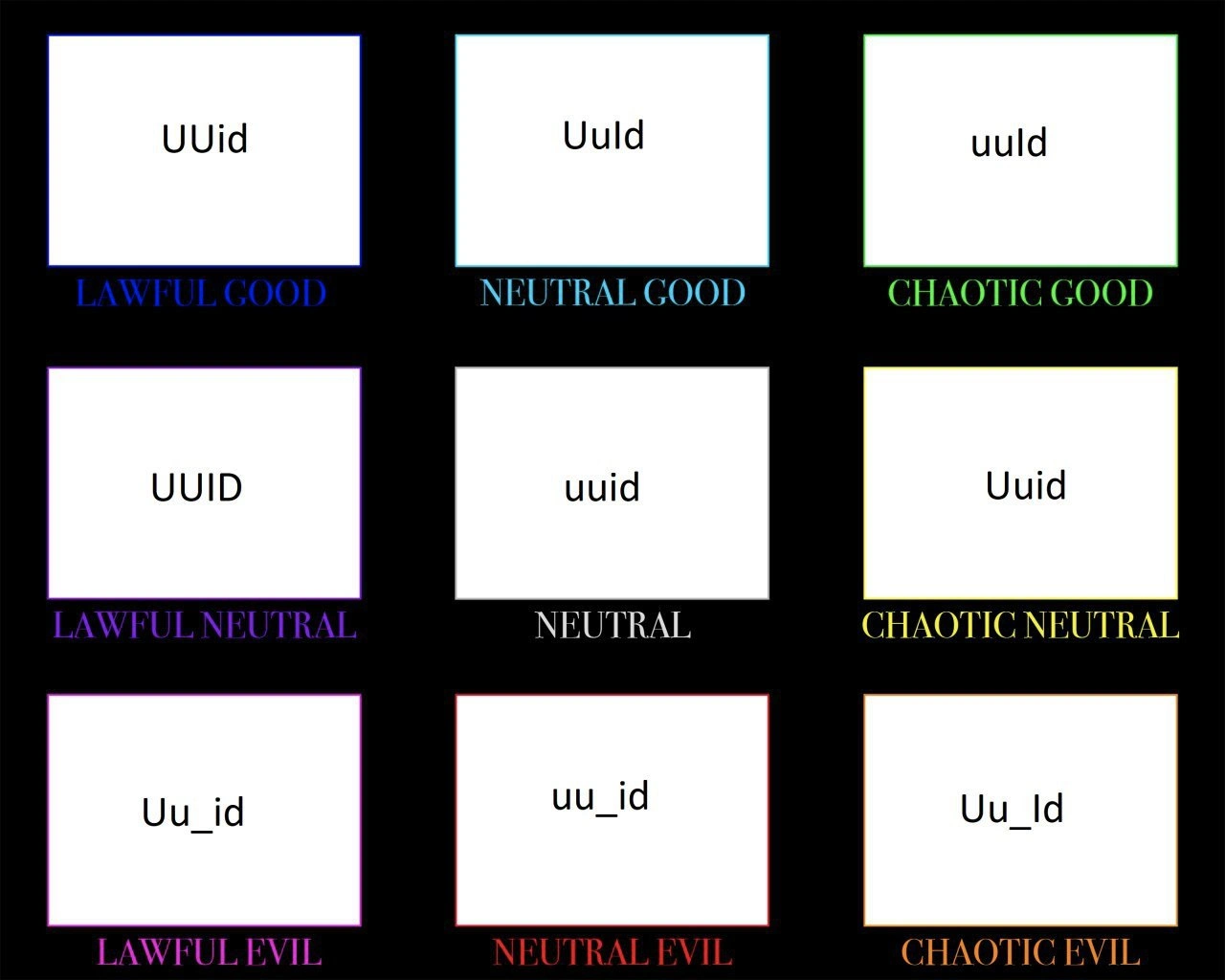
The Nine Circles of UUID Naming Conventions
CodeQuality Post #1749, on Jul 2, 2020 in TG

The Nine Circles of UUID Naming Conventions

Why is this CodeQuality meme funny?

Level 1: Mixed-Up Names

Imagine you have a friend named Tim. Now, every time you write down Tim’s name, you do it a little differently. One day you write it all in lowercase letters as “tim”. The next day, you start with a capital letter like “Tim”. Another time, you get creative and throw in a random symbol or an extra line, writing it as “T_im” or mix big and small letters like “TiM”. Pretty soon, people looking at these notes might be confused – are those all referring to the same Tim, or are they different names? It’s silly because it’s obviously the same friend, just written in weird ways.

That’s exactly what’s happening in this meme, but with a coding twist. In coding, we often use a short word “uuid” as an ID for something (it’s like a special unique tag). The picture shows that word “uuid” written in a bunch of mixed-up ways – some letters big, some small, sometimes an underscore (a little “_” line) thrown in. It’s making fun of how messy and confusing it looks when programmers don’t stick to one consistent way of writing a name. Just like with Tim’s name, writing “uuid” differently every time is hard to read and just looks wrong. The meme is funny because it’s so exaggerated: it’s as if the word went through nine different moods or costumes. Even though all those panels are trying to say “uuid,” the inconsistent spelling makes it feel like a chaotic jumble. The takeaway is simple – whether you’re writing your friend’s name or a bit of code, it’s usually a good idea to keep the style the same every time, or else it turns into a confusing mess for everyone reading it.

Level 2: Camel vs Snake Showdown

Let’s step back and explain the joke in simpler terms. This meme is styled as a Dungeons & Dragons alignment chart – basically a 3x3 grid that labels things as lawful vs chaotic on one axis and good vs evil on the other. It’s a popular way in internet culture to categorize any set of nine variations. In D&D, a Lawful Good character is one who always follows the rules and tries to do the right thing, whereas a Chaotic Evil character breaks all rules and causes harm. Here, instead of characters, we have nine variable names – all meant to represent the same concept (uuid) written with different capitalization or added characters. The joke is comparing coding styles to personalities: some naming styles dutifully follow rules (lawful), some are random and unpredictable (chaotic), some are harmless or even helpful (good), and others are troublesome (evil). It’s a playful metaphor: a developer alignment meme.

The word “uuid” is at the center of it. UUID stands for Universally Unique Identifier, which is a term programmers use for a special kind of ID string (often a long random-looking number) that is unique across systems. Developers often have variables or database fields named “uuid” to store those identifiers. So it’s a very common term in code – a perfect example to use for showing naming differences.

Now, onto the naming conventions themselves. In programming, naming conventions are agreed-upon ways to name things like variables and functions so that code is consistent and easy to read. Two very common naming styles are often nicknamed after animals or shapes:

  • CamelCase: Words are joined together, and each word (after the first) starts with a capital letter, kinda like the hump of a camel. For example, you might name a variable userIdNumber – notice the capital “I” and “N” in the middle indicating new words “Id” and “Number”. If it starts with a lowercase letter (like userName), that’s often called lower camelCase. If it starts with an uppercase (like UserName), that’s called PascalCase (often used for class names or things like CamelCase itself). In a CamelCase world, “uuid” could be written as uuid (all lower, since it’s short) or sometimes Uuid (treating “UUID” as a word and capitalizing only the first letter). People have different opinions here, which is part of the chaos.

  • snake_case: Words are written in all lowercase and separated by underscores (the _ character looks a bit like a snake, hence the name). For example: user_id_number would be snake_case for the same idea as above. In a snake_case style, you might write “uuid” simply as uuid (one word, no underscore needed) or if combining with another word, like user_uuid. Some developers, however, might be tempted to break “UUID” itself with an underscore for clarity, resulting in something odd like uu_id (which separates the “id” part).

The meme shows combinations of these styles applied to the same letters U, U, I, D. For instance:

  • UUID (all letters uppercase) – that’s not camelCase or snake_case, it’s literally treating the whole thing as an acronym or maybe a constant. It stands out, almost like a shout.
  • uuid (all letters lowercase) – clean and simple, works in many languages especially those that prefer lowercase names (like Python). This is a standard way if you’re not treating “UUID” as multiple words.
  • Uuid (only first letter capital) – looks like PascalCase (like a class name) or someone thinking of “UUID” as one word and just capitalizing it as if it were a proper noun.
  • UUid or UuId – mixes of uppercase and lowercase in odd places. These look like mistakes or a mishmash of styles. For example, UUid has two capital U’s then lowercase id. That might happen if someone wasn’t sure how to handle the acronym: capitalize both U’s? It’s unusual. UuId (capital I in the middle) really looks like a typo – perhaps the person meant to type Uuid and accidentally hit Shift for the “i”. It could also come from some internal logic like “maybe I capitalize the start of ID” but not consistently applied.
  • Then the ones with underscores: Uu_id, uu_id, Uu_Id. These introduce the underscore character. Typically, you’d only use underscores if you were writing everything lowercase (like uu_id might be seen in a database column name or some code where underscores are the norm). But Uu_id and Uu_Id are weird because they mix camelCase and snake_case. It’s like two different naming worlds colliding. That’s why they’re labeled as “evil” in the alignment chart – they break consistency in a way that’s kind of ugly.

So why do these differences matter? In many programming languages, case sensitivity is a thing – meaning uuid, Uuid, and UUID would be seen as completely different identifiers by the compiler or interpreter. For example, in Java or C++, you could technically have three different variables named uuid, Uuid, and UUID in the same scope (though that would be very confusing for any human reading it!). In Python or JavaScript, if you mistype the case, you’ll either create a new variable or more likely get an error because it can’t find the variable you intended (since myVar is not the same as myvar). So consistent spelling and casing are important to avoid bugs and confusion.

Inconsistent naming in a codebase can lead to real problems:

  • Readability: When humans read code, we recognize patterns. If the same concept (like a user ID or a UUID) is sometimes written one way and sometimes another, a new reader might wonder “are these two different things or the same thing?” For instance, if I see orderUuid in one file and orderUUID in another, I might initially think one is a different variable or needs a different handling – only to realize they both mean the order’s unique ID.
  • Maintainability: If you ever do a search through the code for uuid, you might miss occurrences that are spelled UUID or UUid because the search is case-sensitive or has to be repeated in different forms. It’s an unnecessary headache.
  • Bugs from typos: Consider Uuld (as written in the Neutral Good panel, presumably a mistaken spelling of Uuid). That one letter difference (l instead of i) could be disastrous if not caught. In many languages, referencing Uuld when the actual variable is Uuid will throw an error (which is good – you find out immediately). But in some contexts (like certain config files or case-insensitive systems), it might silently create a new thing or just be treated as separate, which is a nightmare to debug. Even if it errors out, it’s a simple mistake that stops your program until fixed. A consistent naming convention (and maybe automated tools to check names) can prevent these oopsies by making unusual names stand out.

Now think of a team of developers working on the same project. If they haven’t agreed on a single naming convention, each developer might use their personal style. Developer Alice names everything in camelCase, developer Bob prefers snake_case, and developer Carol always uppercases acronyms fully. When their code merges, you get a patchwork of styles – exactly what this meme is portraying with the many variants of uuid. It’s a bit like having multiple accents or dialects in one book – the content might be understandable, but it feels disjointed and sloppy. That’s why teams usually have a coding standard document or linter rules: for example, “all variable names must be lowerCamelCase, acronyms should be treated as words (so use Uuid instead of UUID or uuid_id etc.).” If such guidelines aren’t in place (or not enforced), you end up with the wild west of naming.

The D&D alignment labels give an extra layer of jest. They humorously assign a “moral alignment” to each naming choice. For instance:

  • Lawful” names are ones that look like they followed some rule or convention systematically. UUID (all caps) or UUid (both U’s capped) feel like someone was sticking to a rule (even if it’s an odd one).
  • Chaotic” names look random or inconsistent with any single rule. Uu_Id is a prime example – it doesn’t clearly follow camelCase or snake_case exclusively, so it feels haphazard.
  • Good” vs “Evil” in this context roughly translates to “how much does this hurt readability (or our eyes)?” Good names are closer to what most devs would find acceptable or at least harmless. Evil ones are the cringe-worthy or problematic ones that make you go "ugh". For example, uuid (all lowercase) is pretty harmless and clear – that’s a good one. Uu_Id, with its bizarre mixing, is painful – that’s evil. Uuld (with a likely typo) could be considered evil because it’s plainly wrong (even if the intention was good, it introduces a potential error).

Beyond the humor, the meme is actually highlighting a real CodeQuality concern: inconsistent naming can make code harder to work with. It’s a lighthearted reminder that something as simple as how you capitalize your variable names should be consistent in a project. It also pokes fun at how developers sometimes treat these conventions with almost moral fervor (hence the alignment chart as if each style is a creed or philosophy). Online, you’ll often see DeveloperHumor posts joking about naming things, because it’s a universal struggle – every programmer has at some point thought, “What should I call this variable? And in what format?”

In short, for a less experienced developer or someone new to coding: this meme says if we don’t all agree how to name our variables, things get ugly fast – and here’s a fantasy-themed exaggeration of just how absurd it can look. It teaches the importance of NamingConventions in a comical way. The fact that all nine panels are just variations of the same four-letter word drives home how unnecessary this chaos is. After all, no matter how you spell it – UUID or uuid or even Uu_id – it’s supposed to represent the exact same thing. Wouldn’t it be nicer to just pick one and stick to it? That’s the underlying message, wrapped in a joke.

Level 3: Case Convention Chaos

At first glance, this nine-panel D&D alignment chart is a chaotic mess of letters. Each panel shows a different way to spell uuid (a common variable for a Universally Unique Identifier). Seasoned developers immediately recognize this as a satire of inconsistent naming conventions in a codebase. The humor comes from mapping naming styles to moral alignments: from Lawful Good to Chaotic Evil, the meme dramatizes the ethics of variable naming. Why is this so funny (and painfully familiar)? Because in real projects, something as simple as an ID variable can end up with every imaginable casing and punctuation, especially if coding standards are loose. It’s a perfect illustration of how CodeQuality issues arise when teams don’t agree on naming. This meme hits home for anyone who’s done a code review and thought, “How on earth do we have Uuid, UUID, and uuid_value all referring to the same thing?” It’s both hilarious and horrifying. Let’s break down the alignments and the unsaid developer backstories behind each:

  • Lawful Good: UUid – This developer means well and is trying to follow the rules... just maybe the wrong rules. Perhaps they thought “UUID” is an acronym, so both ‘U’s should be capitalized to obey some style guide. It’s technically consistent (two uppercase U’s, then lowercase id), but unusual. Still, their heart is in the right place: the name is recognizable as “uuid,” just with extra zeal for capitalization. Lawful Good coders follow a coding standard strictly; here the “law” might be “capitalize known abbreviations”. The result is a bit awkward but not harmful. Everyone can tell it’s a UUID, so it’s good, even if it’s a pedantic interpretation of the standard.

  • Neutral Good: UuId – A slight variation, possibly a typo turned into a naming style. This looks like the developer tried to use CamelCase (Uuid) but hit the shift key in the middle, ending up with a random capital I. Or maybe they’re following a peculiar personal rule like “capitalize the third letter for acronyms.” Regardless, they aren’t trying to hurt anyone (it’s good in intent), but they’re not strictly following any common convention either (hence neutral on law vs chaos). It’s easy to imagine this happening when multiple developers touch the same code: one wrote Uuid, another saw it and thought it was UuId due to font or confusion (capital I looking like l), and suddenly the codebase has both. The variable still clearly refers to a UUID, so it’s benign, but it introduces that slight cognitive friction: “Wait, why is the ‘I’ capitalized? Is that deliberate?”

  • Chaotic Good: uuid – All lowercase, clean and simple. In many languages and contexts, naming a variable uuid in plain lowercase is perfectly fine (and common in Python or as a local variable name). Why would this be labeled Chaotic? Think of a project where the agreed convention is CamelCase or capitalizing acronyms – then one dev comes along and just writes it in pure lowercase anyway. That’s a little rebellious (ignoring the “law” of team style), but it’s still a “good” name in that it’s short, clear, and has no weird characters. It’s chaotic only relative to a codebase that expected something else. In isolation, uuid is arguably the most straightforward, readable form. A senior dev chuckles here because they’ve seen plenty of code where one pragmatic person keeps names simple and lowercase (chaotic good), while others over-engineer the casing. This panel essentially says: even when you do the simplest, arguably right thing, if it diverges from the project norm, it’s viewed as a lovable rogue – breaking rules for the greater good of clarity.

  • Lawful Neutral: UUID – Now we’re in all-caps territory. UUID in code often implies a constant or a macro, or it’s treating the acronym as a whole word. A Lawful Neutral developer might be following an old-school or formal rule: “If it’s an acronym, just use all caps.” That’s a very lawful stance – it follows a consistent rule with no exceptions. It’s neutral because, well, it’s not necessarily good or bad – it’s correct, but could be overkill. In a Java constant or a C define, UUID might be fine, but as a variable name in regular code, all-caps stands out (and usually all-caps is reserved for constants like MAX_VALUE). Here it’s neither particularly helpful nor harmful – it’s neutral. It does shout at you a bit when reading code (UUID feels like it’s yelling), but at least it’s unmistakably the acronym. A senior engineer reading this thinks of those coworkers who treat every abbreviation with all caps rigidity, even in contexts where it isn’t needed. The result is consistent (lawful), but not necessarily improving readability (hence neutral in goodness).

  • Neutral (True Neutral): uuid – The center panel is pure Neutral and shows uuid as well – seemingly the same as the Chaotic Good one. Why duplicate? In many alignment chart memes, the center “Neutral” represents the most plain, un-opinionated version of the thing. uuid in simple lowercase could be considered the baseline, no-frills naming convention – the kind of default you’d see if there was absolutely no strong rule in play except common sense. It’s the Switzerland of the chart: just “uuid”, plain white text on black, with the label NEUTRAL. This suggests that writing it exactly as the acronym pronounced (“uuid” as one word) is the truest neutral stance – it’s neither enforcing a style nor breaking one, just using the letters plainly. An experienced dev interprets this as: when in doubt, just name the variable uuid consistently and move on. No style war here – neutral ground. (Of course, it’s a bit redundant to have it twice in the meme, but maybe the creator wanted to emphasize that the simplest form can be seen as both a bit chaotic in a rigid setting yet also the neutral default in a vacuum. Or it could be a minor mistake in the meme text – which, honestly, fits the theme of typos in naming!)

  • Chaotic Neutral: Uuid – This one has just the first letter capitalized (uppercase U then lowercase uid). In many languages, capitalizing the first letter is reserved for class names or constructors (PascalCase), not for ordinary variables. Seeing Uuid as a variable name in code is odd – it’s like someone named a class but is using it as a variable, or they just randomly hit Shift on the first character only. It’s neutral on the good-vs-evil axis because it’s not actively harmful – you can read it, it’s spelled correctly, and if the language is case-sensitive it’s a distinct identifier. But it’s chaotic on the lawful-vs-chaos axis because it violates typical naming norms without clear reason. One imagines a scenario: a developer coming from a language where variables often start uppercase (or they accidentally made it uppercase and never changed it) – not malicious, just not conforming to the local convention. A senior dev might recall reviewing code where a newcomer treated variable names like class names, resulting in weird capitalizations like this. It doesn’t break anything per se, but it definitely looks out of place – a true neutral situation that just kind of exists, eliciting a shrug and a rename commit later.

  • Lawful Evil: Uu_id – Here comes a mix of styles: part CamelCase (Uu suggests maybe they started with “Uu...” as if trying to CamelCase Uuid by capitalizing only the first U) and part snake_case (an underscore sneaks in before “id”). This is like someone tried to follow two different laws at once – and the result is lawfully awful. Why would anyone do Uu_id? Picture a very rule-oriented developer who has conflicting guidelines: one rule says “use CamelCase for multiword variables,” another says “separate abbreviations with an underscore for clarity.” So they end up with this Frankenstein name that technically satisfies both rules on a superficial level, but at the cost of readability. It’s evil in the sense that it makes the code base uglier and more confusing, even though the person thought they were doing the right (lawful) thing. This panel really resonates with the idea of CodingStandards gone wrong – following a guideline in a rigid way, but the guideline itself (or its combination) is flawed. Lawful Evil in developer terms could be that strict team lead who enforces a bizarre naming scheme that everyone hates but must follow. The result: an ID variable with a capital letter, a weird underscore, and no logical reason to be this way. Truly an inconsistent_naming nightmare, born from too much process and not enough pragmatism.

  • Neutral Evil: uu_id – All lowercase with an underscore – that’s classic snake_case. In many contexts (like Python, Ruby, or database field naming), uu_id would actually be fine if used consistently. But here it’s labeled evil because presumably, in our imaginary codebase, nobody else uses snake_case for variables – so this one dev deciding to use uu_id stands out as renegade. It’s neutral on the lawful-chaotic axis: snake_case is a perfectly valid convention (not chaotic at all within a culture that expects it). The evil part is that it’s out of place and adds one more style to maintain. A senior dev has definitely encountered this: a project where everything is named like userId except one module where someone wrote user_id throughout. The result is two naming styles fighting each other. If you search the code for uuid, you might miss uu_id references because of the underscore. It’s a minor evil, but an evil nonetheless, born from either ignorance of the prevailing style or willful disregard for it. In effect, this panel points out how even a normally okay naming style (snake_case) becomes “evil” in a codebase that isn’t standardized on it. It’s a tongue-in-cheek way to say “One of these things is not like the others, and the inconsistency is what’s bad.”

  • Chaotic Evil: Uu_Id – This is the final boss of bad naming. It’s got everything: random capitalization and an underscore thrown in for no good reason. It’s as if the developer just smashed together the worst parts of CamelCase and snake_case with a dash of unpredictability. This is chaotic to the max – no rhyme or reason, just pure inconsistency embodied in one variable name. And it’s evil because it’s painful to read and maintain. This might happen if multiple people edited the same variable name over time, each applying their own twist. Or perhaps a single developer who utterly disregards conventions (or doesn’t know them at all) created this monstrosity. To a seasoned coder, Uu_Id is practically a horror story: you’d see it in code and immediately know something is deeply wrong with the project’s standards (or lack thereof). It’s the kind of name that in a code review would be circled in red with multiple comments: “Why the underscore? Why mixed case? PICK ONE.” If a codebase’s naming were an alignment chart, this is the chaotic evil corner – avoid at all costs.

Real-world senior perspective: we’ve all had to work in codebases where naming conventions weren’t consistently enforced. Maybe the project evolved over years and each generation of devs had their own style. The result? You might find half the code uses camelCase, some uses PascalCase, others use snake_case, and acronyms are capitalized differently all over. Encountering userID and userId and user_id in adjacent files is CodeQuality hell – it doesn’t break the app, but it sure breaks your brain for a second. It’s a subtle form of technical debt. Consistency in naming is more important than which style you choose, and that’s exactly what this meme highlights in a fun way. The D&D alignment framing adds a witty layer: it’s implying there is a moral dimension to naming choices. The “good” names are the ones that, despite differences, aren’t too misleading or harmful. The “evil” ones actively hurt readability or are just egregiously wrong. And “lawful” vs “chaotic” hints at whether the person was trying to follow some rule or just doing their own thing.

This resonates with experienced devs because variable naming holy wars have been around forever. Tabs vs spaces, brace style, and yes, naming conventions – these are almost religious debates in programming. In fact, there’s a famous saying in software development:

“There are only two hard things in Computer Science: cache invalidation, naming things, and off-by-one errors.”

Naming things is always on that list of hardest problems, right next to genuinely complex issues like caching and off-by-one bugs. It’s tongue-in-cheek, but there’s truth there: picking consistent, clear names is surprisingly tough, especially in big teams. This meme playfully shows how not having a consensus can lead to a situation where something as simple as a uuid variable devolves into nine different spellings across the code. Every senior dev has lived this – maybe not nine variants, but certainly a few. It’s the kind of thing that prompts adding a section to the project’s CodingStandards document or setting up a linter rule: “Use one format for acronyms, please!”

Furthermore, the meme taps into DeveloperHumor by referencing a beloved geek framework (Dungeons & Dragons alignments) and a daily annoyance (naming inconsistency). It’s essentially saying “Behold, the pantheon of UUID naming in our repo – choose your fighter!” The joke lands because each variation has a kernel of truth in why it might happen, and seeing them all at once is absurd. The “chaotic evil” variant almost gives some developers war flashbacks of terrible legacy code, while the “lawful good” one reminds them of overly rigid code guidelines from a past job. It’s a shared laugh at the fact that we all struggle to name things well and consistently.

In summary, this top-level analysis uncovers the developer alignment meme as a commentary on naming chaos in programming. It humorously frames the serious issue of inconsistent naming (which affects maintenance and readability) in a format that casts variable names as if they were characters with moral alignments. For the experienced dev, it’s funny because it’s true: VariableNaming can feel like an epic battle between order and chaos. And in this meme, chaos clearly has been given plenty of room to roam. It’s a reminder that even something as small as whether to capitalize letters or add an underscore can become an arena of conflict – often with the code’s clarity hanging in the balance.

Description

A meme formatted as a classic 3x3 Dungeons & Dragons alignment chart, used to satirize programming naming conventions for the acronym 'UUID'. Each square has a colored border, a white background, and text representing a different casing style, corresponding to an alignment. The alignments are: 'LAWFUL GOOD' with 'UUid', 'NEUTRAL GOOD' with 'Uuid', 'CHAOTIC GOOD' with 'uuid', 'LAWFUL NEUTRAL' with 'UUID', 'NEUTRAL' with 'uuid', 'CHAOTIC NEUTRAL' with 'Uuid', 'LAWFUL EVIL' with 'Uu_id', 'NEUTRAL EVIL' with 'uu_id', and 'CHAOTIC EVIL' with 'Uu_Id'. The joke is that while there are several reasonable ways to format 'UUID' (the 'good' and 'neutral' options), there are also truly cursed, inconsistent variations (the 'evil' options) that violate all common style guides. This resonates deeply with senior developers who have wasted countless hours in code reviews debating trivial naming standards or have suffered through maintaining codebases with 'chaotic evil' inconsistencies
Comments

7
Anonymous ★ Top Pick The 'Chaotic Evil' `Uu_Id` isn't just a naming convention; it's a GUID, a Globally Unique Identifier for technical debt
  1. Anonymous ★ Top Pick

    The 'Chaotic Evil' `Uu_Id` isn't just a naming convention; it's a GUID, a Globally Unique Identifier for technical debt

  2. Anonymous

    The real alignment check is `grep -R -i "uuid" | sort -u`; if the number of unique spellings exceeds your microservice count, you’ve officially crossed into Chaotic Evil

  3. Anonymous

    After 20 years in the industry, I've learned that the real chaos isn't in distributed systems or microservices - it's finding 'Uu_Id' in production code and realizing it's been propagated through 47 database migrations and nobody wants to touch it because 'it works.'

  4. Anonymous

    After 20 years in the industry, I've learned that the real 'universally unique' part of UUID isn't the 128-bit value - it's that every team has their own uniquely terrible convention for writing it. The alignment chart is accurate though: anyone using 'Uu_Id' has definitely crossed into chaotic evil territory, probably the same architect who insists on Hungarian notation in your TypeScript codebase and names variables like 'strUu_IdValue'. Meanwhile, the 'uuid' purists and 'UUID' shouters will fight to the death in code review over a four-letter identifier while the actual bug - a race condition in your distributed transaction coordinator - ships to production

  5. Anonymous

    Proof that naming is the hardest problem: the D&D chart for uuid casing; pick any square and your ORM picks another - true chaotic evil is the mixed‑case Postgres column “Uu_Id” that sentences every query to double quotes for eternity

  6. Anonymous

    Nothing exposes a microservice architecture like deciding if it’s uuid, UUID, or Uu_Id - one bikeshed later you schedule nine migrations and rediscover the Turkish-I bug

  7. Anonymous

    CAP theorem for IDs: pick two - consistent, readable, or refactorable - because 'U_Id' always wins in prod

Use J and K for navigation