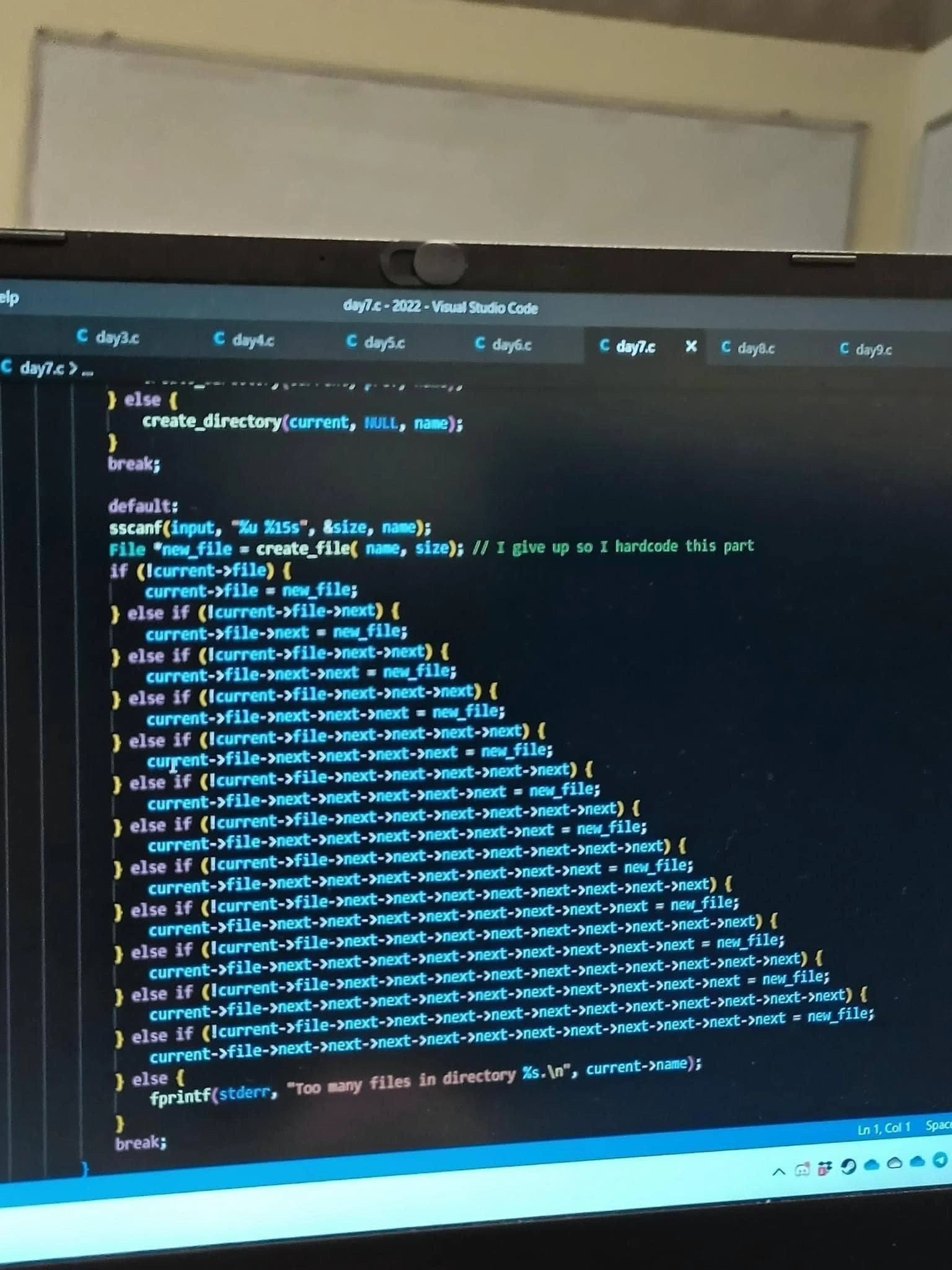
When you forget how loops work in the middle of a linked list problem
Why is this CS Fundamentals meme funny?
Level 1: Why Stop at Eight?
Imagine you’re learning to count, and you decide to write down instructions for yourself. You write: “Step 1: say ‘one’. Step 2: say ‘two’. … Step 8: say ‘eight’. If there are more numbers after eight, just give up and announce ‘Too many numbers!’.” Sounds silly, right? You know you can count beyond eight by just continuing the pattern—nine, ten, eleven, and so on. Stopping at eight is arbitrary and absurd.
That’s exactly what happened in this code. The programmer basically handled counting up to eight things by writing each step out, then quit instead of letting the computer follow a simple repeatable rule for any number. It’s funny because it’s like watching someone refuse to keep going even though the method to continue was obvious. Everyone else expects the counting (or the process) to just continue naturally, but here it halts at an 8th step for no real reason. The joke is that the developer gave up on a proper solution and said “eh, eight is enough,” which is as out-of-place as a person who stops counting at eight and calls it a day.
Level 2: Manual Linked List
Let’s break down what’s happening in that C code. The program is dealing with something like a list of files in a directory. In C, a typical way to keep track of multiple items is a linked list – imagine a chain of nodes where each node points to the next one. Here, current->file points to the first file in the directory. Each file struct in turn has a pointer called next that can link to another file, and so on, forming a chain. Ideally, to add a new file, you’d traverse this chain until you reach the last link and then attach your new file at the end.
However, the code in the meme doesn’t use a loop or recursive function to traverse the list. Instead, the programmer wrote a bunch of consecutive else if checks, each one moving one step further along the chain of pointers. The code basically says:
- If the directory is empty (
current->fileisNULL), put the new file there. - Else if there’s one file but no second file (
current->file->nextisNULL), put the new file in the second spot. - Else if there’s a second file but no third (
current->file->next->nextisNULL), use the third spot. - ... and so on, up to the eighth file in the directory.
- If even an eighth file exists (
current->file->next->next->...->nextat the 8th level isn’tNULL), then we hit theelsecase: print an error"Too many files in directory"and give up. 😖
In simpler terms, the programmer only planned for at most 8 files by explicitly coding each case. This is what we call a hardcoded limit – the number 8 isn’t derived from any configuration or calculation; it’s just how many times they were willing to copy-paste the code! If the directory has a 9th file, the program doesn’t know what to do (other than complain). It’s as rigid as writing a story that only covers scenarios A through H and says “nothing beyond.”
Why is this a problem? Well, it’s both inefficient and risky. Writing essentially the same line (current->file->next = new_file and so on) eight times is a form of duplicate code. If there’s a mistake in that logic, or if you ever need to change how a file is added, you’d have to fix it in eight different places. That’s a maintenance headache. It’s also easy to accidentally make an error in one of those lines (->next->next->next can start to blur together if you count wrong), potentially causing a NULL pointer bug (the kind of bug that gives you a dreaded segmentation fault crash in C).
More fundamentally, this approach ignores basic tools every programmer learns early on. A loop (like a while or for loop) could handle an arbitrary number of files gracefully: it would just iterate until it finds the end of the list. A bit of pseudocode for how it should work is: “while there’s a next file, move on; once you’re at the last file, link the new file there.” The given code instead says “check one step, then two steps, ... up to eight steps.” It’s the opposite of scalable. Similarly, a recursive solution could call itself to walk the list without writing all those steps out manually. Recursion is a technique where a function calls itself to break down a task (like going to the next node and then the next, until the end). The author likely either wasn’t comfortable with recursion or just got too frustrated to implement it properly – the comment “I give up so I hardcode this part” really tells us they hit a wall. We might jokingly call this condition recursion_phobia: an fear of using recursion (or loops) leading to overly manual code.
All of this is a classic example of spaghetti code, a term for code with a tangled, unstructured flow (imagine a bowl of spaghetti noodles going every which way). Here the tangle comes from the pyramid of if/else statements. Even though the code is logically linear, it’s been written in a convoluted, repetitive way that’s hard to follow and easy to mess up. Any programmer reading it will likely groan because it violates the DRY principle (“Don’t Repeat Yourself”). It’s also shouting Technical Debt – meaning the original coder made a quick-and-dirty choice that will cause trouble later. If this were in a real project, someone would have to refactor it (i.e., rewrite the code in a cleaner, more maintainable way, such as using a loop). Until that happens, the codebase owes a “debt” of cleanup work that will need to be paid.
In sum, what we see is a frustrated developer’s workaround: they couldn’t get a generic solution working quickly, so they brute-forced a specific solution with limits. Many new developers have been tempted to do this when stuck — “I’ll just handle the few cases I expect, and hope it never goes beyond that.” It might work for a small input set or a one-time puzzle (like possibly this was from an Advent of Code Day 7 challenge, given the file names), but it’s not the kind of code you want in a real application. The humor (and horror) of the meme comes from recognizing this anti-pattern and remembering our own early-career (or late-night) mistakes. It’s a gentle reminder: use loops or recursion for repetitive tasks, because copy-paste coding not only makes your code long and unwieldy, it also sets a trap for future you (or whoever inherits your code) when the “ ninth file” inevitably comes along.
Level 3: Ladder of Technical Debt
This is the kind of C code that makes seasoned developers cringe and laugh at the same time. In the photo, the developer has built an eight-rung ladder of ->next pointers instead of using a simple loop or recursion. Essentially, they’ve manually unrolled a linked list traversal by copy-pasting the logic eight times in a row. The result? A towering if/else pyramid that screams spaghetti code. Each else if checks one level deeper into a chain of file pointers, like so:
if (current->file == NULL) {
current->file = new_file;
} else if (current->file->next == NULL) {
current->file->next = new_file;
} else if (current->file->next->next == NULL) {
current->file->next->next = new_file;
} // ... imagine this continues on and on ...
else {
fprintf(stderr, "Too many files in directory %s.\n", current->name);
}
Instead of a loop that iterates through the list, the author flat-out wrote separate conditions for the 1st file, 2nd file, 3rd file, ... up to the 8th file in a directory. The last else triggers an error "Too many files in directory %s" once they run out of these hardcoded steps. In other words, the program arbitrarily supports only 8 files per directory because the coder was literally too exhausted to handle the 9th. This isn’t a system limit – it’s a self-imposed cap born out of frustration. The comment in the code, // I give up so I hardcode this part, says it all.
For any experienced engineer, this is a textbook AntiPattern. We have a manual linked list traversal where the poor soul has essentially done the computer’s work by hand, one pointer at a time. It’s as if the developer had a phobia of for loops or a traumatic recursion incident and decided, “Nah, I’ll just brute-force it with copy-paste.” The irony is that writing a proper loop would have been less work and far less error-prone:
// A refactored approach to append a new_file to the list
File *iter = current->file;
if (iter == NULL) {
current->file = new_file;
} else {
while (iter->next != NULL) { // traverse to the end of the list
iter = iter->next;
}
iter->next = new_file; // attach the new file at the end
}
The loop above achieves in a few lines what that eight-level pyramid did with dozens. It handles any number of files (limited only by memory) instead of halting at an arbitrary hardcoded depth. The meme exaggerates a real code smell: it’s like the coder built a ladder with exactly 8 steps and decided anything taller is “too many.” This approach is brittle and screams TechnicalDebt. The next time someone adds a 9th file, this code will break – or rather, rudely refuse to work by printing that error to stderr. Then it’s 3 AM, an on-call engineer is reading that "Too many files" message, and muttering screaming “Who the heck wrote this?!” while digging through the source.
Seasoned devs recognize this as a RefactoringNeeded scenario ASAP. It’s amusing in a throwaway Advent-of-Code puzzle (the open tabs day3.c...day7.c hint at a coding challenge progression, so by Day 7 our hero was probably too tired to care about elegance). But if such CodingMistakes find their way into real codebases, they become landmines. Maintaining this is a nightmare: every time you need to extend the logic, you’d add another nearly identical block – increasing the chance of bugs and making future readers question your CS degree. As one commenter dryly noted, “Data structures alumni, I see.” – implying the coder apparently graduated a data structures course but forgot to apply the actual lessons. This meme is funny because it spotlights a painfully common lapse in using basic programming constructs, one that every experienced dev has seen (or unfortunately written) at least once under deadline pressure.
Description
A close-up photograph of a laptop screen displaying C code in a dark-themed editor, likely Visual Studio Code. The code shows an egregiously long chain of 'if-else if' statements. The programmer is attempting to add a new file to a directory, which is structured as a linked list. Instead of iterating through the list with a loop to find the end, they are manually checking each 'next' pointer one by one, from 'current->file->next' to 'current->file->next->next->next...' and so on. A prominent comment in the code reads, '// I give up so I hardcode this part', perfectly capturing the developer's moment of defeat. The final 'else' block prints an error 'Too many files in directory'. This is a humorous example of an anti-pattern, showcasing a complete misunderstanding or abandonment of fundamental data structure traversal, and is something that would make any experienced programmer cringe or laugh in recognition of past struggles

Comments
15Comment deleted
It's not a bug, it's a feature: the directory has a hard-coded file limit, which is directly proportional to the developer's rapidly depleting sanity
Nothing says “enterprise-ready” like unrolling your linked-list traversal by hand until the diff reviewer scrolls for longer than the algorithm actually runs
This is what happens when you realize writing a while loop would've taken 30 seconds, but you're already 10 levels deep in copy-paste commitment and sunk cost fallacy has entered the chat. The '// I give up' comment is the software equivalent of a white flag planted in a field of pointer dereferences
When your linked list traversal looks like you're playing 'next->next->next->next->next' telephone with yourself, you know you've reached that special moment in Advent of Code where proper data structures become 'tomorrow's problem.' The comment '// I give up so I hardcode this part' is the developer equivalent of a white flag - honest, relatable, and a perfect encapsulation of the 3 AM debugging mindset where O(1) lookup suddenly seems less important than O(1) sanity preservation. At least they capped it at 15 levels deep; somewhere a CS professor just felt a disturbance in the force
Turning linked-list traversal into a 20-level else‑if ladder: congrats, you achieved O(1) - as long as the directory has ≤19 files and your cyclomatic complexity has its own SLO
Manually unrolling a linked‑list insert: O(1) until file #17, then O(outage) with an SLA of fprintf(stderr, "Too many files...")
Hand-rolled exclusions: because array.includes() allocates too much 'technical debt memory'
задания школы 42, нет? Comment deleted
Please use English in ths chat Comment deleted
never even paid attention that all messages here are in english, lol this is tasks of school 42(ecole 42), no? Comment deleted
lmao Comment deleted
It’s either school 42 or adventofcode Comment deleted
I hate English Comment deleted
Well, that's probably your problem There are rules in this chat (they also apply to comments) and they prohibit using any language except English when no translation or explanation is given Comment deleted
this do be lowkey kinda true tho, still good enough for me tho(i just dont know other languages) Comment deleted