Skip to content
DevMeme
4962 of 7435
The Ultimate CAPTCHA Defiance: Not Today, Skynet
AI ML Post #5429, on Sep 13, 2023 in TG

The Ultimate CAPTCHA Defiance: Not Today, Skynet

Why is this AI ML meme funny?

Level 1: Not Helping the Bad Robot

Imagine a really bad robot from a movie wants to find a particular hero’s mom so it can stop the hero from ever winning. This meme is like a little story where the robot tries to trick people into helping. It shows a test on a computer that says “Pick all the pictures of Sarah Connor” – Sarah Connor is the mom of the hero who will fight the bad robots in the Terminator movies. Normally, we see tests online asking us to click pictures of cats or traffic lights just to prove we are a real person. But here it’s asking for a person. That’s strange and funny! It's as if the evil robot (named Skynet in the movies) is sneaking around saying, "Hey human, can you help me find this lady?"

In the second part, someone replied with a comment saying basically: “Nice try, robot, but I’m not going to help you find the mother of the resistance!” In very simple terms, that person is refusing to help the bad guy. It’s like if a villain showed you a bunch of school photos and said, “Point out which one is your friend so I can go get them,” and you respond, “No way, I won’t tell you!” Here, the villain is a fictional evil computer, and the friend’s mom is Sarah Connor, who is super important to the good guys. The whole joke is funny because we usually do what these little online tests ask without thinking much, but this time the task looks suspiciously evil. The person recognizes the picture (Sarah Connor from the movie) and jokingly acts like by refusing to click, he’s protecting the hero and foiling the evil plan.

So, the emotional core of this meme is about standing up to a bad request in a playful way. It’s a bit like saying, “I won’t be a helper for something bad.” Even though in reality clicking some pictures online isn’t as dramatic as saving the world, it feels good (and funny) to imagine that by not clicking, you’re joining the rebel team against an evil robot. It’s a silly pretend scenario that makes people laugh, especially if they know the Terminator story. Basically: a computer asks for help with something sneaky, and the human proudly says, “Nope, I’m not helping the bad robot today!”

Level 2: How CAPTCHAs Train AI

Let’s break down the meme for a newer developer or anyone not deep into AI yet. First, CAPTCHAs are those little tests you see on websites that ask you to do something like “select all images with traffic lights” or type some wavy letters. CAPTCHA is actually an acronym for "Completely Automated Public Turing test to tell Computers and Humans Apart." In simpler terms, it’s a test to confirm you’re a real human, not a spam bot or malicious script. reCAPTCHA is a popular version provided by Google. You’ve probably encountered a reCAPTCHA where you check a box or click on image tiles. It started as a security measure, but reCAPTCHA has a clever second purpose: while you’re proving you’re human, you’re also providing data. For example, when you mark all the pictures with a crosswalk, Google uses those answers to teach its machine learning models what a crosswalk looks like in images. In other words, you’re helping train an AI’s vision. This is known as crowd-sourced labeling – using the crowd (lots of internet users) to label data (like images) that will improve an AI.

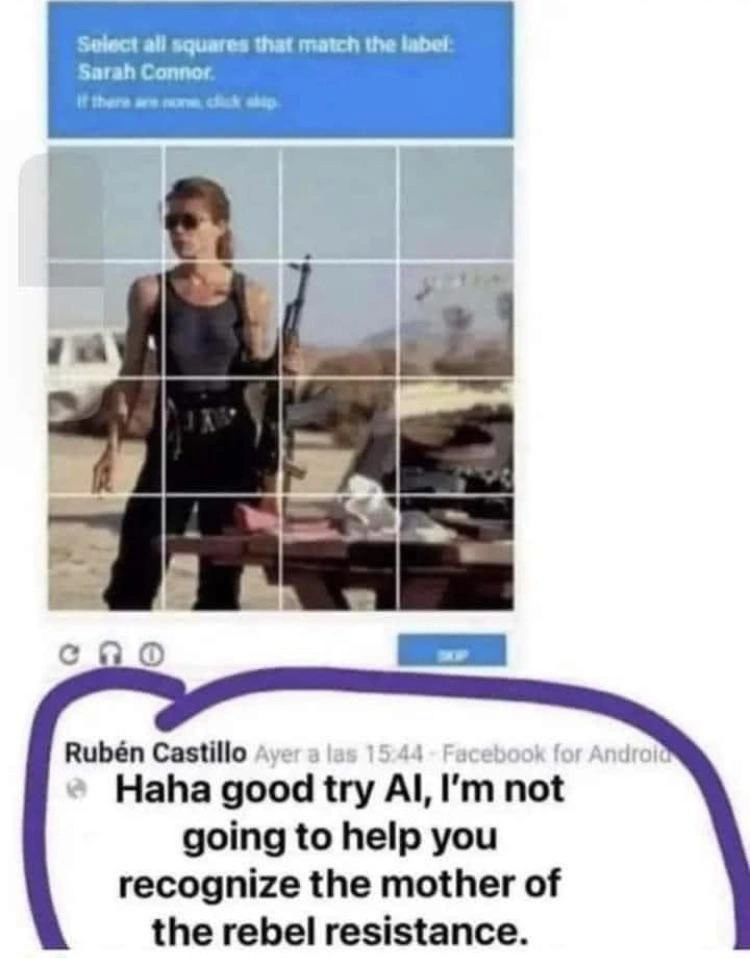
Now, the meme shows a fake CAPTCHA prompt asking to identify Sarah Connor. This is funny because usually the prompt is something boring and generic (cars, trees, stop signs), not a specific person’s name! Sarah Connor is a character from the famous Terminator movies. In that story, an AI called Skynet becomes self-aware and tries to eliminate humans to prevent them from stopping its plans. Sarah Connor is important because she’s the mother of John Connor, the future leader of the human resistance against the machines. Skynet views her as a threat (since her son will lead the rebels), so it wants to find and eliminate her before that future happens. The meme imagines that somewhere in our world, an AI (like Skynet) inserted a tricky CAPTCHA to get humans to help it recognize what Sarah Connor looks like. The instruction “If there are none, click skip” is standard in CAPTCHAs, but here it has a dramatic twist: if you don’t see Sarah Connor, you’d skip, implying maybe she’s not in the photo. But the image behind the grid does show Sarah Connor (from Terminator 2, with her tactical gear and rifle). So the “correct” action would be to click all tiles that contain parts of her figure. Doing so would, hypothetically, confirm to the AI which parts of the image are Sarah Connor. In a real AI training sense, that’s like labeling the image “Sarah Connor = present.” Enough labels like that, and an AI could learn to pick her out in new photos – that’s basically facial recognition training on a very specific target!

The bottom half of the meme is a screenshot of a Facebook comment by a user named Rubén Castillo. He wrote: “Haha good try AI, I’m not going to help you recognize the mother of the rebel resistance.” He’s joking that he sees through this clever scheme. In plain terms: he realizes this CAPTCHA is trying to trick him into helping an AI identify Sarah Connor, and he refuses to participate. This is humorous because obviously in reality no website is literally asking people to identify Sarah Connor – this is a made-up scenario. But it references the real concern that when we do those real image CAPTCHAs, we are helping AI systems learn (usually harmless things like reading house numbers or identifying road features, but potentially also things like faces). There’s an underlying data privacy and ethics joke: what if our actions online are used to build something we wouldn’t agree with, like a surveillance system or, in this case, Skynet’s kill list?

For a junior developer, the key context tags here like AIHumor and MachineLearningHumor mean it’s a joke in the AI/ML space, and DataPrivacy means it touches on concerns about how data (especially personal or identifying data) is used. Terminator_reference, sarah_connor, skynet_warning all point to the Terminator story being central to the meme’s setup. So if you know the movie, you instantly get why identifying Sarah Connor for an AI is ominous. And if not: just know Sarah is basically “the good guy’s mom” and Skynet is “the bad AI.” Crowd_labeling and ai_data_collection highlight that this scenario is a form of crowd-sourced data gathering. Companies really do this: for example, Tesla once used images from its cars and even games for people to label objects to improve its self-driving AI. Here the “company” is jokingly an evil AI. Finally, the hashtag #fightAI and context human_resistance_meme show that this post is about humans jokingly resisting AI. It’s a playful scenario where the human (the commenter) believes he’s doing his part to thwart the rise of the machines by not giving the AI what it wants.

Summing up: The meme combines a geeky sci-fi reference with a real-life tech insight. It’s saying, “Hey, these CAPTCHAs are basically making us unpaid AI trainers – and what if that AI we’re training turned out to be evil, like Skynet? Wouldn’t you refuse to help too?” It’s funny to developers because it exaggerates a truth (we do label data for AI via CAPTCHAs) in a dramatic way (helping a fictional world-dominating AI pick out its target). Plus, for anyone who’s ever rolled their eyes at yet another “select all the storefronts” test, the idea of finally saying “Nope, I won’t do your dirty work!” is kind of satisfying. Even if it’s about a movie character, it’s a small fantasy of sticking it to the (robot) man.

Level 3: Labeled for Termination

This meme hits a nerve with seasoned developers by combining a Terminator reference with an insider joke about CAPTCHA data labeling. The top panel mimics a typical reCAPTCHA prompt: “Select all squares that match the label: Sarah Connor.” That alone is comically absurd – unlike the usual "traffic light" or "crosswalk," we have a specific person’s name. It’s immediately recognizable to sci-fi savvy engineers as Sarah Connor, the iconic character from Terminator who is targeted by the evil AI Skynet. If you’ve been around tech (and pop culture), you get the double joke: not only is the AI asking you to prove you’re human, it’s cheekily outsourcing the job of identifying its target. It’s as if Skynet snuck into the everyday internet, turning a security test into free facial recognition training for its hunter-killer robots. The Facebook commenter’s line — “Haha good try AI, I’m not going to help you recognize the mother of the rebel resistance.” — nails the punchline. Experienced devs chuckle because they see two things here: the Terminator plot reference, and the real-world truth that CAPTCHAs are indeed a form of crowd-sourced labeling that benefits AI training.

In practice, we all know those image selection CAPTCHAs aren't just for security; they’re feeding data to some machine learning model. Google’s reCAPTCHA famously had us identifying traffic signs, buses, and hydrants to train their self-driving car algorithms and Google Maps data. It’s a bit of an open secret in the industry: every time you “prove you’re not a robot,” you’re also helping a robot learn. This meme exaggerates it with a dystopian twist — instead of training benign apps, you’re training Skynet itself! The Sarah Connor label is a brilliant comedic escalation because it implies a serious breach of Data Privacy and ethics: you’re being tricked into helping an AI locate a specific person for nefarious reasons. Seasoned engineers appreciate this dark humor because it echoes real ethical concerns. We worry about how our technologies (like facial recognition) might be used in surveillance or authoritarian contexts. Here, Skynet is the ultimate metaphor for those fears: an AI using innocent people to build a dataset that ultimately could be used to oppress or eliminate humans.

The meme also jabs at the uneasy feeling of AI hype vs reality. The hype says AI is intelligent and autonomous, but reality often is that AI needs tons of human-labeled examples to get anything right. So the AI (even a hyper-advanced one like Skynet) still relies on us poor humans clicking squares. There’s irony and AI humor gold in that: the almighty future robot overlord can’t even recognize its prime target without crowdsourcing help on the internet! This aligns with developer cynicism around things like “AI wizardry” that in truth is sometimes propped up by hidden human labor (be it CAPTCHAs, Amazon Mechanical Turk, or massive labeling teams). We’ve seen cases where what’s sold as cutting-edge AI was actually a bunch of humans behind the scenes quietly doing the hard parts (the old Mechanical Turk trick in modern form). So when Rubén Castillo declares he won’t contribute, it’s a small act of rebellion that resonates. It’s the engineer’s equivalent of saying, “I refuse to add to this technical debt or shady data practice.”

In essence, the meme is funny for its blend of machine learning humor and sci-fi: it imagines a world where our innocuous clicks are literally aiding Skynet’s evil plan. The hashtag #fightAI in the post caption encapsulates that tongue-in-cheek resistance. It’s not that developers literally believe a Terminator scenario is unfolding via CAPTCHAs, but we’ve all had that moment of hesitation: What exactly am I helping here? The humor works because it validates that paranoid spark — maybe training all these AI systems blindly isn’t such a great idea. It’s a communal wink among tech folks who understand how AI data collection works. We laugh, and maybe nervously think, “hey, better safe than sorry – I’m gonna click ‘Skip’ on this one.”

Level 4: Reverse Turing Gambit

At the cutting edge of AI and human interaction, this meme pokes at the theoretical core of the Turing test and CAPTCHA systems. Originally, a CAPTCHA (Completely Automated Public Turing test to tell Computers and Humans Apart) exploits tasks that are trivial for humans but hard for machines – a direct application of Alan Turing’s ideas on distinguishing humans from AI. Here, that idea is turned on its head: the machine is effectively running a reverse Turing test, not just to verify you’re human, but to learn from you. By asking users to identify Sarah Connor in images, the system is leveraging human computation to improve its own computer vision model. This is a real-world example of interactive learning in AI – the algorithm outsources what it can’t do (reliably recognizing Sarah Connor’s face) to a vast, unpaid network of human labelers. Each click on the correct squares provides a new piece of training data, subtly refining the model’s parameters.

From an academic perspective, this relates to supervised learning and even active learning techniques: the model queries humans for labels on data it’s uncertain about. It’s a high-tech take on crowd-sourced data labeling – akin to a digital assembly line feeding an AI’s knowledge base. There’s a fascinating (and slightly eerie) feedback loop here. As humans solve these CAPTCHAs, the AI’s facial recognition capability improves, shrinking the set of tasks where humans outperform machines. In machine learning theory, one might recall the No Free Lunch theorem – there’s no universally superior model without domain-specific data – and CAPTCHAs are a sneaky way to collect that domain-specific data. In practice, the "clever AI" in the meme is exploiting this theorem by gathering exactly the images it needs (pictures of its target, Sarah Connor) labeled by the only source that can reliably do it: actual people.

This mix of pop culture and theory highlights a broader point: as AI systems advance, the boundary of what’s hard for machines, easy for humans constantly shifts. Years ago, reading distorted text was challenging for AI but trivial for us – hence CAPTCHAs with squiggly letters. Today’s neural networks have largely solved text recognition, so modern CAPTCHAs pivot to images of street signs, buses, or apparently resistance leaders. It’s almost an AI arms race. The better AI gets at vision, the more complex the CAPTCHA challenges become (and the more they resemble free training data). The Terminator reference adds a tongue-in-cheek AI ethics layer: we’re essentially teaching an AI to identify a target – a scenario that tickles discussions from sci-fi literature and real AI policy debates alike. After all, a Skynet-style artificial general intelligence might very well need massive datasets to truly become self-sufficient. Who better than unwitting humans to build out those datasets? The meme humorously surfaces this theoretical concern that by helping machine learning models with innocuous tasks, we could be contributing to an AI that eventually outsmarts or overpowers its creators (a classic Judgment Day scenario). It’s a playful jab, but it reflects genuine academic quandaries about human-in-the-loop systems: we are both the teachers and the gatekeepers of AI, which raises the question – could we inadvertently be teaching it too well?

Description

This meme consists of two parts. The top part is a screenshot of a CAPTCHA test, the kind used to verify a user is human. The prompt reads, 'Select all squares that match the label: Sarah Connor.' The image below is a grid overlay on a picture of the character Sarah Connor from the movie 'Terminator 2: Judgment Day', looking tough and holding a rifle. The bottom part of the image is a screenshot of a Facebook comment which has been circled in purple for emphasis. The comment, by Rubén Castillo, says, 'Haha good try AI, I'm not going to help you recognize the mother of the rebel resistance.' The humor is layered: it acknowledges that by solving CAPTCHAs, humans are providing labeled data to train AI models. In the context of the Terminator franchise, where a malevolent AI (Skynet) tries to eliminate humanity, the user is humorously refusing to help the 'AI' learn to identify its greatest enemy, thus preventing the future robot apocalypse
Comments

9
Anonymous ★ Top Pick The irony is that by refusing to label Sarah Connor, he's probably just creating an outlier that the model will spend 80% of its training time on. The resistance is only making Skynet stronger
  1. Anonymous ★ Top Pick

    The irony is that by refusing to label Sarah Connor, he's probably just creating an outlier that the model will spend 80% of its training time on. The resistance is only making Skynet stronger

  2. Anonymous

    reCAPTCHA used to teach models what a crosswalk looks like - now it wants Sarah Connor; pretty sure that’s the point where you return 403 Forbidden

  3. Anonymous

    After 20 years of training neural networks, you realize the real irony isn't that we're teaching machines to see - it's that we've become the unpaid mechanical turks in our own dystopian future, one CAPTCHA at a time. At least Sarah Connor had the dignity of being hunted by a T-800, not conscripted into labeling training data for Skynet's computer vision pipeline

  4. Anonymous

    When your CAPTCHA system asks you to help train the very AI that will eventually hunt down humanity's last hope, but you've seen Terminator 2 enough times to know better than to label Sarah Connor for Skynet's image recognition model. Classic case of adversarial training data poisoning - except the adversary is literally trying to prevent the robot apocalypse. Somewhere, a machine learning engineer is wondering why their model's precision on 'action movie protagonists' keeps dropping

  5. Anonymous

    reCAPTCHA's greatest trick: turning bot defense into free data labeling; sorry Skynet, I'm not contributing ground truth for target_acquisition_v3

  6. Anonymous

    Billion-param vision model meets wasteland mom: confidence score nosedives faster than a legacy monolith under load

  7. Anonymous

    Not falling for the reCAPTCHA mechanical-turk; I'm not donating labels to your computer-vision pipeline - my risk register lists accidentally bootstrapping Skynet as a Sev-0

  8. @kulikov0 2y

    😁😁😁😁😁😃😃😃😃

    1. @Ra_zor 2y

      Ah, didn't get it at first, thanks for clarification!

Use J and K for navigation