Skip to content
DevMeme
6192 of 7435
The Unrelenting Pressure of AI Competition Personified
AI ML Post #6790, on May 23, 2025 in TG

The Unrelenting Pressure of AI Competition Personified

Why is this AI ML meme funny?

Level 1: Runaway Train

Imagine a big toy train that just keeps going around the track faster and faster, and nobody can find the stop button. Every time someone tries to slow it down, it just chugs even harder. This meme is like saying Google is that runaway train. Google keeps rolling out new things one after another, like a machine that never takes a break. The picture shows a worried helper whispering to his boss, kind of like, “We can’t stop it!” It’s funny in the way a cartoon is funny when the hero is trying to plug a leaking dam with their fingers but new leaks keep spurting out. The feeling it gives is a mix of amazement and panic: Google won’t slow down, and everyone else is left spinning in circles trying to catch up. Even if you don’t get the tech details, you can laugh at the idea of something so over-the-top unstoppable – it’s like watching someone try to hold back a tidal wave with a paper cup. The humor is in that hopeless, exaggerated chase, which makes us grin and think, “Yep, Google is on a roll and nothing’s gonna stop that anytime soon!”

Level 2: No Brakes

Let’s break down the tech lingo and scenario for a newer developer or anyone outside the bubble. Google’s release velocity just means how fast Google launches new stuff – new products, features, updates, you name it. Google is known for doing this very quickly. If you’ve ever used Chrome or Android, you’ve probably seen how often they get updated. High release velocity is a hallmark of modern tech giants: updates can roll out weekly or even daily behind the scenes. It’s like Google’s development teams are on a high-speed conveyor belt of continuous delivery.

Now, what is exponential back-off? This is a technique used in computing to throttle (slow down) repeated actions, especially after failures. “Exponential” means growing very fast (doubling, tripling, etc.), and “back-off” means waiting. For example, say your app is calling a Google API and it starts getting errors because you’re sending requests too quickly. Instead of spamming retry every second (which could make things worse), the app will wait 1 second before the first retry, then 2 seconds before the next, then 4 seconds, then 8, and so on. That delay grows exponentially. This way, you ease off the gas if something’s wrong, giving the server time to recover. It’s a bit like if you knock on a door and nobody answers, you wait longer and longer between knocks so you don’t annoy the person inside. In code, it might look like:

delay = 1  # start with 1 second
while not success:
    try:
        response = call_google_api()  # attempt the action
        success = True  # if we got here, it worked
    except TooManyRequestsError:  # got told to slow down
        print("Oops, too fast! Backing off...")
        time.sleep(delay)      # wait for a bit
        delay *= 2             # double the wait time for next try

This rate-limiting approach usually works well to prevent overwhelming a system. It’s a built-in brake pedal for software.

So when the meme says even exponential back-off can’t throttle Google’s release velocity, it’s painting a comic picture: Google is launching things so frequently that even if you double the wait time each attempt to catch your breath, you’d still never catch up. Imagine you’re trying to keep up with Google’s announcements or changes – you tell yourself, “Okay, I’ll take a longer pause before checking again,” and every time you peek, boom, there are a dozen more updates. 😅 It’s like playing a game of Red Light/Green Light, except the light is always green for Google.

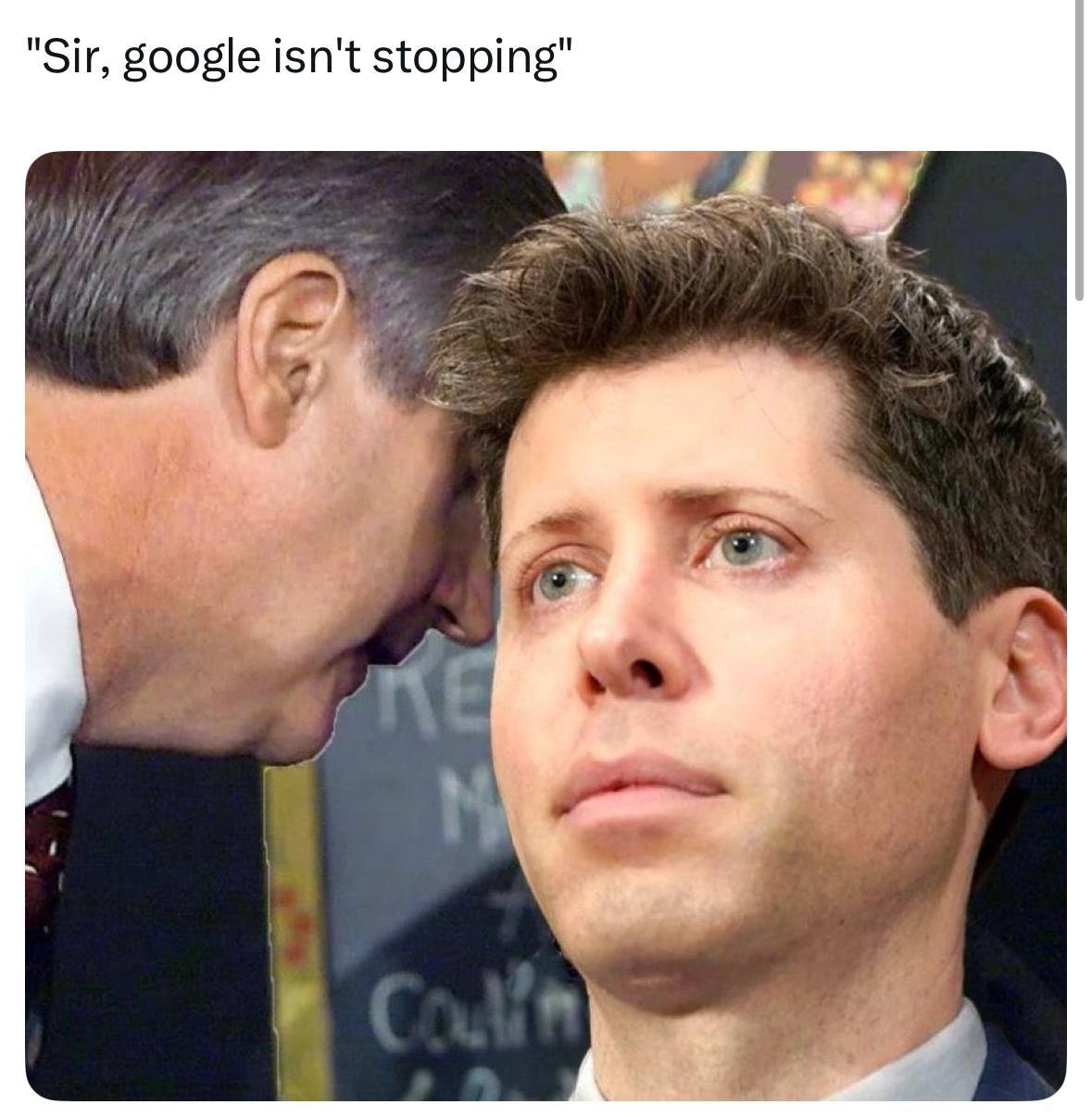
The image reinforces this: a suited man urgently whispers “Sir, Google isn’t stopping” into another man’s ear. This looks like a scene from a crisis, right? The kind of whisper you’d expect if something very concerning was happening. The humor is that the “concerning thing” is just Google’s unstoppable stream of activity. It suggests that maybe a competitor company’s leadership or even government officials are nervously watching Google and saying, “We tried to slow them down or wait them out, but they just keep going.” In simpler terms, everyone else is like, “When will Google take a break?!”

Why is this TechHumor? Because in the tech world, Google has a bit of a reputation: they move fast, sometimes break things (or kill things off), and then move on to the next big idea. People working in tech (from junior devs to CTOs) have felt that pressure. Maybe you just learned Google’s library A, and then they announce Library B that replaces it. Or you finally finished adapting to one policy change, and then a new update drops. This meme exaggerates that feeling to an extreme: it’s as if Google is a speeding car with no brakes, and everyone else is just holding on, wide-eyed. The tags like unstoppable_google and bigtech_dominance hint that this isn’t only about engineering – it’s also about how huge Google’s presence is in the industry. When Google doesn’t slow down, it affects a lot of people and companies.

In short, the meme uses a splash of technical concept (exponential back-off) in a funny way to say: “Google moves so fast, nothing can slow it!” Even if you’re new to tech, you can understand that means Google’s always doing something new, and it’s a challenge for everyone else to keep pace.

Level 3: Rate Limit Exceeded

In this meme, we see a frantic whisper:

"Sir, Google isn't stopping."

That single line sets a scene every seasoned engineer and tech executive can imagine. It sounds like an exhausted ops engineer reporting a production incident, except the “incident” here is Google’s relentless launch spree. The humor comes from treating Google’s product releases as if they were a DDoS attack on the rest of the industry – an onslaught so continuous that even an exponential back-off (normally a very effective brake in tech systems) isn’t slowing it. Essentially, Google has turned up its release velocity to a level that triggers panic in competitors, partners, and maybe even regulators.

Why is this funny to industry veterans? Because it’s painfully relatable. Google is notorious for its firehose of new products, features, rebrands, and even surprise deprecations. One running joke in the developer community is the Google Graveyard – the long list of products Google launched with fanfare then quietly killed when they didn’t take off (RIP Google Wave, Google Buzz, Google+…). But here we’re not even mourning the dead ones; we’re ducking for cover from the swarm of new arrivals. It’s like the continuous deployment dial got stuck on 11. 😅

Consider Google’s track record: Android and Chrome updates flying out on schedule so fast you lose count of the version numbers, rebrands like G Suite transitioning to Workspace overnight, and messaging apps multiplying like rabbits (Hangouts, Chat, Meet, Allo, Duo – who can keep up?). As a senior developer, you might wake up to find half your tech news feed filled with “Google announces X” and “Google launches Y in beta”. Integrating with a Google API? Blink and you’ll find a new version or a deprecation notice (“Legacy API shutting down next quarter – please migrate ASAP”). Maintaining a project that relies on Google’s ecosystem often means constant chase: by the time you implement the last change, a new change request comes in because Google shipped a revision. It genuinely feels like trying to hit a moving target that’s moving faster each day.

From an IndustryTrends and CorporateCulture standpoint, this meme nails an irony: In Silicon Valley, Big Tech Companies compete partly by out-iterating everyone else. Google’s culture famously encourages rapid innovation – employees get 20% time for side projects, teams are rewarded for launches, and beta releases flow freely. The result? A company that’s always in hyperdrive, launching moonshot projects and incremental improvements in parallel. Smaller competitors often operate with a healthy fear of this pace. Imagine being a startup CEO and hearing Google just deployed a product exactly like your niche offering and did it before you even exited beta. It’s terrifying! The meme’s whispered tone (“Sir, Google isn’t stopping”) could very well be a VP briefing a CEO or a general counsel alerting a policy maker. It echoes real worries that Google’s expansion into every domain — from cloud services to self-driving cars to AI — is like a line of dominoes falling too fast to react to. Even regulators feel this; by the time an antitrust case is investigated, Google has moved on to new markets or changed the game, effectively dodging the slow-moving “throttle” of government intervention.

The choice of words also parodies tech jargon seeping into executive panic. “Exponential back-off” is what developers implement to politely slow things down, for example, when hitting Google’s own servers too rapidly. The meme flips it: now we wish we had a way to slow Google down! It’s a wry nod to the power dynamic: Google is the one usually setting the rules (rate limits on APIs, update schedules for Android, etc.), and everyone else must adapt. Here, even a theoretically robust strategy (exponential back-off) can’t handle the accelerant that is Google’s release cadence. For seasoned folks, there’s a dark chuckle in that: it’s as if Google is running at “warp speed” while the rest of us are stuck with regular engines, furiously trying to not burn out. The industry irony is strong with this one — it highlights both Google’s dominance and the absurd feeling of chasing a train that just won’t hit the brakes.

Level 4: Escape Velocity Achieved

Exponential back-off is a classic rate-control algorithm deeply rooted in networking and distributed systems. In the early days of Ethernet, when two devices would transmit data at the same time (a collision), they were designed to wait before retrying – and not just wait a fixed time, but an exponentially increasing time. First collision? Wait a random interval up to 1 unit. Collision again? Wait up to 2 units, then 4, and so on. This doubling delay strategy is mathematically proven to prevent an overload of retries; it's a form of back-pressure that gives breathing room to busy systems. We see exponential back-off everywhere – from TCP network congestion control to API client libraries – as a fundamental way to throttle (slow down) requests and avoid meltdown.

So what happens when something grows faster than the throttle meant to restrain it? That’s the absurd scenario this meme hints at. Google’s release velocity has essentially reached a kind of escape velocity – a speed so high that normal damping mechanisms (like our trusty exponential back-off) can’t pull it back down to a manageable rate. In control theory terms, it’s like a feedback loop stuck on positive gain: no amount of error signal (e.g. warnings, market saturation, or even regulatory fines) is reducing the output. If one process is accelerating super-linearly, even an exponential delay on the other side might always lag behind. The meme’s joke is a hyperbole: it imagines Google as an unstoppable force in a system designed to slow things down. In physical terms, think of a rocket (Google’s innovation drive) that’s broken free of Earth’s gravity (the industry’s ability to impose limits). The usual algorithms that keep systems stable just can’t keep up. It’s as if Google’s deployment pipeline is ignoring every “collision detected, please wait” signal and screaming ahead packet-loss be damned. Such a concept tickles engineers’ brains because it mixes serious engineering principles with corporate behavior: a Big Tech company acting like a runaway process that no rate-limiter on Earth can tame.

Description

This meme uses a popular format where one person whispers urgently into another's ear. The image features a close-up of OpenAI CEO Sam Altman, who has a distant, concerned, and slightly stressed look on his face. An older man is leaning in and whispering directly into his ear. The caption at the top of the image reads, '"Sir, google isn't stopping"'. The humor and relatability for a technical audience come from the dramatization of the intense, high-stakes competition in the artificial intelligence industry. It perfectly captures the immense pressure faced by leaders like Altman, implying that even with groundbreaking achievements, the threat from a relentless, resource-rich competitor like Google is ever-present. The meme transforms a corporate battle into a moment of personal, cinematic tension, resonating with anyone in a competitive tech field who knows the feeling of a rival's footsteps constantly behind them


Comments

10
Anonymous ★ Top Pick That's the look you have when you've just shipped a revolutionary new model, but then you remember Google has more TPUs than you have lines of code
  1. Anonymous ★ Top Pick

    That's the look you have when you've just shipped a revolutionary new model, but then you remember Google has more TPUs than you have lines of code

  2. Anonymous

    Apparently someone configured Google’s deploy pipeline with while(true){ ship(); } and forgot the global rate-limiter AND the antitrust circuit-breaker

  3. Anonymous

    After 20 years in tech, you learn there are only two certainties: your perfectly working legacy system will need a complete rewrite next quarter, and Google will either kill your favorite service or build a competitor that makes your entire product roadmap obsolete - sometimes both in the same announcement

  4. Anonymous

    Ah yes, the classic "Google isn't stopping" scenario - when your pagination logic forgets the base case and you're suddenly serving the entire internet one scroll at a time. It's the production equivalent of `while(true)` with a corporate dress code, where the only thing infinite is your regret for not implementing circuit breakers and the number of Slack notifications from your monitoring system. At least when your recursive function doesn't terminate, it only crashes your IDE - when Google doesn't stop, it crashes your weekend plans and your SLA

  5. Anonymous

    Every system is web-scale until Googlebot discovers the un-cached search endpoint - then your SLO becomes folklore, 429s become confetti, and the incident bridge needs overflow capacity

  6. Anonymous

    When your bug's so obscure, Google's crawl budget deems it non-canonical

  7. Anonymous

    Exec: open a ticket to pause Google; SRE: unless kubectl scale competitor --replicas=0 exists, all I’ve got is robots.txt and prayer-based rate limiting

  8. @ZgGPuo8dZef58K6hxxGVj3Z2 1y

    I've sent this to a bunch of my friends. They didn't get the reference. So if you are one of them, this is a reference to "They've hit the second tower" when Bush was reading a childrens book while 9/11

    1. @SamsonovAnton 1y

      But who are those guys and what they are talking about (besides that it's something Google-related)?

      1. @ZgGPuo8dZef58K6hxxGVj3Z2 1y

        The left is George Bush's Security (?) the right one was where George Bush sitting but now it got replaced by Sam Altman who is the CEO of OpenAI. Google just released a bunch if shit that directly competes with OpenAI including their copy cap 249$/mo subscription 🗿

Use J and K for navigation