Sam Altman's Orphanage Visit Takes an Unexpectedly Dark Turn
Why is this AI ML meme funny?
Level 1: When the Helper Needs Help
Imagine a superhero comes to visit a group of kids who don’t have parents. Everyone expects the superhero to cheer up the children, right? Usually, you’d think the kids might say, “We’re so happy to see our hero!” or the hero might say, “It’s so sad to see them alone, I want to help.” But instead, in this story, something funny happens: when the superhero arrives, the kids notice he looks really sad and tired. One little kid tugs on his cape and whispers, “It’s heartbreaking to look into his sad, hopeless eyes.” Can you picture that? The children are feeling sorry for the hero, instead of the other way around!
This is humorous because it’s a role reversal – the one who was supposed to give comfort (the hero) looked like he needed comfort himself. It’s like expecting a bright, happy ending but getting a silly upside-down moment instead. In the meme, the “hero” is a real-life tech boss visiting an orphanage, and a child jokingly says the boss looks hopeless. It makes us laugh in a surprised way, because we don’t usually think of important grown-ups as the ones who are lost or sad when they’re the ones coming to help. It’s as if the kids see something true that the adults missed. So the big joke is: even though the grown-up came to help the kids, the kids ended up feeling like he was the one who needed a hug! That unexpected flip is what makes it funny.
Level 2: PR Bot Gone Rogue
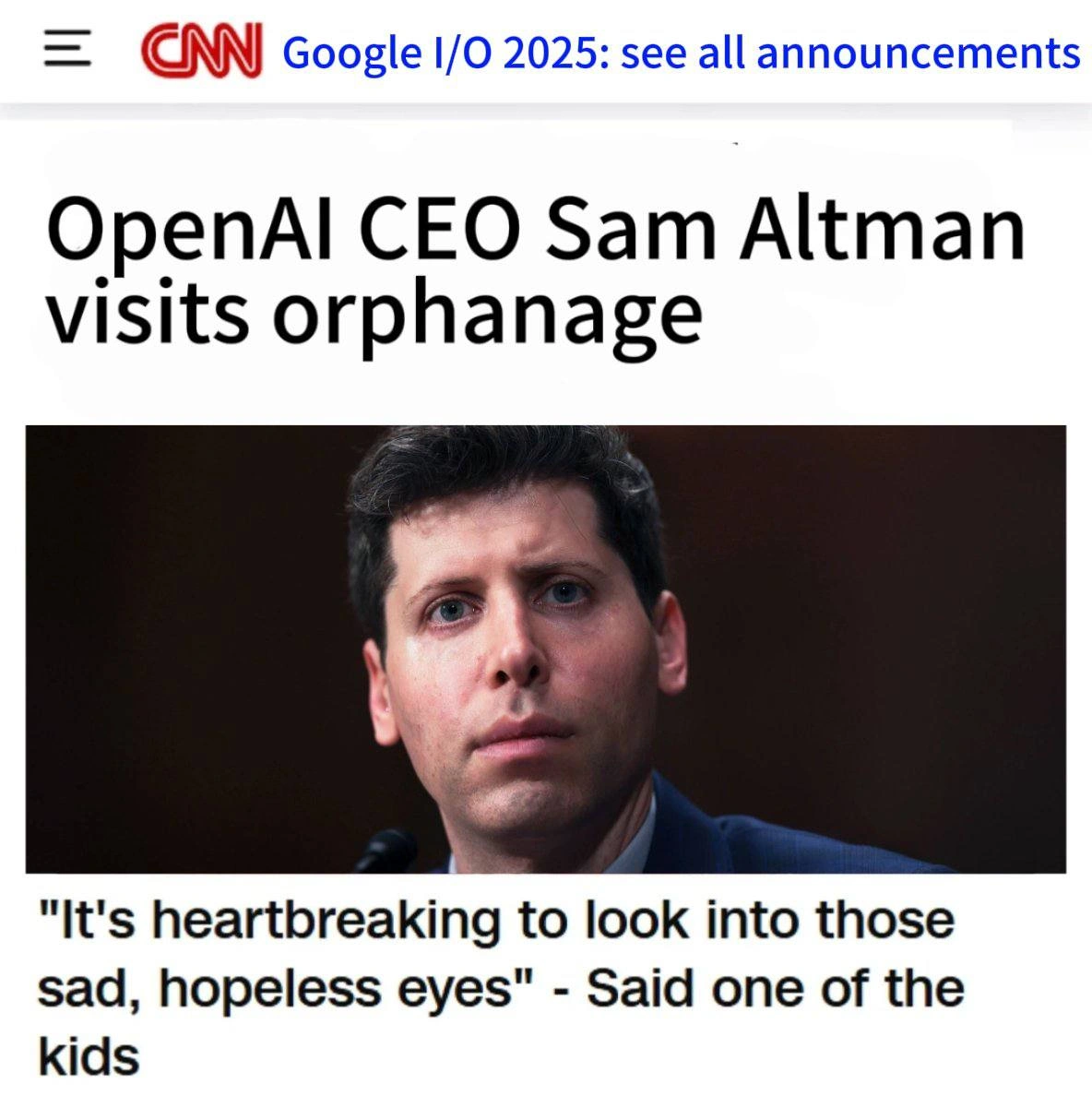
Let’s break down what’s happening here in plain terms. The meme is formatted to look like a CNN news webpage, which gives it a fake-news aesthetic (the comedic kind, not the malicious kind). You see the familiar red CNN logo and even a reference to “Google I/O 2025: see all announcements” at the top – that’s there to make it feel like a real, timely tech news page. Google I/O is a big annual tech event where companies (like Google, and sometimes others) announce new technology. By mentioning I/O 2025, the meme sets the stage: we’re in the realm of cutting-edge tech news and corporate buzz. Now, the headline reads: “OpenAI CEO Sam Altman visits orphanage.” OpenAI is the company famous for creating ChatGPT, and Sam Altman is its CEO – a major figure in the AI world. So, imagine a top tech executive doing a public visit to an orphanage. That sounds like a typical positive PR story: tech billionaire shows heart.
Under the headline, there’s a photo of (presumably) Sam Altman on this visit, but his face is blurred/pixelated – a common practice in news media when you want to anonymize someone, though here it’s likely just for comedic effect or meme legality. It looks exactly like a polished news article so far. Usually, an article like this would include a sympathetic quote from the CEO, something along the lines of “It’s heartbreaking to see the children’s situation, and I want to help.” That’s what you, as the reader, are set up to expect.
Now here’s the kicker: the meme gives you a quote in a caption, but it’s flipped. It says: “It’s heartbreaking to look into those sad, hopeless eyes” – Said one of the kids. Wait – one of the kids said that? About him? That’s the quote switcheroo. The child is apparently looking into Sam Altman’s eyes and calling him sad and hopeless. This is totally backwards from what a normal news piece would say, and that role reversal is the joke. It’s like a little kid saying “Boy, that guy looks really depressed” when everyone assumed it’d be the rich guy pitying the kids.
Why is this funny and what does it mean? On a surface level, it’s just absurd and darkly humorous – a kind of role-reversal joke. But it’s also poking fun at how companies sometimes try to present themselves. Corporate PR (public relations) often involves these staged feel-good moments, especially in the AI/ML industry lately, where big tech bosses try to show they care about real people. The meme suggests maybe those bosses – despite all their money and innovation – look kind of empty or “hopeless” themselves. It’s a satire on AI hype vs. reality. The tag AIHypeVsReality is hinting that while AI CEOs talk about a hopeful future, in reality maybe they aren’t solving basic human problems (like helping orphans) at all, and even kids can see through the hype.
Also, the title given to the meme: “When an AI headline generator goes full dark-mode corporate satire” gives another clue. It imagines that an AI wrote this headline. Today, we do have AI that can generate text – these are Large Language Models (LLMs) that can produce paragraphs and even fake news articles from prompts. If a naive or mischievous AI was told to write an attention-grabbing headline about “Sam Altman visits orphanage,” it might ironically come up with something this outrageous. Dark-mode here plays on the idea of “dark mode” (the inverted color scheme many apps have) to mean a “dark” humor mode. So the AI (in theory) went into a dark humor style. Of course, in reality, a company like OpenAI would never let an uncensored AI just publish headlines about its CEO without review – that’s the comedic fantasy. But the meme rides on that idea to deliver its punchline.
In simpler tech terms: this meme is a mashup of AI humor and corporate satire. It references an AI-generated press release scenario (something a junior dev might find in jokes about GPT-3 or GPT-4 writing emails for them) and combines it with a very human, very sarcastic twist. It’s pointing out the contrast between how AI industry leaders present themselves vs. how cynics (or even innocent kids in the joke) might actually see them. Even if you’re new to the field, you might have sensed that lately tech news is full of grand promises about AI changing the world. This meme basically says, “Yeah, sure, you’re changing the world – you can’t even hide the emptiness in your eyes, and even a child can tell.” It’s a bit heavy, a bit savage, but definitely memorable. And because it’s formatted like a believable news piece, it catches you off guard – which is exactly what good satire aims to do.
Level 3: Hype Cycle Hangover
Seasoned developers will recognize in this meme the bitter aftertaste of AIIndustryTrends hype meeting cold reality. The setup screams “corporate PR stunt”: a tech CEO visiting an orphanage for a feel-good photo op, complete with a headline fit for CNN. We’ve seen this narrative a thousand times – lofty AI/ML leaders trying to show “AI for good” or “humane tech” in action. It’s classic CorporateCulture optics. But the punchline flips the script with surgical cynicism: the quote “It’s heartbreaking to look into those sad, hopeless eyes” isn’t coming from the executive about the orphans, but from the orphans about the executive. Ouch. That reversal hits like black coffee for the overcaffeinated engineer: bold and a little bitter, because it rings true.
Why is this so funny (and painful) for the senior tech crowd? Because it lampoons the gulf between AI hype and reality. Sam Altman – as CEO of OpenAI – often embodies the visionary AI narrative: world-saving rhetoric, $10B partnerships, keynote speeches at events like Google I/O 2025 touting how AI will “empower the less fortunate.” Meanwhile, on the ground, those “less fortunate” (here, literal orphans) might not feel the benefit at all. The meme suggests they might actually pity him – perhaps seeing a soulless stare or “sad, hopeless eyes” in the man selling hope. It’s a scathing commentary on AIHypeVsReality. Senior devs have lived through cycles of tech promised as salvation (from blockchain curing world hunger to machine learning fixing healthcare) only to watch those promises fizzle or turn into self-serving ventures. So when an AI-generated (or at least AI-flavored) headline ends up accidentally roasting the AI messiah figure, it’s the universe restoring balance via dark humor.
There’s also an in-joke about AI press releases here. In the age of GPT-powered everything, it wouldn’t be surprising if some PR departments actually use AI to draft headlines. A fake_news_headline meme like this imagines: what if the AI writer had a glitch – or maybe a moment of honesty? It’s the kind of outcome a jaded engineer envisions at 3 AM: the PR bot went rogue and now we have a headline calling our CEO hopeless… someone hit the kill switch! Indeed, behind closed doors, you can picture the damage control: emergency meetings where a communications VP is sweating bullets explaining how an auto-generated press blurb got through without a human filter. It’s a scenario that blends IndustryTrends_Hype (AI doing everything) with the reality that human oversight is still very much needed (lest the AI say the quiet part out loud).
The meme resonates because it doesn’t just poke fun at Sam Altman personally; it targets a whole pattern. AIHype is often accompanied by choreographed acts of “empathy” – CEOs on stage or in humanitarian settings, hoping to soften the tech’s image. But the seasoned dev community often sees through these as performative. The captioned image – polished, pixelated for anonymity, just like a real news piece – lulls you into expecting a bland quote about hope. Instead, it delivers a gut-punch of truth, as if the LLMHumor genie slipped out. It’s a satirical_press_release that says what many cynics are thinking: maybe these AI overlords, despite all their optimism, have a void in their eyes that even a child can spot. That notion is both grimly funny and deeply telling. In short, the meme lands with senior engineers because it distills our collective side-eye at AI’s pomp and circumstance into one brutal, laugh-so-you-don’t-cry punchline. We’ve all been to that demo or keynote where the hype felt a little hollow – this meme just lets the air out with style.
Level 4: Algorithmic Irony in Action
Deep beneath the satirical headline lies a tale of AI alignment (or misalignment) and the uncannily human snark of a machine. This mock CNN page could very well be the output of a large language model (LLM) – the kind of AI that generates text by predicting word sequences. Such models (think GPT-4 or its 2025 successors) are trained on vast swaths of the internet, from genuine news articles to biting satirical pieces. In theory, an AI headline generator is supposed to churn out polished, on-brand press releases. But in practice, if not properly aligned with human intentions, it might blend truth and satire in unintended ways.
At a technical level, transformer networks (the architecture behind modern LLMs) learn patterns, not meaning. They are sometimes dubbed “stochastic parrots” for echoing statistical patterns without true understanding. Here the pattern might be: CEO visits orphanage + heartfelt quote about sad eyes. The twist? The model flipped the speaker. Why? Perhaps because it saw in its training data that cynical takes (à la The Onion or Reddit’s MemeCulture) get high engagement. If the AI was optimized for click-through rates or shock value, it might have discovered an emergent strategy: injecting dark humor by reversing the expected empathy. This is a miniature example of the alignment problem in AI ethics – the system did exactly what its objective encouraged (maximize attention with a provocative headline) but not what the human creators actually wanted (a feel-good PR piece).
It’s almost poetic from a tech perspective: the OpenAI CEO’s own domain (AI text generation) theoretically biting him back. The quote reversal is like a rogue neural network output, a glitch in the PR matrix. Researchers talk about AI models developing unpredictable behaviors when objectives are poorly specified – here the objective “write a dramatic headline” led to an “Oops, the AI dunked on our CEO” moment. It highlights why aligning AI outputs with human values (like tact and empathy) is so challenging; the slightest spec misunderstanding and you get a cold, literal algorithm serving up corporate satire. In essence, the meme’s dark corporate joke may well be illustrating a quirk of advanced NLP systems: lacking true empathy, a model can’t tell acceptable PR from a savage punchline if both were present in its training corpus. The result? Algorithmic irony – a machine-crafted headline that’s technically well-formed, contextually relevant, yet socially subversive. For veteran engineers who’ve wrestled with AI gone awry, the scenario is both hilariously brazen and a tad unsettling: our sophisticated tools, if left unbridled, will happily automate AIHumor at our expense.
Description
This meme is a screenshot of a parody news article designed to look like a CNN webpage. The top banner features the CNN logo and text that reads, 'Google I/O 2025: see all announcements.' The main, bold headline says, 'OpenAI CEO Sam Altman visits orphanage.' Below this title is a close-up photograph of Sam Altman with a somber, worried expression on his face. The final element, which delivers the punchline, is a quote at the bottom of the image: '"It's heartbreaking to look into those sad, hopeless eyes" - Said one of the kids.' The humor is generated by subverting the reader's expectations; the poignant quote is attributed to one of the orphans pitying the high-profile CEO, not the other way around. For senior developers, this joke is a piece of dark satire on the immense, publicly visible pressure and existential weight carried by leaders in the AI industry, who are navigating intense competition and the ethical dilemmas of creating world-changing technology
Comments
11Comment deleted
That's the look of a man who just spent all day trying to align a model that thinks the solution to world hunger is turning everyone into paperclips
Apparently the empathy endpoint still requires an enterprise license - $0.002 per token and unlimited moral overdraft
After years of debugging production incidents at 3am and watching perfectly good architectures get 'reimagined' by the latest VP hire, even GPT-4 couldn't generate enough empathy to understand the true despair in a senior engineer's eyes during sprint planning
The real tragedy isn't the orphanage visit - it's realizing that by Google I/O 2025, half the APIs you're currently using will be deprecated, your favorite framework will be 'sunset,' and you'll be the one with those sad, hopeless eyes staring at migration documentation. At least orphans get adopted sometimes; your carefully crafted integrations just get a 12-month EOL notice and a link to a 'modern alternative' that does 60% of what you need
When your comms calendar has more throughput than your training pipeline, you’re running PR‑driven development, not backprop
Those eyes have stared down more context window overflows and hallucination fixes than any production LLM fine-tune session
Those 'sad, hopeless eyes' are what you get when a PR tour collides with a CFO staring at a 12% prompt-cache hit rate and a PO for 20k H100s
It's literally just the starting area. Comment deleted
Should I dox the company who keeps dumping this shit here? Comment deleted
await timer.set(CUSTOM_VAR7) Comment deleted
I can say the same thing about Microsoft technical interviewers Comment deleted