When the Intrusive Thoughts of a Hardware Engineer Manifest
Why is this Hardware meme funny?
Level 1: When Frustration Wins
Imagine you’re trying to fix your favorite toy, but nothing is working and you’re getting really upset. Instead of fixing the toy, you suddenly take the glue and glue the glue stick to itself – you’re not helping the toy at all, you’re just doing something silly because you’re mad. That’s what’s happening in this picture. The person was so frustrated with their electronic project that they did something goofy: they melted the solder (the metal stuff used to connect things) all over its own roll. It’s like throwing a tantrum with your tools. We find it funny because we’ve all felt that feeling of “Ugh, I give up, this is so annoying!” It shows how sometimes, when you’re really tired and frustrated, you might do things that don’t make sense – and later, you can laugh at how silly it was. The phrase “the voices won” just means the little crazy idea in their head (like a mischievous imaginary friend) told them to do it, and they gave in. In simple terms: they got so fed up trying to fix the thing the right way that they did something wrong on purpose, just because. It’s a funny way to say “I was defeated by my own frustration.”
Level 2: Hardware Burnout
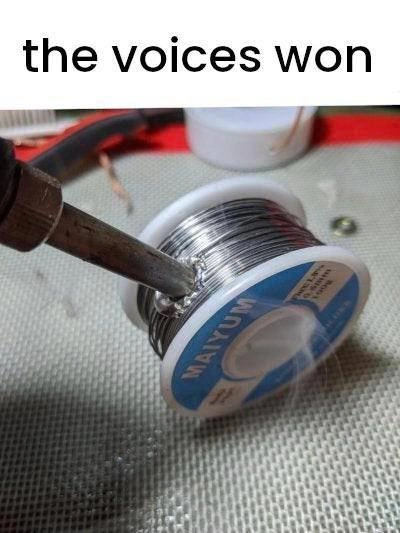
For a junior dev or an electronics beginner, let’s break down what’s happening. The image shows a roll (spool) of solder wire – that’s the shiny coil of metal – being heated directly by a soldering iron. Normally, you use a soldering iron like a precise pen to melt a bit of that solder wire onto electronic components, say to connect a wire to a circuit board. Solder is a metal alloy (often tin/lead or a lead-free mix) that melts at a relatively low temperature, so it’s perfect for bonding parts together in Embedded Systems work. The blue-and-white thing under the coil is the spool’s label, and it usually says the solder type (here it looks like a brand name “MAIYUM” or similar). The smoke curling up is from the flux in the solder – flux is a chemical in the wire that helps it flow and clean the metal surfaces, but it makes a bit of smoke when heated. Now, why is this funny or significant? Because the person with the iron isn’t soldering a component or fixing a device at all – they’re just melting the solder onto its own spool. It’s a totally pointless and counterproductive action. Imagine if you got mad at your pen and scribbled so hard you destroyed the pen’s ink cartridge – that’s the vibe. The top text “the voices won” is meme-speak for “I gave in to the crazy idea in my head.” In engineering or coding, when you debug for hours and nothing works, you start having intrusive thoughts like “Maybe I should just rip this out or do something wild.” Here, the wild idea was “what if I solder the entire roll of solder itself?” It’s a joke about losing patience and doing something silly. In hardware terms, they’re basically short-circuiting their own solder supply. A short circuit is when you connect something in a circuit in a way that causes an unintended direct path for current, often leading to lots of current flow (and usually sparks or heat). Here the short isn’t electrical (the spool isn’t powered), but metaphorically, the engineer “shorted out” their workflow by wasting time melting solder aimlessly. This also hints at burnout – not the literal smoke kind, but developer burnout: exhaustion and frustration leading to bad decisions. The categories tag MentalHealth is there because it’s acknowledging that hey, engineers have brains that get tired and sometimes you stop thinking straight. Debugging & Troubleshooting in hardware can be really draining; you’re often hunched over a board on a bench, maybe wearing an ESD strap (Electrostatic Discharge wristband) to avoid zapping chips with static – though in the picture, if there was one, the person clearly ignored it. By “soldering the whole spool,” they’ve essentially given up on proper debugging. For anyone new to this: it’s a bit like rage-quitting a video game, but in the electronics world. You’re so fed up trying to find the tiny broken connection or the faulty component that in a split second of insanity impulse, you do something destructive (and kind of dumb) as a form of release. The meme is an example of EngineeringAbsurdity – doing the last thing you’d logically ever want to do, just because your brain had a lapse. Seasoned engineers see this and laugh nervously, because it’s a parody of those late-night lab moments that do happen. The tags like #HardwareHumor and #DeveloperHumor signal that we’re poking fun at ourselves – we know this isn’t how you’re supposed to debug, and that’s exactly why it’s funny.
Level 3: Self-Inflicted Short
At a more practical senior-engineer level, this meme hits like a punch to the ESD-grounded gut. Hardware debugging at ungodly hours has a way of eroding your better judgment. The photo shows a soldering iron pressed against a solder spool, melting the solder onto itself. This is essentially a self-inflicted short circuit – literally fusing the supply of solder into a single useless lump. The caption “the voices won” says it all: the intrusive thoughts that every burned-out engineer jokes about have taken control. Anyone who’s spent late nights in an electronics lab knows that borderline insane impulse: “Everything is failing... maybe I should just solder everything together and see what happens!” It’s the hardware equivalent of a developer rage-quitting by typing rm -rf / – destructive, pointless, but weirdly tempting when you’re out of ideas. This image perfectly satirizes debugging frustration: instead of methodically tracing a circuit or checking datasheets, the engineer succumbs to a moment of nihilistic creativity. The humor has layers of engineering absurdity. First, there’s the obvious circular dependency irony – the spool of solder (your fix-it material) becomes the target of soldering itself, a closed loop of problem creation. It’s like trying to debug your code by randomly rewriting the compiler – solving nothing and potentially ruining your tools. Second, the scene flagrantly violates every sensible lab protocol: no ESD strap in sight, likely inhaling flux fumes without proper ventilation, and definitely no progress being made on the actual project. That grey mesh under the spool is a heat-resistant soldering mat, meant to protect the bench; in a dark twist, it’s now catching drippings from this needless solder meltdown. A veteran engineer can almost smell that acrid smoke and feel the mix of anger and dark humor in the air. It’s HardwareHumor on the edge of madness. The meme resonates because many of us have felt that developer burnout where you stop caring about the right way and just want to do something absurd. We laugh, and cringe, because we recognize the mental health moment here: when problem-solving patience snaps and you give in to a destructive impulse. The next day you’ll have a good DeveloperHumor story (“Remember that time I literally soldered my entire solder supply out of spite?”), but in the moment, it’s a portrait of DebuggingFrustration so deep that the lab fume headspace takes over. In short, this meme is painfully relatable to any senior dev who’s ever stared down a stubborn bug or a fried circuit at 2 AM and thought, “Screw it, let’s burn this down and see what rises from the ashes.”
Level 4: Runaway Feedback Loop
In high-stakes embedded systems debugging, there's a concept akin to a runaway feedback loop – a cascade where an output feeds into itself, growing without bound. That image of a soldering iron melting solder directly on its spool is a literal hardware ouroboros, like a circuit shorting its own power source. It’s as if the debugging process itself got caught in a recursive trap. At 3 AM, an engineer’s mind can enter a similar positive feedback cycle: frustration begets risky action, which begets more chaos. Here, the intrusive thought ("What if I just solder the whole spool?") acts like a rogue signal fed back into the system. In control theory, removing negative feedback leads to instability – just as removing rational restraint leads to this absurd scene. The result? A self-referential solder job where tool and problem merge into one smoky mess. This moment also evokes the mythical Halt and Catch Fire instruction – an inside joke from early computing where a CPU would supposedly execute an undefined operation and essentially catch fire. By pressing a hot iron to the coil of solder, the engineer has created a mini HCF event in real life. It’s a spectacular failure mode: a debugging attempt that short-circuits not the device under test, but the very material meant to fix it. In theoretical terms, it’s a reminder that even in hardware, circular dependencies (like a spool feeding itself solder) lead to a meltdown. Philosophically, there’s almost a grim entropy poetry here – all that ordered coil of solder now melting into chaotic blobs, much like a logical troubleshooting process dissolving into irrational damage. This is engineering absurdity in its purest form: the system under test isn’t the only thing unstable – the tester’s mental state has become part of the system, with disastrous closed-loop consequences.
Description
The image captures a moment of dark, absurd humor from the perspective of someone working with electronics. It's a close-up photo of a hot soldering iron being used incorrectly and destructively. Instead of melting solder for a connection, the iron's tip is being pushed directly through the plastic side of a spool of solder wire, melting a hole in it. The background is a gray, textured workbench mat. Overlaid at the top of the image in a simple black font is the caption, 'the voices won'. This meme format humorously attributes a bizarre, self-sabotaging action to giving in to intrusive thoughts. For hardware engineers and makers, it's a deeply relatable metaphor for the moments of extreme frustration during debugging or prototyping where one might have a fleeting, irrational impulse to destroy their tools or project. It perfectly encapsulates the feeling of being pushed to the brink by a stubborn technical problem

Comments
13Comment deleted
This is the hardware equivalent of `git push --force`
The hardware equivalent of checking in a symlink to itself - congrats, your supply chain now has a literal circular dependency
After 20 years in tech, you realize the real challenge isn't preventing race conditions in your code - it's preventing the race condition between your prefrontal cortex and the part of your brain that wants to see what happens when you deploy straight to prod on a Friday afternoon
Every senior engineer knows that moment when the rational voice saying 'file a ticket and order the replacement part' loses to the voice whispering 'you could just bridge those traces right now.' The solder spool doesn't judge your architectural decisions, and unlike your CI/CD pipeline, it gives immediate feedback. Sure, you'll document it later in the commit message as 'minor hardware optimization' - right after you finish this one last bodge wire that somehow becomes load-bearing infrastructure for the next five years
Hardware equivalent of 'npm audit fix --force': heat the entire dependency spool and pray the blast radius stops at the label
The hardware equivalent of kubectl exec into prod to hotpatch vendor code: plenty of smoke, zero reliable connections
The voices won: because sometimes the race condition was just a cold joint begging for 350°C love
Fuck, now i will have the same intrusive thoughts Comment deleted
Bro gave us ideas we never even could have dreamt of Comment deleted
WDYM?! Comment deleted
I never had this intrusive thought but I bet next time I solder I will be on the edge of doing this Comment deleted
I did this in high school Comment deleted
We kept the solder spool around with a little sign saying “no need; already done” Comment deleted