Skip to content
DevMeme
5889 of 7435
Dad realizes gaming rig morphed into a rogue LLM fine-tuning cluster
AI ML Post #6449, on Dec 10, 2024 in TG

Dad realizes gaming rig morphed into a rogue LLM fine-tuning cluster

Why is this AI ML meme funny?

Level 1: Not Just a Toy

Imagine you buy your child a fancy new sports car so they can drive around for fun, but one day you discover they’ve been using it as a taxi to ferry strangers around town. You’d be pretty shocked, right? That’s basically what’s happening in this meme: the dad gave his son a powerful “toy” (a high-end computer for games), and the son turned around and used it for something much more serious (training an AI). The father is surprised and a little horrified because he expected his gift to be used for play, not turned into a miniature science project that might have big consequences (like a huge electric bill!). In simple terms, it’s funny because the thing meant for fun wasn’t just a toy anymore – the kid made it do real work, and Dad definitely wasn’t ready for that surprise.

Level 2: Gaming vs Training

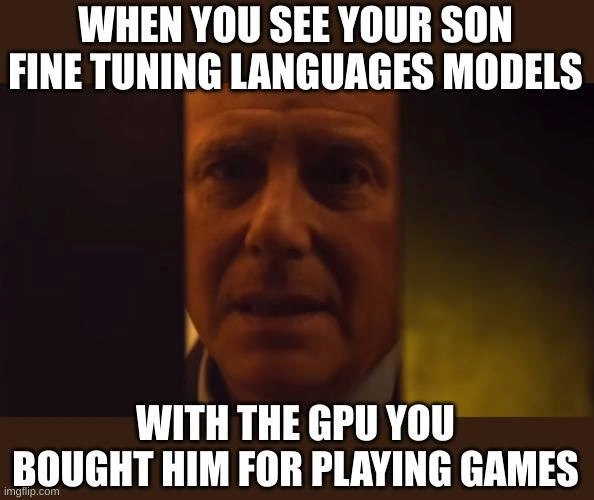
In simpler terms, this meme is about a dad’s surprise when he finds out the expensive graphics card he bought for his son’s gaming hobby is being used for something entirely different: AI model training. The top caption “WHEN YOU SEE YOUR SON FINE TUNING LANGUAGE MODELS” means the father walks in to discover his son doing fine-tuning – that is, further training a pre-existing language model (a kind of AI that generates text, like a mini version of ChatGPT). The bottom line “WITH THE GPU YOU BOUGHT HIM FOR PLAYING GAMES” drives home why the dad is stunned: the GPU (Graphics Processing Unit) was a gift meant to make video games run super smoothly with high graphics settings. Instead, the son has that same powerful hardware cranking away on a machine learning task.

Let’s break down the key bits for a newer developer or someone not as familiar with AI terms: A GPU is a special computer chip originally made to handle graphics – think of all the 3D visuals in a game. It’s very good at doing lots of simple calculations in parallel, which is why gamers love them (smooth frame rates!) and also why AI researchers love them (fast math for training neural networks). A language model is an AI program trained to understand and generate text (for example, predicting the next word in a sentence). Fine-tuning means taking a big pre-trained model and training it a little more on a new set of data or for a specific task. It’s like taking a student who’s learned general knowledge and coaching them specifically in medicine or law – here the son might be fine-tuning the model to, say, answer questions about a game or write code, who knows. The funny part is that doing this fine-tuning at home turns the kid’s PC into a makeshift training server. The GPU fans start roaring, the room heats up, and nothing “fun” appears on the screen (just lots of code or progress bars). This is very different from a typical gaming session where the GPU usage is tied to flashy visuals and immediate fun feedback.

So, the parental_shock comes from that mismatch. Dad expected to peek in and maybe see his son playing the latest AAA game with stunning graphics. Instead, he sees some kind of serious-looking program running – maybe a black terminal window with scrolling text, or graphs of training progress. It’s like expecting to hear game sound effects but hearing the computer humming like it’s doing heavy lifting. The dad likely thinks, “I bought this high-end card so you could play games with your friends, not to turn your room into a tech lab!” He might not fully understand what “training a model” entails, but he can tell the GPU is running at full blast on something that’s definitely not a game. Perhaps he notices the power usage meter on the PC or just feels the heat pouring out of the case – high-end GPUs can draw a lot of electricity, and if they run non-stop, they can indeed make the electric bill jump. That’s why one of the context jokes here is the unexpected_power_bill: the dad might only find out something was up when a much larger utility bill arrives, prompting him to investigate what on earth his son is doing.

The phrase “rogue LLM fine-tuning cluster” from the title is a humorous exaggeration. It’s calling the son’s gaming PC a “cluster” (which normally means a bunch of servers working together in a data center) that’s gone rogue (rogue meaning unexpected or not planned for). Of course, it’s just a single PC, but from the dad’s shocked perspective, it might as well be a full-blown datacenter in his house given how intensely it’s running. To a junior developer, this highlights how powerful modern consumer tech is – you can literally do small-scale DeepLearning experiments at home on the same machine you use for entertainment. Many hobbyist programmers realize at some point that the gaming rig under their desk can double as a personal AI workstation. It’s exciting, but as this meme jokes, it might be a bit of a surprise (or shock) to those footing the bill or expecting that hardware to be used just for harmless fun. In short, the dad in the meme is finding out that the GPU he bought for HardwareHumor (cool graphics) is now being used in serious AI/ML work, and his face says, “I did not see that coming!”

Level 3: But Can It Run GPT?

WHEN YOU SEE YOUR SON FINE TUNING LANGUAGE MODELS
WITH THE GPU YOU BOUGHT HIM FOR PLAYING GAMES

Those all-caps lines set the scene: a parent walks in expecting to find their kid engaged in harmless gaming, only to discover the GPU they generously gifted is grinding away on some mysterious machine learning task. This juxtaposition is hilarious to developers because it captures a classic modern twist on repurposed hardware. The dad’s face — equal parts horror and disbelief — says it all. He thought he was buying a graphics card for high-resolution gaming, not realizing he was arming his child with a tool potent enough to train AI models. It’s the ultimate “Wait… you’re doing what with that expensive toy?!” moment.

From a seasoned developer’s perspective, the humor lies in the gaming_vs_ai_workload contrast. In a typical gaming session, a GPU might spike to 100% while rendering a chaotic battle, but it’s a bursty, interactive workload; you see explosions on screen and hear cheers (or rage) from the player. In an AI/ML workload like fine-tuning, the GPU pins at max utilization for hours on end, with nothing visually exciting on screen – maybe just a console log slowly updating with training loss values. It’s like finding a Ferrari engine running a heavy-duty generator instead of racing on a track. No wonder the dad feels blindsided. The rig he bankrolled was supposed to deliver buttery-smooth frame rates in Call of Duty, not become a crunching engine for GPT text generation. He’s essentially witnessing his son turn a recreational gaming PC into a quasi-“rogue LLM fine-tuning cluster.” The word “cluster” here is tongue-in-cheek – it’s probably just a single PC. But to a parent, seeing servers or hearing a constant fervent whir from a bedroom rig at 3 AM sure makes it feel like Google’s datacenter moved in next door.

There’s a rich vein of AI humor here about expectations versus reality. The dad likely expected conversations like, “Hey Dad, check out the ray-traced graphics on this game!” Instead he’s hearing, “I reduced the model’s perplexity and fine-tuned the Transformer with a new dataset!” Imagine Dad’s internal monologue: I bought a top-tier GPU so my kid could enjoy games with friends. Now he’s talking about “epochs,” “embedding layers,” and “tensor shapes.” It’s a classic misalignment of expectations. Tech folks find it funny because many have been on one side or the other of this story. Perhaps you justified a high-end GPU purchase by promising MachineLearning or “it’s for my programming projects,” when really you wanted to play games – here it’s the opposite! The GPU truly is being used for serious development, just not the kind of “development” Dad had in mind.

Another layer of humor is the unexpected_power_bill aspect. Fine-tuning a large model can make a GPU draw near its peak wattage continuously. That fancy GPU might be pulling 300W or more non-stop, dumping heat like a space heater. Dad’s going to be in for a shock (literally a shock of warm air when he opens the door, and later a shock from the electric bill). His face lit by the warm monitor glow hints that he’s already feeling the furnace-like conditions of a household_datacenter. Seasoned devs know this scene well: the room is hot, the fans are howling, and you realize this isn’t normal gaming use. Many of us have cheekily called our gaming-cum-compute setups “home clusters” or “server farms” when we run overnight jobs. The meme nails that scenario with the phrase “fine-tuning cluster” – implying the son turned his bedroom into a mini cloud computing zone.

And let’s not forget the generational angle. There’s a bit of parental_shock pride and confusion mixed together. Part of Dad might be thinking, “My kid is doing advanced AI work I barely understand – maybe I’ve got a little genius here?” The other part is, “This little genius is going to trip the circuit breaker or bankrupt me in electricity!” It’s funny because it’s true: many cutting-edge developers started young, repurposing whatever hardware they had. The dad’s shocked Pikachu face is basically the reaction of any non-techie realizing that today’s “toys” (GPUs) are so powerful they can do serious work. The caption could easily have been phrased as, “He was supposed to be playing AAA games, not AI researcher at home!”. That’s the heart of the joke: the absurd leap from playing games to training models on the same device. It flips the script – the kid isn’t wasting the GPU on games, he’s arguably over-utilizing it on something academically complex! In developer culture, that’s both impressive and comical, especially imagining the dad’s stunned face as he realizes his teenager’s “gaming rig” is spitting out AI benchmarks instead of frame rates.

To put it in relatable terms, think of all the times tech has been stealthily repurposed at home. It’s like finding out the office printer you bought is running a side hustle printing a novel. Here Dad discovers the pricey GPU is crunching DeepLearning workloads. The meme hits a shared experience: powerful hardware often finds its way into off-label uses. Whether it was GPUs being hijacked for crypto mining or, in this case, for custom ModelTraining, parents and bosses everywhere have uttered some version of “I didn’t buy it for THAT!” The surprise, mild betrayal, and begrudging admiration wrapped up in Dad’s face – that’s why we’re laughing. He inadvertently set up his son with a machine that’s doing cutting-edge AI, not just cutting-edge graphics. In summary, the humor lands because the repurposed_gpu story is both absurd and surprisingly common: in the world of tech, today’s gaming toy can easily become tomorrow’s DIY supercomputer. And poor Dad just realized he’s running an AI lab in the guise of a gaming den.

# What Dad expects to see running on the PC:
run("Crysis.exe")   # A demanding video game known for pushing GPUs to the limit

# What he actually finds running:
run("train_llm.py")  # A custom Python script fine-tuning a language model

(Above: Instead of rendering alien battles in high-res glory, the GPU is busy updating millions of neural network weights. Dad probably doesn’t know whether to be angry or impressed.)

Level 4: From Polygons to Transformers

At the deepest technical level, this meme spotlights a dramatic shift in how GPU hardware is utilized. A GPU (Graphics Processing Unit), originally designed to shove millions of textured polygons to your screen for video game graphics, is now being harnessed to train Transformer models – the neural network architecture behind modern large language models (LLMs). In other words, silicon meant for silky-smooth FPS in Fortnite or realistic ray-traced reflections in AAA games is instead churning through linear algebra for AI. The father’s wide-eyed horror stems from realizing that his son’s gaming rig has effectively become a mini research supercomputer right under his nose.

Let’s unpack that transformation: modern deep learning algorithms rely on multiplying huge matrices of numbers (representing layers of neurons and their connections). GPUs excel at this because they can perform thousands of operations in parallel across their many cores. Training or fine-tuning an LLM involves repeatedly adjusting billions of parameters via back-propagation – an intense number-crunching workout for any chip. A consumer GPU, like the one Dad bought “for games,” can execute these operations efficiently thanks to its massive memory bandwidth and parallel SIMD architecture. Essentially, what used to be the domain of specialized HPC clusters or university labs can now happen on a single high-end PC at home. The meme humorously casts the son’s room as a household datacenter, running tasks that wouldn’t be out of place in a corporate AI lab.

To add more context, fine-tuning is the process of taking a pre-trained language model and training it further on a custom dataset or task. It’s how one might tailor a general model (like GPT) to a specific purpose – say, a chatbot that speaks like Shakespeare or a support agent fluent in your company’s knowledge base. One popular method is using LoRA (Low-Rank Adaptation) adapters, which allow updating a smaller subset of the model’s weights instead of all of them, drastically reducing the VRAM needed. This is likely how junior managed to squeeze an LLM training run onto a single gaming GPU without it outright melting. The dad in the meme is essentially catching his kid red-handed running back-prop and gradient descent loops on a device he thought would just render Minecraft. The warm monitor glow lighting up that shocked face isn’t from a game’s explosion – it’s from a PyTorch training script iterating through epochs of data.

This scenario is loaded with AI humor and irony. The father’s bewilderment might deepen when he hears jargon spilling out of his son’s bedroom: talk of “model training,” “learning rates,” or an rlhf_pipeline. For the record, RLHF stands for Reinforcement Learning from Human Feedback, an advanced fine-tuning technique where a model learns from preference scores (it’s how ChatGPT was tuned to better follow instructions). If Junior is dabbling with an RLHF pipeline — perhaps using the 🐼 Hugging Face libraries to refine the model with dad as an unwitting human feedback provider — then this gaming PC has truly gone rogue! We have a teenager performing tasks typically reserved for cloud clusters with multiple GPUs, maybe running the transformers library or even distributed training frameworks on a single card. No wonder Dad looks like he’s seen a ghost: it’s the ghost of his electricity bill and the realization that he’s inadvertently funded a cutting-edge AI lab in his own home. In essence, hardware meant for ray-tracing dragons and racing cars is now back-propagating through text corpora – a complete role reversal that embodies both the progress and the absurdity of today’s AI-at-home era.

Description

Impact-font meme on a dark brown background. Top white, all-caps text reads: "WHEN YOU SEE YOUR SON FINE TUNING LANGUAGE MODELS". Bottom matching text says: "WITH THE GPU YOU BOUGHT HIM FOR PLAYING GAMES". The center panel (blurred in this version) shows a shocked, wide-eyed father-figure reaction shot lit by a warm monitor glow, conveying a mix of horror and disbelief. Technically, the joke riffs on how modern consumer GPUs (originally justified as "for FPS" or "ray-traced reflections") end up running back-prop, LoRA adapters, and other fine-tuning workloads instead of AAA titles - highlighting the stealthy household migration from gaming PC to quasi-datacenter

Comments

15
Anonymous ★ Top Pick Nothing says multi-tenant architecture like discovering your teenager just turned your "RTX for Fortnite" budget into a nightly LoRA training job - guess who’s paying the cloud egress bill now?
  1. Anonymous ★ Top Pick

    Nothing says multi-tenant architecture like discovering your teenager just turned your "RTX for Fortnite" budget into a nightly LoRA training job - guess who’s paying the cloud egress bill now?

  2. Anonymous

    The real horror isn't that junior's using a $1600 RTX 4090 for ML instead of gaming - it's that they're probably getting better ROI training LoRA adapters for anime waifus than you ever got from your enterprise Kubernetes cluster

  3. Anonymous

    The real ROI on that RTX 4090 wasn't the frames per second in Cyberpunk - it was the tokens per second in his custom LoRA adapter. Nothing says 'parental investment paid off' quite like watching your kid burn $2/hour in electricity costs to shave 0.3 points off their validation loss at 3 AM. At least when he was gaming, the GPU throttling was from poor case airflow, not from trying to fit a 70B parameter model into 24GB of VRAM

  4. Anonymous

    That “for gaming” 4090 just became a home‑lab LLM rig: 24 tokens/sec, gradient checkpointing to dodge CUDA OOM, and a power bill that now counts as our shadow MLOps budget

  5. Anonymous

    Approved budget for higher FPS, accidentally procured a 24GB on‑prem LLM lab; next sprint expect a change request for a PSU upgrade to unblock bf16 LoRA runs

  6. Anonymous

    RTX 4090: 24GB VRAM for ray tracing? Nah, perfect for quantizing 70B params while Dad traces his regrets

  7. @ZgGPuo8dZef58K6hxxGVj3Z2 1y

    Typo

  8. @S_S51546 1y

    When you see your son run game on gpu you bought him for fine tuning languages models

    1. @anonusernametg 1y

      Oh poor fella :(

  9. @anonusernametg 1y

    His repo btw: https://github.com/lnmangione/Stock-Bot/tree/master

  10. @AlexAparnev 1y

    When you see your son runs CUDA computing on the GPU you bought to him to play games but GPU is AMD

    1. dev_meme 1y

      https://github.com/lloydchang/vosen-ZLUDA But ofc it’s no where close to properly run cuda on nvidia cards

      1. @RiedleroD 1y

        I vaguely remember there being a different cuda compat layer for ROCm. don't remember what it's called tho

        1. @RiedleroD 1y

          or maybe it was ROCm on nvidia? I don't remember. trying to get anything to run has been extremely frustrating either way

        2. @TheFloofyFloof 1y

          HIP but it requires source code access

Use J and K for navigation