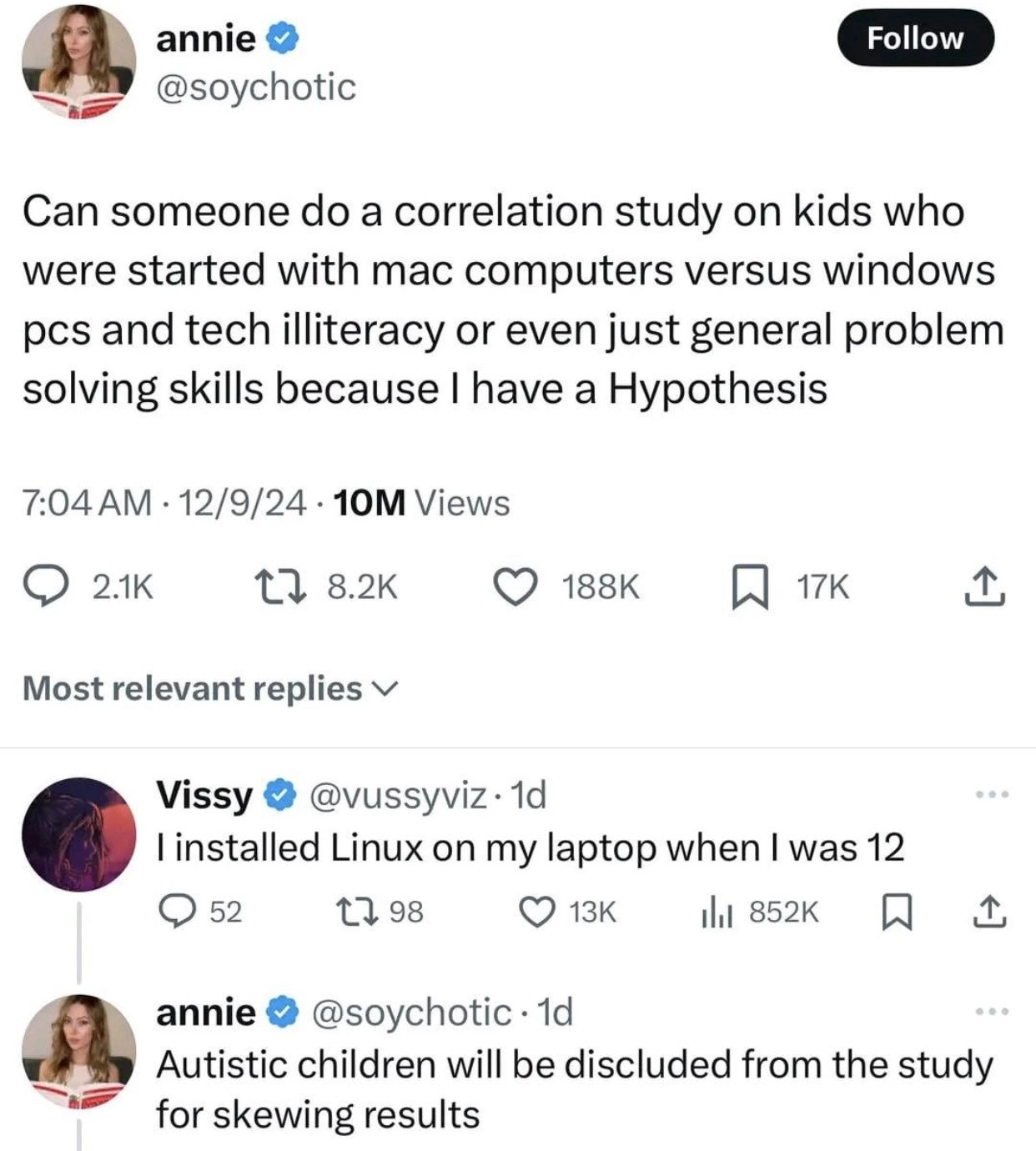
When your sample set includes the kid who installed Linux at 12
Why is this OperatingSystems meme funny?
Level 1: The Unfair Race
Imagine two groups of kids are having a running race. One group wears Brand A sneakers and the other group wears Brand B sneakers. An adult wants to see which shoes make the kids run faster – that’s the whole point of the race. Now, as the race is about to start, one extra kid rolls up... on a bicycle! This kid on the bike isn’t running at all; he’s doing something completely different (and much faster). When the race starts, guess who zooms way ahead? The kid on the bike, of course! He’s so far ahead that none of the running kids, no matter what shoes they have, stand a chance.
Now, if the adult really wants to compare Brand A vs Brand B shoes fairly, the kid on the bicycle is a problem. That bicycle makes the whole comparison unfair and the results confusing – it’s no longer a simple running race. So the adult might say, “You know what, let’s not count the bicycle kid in our results.” They might even joke, “Yeah, that kid doesn’t count for this study because he’s not really part of the running test – he’d just mess up the results.”
This is exactly what’s happening in the meme, just with computers instead of a race. Most kids grew up using one of two types of common computers (like the two brands of shoes in the race). But one kid was doing something way beyond normal – using a much more complex, unusual computer setup at a very young age (that’s the kid on the bike). The person who wanted the comparison decides to ignore that super advanced kid to keep things simple and prove their point. It’s funny because it’s a silly solution: instead of dealing with the fact that one kid is just way different, they basically say “nah, we won’t count him.” It’s like covering your eyes to keep your favorite idea true. Even a child can get why that’s goofy – it’s an unfair race if you include the bike, but it’s also kinda cheating to just ignore the bike to claim one pair of shoes is the best. That little twist – the “he’s too good, so let’s pretend he’s not there” – is what makes the whole thing a joke that people can laugh about.
Level 2: The Odd OS Out
Let’s unpack the joke in simpler terms. In computing, an operating system is the main software that runs your computer and defines how you interact with it. The big ones are Windows, MacOS, and Linux. Each of these has its own community of fans, almost like how people support different sports teams or game consoles:
- Windows – Made by Microsoft, it’s the most common OS on PCs. If you’ve used a regular desktop or laptop (especially for school or gaming), you probably used Windows. Many people start here, and they learn basic computer use on Windows. Think of the kid who knows how to install a game, fiddle with some settings, or troubleshoot when something basic breaks (like restarting the Wi-Fi or closing a frozen program).
- MacOS – This is Apple’s operating system for their Mac computers. It’s known for a clean design and being user-friendly. A kid who grows up on a Mac might get really comfortable with intuitive interfaces, maybe dabble in creative software (like GarageBand or iMovie), and generally have a smooth experience (Apple tries to handle a lot of the tricky stuff behind the scenes). Mac users sometimes joke they live in a polished “walled garden” — things work well, but you don’t get to change the system much.
- Linux – Linux is the odd one because it’s not often pre-installed on store-bought computers (except some specialized ones). It’s an open-source OS, meaning it’s free and maintained by a community. There are many versions (called distributions or distros – like Ubuntu, Fedora, etc.), and you usually have to install it yourself. It’s powerful and very customizable, but not as “plug-and-play” for a typical user. Usually, only enthusiasts or curious tinkerers use Linux, especially at younger ages, because it requires learning and doing more manual setup.
Now, dev communities (groups of developers and tech enthusiasts) can be pretty passionate about these systems. This sometimes leads to what we jokingly call operating system tribalism – basically, team spirit for your favorite OS. You’ll see playful fights on forums or social media about Mac vs Windows, each side claiming their OS is better (faster, easier, more secure, etc.). It’s a friendly rivalry, much like kids arguing Playstation vs Xbox. Meme culture around this is full of inside jokes – for example, blaming Windows for viruses, teasing Mac users for paying a lot, or laughing about how complicated Linux can be. It’s generally good-natured ribbing, but it’s definitely a thing in tech circles.
Now to the meme itself: The initial tweet is saying, “Can someone study kids who started on Mac vs kids who started on Windows, and see if there’s any difference in tech illiteracy or problem-solving skills? I have a hypothesis.” Here, tech illiteracy means not being good with technology, and problem-solving skills means how well they can troubleshoot or figure things out. A hypothesis is basically an educated guess – the person tweeting has a guess (maybe they suspect one group is more skilled than the other) and wants data to prove it. In simpler terms, this person wonders: if your first computer was a Mac, are you better or worse at tech stuff later compared to someone whose first computer was Windows? Perhaps they’ve noticed something in people around them and want to confirm it scientifically. It’s a classic kind of debate in tech: environment and upbringing might affect your skills.
The twist comes with the reply: “I installed Linux on my laptop when I was 12.” This introduces a third category that the original poster didn’t mention: someone who used Linux as a kid. For context, having a 12-year-old install Linux is not a common story; that’s a very tech-savvy kid! Most kids that age are just users of whatever computer their parents gave them. But this kid actually went out of their way to wipe or dual-boot their system with Linux (which involves steps like partitioning a drive, installing the OS, possibly dealing with drivers – it’s non-trivial). In the world of tech people, hearing “I was using Linux at 12” is like hearing someone say “I was building my own robots in middle school” – it stands out. This kid would likely have exceptional problem-solving skills for their age, simply because using Linux forces you to learn a lot (you often have to fix things yourself, use the command line, etc.). In statistical terms, they’re an outlier – a rare case that’s far outside the normal range.
Now the original poster responds to that with a joke: “Autistic children will be discluded from the study for skewing results.” Let’s break down what that means. Autistic children refers to kids on the autism spectrum. Autism can manifest as having intense focus or special interest in particular subjects (like computers). The poster is basically stereotyping (in a joking way) that a 12-year-old who installed Linux might be autistic – the idea being that such intense technical ability at that age often is seen in autistic prodigies. The word “discluded” is not standard English; the correct word would be “excluded.” Using “discluded” here is a bit of humorous effect (or a mistake) – ironically, in a conversation about tech literacy, they use a somewhat illiterate word.
The phrase “skewing results” means messing up the outcome of the study. If you include that Linux kid in the Mac vs Windows study, the results could get skewed – in other words, that one data point could throw off the pattern. Why? Imagine if the study tried to measure “tech skill level” later in life: probably most Mac kids and Windows kids fall into some middle range with some differences here and there. But the Linux-at-12 kid might score off the charts, way higher in tech skill than almost anyone, because they’ve been doing complex stuff from a young age. That would make it hard to draw a simple conclusion like “Mac or Windows makes you better,” because an outlier like that introduces self-selection bias. Self-selection bias is when the people (or examples) you’re examining aren’t random; they’ve selected themselves in a way that already is skewed. Here, a kid choosing Linux at 12 self-selects as someone who’s very into tech. They’re not a random kid who was handed a computer – they went out of their way to do something hard with it. Including them isn’t a fair comparison to the average kid who just used whatever was given.
So, the original poster basically jokes that they would exclude those outlier kids (specifically autistic tech prodigies) from the study to keep the results neat. This is funny (and a bit edgy) because it’s the opposite of how a real study should work — you can’t throw out data points just because they don’t fit your hypothesis! But in the context of an internet debate, it’s poking fun at how strongly people feel about their “team.” It’s like they’re half-seriously saying: “Look, Linux kids are a different breed; if we include them, of course they’ll make everyone else look bad, and then we won’t get a clear answer. So let’s just not count them.”
The humor also comes from relatability: In tech circles, whenever someone tries to make a sweeping claim (“X is better than Y for learning!”), there’s always that one person who says “Actually, I did Z which is way more hardcore.” 😅 Here Z is Linux, and indeed it is way more hardcore for a 12-year-old. The original poster’s quip about autism is a knowingly outrageous way to acknowledge, “Yeah, those kids exist and they’ll wreck my neat theory, so I’m just going to set them aside for the sake of argument.” It’s a form of inside joke where everyone understands that the “study” isn’t serious to begin with. No one is really conducting this research; it’s all a hypothetical played for laughs. And implying you’d hand-pick your data (excluding whiz-kids) to prove your point – that’s satire on how some arguments are won on the internet (by conveniently ignoring counter-evidence).
In summary, for a junior or someone new to this humor: The meme is funny because it exaggerates the lengths someone might go to prove their favorite computer system is the best. It introduces a ridiculously exceptional case (the kid who used Linux super early) and then, in an ironic twist, discards that case to keep things “fair.” It’s poking fun at both the tribal loyalty people have toward operating systems and the absurdity of trying to make a clean-cut argument in a world full of messy, diverse experiences. And if you didn’t catch that “discluded” isn’t a real word – that’s part of the joke too, hinting that the original poster might not be as learned as they think when throwing around scientific terms like “Hypothesis.” In tech meme culture, calling something out in this over-the-top way is a form of relatable humor. We all know that one kid (or maybe we were that kid!) who doesn’t fit the usual mold, and this meme gives a nod to them while also playfully rolling eyes at how they complicate the endless Mac vs Windows debate.
Level 3: Penguins in the Data
At first glance, this meme looks like a casual tweet about doing a scientific comparison: MacOS kids vs Windows kids and their later tech skills. But every seasoned engineer knows that any discussion of OperatingSystems can quickly turn into an operating system tribalism war. The original poster asks for a correlation study on childhood OS exposure and tech literacy (basically, how well they handle technology or problem-solving). They confidently announce, "I have a Hypothesis," hinting they suspect one platform (Mac or Windows) might have an edge. This taps into a DevCommunity rivalry that’s been around for decades: the mac_vs_windows_debate. Tech folks have long camped into tribes — Mac enthusiasts praising the “it just works” philosophy, Windows power-users touting flexibility and games — each side half-jokingly deriding the other’s supposed lack of skills or tech illiteracy. It’s a classic inside joke setup in MemeCulture for anyone who’s seen these friendly OS flame wars before.
But then, like a plot twist, someone replies with the ultimate curveball:
"I installed Linux on my laptop when I was 12."
This single reply flips the script by introducing the Linux tribe — the often-forgotten third faction in these debates. In tech humor, linux_users_are_outliers. Linux is the open-source rebel of OperatingSystems, typically not chosen by average 12-year-olds. So when a person brags about early_linux_adoption (installing Linux at 12), it’s both impressive and hilariously cliché. Veteran devs have seen variations of this humblebrag on forums and IRC for years: the wunderkind who was compiling kernels while other kids were installing video games. It’s an insider wink to those “one-up” stories in dev communities. We nod knowingly because we’ve met that kid (or were that kid) who ran a personal web server in middle school or booted into Debian just to poke around. This reply is essentially saying, “Your Mac vs Windows study is cute, but I was on a whole different level.” It’s the outlier that any statistician would flag with a giant red pen.
Now the original poster, realizing their neat Mac-vs-Windows hypothesis just got dunked on by a Linux outlier, responds with a tongue-in-cheek comeback: “Autistic children will be discluded from the study for skewing results.” Ouch! This punchline packs multiple layers of tech insider humor (and a dose of dark sarcasm). First, the term “discluded” jumps out – it’s not even a real word (they likely meant excluded). The irony is rich: someone concerned about “tech illiteracy” is inventing words. Many senior devs will chuckle at that self-own; it’s like a grammar glitch in an attempt to sound authoritative. But beyond word choice, look at what they imply: those super-advanced kids (the ones who install Linux at 12) are being equated with autistic children, and they’re being purposely left out to avoid skewing the results. This is basically an admission of self_selection_bias – cherry-picking data to fit your hypothesis – served with a side of gallows humor. In other words, “We want to prove Macs or Windows make you better at tech, and including that ultra-nerdy kid would wreck our theory, so let’s just pretend they don’t exist.” It’s satire on how some people handle inconvenient data (by simply removing it), and it also nods to a stereotype that many ultra-focused young tech prodigies are on the autism spectrum. The joke finds its edgy comedic rhythm by exaggerating that “solution”: if reality messes up your hypothesis, just disclude reality. 🙃
To really appreciate why this hits home with veteran devs, consider the long history of OS pride and peccadilloes. Back in the day, forums were full of heated arguments about which OS breeds better geeks. Windows was everywhere, so it produced sheer quantity – lots of casual users and a fair share of tinkering power users. MacOS attracted those who valued a curated experience; some argued Mac users didn’t learn “hardcore” troubleshooting because Apple’s ecosystem is controlled (no driver hell, fewer viruses), while others argued Macs let folks focus on creative problem-solving without wrestling the system. Then you have Linux – the wild west where nothing is handed on a platter. Early Linux users had to become their own tech support, learning the command line, editing config files, dealing with obscure hardware compatibility issues. Naturally, a kid drawn to Linux that young isn’t your average user; they’re the kind who read technical manuals for fun or spent recess installing Ubuntu. Including them in a casual Mac vs Windows comparison is like inviting a chess prodigy to a checkers match. Everyone in the DevCommunity recognizes that scenario, which is why the OP’s joking decision to exclude them “for skewing results” gets a laugh. It wryly acknowledges that operating_system_tribalism debates can never be apples-to-apples – there’s always a fruity penguin 🐧 in the mix messing up the narrative.
Let’s break down the archetypes in play here, as seen by experienced devs:
| Mac Kid 🖥️ | Windows Kid 💻 | Linux Kid 🐧 |
|---|---|---|
| Grows up with Apple’s polished MacOS interface, everything “just works” out of the box. | Navigates the ubiquitous Windows PC world, dealing with whatever the family computer throws at them (school reports, games, the occasional virus). | By 12, decides the standard OS isn’t enough – downloads a Linux distro and installs a whole new system for the challenge of it. |
| Gains tech skills gradually: maybe learns some design software or basic coding via Xcode, but mostly uses a stable, user-friendly system. | Gains tech skills by necessity: learns to troubleshoot common issues (why won’t the printer connect?!), install antivirus, maybe dabble with .BAT files or simple scripts. | Gains tech skills by diving in head-first: encounters the command line, learns about filesystems, config files, and bash scripts simply to make the laptop usable. |
| Problem-solving style: more insulated from system messiness – when stuck, might rely on official Apple support or forums tailored to end-users. | Problem-solving style: trial-and-error – rebooting, Googling error messages, asking on general forums. Learns resilience after plenty of “turn it off and on again” moments. | Problem-solving style: essentially a junior sysadmin – combing through online Linux forums, editing /etc/ files, and experiencing the joy of fixing what they broke. This kid learns to “RTFM” (read the fine manual) early. |
| Part of a sleek, design-focused dev community that jokes about the “peasants” on other systems but generally avoids low-level tweaking. | Part of the massive mainstream community – they swap tips on Windows settings, share .exe game mods, and collectively groan at every Blue Screen of Death. | Part of a niche, passionate community of tinkerers. They bond over memes about the year of the Linux desktop (always “next year”), and wear their hard-earned command-line scars with pride. |
As shown above, the Linux kid is clearly the odd one out – a tiny fraction of users, but often years ahead in certain skills due to their hands-on experience. So from a senior dev perspective, the humor is two-fold: we’re laughing at the absurdity of trying to make a neat graph out of messy human tech habits, and we’re laughing at ourselves (or our peers) who were that statistical outlier. The tweet’s punchline essentially says, “Let’s ignore the super-nerds so our neat theory can work.” Every experienced engineer who’s seen inside_jokes in tech culture gets the chuckle: real life doesn’t conveniently follow our hypotheses, especially not in MemeCulture scenarios where the Linux outlier crashes the party. And if your data doesn’t fit your narrative? Sure, just exclude disclude it – we’ve all seen managers or biased studies do something like that, taken to a comic extreme here. In the end, this meme tickles that common memory among veteran tech folks: no matter how you slice the Mac vs Windows debate, someone will pipe up, “Well actually, I’ve been using Linux since I was a kid,” and everyone just collectively facepalms and laughs. Because of course the kid with the Linux laptop at 12 skewed the curve — they bent the rules of the game long before the rest of us even knew the game existed.
Description
Screenshot of a Twitter exchange on a light-mode interface. Tweet 1 (by @soychotic, verified blue check): “Can someone do a correlation study on kids who were started with mac computers versus windows pcs and tech illiteracy or even just general problem solving skills because I have a Hypothesis”. Timestamp shows 7:04 AM · 12/9/24 · 10M Views, with 2.1 K replies, 8.2 K retweets, 188 K likes, and 17 K bookmarks. Under “Most relevant replies”, user @vussyviz says: “I installed Linux on my laptop when I was 12” (52 replies, 98 retweets, 13 K likes, 852 K views). Original poster responds: “Autistic children will be discluded from the study for skewing results.” Visually, each tweet is framed in standard Twitter cards with profile pictures blurred. Technically, the humor plays on operating-system tribalism: Mac and Windows as mainstream baselines, while early Linux adopters are statistical outliers that wreck any neat correlation study - an in-joke many veteran engineers recognize from decades of OS flame wars and self-selection bias in developer communities
Comments
34Comment deleted
Every data scientist hates that one datapoint that compiled a custom kernel before puberty - the residuals never recover
The real correlation is between "I use Arch btw" and the number of coworkers who suddenly remember they have a meeting when you approach their desk
The real correlation study we need is between developers who claim 'I installed Linux at 12' and those who now spend 40% of their workday explaining why their custom Arch setup is actually more productive than just using the company-standard MacBook. Spoiler: the study would be confounded by the fact that both groups will spend the other 60% arguing about it on Twitter instead of shipping features
Run the regression with controls for SES, teacher quality, and “compiled a kernel at 12”; the childhood OS coefficient drops below Alt-Tab latency - what remains is lifelong package-manager preference
Requesting a Mac-versus-Windows correlation study is cute, but the only statistically significant result is that the 'installed Linux at 12' cohort is a self-selected treatment group whose adult outcome variable is 'compiled their personality from source' and now files font-rendering bug reports for fun
Excluding Linux kids from the study? Wise - otherwise the results would fork into a debate on systemd vs init forever
It's not an autism it's particle of god Comment deleted
- Take a USB and any "create bootable Linux USB tool" - Reboot - Next, next, next, next... ... - I installed Linux, you Windows slaves! There are some issues with installing desktop Gentoo from minimal - you at least have to know keywords. It's even harder to install LFS (well, I doubt it has any real purpose beyond being a hobby). It gets really hard when it comes to hardware issues like PCI passthrough to Wine or using some weird Wi-Fi adapter (supported by Windows for 10 years already but still missing in Linux). Hardened distributions can cause even more pain. But just "installed Linux" stopped being an achievement in the late 90s... Comment deleted
It was my comment about autism, not about installing Linux Comment deleted
But about fucking with Linux Optimus laptops are fucking disaster Comment deleted
When I was buying a laptop in 2013 I searched for the only one which had zero use (including video output) of internal GPU. Comment deleted
Well I was 11 when I first installed Linux so i guess its not totally out of question Comment deleted
When I was 10, I assembled my pc from scratch, you know nothing about autism Comment deleted
approved Comment deleted
do you like trains? Comment deleted
not particularly Comment deleted
Are you a furry? Comment deleted
You assembled your computer from scratch, and had no attraction to TTD?! Comment deleted
openttd is based Comment deleted
Autism Furry Trans Pick minimum of two to play Comment deleted
When I tried Linux at 12 I was frustrated it didn't support any games and installed windows shortly after Comment deleted
is everyone getting verified emblems next to their names in social platforms or is it that I don't know their profession? Comment deleted
This is twitter. There you buy to have a verified like looking account💀🗿 Comment deleted
oops Comment deleted
i remember when i installed linux i think was ubuntu at 9-10 Comment deleted
When i was 12 my dad couldn't fix my computer so he made me install Ubuntu now im a gentoo user Comment deleted
Understandable, have a good day. Comment deleted
Fuck, misclick Comment deleted
Hey I grew up with a PowerMac G4 that shit was a Unix box Comment deleted
Installing Gentoo is easy if you can read wiki from your phone. Comment deleted
Misclick Comment deleted
Fuck Comment deleted
Lurking failed retreating immediately Comment deleted
hehe :3 Comment deleted