When Your Friends Are Your Best Pen-Testers
Why is this Security meme funny?
Level 1: Guarding the Wrong Door
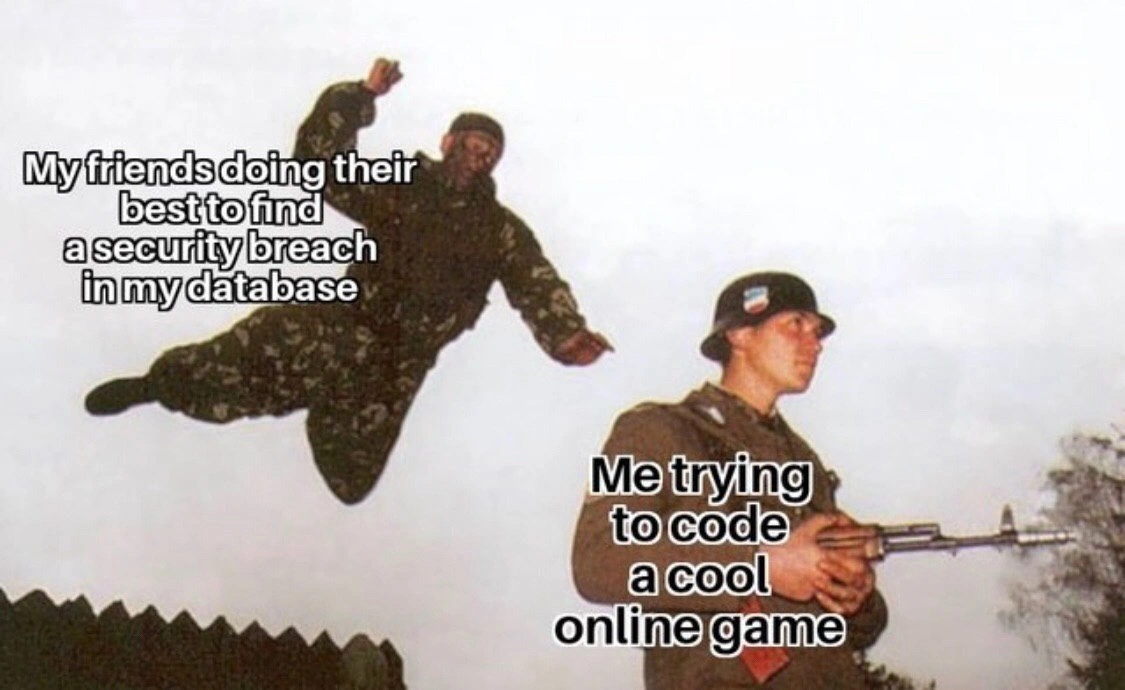
Imagine you spent all weekend building an amazing treehouse, and you're standing at the front, proudly polishing the doorbell — while your best friend is already climbing through the back window just to prove they can. They're not even being mean; testing whether the treehouse can be broken into is the game for them. The picture captures that exact instant: the builder calmly looking one way, the friend flying through the air from the other. It's funny because anyone who's ever made something knows the feeling — the moment you show your creation to friends, their first instinct isn't to admire it. It's to poke it until something falls off.
Level 2: Why the Database Is the Target
A few terms hiding in those labels. A security breach is any unauthorized access to data or systems. The database is where an online game keeps everything durable — accounts, passwords, scores, chat logs — which is why it's the prize: pop the database and you own every player at once. The most famous way in is SQL injection, where user input gets pasted directly into a database query:
-- The developer wrote:
SELECT * FROM users WHERE name = '<input>';
-- The "friend" typed: ' OR '1'='1
-- The database now happily runs:
SELECT * FROM users WHERE name = '' OR '1'='1'; -- returns EVERYONE
The fix — parameterized queries — is one line of discipline, which is exactly why forgetting it is so embarrassing. An auth bypass is the same spirit applied to login: finding a path into an account without the password. And pentesting (penetration testing) is the legitimate profession of attacking systems on purpose to find these holes before criminals do. The early-career lesson encoded in the meme: never trust input from the client. Your first multiplayer project will teach you this the way it taught everyone — when a friend sets their high score to two billion using nothing but the browser dev tools, and you realize the server believed whatever the client claimed.
Level 3: The Unpaid Red Team
The image format is doing the threat modeling for you: a camouflaged soldier frozen mid-leap, labeled
"My friends doing their best to find a security breach in my database"
descending on an oblivious rifleman labeled
"Me trying to code a cool online game"
— who is staring serenely forward, in the exact opposite direction of the attack. That stance is the whole satire. The hobby developer's attention is pointed at the fun problem (netcode, physics, the cool part), while the actual threat arrives from the surface they haven't even started thinking about: persistence, authentication, and input handling.
What seniors recognize here is a compressed version of a real industry dynamic. The moment software gets users, it gets adversaries — and friends are the most honest adversary class there is. They don't file responsible-disclosure reports; they put '; DROP TABLE players;-- in the username field at 1 a.m. and screenshot the result to the group chat. This is, functionally, a free red team: motivated, creative, zero-cost, and operating with the one advantage professional pentesters charge a fortune to simulate — genuine glee. Plenty of working security engineers got their start exactly this way, breaking a friend's hobby project for laughs.
The deeper pattern being mocked is the universal ordering of priorities in side projects. Security is never the MVP. SQL injection protection, salted password hashing, server-side validation of client input — all of these are "later" tasks, and "later" reliably arrives after the first breach, not before. The hobby game recapitulates the entire industry's history in miniature: build the feature, ship it, get owned, then read the OWASP Top 10. Multiplayer games are an especially brutal teacher because the client is in the player's hands — every value it sends (score, position, currency) is attacker-controlled, and trusting the client is the original sin of online game development. The leaping soldier doesn't even need to be skilled; he just needs the defender to keep admiring the gameplay while the database listens on a public port with the default password.
Description
An object-labeling meme depicting two soldiers in a field. One soldier, in the foreground, is holding a rifle and looking off to the side, with the text 'Me trying to code a cool online game' next to him. In the background, another soldier is captured mid-air, seemingly performing a flying kick or jump attack, with the accompanying text 'My friends doing their best to find a security breach in my database'. The meme humorously portrays the dynamic between a developer focused on building a project and their security-conscious friends who enthusiastically take on the role of penetration testers. It captures the feeling of being under friendly fire, where the 'attacks' are well-intentioned but still disruptive to the creative process. This scenario is highly relatable to developers whose friends in tech love to 'help' by trying to break their creations, highlighting the constant tension between development and security

Comments
8Comment deleted
Your friends are the only pen testers who will find a critical vulnerability, report it by dropping an SQL injection payload in the group chat, and then ask if you're still on for game night
I’m still polishing particle effects; they’re speed-running the OWASP Top 10 on my unauthenticated leaderboard - nothing like friends to prove “early access” actually means “wide-open attack surface.”
Nothing says "I trust you" quite like giving your friends read-only database access and watching them immediately craft a SQL injection that bypasses three layers of sanitization you swore was bulletproof
Free pentesting from friends is the best deal in security - the invoice only arrives later, denominated in dropped tables and a leaderboard where everyone has 2^31-1 points
When your security team is running OWASP ZAP and sqlmap against your production database while you're deep in the zone implementing procedural terrain generation for your indie game - because clearly, parameterized queries can wait until after you've nailed the perlin noise algorithm. The real vulnerability isn't SQL injection; it's the injection of 'just one more feature' into your side project while your actual infrastructure resembles a honeypot for script kiddies
While you're fusing WebSockets for real-time sync, friends already own your auth via unsanitized inputs - free red team included
Ship matchmaking before RBAC and your “cool online game” turns into a CTF - my friends speedran from login to prod DB faster than the render loop
First rule of gamedev backends: ship prepared statements before player movement - your friends will speedrun past authn/authz and land a UNION SELECT on the leaderboard