Recursion Explains Itself Recursively
Why is this CS Fundamentals meme funny?
Level 1: A Picture Inside Itself
Imagine holding a photo of yourself holding the same photo, and in that photo there is an even smaller photo of you holding it again. That is the joke here. Recursion is when something keeps using a smaller copy of itself, and this meme explains that by doing exactly that.
Level 2: Smaller Versions
In computer science, recursion means solving a problem by breaking it into a smaller version of the same problem. A common example is walking through a folder tree: to list everything in a folder, you list its files, then do the same thing for each subfolder.
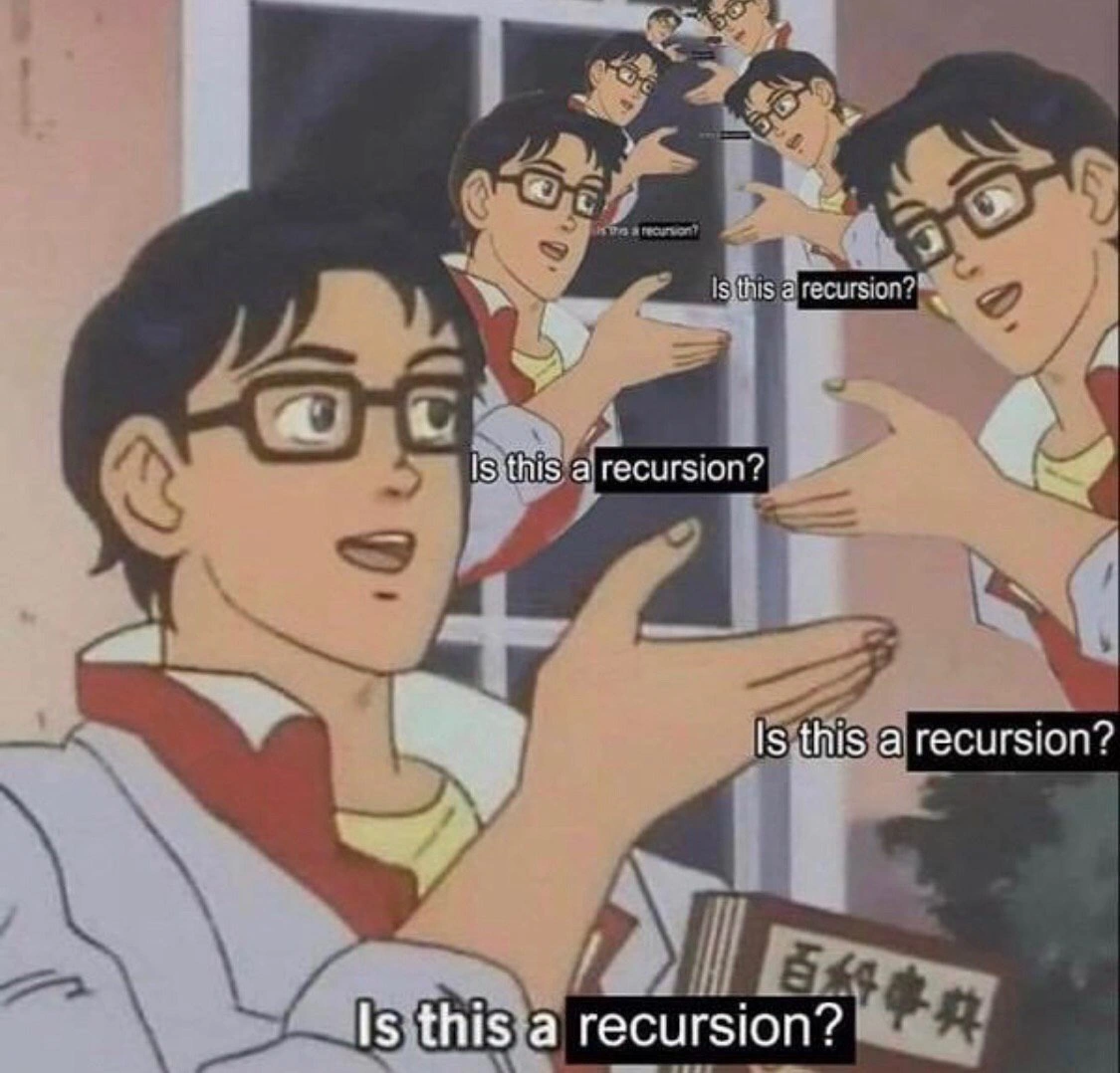
The picture explains that idea visually. The main image asks, "Is this a recursion?" Inside it is a smaller version asking the same question. Inside that is another smaller version, and the pattern continues. That nesting is why the meme works: it does not merely mention recursion; it performs recursion as an image.
The important beginner lesson is that recursion must stop somewhere. In code, that stopping point is called the base case. In this meme, the stopping point is when the repeated images get too small to read. In a program, forgetting the base case usually means the function calls itself forever until the runtime stops it.
Level 3: Base Case Missing
The meme repeats the same visual question at shrinking scales:
Is this a recursion?
And, unusually for a meme, the answer is basically yes. The image contains a smaller copy of itself, which contains a smaller copy of itself, and so on. That is a visual analogy for recursion: a structure or process defined in terms of a smaller version of the same structure or process. The anime character keeps presenting the nested image as if asking whether the thing inside the thing inside the thing is still the same thing. It is, until image resolution gives up and becomes the accidental base case.
The senior-level joke is that recursion is elegant in theory and treacherous in practice. The concept is simple enough to fit in one sentence, but real recursive code needs two pieces that beginners often separate too late: a recursive step and a base case. The recursive step says, "solve this by solving a smaller version." The base case says, "stop here." Without that stopping rule, the program keeps calling itself until the call stack runs out, the heap fills, or the monitoring dashboard starts making career suggestions.
def count_down(n):
if n == 0: # base case
return "done"
return count_down(n - 1) # recursive step
The image gets the recursive step exactly right: each copy points to another copy. It also hints at the hidden constraint: real systems are finite. Screens have pixels, images have compression artifacts, and programs have memory limits. Recursion feels magical because it turns repetition into structure, but it only works when each step moves toward termination. Otherwise, the joke stops being "classic" and becomes a production incident with a stack trace.
Description
The image shows an anime-style character pointing toward a nested copy of the same image, which contains another smaller copy, continuing inward several times. The visible caption "Is this a recursion?" appears repeatedly at different scales across the recursive image-within-image composition. A small sign with East Asian characters appears near the lower-right area of the original frame. The meme visualizes recursion by making the meme format contain itself, turning a common computer science concept into a self-demonstrating joke.
Comments
1Comment deleted
The base case is when the image is too compressed for the product manager to ask for one more level.