C++ for Python Devs: Welcome to the Jungle
Why is this Languages meme funny?
Level 1: The Stick-Shift Snob
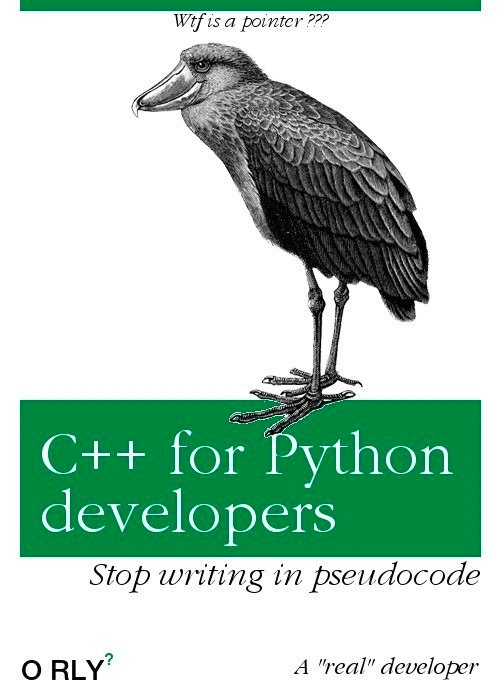
This is a pretend book cover making fun of an argument between two groups of builders. One group uses simple, friendly tools that do a lot of the work for you; the other uses complicated, powerful tools where you control every tiny detail — and some of them are snobby about it, like a driver who insists you're not really driving unless the car is a stick shift. The fake book pretends to be written by one of these snobs, telling the easy-tool folks to stop playing with toys and learn the hard way. The joke is that the snobbery itself is what's silly — and the giant grumpy bird on the cover stares out at everyone like it's tired of the whole argument.
Level 2: Pointers, Pseudocode, and the Two Worlds
A pointer is a variable that holds a memory address — not the value itself, but the location where the value lives. The cover's italic cry of "Wtf is a pointer ???" is the canonical Python-to-C++ culture shock, because Python hides addresses entirely:
# Python: just use the thing
name = "shoebill"
print(name.upper())
// C++: you may meet the address of the thing
std::string name = "shoebill";
std::string* ptr = &name; // & takes the address; ptr "points to" name
std::cout << ptr->size(); // -> dereferences: follow the address
In C++, you can also control when memory is allocated and freed — powerful, fast, and famously easy to get wrong (use a freed pointer and you earn a segmentation fault, the program crash that initiates every new systems programmer). Python instead uses a garbage collector that cleans up automatically, which is a big part of why it feels like pseudocode — the rough, plain-language sketch of an algorithm you'd write on a whiteboard. O'Reilly is the tech publisher famous for putting woodcut animals on programming books, and the O RLY? parody format borrows that visual language to deliver jokes shaped like book titles. The "real developer" line is your first taste of gatekeeping — the idea that you only count once you've suffered with the hard tools. You'll hear it; you may safely ignore it.
Level 3: Gatekeeping in a Green Dust Jacket
The fake O'Reilly cover — complete with the O RLY? logo, a magnificently judgmental shoebill stork, and the deadpan author credit A "real" developer — works because it lands punches in both directions of the eternal language war, and each side reads it as a victory.
Wtf is a pointer ??? C++ for Python developers — Stop writing in pseudocode
The "Python is executable pseudocode" jab has a genuine pedigree: Python's syntax really was designed to read like the pseudocode in algorithms textbooks, and that's a feature its creators were proud of. The insult only works by smuggling in the gatekeeper's premise — that ease of expression is cheating, and suffering through manual memory management is what mints a "real" developer. That premise is the actual satire target. The scare quotes around "real" are doing heavy lifting: the meme knows this author. He's the guy in code review who says "back in my day we malloc'd uphill both ways," who treats segfault scars as a rank insignia, and who conveniently forgets that the C++ community itself spent two decades building std::unique_ptr, std::shared_ptr, and RAII precisely so nobody has to hand-wrangle raw pointers anymore.
The deeper industry truth the cover gestures at: the two languages aren't even competitors so much as layers. The dirty secret of the Python ecosystem is that it's a friendly steering wheel bolted onto C and C++ engines — NumPy, PyTorch, CPython itself. Python developers ship pointer-juggling code every day; they've just delegated the juggling to people who enjoy it. Meanwhile the smug tagline cuts both ways: if Python is pseudocode, then the Python dev finished sketching the solution while the C++ dev was still arguing with the linker. Every veteran has watched a prototype "pseudocode" service outlive three attempts to rewrite it in something serious.
And the shoebill is perfect casting: a bird that looks prehistoric, stands motionless for hours, and stares at you like you've personally disappointed it. If C++ had an avian form, this is it.
Description
A parody of an O'Reilly programming book cover, featuring a detailed, black-and-white scientific illustration of a shoebill stork, known for its intense, prehistoric gaze. The image has a white background with green banners at the top and middle. The top banner contains the text 'Wtf is a pointer ???'. The middle green banner holds the main title in a serif font: 'C++ for Python developers'. Below this, a subtitle reads, 'Stop writing in pseudocode'. In the bottom-left corner, the publisher's logo is humorously altered to 'O RLY?', and in the bottom-right, the author is credited as 'A "real" developer'. The meme satirizes the steep learning curve and culture shock a Python developer faces when transitioning to C++, a lower-level language. It mocks the gatekeeping attitude within some programming circles by calling Python 'pseudocode' while simultaneously highlighting a notoriously difficult C++ concept (pointers) that Python abstracts away

Comments
8Comment deleted
The first chapter of this book is just a single sentence: 'If you have to ask what a pointer is, you've already segfaulted in your heart.'
C++ for Python devs: it still quacks like a duck, but you’re now on the hook for who owns the duck, when it’s plucked, and which pointer’s holding the feathers
After 20 years in this industry, I've learned that the developers who mock Python for being "pseudocode" are the same ones who spend three sprints debugging a memory leak that Python's garbage collector would have prevented, only to discover they were incrementing a pointer instead of dereferencing it
Chapter 1 is just the Python dev discovering that in C++, 'it works on my machine' can be undefined behavior that also works - until the optimizer reads the standard more literally than you did
The marabou stork is perfect here - a scavenger that picks through remains, much like a Python developer trying to manually manage memory in C++ after years of garbage collection doing the dirty work. The 'Wtf is a pointer???' perfectly captures that moment when you realize your entire mental model of 'variables' was actually just a comfortable lie built on reference counting and automatic memory management
Say “stop writing pseudocode” and C++ replies with a 200‑line template error - then we wrap it in pybind11 so Python can call it anyway
“Wtf is a pointer?” It’s a reference with the right to be wrong; RAII is HR to keep it from wandering off, and templates are the lawyers you hire when it does
Python devs meet pointers: realizing 'dynamic typing' was code for 'someone else manages my mess'