Skip to content
DevMeme
4218 of 7435
Zero panics when its full floating-point name is spoken aloud
CS Fundamentals Post #4609, on Jun 29, 2022 in TG

Zero panics when its full floating-point name is spoken aloud

Why is this CS Fundamentals meme funny?

Level 1: Full Name Fear

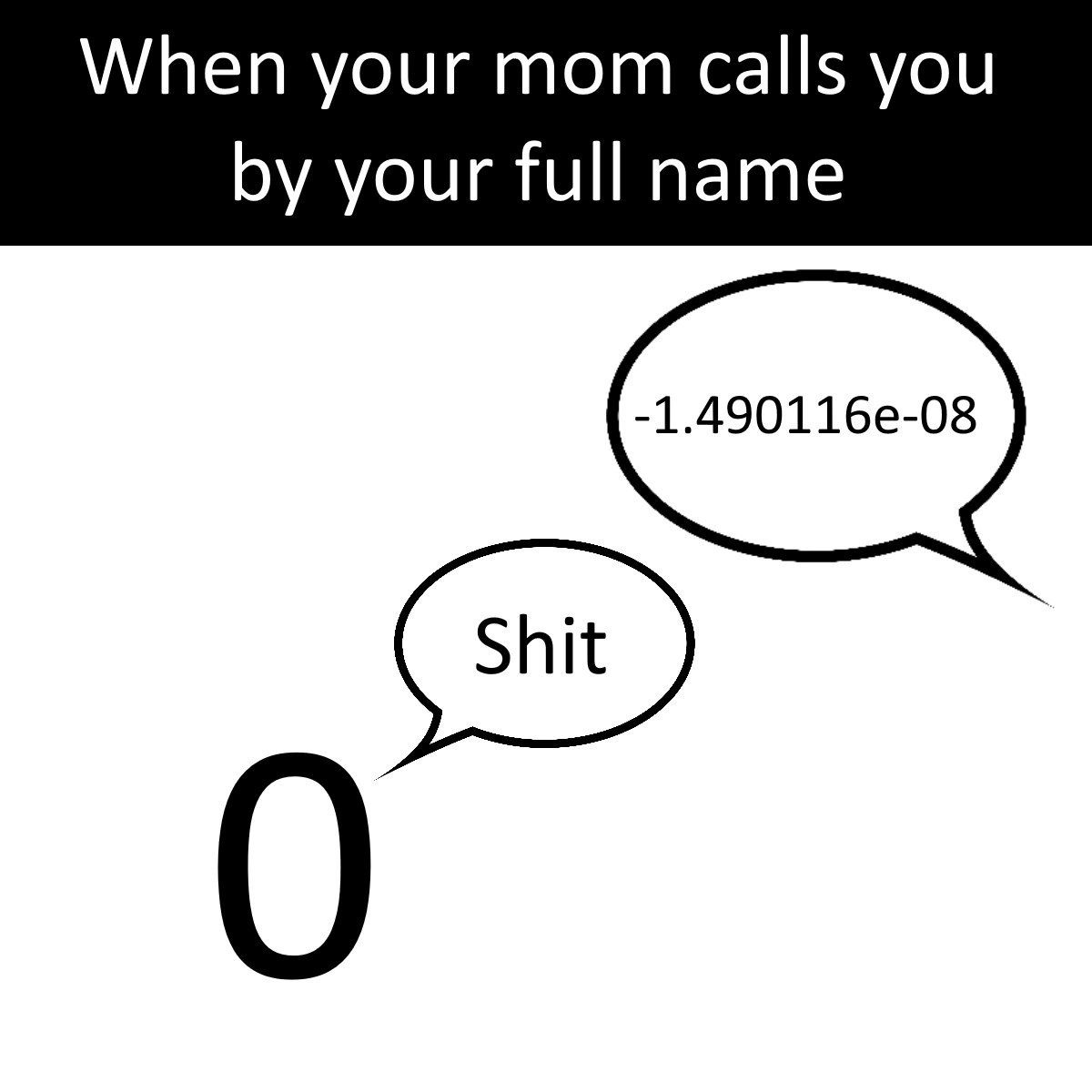
Think about when your mom or dad uses your full name – not just “Charlie,” but “Charles Montgomery Smith, get over here!” You know you’re in big trouble, right? You instantly get that sinking feeling of “Uh oh, what did I do?” This meme compares that moment to what happens with the number zero in a computer. Most of the time, zero is just “0,” nice and simple (like a nickname). But sometimes the computer will spit out a crazy long number like -1.490116e-08 for something that should just be zero. That’s like calling zero by its full name – “negative one point four nine millionths…”, yikes! In the picture, the little zero hears this and immediately says “Shit,” because it knows it’s caught or in trouble. 😂 The joke is showing that even a number as innocent as 0 can sound scary when the computer reveals its super-detailed formal name. In everyday terms, it’s funny because we all know the feeling of dread when your mom busts out your full name – and apparently, even Zero feels the same way when a computer calls it out with a big fancy number!

Level 2: Not Exactly Zero

Computers don’t handle decimal numbers the same way we do on paper. Instead of storing a number like 0.5 or 0.1 as exact decimals, they use a format called floating-point representation – essentially a binary version of scientific notation. For example, a number might be stored a bit like “1.23 × 10³” (scientific notation in decimal), but in binary form under the hood. A single-precision float (short for floating-point number) uses 32 bits and can accurately represent about 7 decimal digits. This limited precision means the computer has to round many values to fit. Just like how 1/3 in decimal is 0.333333 (and you’d round it to 0.3333 if you have only 4 decimal places), a number like 0.1 in decimal becomes an endless 0.0001100110011… in binary. The computer chops it off after a certain point. The result? A tiny rounding error. When you do arithmetic with these rounded values, sometimes you get an answer that’s a hair off from the mathematically perfect result.

The meme gives a perfect example. You’d expect 0 - 0 to be zero, exactly. But imagine in some calculation you were supposed to get 0 and you end up with -0.0000000149 (which is what -1.490116e-08 means in full decimal form: a very small negative number, -0.00000001490116… to be exact). That’s essentially -0.00000001, an extremely tiny negative amount. It’s the computer’s way of saying “I tried to get zero, but here’s a teeny leftover bit.” In programming, this often happens with floating-point math – you expect a nice clean 0, but due to those binary rounding quirks, you get a float that’s almost zero but not quite. This can be confusing for newcomers: why on earth is the computer telling me something that should be zero is negative? The answer is it’s just an artifact of how floats work. The number is so close to zero that for most purposes it is zero – but the computer doesn’t know you wanted an exact zero, it just faithfully reports the tiny difference it has.

This is a classic bug scenario in software. For instance, a junior developer might write code to check if total == 0.0 after some calculations. If total turned out to be -0.0000000149 instead of exactly 0.0000000000, that check would fail, and the program might do something unexpected. The issue isn’t that the math is wrong in a big way – it’s that the float format introduces a minuscule error. The term float epsilon is often used to describe the tiny threshold at which we consider two floating numbers “close enough” to be equal. In many languages, you’ll see something like FLT_EPSILON (for C/C++) which is about 1.192×10^-7 for float32. Our 1.490116e-08 is smaller than that, but it shows errors can vary depending on the scale of numbers involved. The safe practice is to check if a number is almost zero by seeing if its absolute value is below some very small epsilon, rather than checking for strict equality. This way, -0.0000000149 would be treated as effectively zero and not cause trouble.

So what’s with the “full name” joke? The meme’s top text says, “When your mom calls you by your full name.” We all know that feeling – if you hear “John Jacob Smith!” yelled from the kitchen, you know you might be in trouble. In programming, printing a number in full floating-point precision (for example, seeing -1.490116e-08 instead of just 0) is like calling that number by its “full name.” It exposes all the little details that we normally don’t say. Usually, we’d round or format the output to say 0.0, hiding that messy -0.0000000149 part. But when the computer blurts out -1.490116e-08, it’s like using the number’s full formal name – and Zero (just like a kid hearing their full name) reacts with shock: uh oh, what did I do? The humor here is that a plain 0 is being “scolded” by having its tiny hidden error revealed. It’s a lighthearted way to explain a computer science fundamental: floating-point numbers can have little errors that only show up if you look really closely (or print the number in a raw format). And just as hearing your full name is rare and alarming, seeing a bunch of random digits like 1.490116e-08 instead of 0 is a bit alarming for a developer – it means floating-point precision has popped up to say hello.

Level 3: Precision Panic

Every seasoned developer has encountered this scenario: you expect a result to be zero, you print it out, and instead you get something like -0.0000000149 (in scientific notation: -1.490116e-08). Cue the panic. In the meme, the big 0 sees its own “full name” -1.490116e-08 and immediately knows something’s wrong – hence the tiny speech bubble saying "Shit" (which, let’s be honest, is exactly what many of us mutter under our breath upon seeing such a value). The caption “When your mom calls you by your full name” nails the feeling: if a parent busts out your full name, you know you’re in trouble. Likewise, when a simple 0 turns into -1.490116e-08 in your program output, it’s a clear sign something unexpected (though nerdily familiar) has happened in your code. It’s both funny and painfully relatable because it dramatizes a mundane developer annoyance as a moment of personal horror for poor zero.

This joke resonates with anyone who’s battled floating-point precision issues. It satirizes the classic newbie mistake of assuming that floating-point math is exact. For instance, ask a junior dev what 0.1 + 0.2 equals and they’ll confidently say “0.3” – only to run that in code and get 0.30000004 (or occasionally 0.29999998). Surprise! 😱 That first encounter is practically a rite of passage in programming. Here, the meme takes a similar oops-moment and gives it a comedic twist: Zero isn’t as innocent as it looks. In a codebase, seeing a value like -1.49e-08 usually means you’ve hit a rounding snag. Maybe you summed up some percentages or did a physics calculation and expected an exact 0, but due to tiny binary approximation errors, you got a residual -0.0000000149. It’s not a catastrophic bug – nothing caught fire – but it’s enough to make an experienced dev cringe and a test case fail. In real life, this might lead to an assertion like assert(fabs(result) < 1e-6) instead of assert(result == 0.0) to account for those microscopic differences. Seasoned coders know to never compare floats for equality directly; that’s like expecting a call from mom to always be casual – sometimes it’s serious business.

The meme also hints at the collective “ugh, floating points” sentiment. CS fundamentals courses and countless Stack Overflow posts drill this fact: floating-point arithmetic is not perfectly precise. Even though we all know it, these tiny errors still manage to slip into our daily programming and wreak a bit of havoc. A senior engineer reading -1.490116e-08 instantly recognizes it: “Ah, the ol’ round-off error gremlin!” It’s the same familiar gremlin that caused the Patriot missile timing error in ’91 and countless off-by-a-cent errors in financial calculations. We’ve learned to live with it. There’s even an official term, machine epsilon, for the tiniest step a floating-point number can take. When you see weird values like this, you realize the machine is basically whispering, “Here’s the closest I could do, boss.” We chuckle (or groan) because it’s a universal gotcha. The humor here comes from dramatizing that gotcha: the number zero itself freaking out as if it got caught by surprise. It’s an exaggeration of how we feel seeing a harmless 0 suddenly sprout a long, negative, scientific surname.

Historically, this precision quirk is by design – a trade-off made for speed and storage efficiency. The IEEE-754 standard (adopted in 1985) made sure every programming language’s floats behave roughly the same, which is why veterans across the industry share the exact same war stories of “0.1 + 0.2 ≠ 0.3” and tiny phantom numbers haunting their calculations. There’s comfort in that shared misery: we’ve all been there, debugging why our total comes out to 0.0000001 instead of 0. It usually ends with a chuckle and a comment in the code like // adding an epsilon to fix floating-point weirdness. The meme distills that experience into a single image. By anthropomorphizing 0 as a kid fearing their parent’s wrath, it captures the mix of surprise and dread a developer feels upon seeing a float’s full precision output. In short, floating-point arithmetic is a bit of a troublemaker, and we’ve all learned to give it the respect (or side-eye) it deserves. When Zero hears its full floating-point name, we all know something’s up – and that’s hilariously true to life in software development.

Level 4: Sign of Trouble

Under the hood of this joke lies the IEEE-754 floating-point standard, which all modern computers use to represent real numbers in binary. A 32-bit single precision float is composed of a 1-bit sign (positive/negative), an 8-bit exponent, and a 23-bit mantissa (fraction). This binary scientific notation is efficient but cannot precisely represent many decimal values. For example, the decimal 0.1 (one-tenth) has no finite binary representation – in base-2 it's an infinite repeating fraction. The computer can only store a chopped-off approximation of 0.1. Multiply that tiny error by 3 and subtract from a stored 0.3, and you uncover a ghostly little remainder instead of a clean zero. In fact, -1.490116e-08 is not random; it's the result of binary rounding. It’s roughly $1.49 \times 10^{-8}$, which is actually $2^{-26}$ in binary – a minuscule round-off error lingering after the math is done.

Why exactly does this happen? IEEE-754 uses round-to-nearest (often with ties to even) as the default rounding mode. When the ideal result of a calculation can’t be represented exactly in the available 24-bit precision, the hardware rounds it to the closest representable number. Sometimes the rounding goes up, sometimes down. Here it went slightly down below zero, producing a tiny negative value. If you subtract two nearly equal floats (a common scenario known as catastrophic cancellation), the significant digits cancel out and you’re left with whatever rounding noise remains. That noise is what we see here – a negative residue on the order of the float’s precision limits. The magnitude ~$10^{-8}$ is near the scale of float epsilon for single precision (around $1.19\times10^{-7}$, which is the smallest difference between 1.0 and the next representable number). Our little stowaway -1.490116e-08 is about one-eighth of that epsilon, appearing because 0.3 and 0.1×3 aren’t exactly the same in binary.

It’s worth noting this number is almost negative zero but not quite. IEEE-754 actually defines a distinct negative zero value (sign bit = 1, all other bits 0), which would display as -0.0 if printed with enough precision. In this case we have a denormalized (or very small normal) negative number, not an exact -0.0 but in the same family of tiny float artifacts. The sign bit here is 1 (hence the “-” sign), and the fraction bits encode that $-1.49\times10^{-8}$ magnitude. This is a direct consequence of how floats work: the representation error that was invisible before is now exposed in full scientific notation glory. The meme humorously “speaks” the full technical name of zero – revealing all those hidden bits. In floating-point arithmetic, 0 isn’t always exactly 0; it might be $0 + \textit{some tiny \epsilon}$ (or in this case $0 - \epsilon$). The IEEE-754 design is a brilliant compromise that gives us fast math at the cost of tiny rounding errors. Those errors are usually negligible, but they can show up as spooky small numbers like our -1.490116e-08. The meme calls out this spooky detail: the moment when the seemingly innocent zero reveals its true form, down to the last bit of the mantissa.

Description

The meme has a black header with white text reading, "When your mom calls you by your full name." Below, on a white background, a large bold numeral "0" sits at bottom left. A speech bubble emerging from the zero says "Shit" in plain black text, conveying sudden dread. A second, larger speech bubble hovers above and to the right, containing the value "-1.490116e-08" - the tiny negative float often produced by round-off error instead of an exact zero in IEEE-754 single precision. The joke compares the fear of hearing one’s full name from a parent to a programmer’s alarm when supposedly perfect zero reveals its verbose floating-point representation, highlighting floating-point precision quirks familiar to experienced developers

Comments

6
Anonymous ★ Top Pick Every time finance wants an “exact zero” balance, I picture 0 nervously admitting its legal IEEE-754 name, -1.490116e-08, and quietly schedule the post-mortem
  1. Anonymous ★ Top Pick

    Every time finance wants an “exact zero” balance, I picture 0 nervously admitting its legal IEEE-754 name, -1.490116e-08, and quietly schedule the post-mortem

  2. Anonymous

    That moment when you realize your unit tests have been passing for three years because someone wrote `assert(balance > -0.0001)` instead of `assertEquals(0.0, balance)` and now the auditors want to know why the financial reconciliation is off by $47.23

  3. Anonymous

    Every senior engineer has learned the hard way: never use `==` to compare floats to zero. That '-1.490116e-08' isn't just a number - it's the ghost of every accumulated rounding error from your matrix multiplication, the phantom remainder of your trigonometric calculations, and the reason you now religiously use epsilon-based comparisons. It's the numerical equivalent of technical debt that compounds with every operation, reminding us that in floating-point arithmetic, zero is more of a philosophical concept than a concrete value

  4. Anonymous

    0 getting called by its full IEEE 754 name (-1.490116e-08): proof that "== 0" isn’t a boolean, it’s a career-limiting move

  5. Anonymous

    Zero’s full name in prod is -1.490116e-08 - hence seniors write abs(x) < ε, juniors write x == 0, and only one of them sleeps through pager duty

  6. Anonymous

    fabs(mom_full_name) > 1e-10? Abort prod deploy, refactor childhood

Use J and K for navigation