Skip to content
DevMeme
4217 of 7435
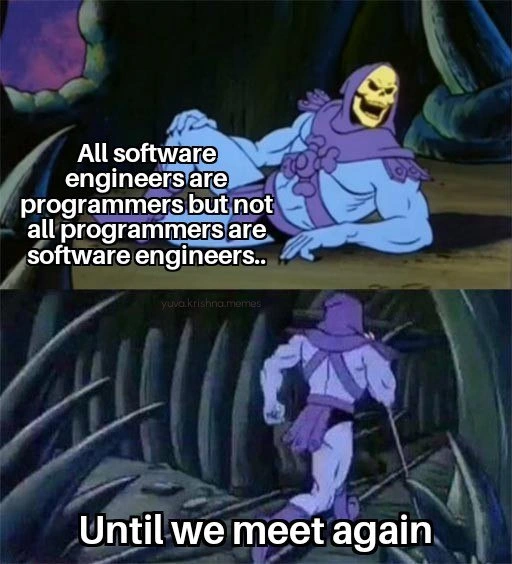
Skeletor drops the software engineer vs programmer truth bomb and flees
DevCommunities Post #4611, on Jun 29, 2022 in TG

Skeletor drops the software engineer vs programmer truth bomb and flees

Why is this DevCommunities meme funny?

Level 1: Says It, Runs Away

Imagine your friend proudly says, “All chefs can cook, but not everyone who cooks is a chef!” Then they immediately dash out of the room yelling, “See you next time!” You’re left blinking, thinking about what they said. It’s kind of true – being a chef is a special role of people who cook – but the way they blurted it out and ran off is silly. This meme is just like that. A cartoon bad guy announces a fact about job names (in a way that might start an argument) and then zooms off saying “Until we meet again,” like a prankster who doesn’t want to stick around for the fallout. It’s funny because he drops a truth and runs away before anyone can shout back, leaving us chuckling and thinking, “Hey, he’s got a point – and he really disappeared fast!”

Level 2: Programmer vs Engineer 101

Let’s break down the key idea for a newer developer. The meme’s text draws a line between a Programmer and a Software Engineer, terms that might sound interchangeable but often carry different connotations:

  • Programmer: Generally, this means anyone who writes code – i.e., creates computer programs. If you write a Python script or build a simple app, you’re programming. A programmer focuses on solving problems by coding. It doesn’t specify how they do it or whether they follow a formal process. It could be a self-taught teenager scripting in their basement or a junior dev cranking out features. “Programmer” is a broad term; all it requires is the act of writing and running code.

  • Software Engineer: This title usually implies a programmer who applies engineering principles to software creation. It’s a more formal role in a team or company setting. A software engineer not only writes code, but also thinks about system design, architecture, scalability, testing, and maintainability – much like an engineer constructing a building, but with software. They might use design documents, follow methodologies (like Agile), do code reviews, and consider the entire lifecycle of the software. In essence, a software engineer is expected to be more systematic and disciplined in building software.

The statement “All software engineers are programmers, but not all programmers are software engineers” is saying that if someone is working as a software engineer, they definitely do programming as part of their job (coding is one tool in an engineer’s toolkit). However, not every person who writes code (a programmer) performs the full breadth of tasks or bears the responsibilities that define “software engineering.” For example, a hobbyist who writes small scripts is programming, but they might not be engineering a large application with formal practices. Likewise, a physics student writing simulations in code is a programmer, but might not identify as a software engineer since their primary focus isn’t building software systems.

This distinction is often about scope and discipline. In real life, companies use these titles differently. Many tech firms label almost all coding roles as “Software Engineer” to emphasize professionalism (and, frankly, because CareerHumor aside, “engineer” sounds fancier on a business card). In other places, you might see “Programmer Analyst” or just “Programmer” in job listings, especially in older industries – but it’s the same idea. There’s a bit of TitleInflationInTech: over the decades, the industry shifted from calling people “computer programmers” to “software developers” and “software engineers” as the field matured. The meme riffs on this nuance: everyone who engineers software writes code, but calling someone an engineer often implies they do more than just write code.

For a junior dev, the meme is also a wink at a common confusion: What am I, a programmer or an engineer? The answer can depend on context or personal identity. If you’re writing code, you are programming – so you are a programmer. If you are also designing solutions, considering edge cases, and following systematic approaches in a project, you’re doing software engineering. Many of us wear both hats! But internet forums love to split hairs over these labels. DeveloperHumor often highlights how serious we get about such titles. The Skeletor meme template, famous in DeveloperCulture, is used here to comically deliver that distinction. Skeletor, with his blue muscular frame and skull face, is shown in a dark cave (panel one) confidently stating this potentially annoying fact. In panel two he’s shown from behind, marching away into the shadows with the caption “Until we meet again.” This mirrors someone posting a bold opinion in a chat and immediately signing off with a dramatic flair. It’s funny because it’s true: these debates pop up repeatedly, and those who start them often know they’re triggering a DeveloperStereotypes squabble, then leave others to argue.

So, the meme is both an explanation and a joke. It explains that being a software engineer encompasses programming plus more, and it jokes about how dropping that fact online can cause an argument. It’s relatable to any developer who’s seen (or unwittingly started) a “programmer vs software engineer” thread. Now you know: writing code makes you a programmer, and if you approach it with structured engineering practices, you can call yourself a software engineer – but be prepared for someone like Skeletor to quip about it and disappear in a puff of purple smoke!

Level 3: Title Taxonomy Truth Bomb

In this meme, Skeletor (the cackling villain from He-Man) drops a logical gem and then bolts: “All software engineers are programmers but not all programmers are software engineers.” It’s a classic set-theory truth bomb in developer culture. Think of it like the old math analogy: all squares are rectangles, but not all rectangles are squares. Here, Software Engineer is treated as a special subset of Programmer. The meme is poking fun at a long-standing role_definition_debate in dev communities. Seasoned engineers have seen this flame war fuel countless times on forums and Slack – someone confidently asserts the hierarchy of job titles, then vanishes before the inevitable rebuttals. Skeletor reclining smugly in a ribcage-like cave sets the snarky tone: he knows he’s stirring the pot. By Panel 2, he’s strutting off (exit(stage_left) style) with “Until we meet again”, just like a forum troll dropping a controversial definition and logging out. This resonates in DeveloperCulture because it is painfully true: discussions about who’s a “real” software engineer versus just a programmer always ignite passionate opinions. The humor lies in how the truth is delivered – as a mic-drop statement. It echoes our shared experiences: perhaps an older colleague insisting on title distinctions, or threads on r/programming debating if “coder” vs “engineer” is merely TitleInflationInTech. Many of us nod knowingly (or roll our eyes) because we’ve been there, done that. DevCommunities notoriously latch onto these semantic battles, and this meme nails the dynamic: a spicy viewpoint thrown like a grenade, followed by a dramatic cartoon_villain_signoff. In short, it’s hilariously relatable – a meme that makes both veterans and newbies smirk, knowing the conversation around job titles will, indeed, meet us again.

Description

Two - panel Skeletor meme from the 1980s He-Man cartoon. Top panel: Skeletor reclines smugly inside a dark cave, white text next to him reads, "All software engineers are programmers but not all programmers are software engineers.." Bottom panel: the villain is seen from behind marching deeper into the rib-cage-like tunnel with the caption, "Until we meet again." Visually the scene is dimly lit with blue-purple tones matching Skeletor’s blue body and purple hood. Technically, the meme riffs on long-standing community debates around job titles, role scope, and the difference between writing code versus practicing disciplined software engineering; Skeletor’s swift exit mirrors how such statements are often dropped in forums before inevitable flame wars erupt
Comments

6
Anonymous ★ Top Pick Every programmer can merge to main; a software engineer also has to diagram the blast radius, write the RFC, and babysit the 3 a.m. rollback - anyway, muting this thread, until we meet again
  1. Anonymous ★ Top Pick

    Every programmer can merge to main; a software engineer also has to diagram the blast radius, write the RFC, and babysit the 3 a.m. rollback - anyway, muting this thread, until we meet again

  2. Anonymous

    The same energy as explaining to the CEO why the "programmer" they hired on Fiverr for $50 can't architect their distributed system, but your staff engineer who hasn't written production code in six months absolutely can

  3. Anonymous

    This meme perfectly captures the industry's most passive-aggressive LinkedIn debate. The distinction matters in some contexts - software engineering implies systems thinking, design patterns, scalability considerations, and architectural trade-offs beyond just syntax mastery. But in practice, we've all seen 'Senior Software Engineers' who cargo-cult Stack Overflow solutions and 'programmers' who architect elegant distributed systems. The real engineering skill? Knowing when to drop this truth bomb in a Slack channel and immediately go offline for 'focus time' before the 47-message thread erupts about whether a bootcamp grad can call themselves an engineer

  4. Anonymous

    Programmers ship the feature; software engineers architect the post-mortem that exposes why it wasn't enough

  5. Anonymous

    All software engineers are programmers; not all programmers are engineers - the giveaway is who ships a canary, a runbook, and a rollback instead of just a README

  6. Anonymous

    Formally: engineers ⊆ programmers and ∃p∈programmers:p∉engineers; practically: HR will turn that into five pay bands and a leveling matrix

Use J and K for navigation