Skip to content
DevMeme
4219 of 7435
Programmers confronted with their contingency-planning failures react with offended agreement
CodeQuality Post #4610, on Jun 29, 2022 in TG

Programmers confronted with their contingency-planning failures react with offended agreement

Why is this CodeQuality meme funny?

Level 1: The Truth Hurts

Imagine you have a big school project due tomorrow. You decide not to save an extra copy of your work because you’re sure nothing will go wrong. But then your computer suddenly crashes and you lose everything. The next day, your teacher says, “You should have planned for something like that.” You feel upset and a bit embarrassed, because deep down you know they’re right — you didn’t prepare for the unexpected. It’s the same kind of feeling this meme jokes about: someone points out a mistake we keep making (not being ready for problems), and even though it hurts your feelings, you secretly agree. It’s funny and true at the same time, which is why we can’t help but laugh.

Level 2: Expect the Unexpected

This meme highlights a common lesson for developers: always plan for things to go wrong. In programming, contingency planning means thinking about “what could go wrong?” and coding defensively to handle those cases. An edge case is a scenario that’s unusual or rare (like an odd input or an unexpected user action) that can break your code if you didn’t account for it. Defensive programming is when you write your code to handle bad or unexpected inputs and situations safely, instead of just assuming everything will be perfect.

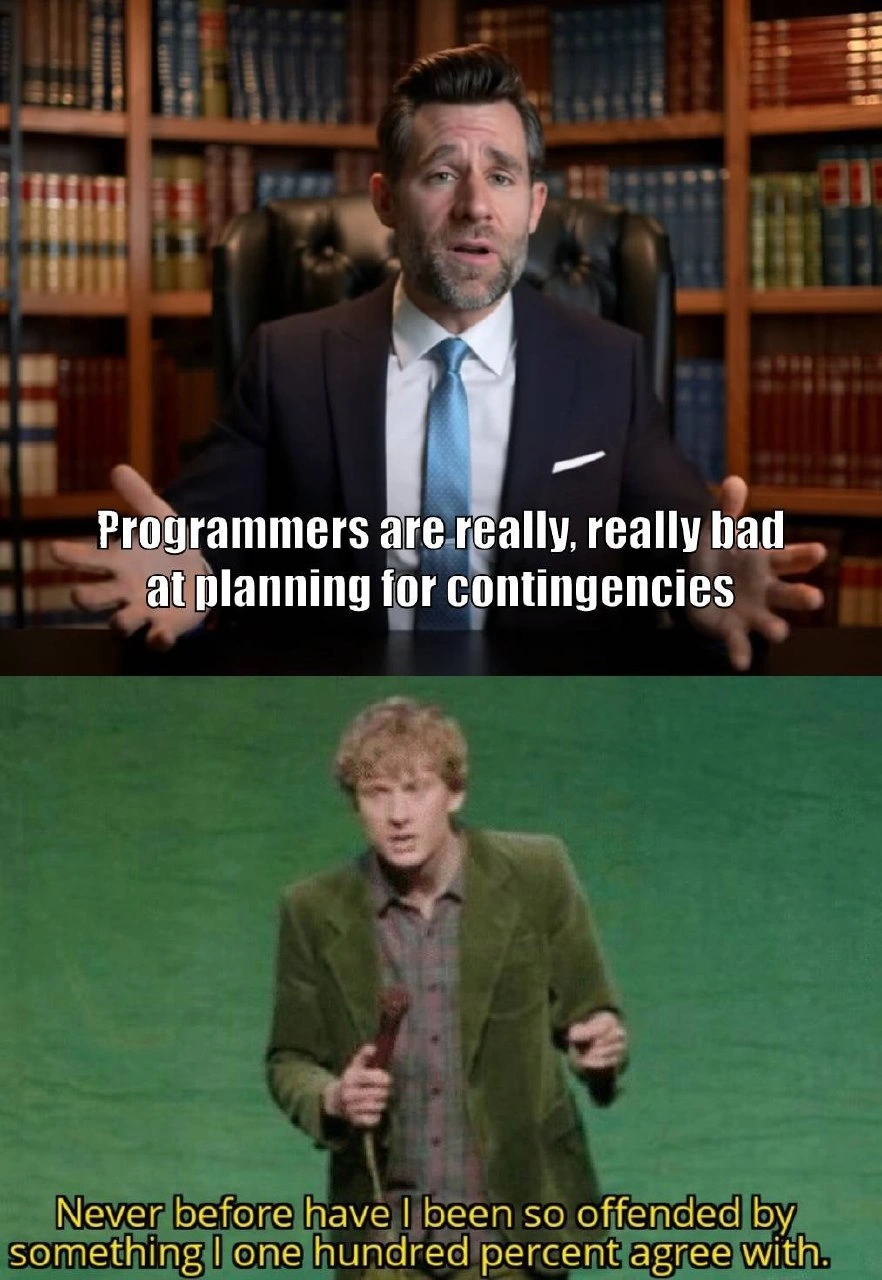
In the top image, someone is basically saying “Programmers are terrible at planning for contingencies,” which is a fancy way of saying we often forget to handle errors and weird cases. The bottom image is a comedian responding, “I’m offended because it’s true.” Developers find this funny because we know we should do better at things like error handling, but many of us have been guilty of ignoring it. It’s a bit of CodingHumor mixed with truth – a gentle roast of our habits.

Think about writing a simple program to multiply a number by 5. If you don’t plan for the contingency that the input might not be a valid number, your program could crash. A junior developer might not realize they need to handle that until it happens. Error handling is the practice of catching these problems so the program can respond gracefully (like showing a friendly message instead of crashing). For example, if you ask a user to enter a number, you should be ready in case they type letters by mistake:

user_input = input("Enter a number: ")
# Without contingency planning, this next line might crash if input is not a number
number = int(user_input)  
print(f"You entered {number}.")

If the user types "abc" instead of a number, int(user_input) will throw an error and the program will stop. Contingency planning means anticipating that and handling it, for example:

user_input = input("Enter a number: ")
try:
    number = int(user_input)
except ValueError:
    # Handle the unexpected scenario
    print("That wasn't a number! I'll use 0 instead.")
    number = 0
print(f"You entered {number}.")

In the fixed version, we used a try/except block to catch the problem (a ValueError if the input isn’t a number) and provide a fallback (number = 0 as a safe default). This is a simple example of defensive programming and planning for an edge case. The program doesn’t crash; it handles the situation and continues, which is much better for the user experience and overall code quality.

Now imagine this on a larger scale: say your app depends on a web service. Good contingency planning means your code should ask, “What if that service is down or slow?” Maybe you’d implement a fallback (like use cached data or try again later) so the app can keep working. If you expect the unexpected, your app might show a friendly error message or retry automatically instead of just freezing. DevOps/SRE folks (site reliability engineers) do this kind of planning all the time: for example, they set up backup servers in case one server fails. If developers forget these steps, the system becomes brittle – meaning even a small glitch can break everything.

The meme is basically poking fun at developers (ourselves) for not doing enough of this. It’s common in our field to concentrate on making the code work under perfect conditions (we call that the happy path), and sometimes we procrastinate on the “unhappy paths” (when things go wrong). The result is plenty of developer pain points: panicky late-night fixes, debugging weird bugs that only appear when something goes wrong, and saying “oops” a lot. So when someone points this out, we feel a bit embarrassed. The bottom caption “offended by something I 100% agree with” captures that feeling: it stings because it’s true. Every new programmer eventually has that moment where a program breaks due to an unhandled case, and you learn the hard way why planning for contingencies is so important.

Level 3: The 3AM Surprise

Programmers often focus on the happy path – writing code under the optimistic assumption that everything will work as expected. The top panel’s claim that “Programmers are really, really bad at planning for contingencies” hits like a harsh truth delivered by a smug consultant (or maybe by your senior DevOps/SRE lead after the latest outage). And the bottom panel’s caption – “Never before have I been so offended by something I 100% agree with.” – perfectly captures our wounded pride. It’s a classic case of programmer self-deprecation: we’re laughing at our own well-known failure to expect the unexpected.

Why are we so bad at contingency planning? Blame a mix of optimism, pressure, and the sheer complexity of systems. We tend to plan for everything going right, doing minimal edge-case thinking. It’s easier and more rewarding to make the code work in ideal conditions than to imagine everything that might go wrong. Writing robust error handling and defensive programming logic for every little failure scenario doesn't get the demo done faster – so it gets skipped. This is how you end up with brittle systems that crumble when something strays from the ideal path. The result? That dreaded 3 AM pager alert when an unhandled scenario blows up in production, i.e. an on-call fire-drill you could have prevented.

We’ve all been there. Maybe you had a microservice assume the database is always reachable – and then the database went down, causing a cascade of failures with no fallback. Or an API call in your code had no retry logic (because “the network never fails,” right?) and a minor glitch turned into a major user-facing error. Perhaps you remember pushing code that handles user logins but forgot to plan for what happens if the authentication service is slow or returns an error. Suddenly, the whole app freezes because of one unhandled exception. Each forgotten edge case is a ticking time bomb waiting to go off at the worst possible moment.

Design trade-offs play a huge role here. Under tight deadlines, teams often trade resilience for speed: skip writing that extra check or backup plan so you can ship a feature by Friday. Everyone implicitly thinks, “We’ll handle the error cases later.” But “later” often never comes – until the system crashes. It's painfully accurate: CodeQuality suffers when contingency planning is treated as an optional add-on. This habit leads to the same DeveloperPainPoints every time: endless debugging sessions, frantic troubleshooting, and post-mortems concluding “We didn’t consider what would happen if X failed.”

The humor lands because it’s EngineeringAbsurdity we all recognize. The meme basically calls us out. A professional-looking guy declares our weakness, and our reaction is a mix of insult and agreement. In real life, many of us have sat through blameless post-incident reviews where someone gently says, “We could have planned better for this failure,” and we all nod along, feeling both guilty and understood. The offended yet agreeable comedian in the second panel is every developer who’s been burned by their own optimistic assumptions. We laugh because we’ve all made these mistakes, and deep down we know the criticism is 100% valid – even if it stings our pride.

To drive it home, here are a few scenarios showing our contingency planning failures:

Ideal Planning Actual Practice Outcome
Add retries and a fallback for that external API call. Hardcode a single call, assume the API is always up. Site crashes when the API times out.
Validate every user input and handle bad data. Assume users will only enter perfectly valid data. One weird emoji in input breaks a feature for everyone.
Deploy redundant servers with a failover strategy. Run a single server to “keep it simple.” Single point of failure → complete outage when that server dies.

Notice a pattern? In each case, the crucial “what if this fails?” logic is left out. We hope nothing goes wrong, instead of coding as if everything will eventually go wrong. When those chickens come home to roost (usually at some ungodly hour), we get that sinking feeling: “Yup, I really should have planned for that.” By then, of course, it’s too late, and the on-call engineer (possibly the same developer who wrote the code) is scrambling to patch the hole under pressure.

From a seasoned perspective, this meme is on point. It jabs at our industry’s dirty little secret: building truly fault-tolerant systems is hard, time-consuming, and often undervalued – until something breaks. Only after a fiasco do higher-ups suddenly prioritize adding fallback code or redesigning for reliability (the classic “We must ensure this never happens again!” vow). The offended-yet-agreeing comedian in the second panel is basically every developer who’s learned the hard way that Murphy’s Law is always lurking. We smirk at the meme because we’ve lived it – the truth hurts, but it’s undeniably funny when put like this.

Description

Two - panel meme. Top panel: a suited man sits confidently in a wood-paneled office lined with law-library books; white text across his chest reads, "Programmers are really, really bad at planning for contingencies." Bottom panel: a comedian on a green stage clutches a microphone, looking mildly outraged; yellow subtitle text says, "Never before have I been so offended by something I one hundred percent agree with." The joke plays on developers’ chronic neglect of edge-case thinking, error paths, and resilience design - painfully accurate yet insulting, highlighting how poor contingency planning leads to brittle systems and on-call fire-drills
Comments

6
Anonymous ★ Top Pick Our whole “high-availability” strategy unravels the moment someone asks for the RTO and the ops lead answers, “However long GitHub Actions needs to redeploy from main.”
  1. Anonymous ★ Top Pick

    Our whole “high-availability” strategy unravels the moment someone asks for the RTO and the ops lead answers, “However long GitHub Actions needs to redeploy from main.”

  2. Anonymous

    We meticulously plan for distributed system failures, implement circuit breakers, design for eventual consistency, and then hardcode the database connection string in three different places because "we'll fix it before production."

  3. Anonymous

    This hits harder than a null pointer exception at 3 AM. We'll spend weeks architecting elegant microservices with perfect separation of concerns, but somehow 'what if the database goes down' never makes it past the backlog grooming session. We're the same people who write comprehensive unit tests for happy paths while production burns because nobody considered what happens when AWS has a bad day in us-east-1. The real contingency plan is always 'page the senior engineer and hope they're not on vacation.'

  4. Anonymous

    Contingency plan: “Just roll back.” Reality: irreversible schema migration and a very detailed, blameless postmortem

  5. Anonymous

    Ah yes, the classic 'happy path only' architecture - until prod reminds us contingencies pay the bills

  6. Anonymous

    Our DR strategy is robust: retries without backoff, circuit breaker in the backlog, and a secondary region that only exists in the architecture diagram

Use J and K for navigation