When Figma’s marketing email lands in your inbox like a frag grenade
Why is this UX UI meme funny?
Level 1: When Emails Attack
Imagine you’re playing with your building blocks very quietly, and then a friend sneaks up and pops a balloon right behind you. BOOM! You’d jump in surprise, right? They might laugh and say, “Hey, I was just checking on you!” They didn’t mean any harm – maybe they thought it would be funny – but it definitely startled you and made you lose track of what you were doing. This meme is like that. The “friendly” email from Figma is the little surprise, and the developer getting scared is like you jumping when the balloon pops. The meme picture uses a big explosion (a grenade) to show how even a small, silly interruption (like someone saying “just checking the vibe!”) can feel super dramatic when it catches you off guard. In other words, it’s funny because it takes a tiny everyday surprise and turns it into a huge over-the-top scene – showing how a little distraction can seem like a big boom when you’re really focused.
Level 2: Inbox Overload
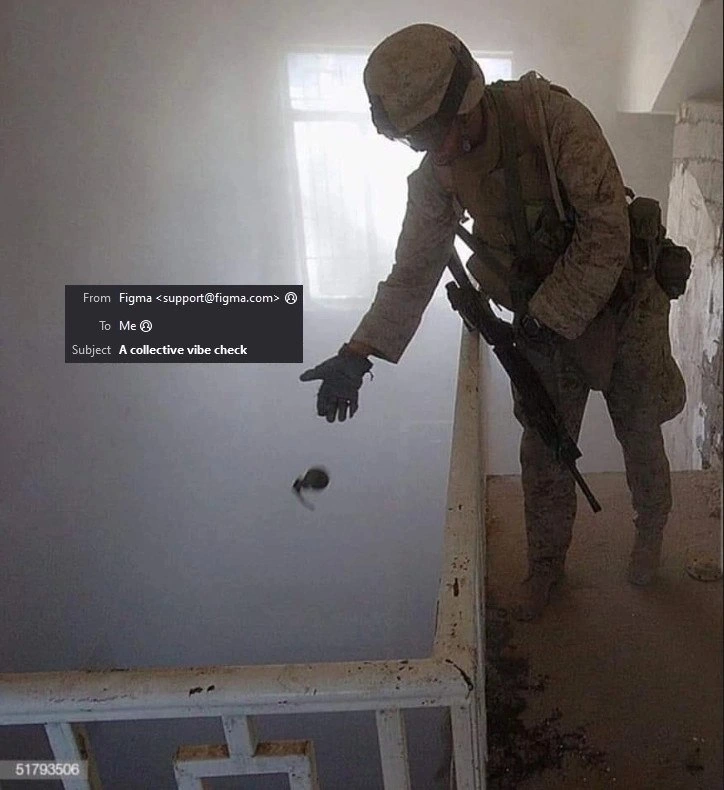
For a junior developer or someone new to this, let’s break down the joke. Figma is a popular cloud-based tool that designers use to create app and website mockups. Developers often interact with Figma to inspect designs or provide feedback on layouts. Because it’s an online service, Figma occasionally sends out marketing emails – those are mass emails companies send to promote new features, share news, or re-engage users. The meme shows an email from Figma with the subject line “A collective vibe check” landing in the person’s inbox.
Now, “vibe check” is a slang term meaning a casual check-in on how everyone’s feeling or what the mood is. It’s the kind of playful language a marketing team might use to seem friendly and in touch with their community (perhaps Figma was trying to ask users for feedback or just share some feel-good update). To a busy developer though, an unexpected email like this can feel like an interruption. They might be deep in concentration or solving a problem when ping! – up pops this cheeky message. The subject might be lighthearted, but it demands a sliver of the developer’s attention, pulling them away from what they were doing.
The image paired with the email text is a soldier dropping a frag grenade (fragmentation grenade) down a stairwell in a smoky, chaotic environment. A frag grenade is a small bomb that explodes and scatters sharp metal fragments – obviously very dangerous in real life. This dramatic visual is being used figuratively. It’s comparing the Figma email to a grenade “landing” in the developer’s inbox. Of course, an email isn’t actually destructive, but the meme exaggerates to make a point. The idea is that the email arrives with a bang, startling the developer just like a sudden grenade blast would. The hazy, dust-filled scene suggests confusion and disarray, much like a developer’s train of thought getting blown up by surprise notifications.
Communication overhead is a term for all the extra communication (emails, chat pings, notifications) you have to deal with besides your actual work. Modern developers use many tools – not just Figma, but also code repos, project trackers (like Jira), CI/CD pipelines, chat apps (Slack, Teams), and so on. Each tool loves to send updates: for example, you might get an email when someone comments on a Figma design, a Slack alert when code deployment fails, or a calendar reminder about a meeting. Add them up and it can become a distracting flood of information. We call that inbox overload or notification fatigue. It means you’re spending so much time skimming messages and alerts that it’s hard to focus on coding.
This meme is funny to developers because it captures that feeling in a silly way. The Figma marketing email was presumably meant to be helpful or fun, but the developer’s reaction (represented by the soldier tossing a grenade) is basically “Thanks, but no thanks!” It highlights a bit of a culture clash: the marketing/design side tries to pep things up with a friendly “vibe check” message, while the engineering side experiences it as just another sudden distraction. If you’ve been coding even for a little while, you might have already experienced something similar – like getting a random “Don’t miss these cool new features!” pop-up or an out-of-the-blue email announcement while you’re knee-deep in debugging. It can feel like your concentration got exploded for no good reason.
In simpler terms, the meme is saying that developers often feel bombarded by too many messages from the very tools that are supposed to help them. Even something small and positive, like a cheery email, can seem huge when it arrives at the wrong time. By showing an actual grenade going off, the meme humorously blows out of proportion how a harmless “just checking in” message can feel to someone who’s super busy. It’s pointing out in a lighthearted way that sometimes even a tiny interruption can seem like a big deal when you’re focused on something important.
Level 3: Email Blast Radius
The meme deploys a darkly comedic scenario that resonates with battle-scarred developers. In a smoky warzone stairwell, a soldier is releasing a frag grenade. Superimposed on this chaotic scene is a benign-looking email preview from Figma with the subject line “A collective vibe check.” The humor detonates from the absurd contrast: a cheery UX tool marketing email landing with the impact of a fragmentation grenade. To a senior engineer already ducking from a barrage of notifications, that playful subject line can feel like shrapnel to their focus.
Communication overhead in modern development has turned inboxes into warzones. We’ve armed ourselves with countless collaboration tools—UX/UI design platforms like Figma, issue trackers, CI pipelines—but each one opens another front for notifications. Every ping and promotional email is another round of “friendly fire.” An email blast innocently titled “vibe check” becomes an email blast radius event, catching the entire team in its scatter. (After all, “email blast” is the marketing term for mass-mailing—here it’s practically literal.) It’s comedic because it’s true: the developer’s day often feels like hunkering down while various apps lob updates and marketing grenades over the cubicle wall.
Seasoned engineers share a kind of alert fatigue when it comes to surprise emails. The subject tries to sound casual and hip — “vibe check,” as if the marketing team is just tapping us on the shoulder. But deployed at the wrong moment, it’s more like a flashbang that leaves us dazed. It’s not that we hate product updates; it’s that they arrive unannounced amidst critical work. One moment you’re deep in code or fighting a production fire, the next your inbox pops up with a cheery “collective vibe check” newsletter, utterly out of context. The absurdity is that these tools exist to help us collaborate and improve Developer Experience (DX), yet their communication style can feel like an ambush. Ironically, a message about “checking vibes” can obliterate whatever zen vibe the developer had going, much like a grenade blast obliterates calm.
This meme satirizes a real industry pattern: tooling frustration caused not by the tools themselves, but by how they communicate. It highlights the tension between marketing culture and developer reality. On one side, companies like Figma want to engage users with quirky, community-building emails. On the other side, overworked devs just see another distraction or—worse—a potential crisis (until proven otherwise, that new email could be anything from a security alert to another JIRA ticket from hell). There’s an unspoken rule among senior devs: if something lands in your inbox unexpectedly, brace for impact. We’ve been conditioned by years of “urgent” emails that turned out to be trivial, and trivial emails that arrived during urgent times. So a subject line’s friendly tone means nothing — even a “fun” vibe check can have us instinctively diving for cover.
Why can’t we simply ignore these emails? Because FOMO and responsibility play a role. Maybe that “collective vibe check” hides a critical update about an API change or a new feature the team should know about. Or maybe it’s just marketing fluff. The trade-off between staying informed and staying focused is a daily dilemma. A senior dev might chuckle at this meme and mutter, “Yep, been there.” They’ve learned to survive by setting up filters, unsubscribing aggressively, or relegating marketing mails to a quarantined folder. But the core issue persists: important tool communications (like real outage alerts or design handoff notices) share the same channel as noisy promos, making it hard to tell a life-saving update from a vibe-check grenade without peeking.
In essence, the meme pokes fun at the shared experience of inbox overload and context-switch whiplash. It’s developer humor deploying hyperbole: turning a mild annoyance into a literal battlefield scenario. The soldier in full gear might as well be the senior engineer’s psyche — armored up, deadpan, and casually dropping that email-grenade with a “nothing personal” attitude. Or perhaps it’s depicting Figma’s marketing team as a well-intentioned commando tossing in some “fun” during a lull, unaware they’re startling the very people they’re trying to engage. Either way, it’s hilariously relatable: every experienced dev sometimes feels like they’re taking cover from the next inbound @figma.com blast. As the cynical veterans like to joke, out here in the trenches of agile development, even the emails have blast damage.
Description
Photo-meme shows a fully armed soldier in a dusty, smoke-filled stairwell, leaning over a railing and dropping a hand grenade toward the lower floor. Overlaid on the hazy background, a dark email preview box reads: “From Figma <[email protected]>”, “To Me”, and “Subject A collective vibe check”. The visual gag equates the playful “vibe check” subject line with the destructive force of a grenade, humorously capturing how unexpected product-marketing blasts can feel to developers already flooded with tool notifications. It riffs on UX/UI tooling culture - Figma is nominally helping teams collaborate on design, yet its promotional email is portrayed as an aggressive interruption, highlighting communication overload and tooling frustration familiar to senior engineers
Comments
20Comment deleted
Figma’s “collective vibe check” lands like: “Surprise, we renamed every color token again - enjoy sweeping the shrapnel out of your visual regression snapshots.”
When your design system has 47 different button variants but the PM insists the real problem is team morale, not the 8-pixel inconsistency that's been haunting production for three quarters
When Figma sends you a 'collective vibe check' notification, you know someone's about to question your 8px vs 12px spacing decision from three sprints ago, and suddenly you're breaching a room full of stakeholder opinions armed only with your design system documentation and a prayer that your component library is up to date
Figma email: “A collective vibe check” - translation: we published a design‑system update that renamed one color token; enjoy the chaos test across 40 microfrontends and every CI job
Translation of “a collective vibe check”: we renamed the design tokens right before code freeze - please calculate the blast radius
Figma vibe check: confirming your design system's constraints hold up better than a legacy monolith under load
??? Comment deleted
??? Comment deleted
??? Comment deleted
??? Comment deleted
??? Comment deleted
??? Comment deleted
ew ordered replication is recently invented in your region Comment deleted
I don't get this Comment deleted
looks to be an email sent out to all customers. smells like someone got fired after this Comment deleted
When creator has to explain.... Comment deleted
I'm not the creator Comment deleted
??? Comment deleted
??? Comment deleted
This is just a play on how that soldier is doing a collective vibe check same as figma in their newsletter Look up vibe check memes if you have any questions left Comment deleted