Skip to content
DevMeme
5259 of 7435
Vitalik Buterin's Unapologetic Crypto Royalty
Blockchain Post #5767, on Dec 24, 2023 in TG

Vitalik Buterin's Unapologetic Crypto Royalty

Why is this Blockchain meme funny?

Level 1: Make-Believe Prince

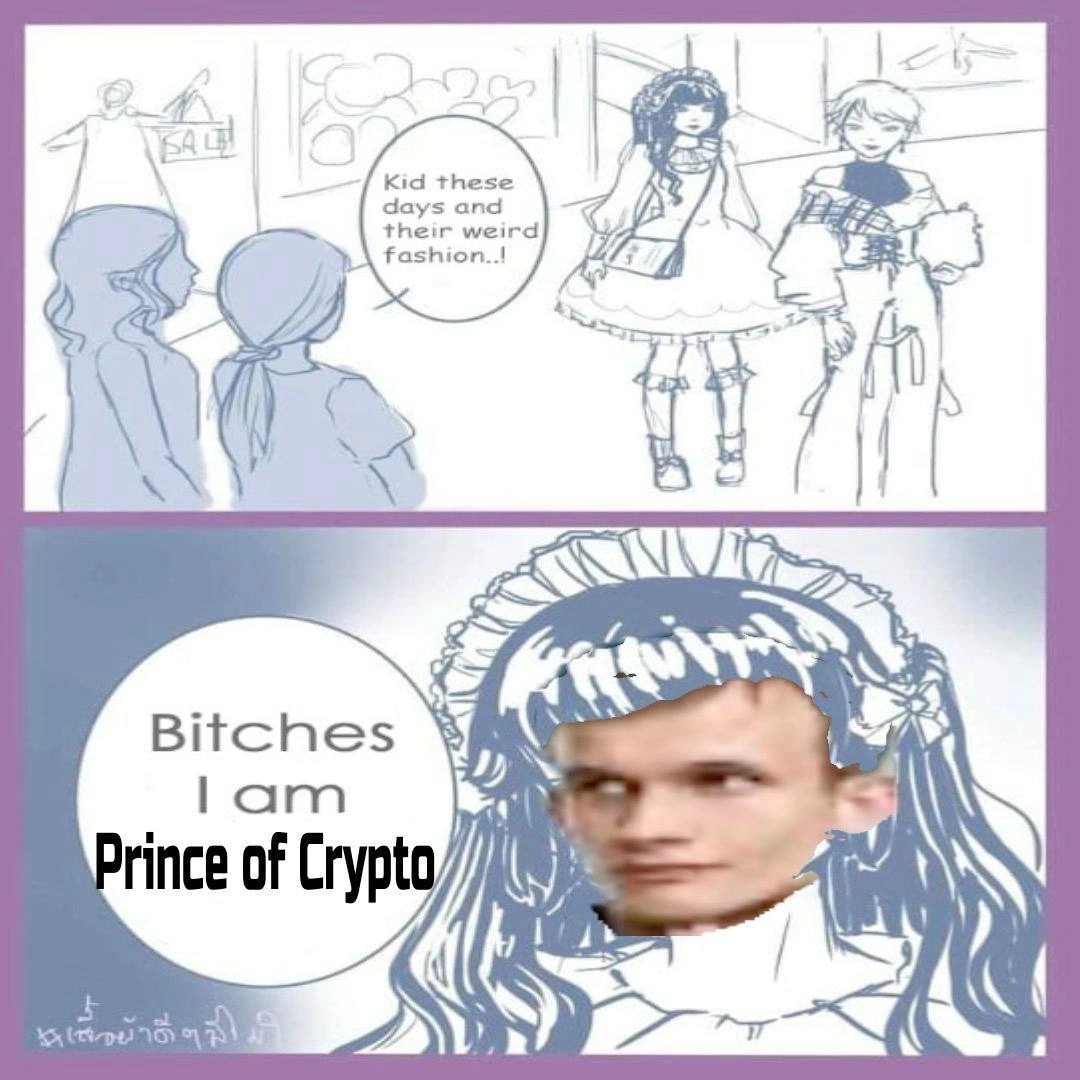
Imagine a little kid playing dress-up in an outrageously fancy prince outfit, complete with a shiny crown and frilly sleeves. Now picture some adults watching this. The adults shake their heads and say, “Kids these days wear such funny costumes!” They think the outfit is strange and over-the-top. But the kid isn’t bothered at all. He stands tall, puffs out his chest, and proudly announces to everyone: “I am the prince of a whole new world!” The kid truly believes he’s royalty in his pretend kingdom. The adults find it funny because, well, he’s just a kid in a costume claiming to be a prince – it’s cute and a bit absurd. In the meme, the “new world” the child claims to rule is the world of crypto (a fancy term for new digital money and tech), but you don’t even need to know that to get the joke. It’s basically like when a child wears a superhero cape and goes around telling people he can fly, while the grown-ups smile and think, “Aw, kids and their wild imaginations.” Here the kid is wearing a frilly fashion and saying he’s a prince, and the grown-ups are bemused. It’s funny because the kid is so confident about something that to others seems completely imaginary and over-the-top. The whole scene is a playful way to show the gap between how excited newcomers can get about something and how odd it might look to onlookers. In simple terms: it’s humor about a kid playing make-believe king and the adults who just don’t get what all the fuss is about.

Level 2: Crypto Swagger

Let’s break down what’s happening in this comic for those not steeped in crypto lore. In the first panel, two ordinary folks are watching a boy and a girl walk by in very elaborate, frilly outfits. These onlookers say, “Kids these days and their weird fashion…!” Basically, they’re commenting that young people are dressing in strange ways that older people don’t really get. This mirrors a common real-life situation: imagine grandparents seeing teenagers with neon hair, ripped jeans, or cosplay costumes and shaking their heads in confusion. Here, the “weird fashion” is drawn as a Lolita-style or cosplay outfit – ruffled dress, lace headband, the whole nine yards – something normal in a niche subculture but odd to everyday passersby. It sets the stage that the kid is really into some scene that outsiders find odd.

Now the second panel zooms in on the confident boy in the frilly costume. He’s unbothered by the comment and boldly declares, “Bitches, I am Prince of Crypto.” (Pardon the language – the meme uses that crass word intentionally for shock humor.) The phrase “I am Prince of Crypto” is the big punchline. What does it mean? It’s not a real title; he’s basically proclaiming himself royalty in the world of cryptocurrency. It’s like a kid in a crown saying “I’m the king of candyland!” only here it’s about crypto (short for cryptocurrency and blockchain tech). By calling himself a Prince, he’s showing an exaggerated sense of importance or swagger about his involvement in crypto. This is poking fun at cryptocurrency evangelists – those super enthusiastic people who act like crypto is the best thing ever and that they are at the top of that trend. The boy’s over-the-top fancy dress is a visual metaphor for that attitude. He’s not literally wearing Bitcoin logos or anything, but the elaborate costume symbolizes how obvious and flamboyant the blockchain hype can look to others. It’s saying: this is how a crypto fanatic might appear to the outside world – like a kid in absurd royal attire declaring himself on top.

Let’s unpack some terms for clarity. Blockchain is the technology behind cryptocurrencies like Bitcoin and Ethereum. It’s essentially a distributed digital ledger – imagine a record book that’s duplicated across lots of computers globally, so no single person (or prince!) owns it. Cryptocurrency is digital money built on blockchain; Bitcoin is one example, Ethereum is another. People who are really into crypto sometimes believe it’s going to change everything – finance, art, society, you name it. That excitement can become hype, which is when enthusiasm gets a bit carried away. We’ve seen hype waves in tech before: one year everyone insists 3D TVs will take over the living room (they didn’t), another year it’s all about VR, and so on. For crypto, especially during big boom times (like late 2017 or early 2021 when prices were soaring), the hype was through the roof. Some crypto fans started acting as if buying some coins or NFTs made them part of an elite future nobility. This meme plays on that with the phrase “Prince of Crypto,” implying someone who’s crowned themselves important just because they’re into the latest trend.

The humor also comes from the kid’s swagger versus the onlookers’ bafflement. “Swagger” here means an attitude of confidence, even a bit of arrogance. In tech circles, we sometimes jokingly talk about “crypto bros” – a subset of cryptocurrency enthusiasts often (though not always) young and male, who are extremely bullish on crypto. They might flex by talking about their coin holdings, dropping buzzwords like “decentralize everything,” and maybe even dressing in crypto-branded merch (ever seen someone in a Dogecoin T-shirt or an Ethereum cap?). That’s the kind of vibe being exaggerated here. The kid in the comic effectively says, “I know you think I look odd, but you fools have no idea – I’m basically royalty in this new world of crypto.” It’s an outrageous claim, which is why it’s funny. It’s like if a 12-year-old in a robe told some strangers, “Bow to me, for I am the King of the Internet.” You’d chuckle, right? It’s so over-the-top that it crosses into humor.

For a bit more context: the blockchain culture parody part of this is comparing how people involved in blockchain sometimes behave, to something very visible like fashion. During the peak of crypto trends, some individuals indeed developed a kind of superiority complex – they’d say things like “those who don’t get into crypto now will regret it,” basically implying they’re ahead of the curve (wearing the future’s fashion, so to speak). At the same time, plenty of onlookers (be it traditional finance folks, or old-school engineers) were shaking their heads, much like the characters in panel one, thinking the whole thing was bizarre or a scam. So the meme captures that dynamic in a lighthearted way. It’s also worth noting this is tech humor – the meme is intended for people in the software/developer community who have seen the rise of crypto first-hand. Developer humor often involves these kinds of analogies to everyday life (like comparing software bugs to pests, or in this case, crypto hype to flashy clothes) to make a point in a relatable way. Even if you’re a junior developer or just tech-curious, you might have encountered the intensity of crypto discussions online. If you ever scrolled tech Twitter or Reddit during a Bitcoin boom, you’d have seen posts that felt as boastful as “I am Prince of Crypto,” minus the lace outfit!

Finally, there’s a wink in the meme text style: the words “Prince of Crypto” are written in a bold, different font within the speech bubble. That indicates it was likely photoshopped into an existing comic. In the edited image, it looks like they also pasted a real person’s face onto the drawn character – specifically the face of Vitalik Buterin (a famous crypto figure, co-creator of Ethereum). If you don’t recognize him, no worry; just know he’s kind of a big deal in crypto, so using his face underscores the joke. It’s like putting a famous basketball player’s face in a comic about a kid bragging he’ll be an NBA star. In essence, the meme creator is saying, “This kid isn’t just any kid, he’s the Prince of Crypto – heck, he might as well be Vitalik himself strutting around.” This mashup of a real tech celebrity’s face with a goofy comic scenario is very common in tech memes. It adds another layer of in-joke for those who can spot it. But even without knowing the face, the joke stands: it’s about bold claims and generational perception. So don’t worry if you didn’t catch every reference – the takeaway is that the meme is comparing blockchain hype to an eccentric fashion statement. It exaggerates both to make us laugh: the outfit is overly frilly, and the crypto kid’s claim is overly frilly too (in a figurative sense). It’s a playful reminder not to take the latest tech obsession too seriously – otherwise you might end up looking as outlandish as a kid proclaiming himself a prince in a public mall.

Level 3: Hype Couture

This meme strikes a chord with seasoned developers by capturing the tech hype cycle in a nutshell: youthful exuberance draped in fancy new trends, confronted by the eye-rolls of experience. The first panel’s onlookers mutter, “Kids these days and their weird fashion…!” — an obvious parallel to how veteran engineers view the latest Blockchain fad. We’ve all heard some grizzled dev in the break room sigh, “Kids these days and their weird tech…” whenever a new framework or cryptocurrency craze comes up. The frilly gothic-lolita outfits in the comic could just as easily be the flashy jargon and grandiose claims surrounding blockchain hype culture. It’s fashionable in the tech scene to name-drop terms like Web3, DeFi, or “crypto revolution,” much like wearing a loud costume to prove you’re part of the in-crowd.

The second panel zooms in on the confident kid proudly declaring, “Bitches I am Prince of Crypto,” which perfectly caricatures the crypto swagger we’ve seen at tech conferences and online forums. It’s that archetypal crypto evangelist who struts into every conversation with a mix of superiority complex and unchecked optimism. They might be a 20-something who just made a killing on a meme coin, now acting like decentralization’s gift to mankind. The humor here is that developers who’ve been around the block(chain) can spot this bravado a mile away – and it’s equal parts amusing and cringe. We’ve weathered hype cycles before: one year it’s “Big Data will save us all,” the next it’s “AI will take over,” and lately it’s “Blockchain will revolutionize everything.” The costumes change, but the hype couture remains the same flamboyant style.

What makes this especially funny (and a tad painful) for industry veterans is how accurately it lampoons real scenarios. Remember the ICO gold rush of 2017? Dozens of freshly-minted “CEOs” barely out of college were parading around in blockchain startups with whitepapers full of flowery language (their equivalent of frilly sleeves and lace headbands). Many acted like royalty after raising millions overnight with a token sale – until the crypto winter came and a lot of those projects went out of style, fast. In 2021, the pattern repeated with NFTs: some folks literally used cartoon apes as status symbols in Twitter bios, akin to wearing a bizarre fashion piece to signal membership in the club. An older dev seeing tweets of “I just bought this JPG for $200k, you normies don’t get it” feels exactly like those onlookers saying “kids these days and their weird… whatever.” We’ve seen this movie before, and we know it usually ends with a tough lesson in reality.

The meme also hides a cheeky Easter egg for the crypto-savvy: the boy’s face is that of Vitalik Buterin, co-founder of Ethereum, who is often playfully regarded as crypto royalty (if anyone could be “Prince of Crypto,” a prodigy who built a $200B platform by age 21 is a prime candidate). Vitalik is known for his unassuming nerdy style – he’s shown up to conferences in unicorn T-shirts and occasionally cosplay-like outfits for fun – so plastering his face on a decked-out princeling is pure tech humor. It pokes fun at the community’s tendency to put leaders on a pedestal, even though blockchain tech is supposed to be leaderless. In Ethereum’s early days, Vitalik was treated by some almost like a teen idol in the blockchain world; seeing his slightly blurred visage under a lacy bonnet underscores how absurd that hero worship can look. After all, IndustryTrends_Hype often elevate individuals to icon status: today’s “Prince” was yesterday’s clever coder. The veteran perspective recognizes this pattern and chuckles – we know that behind the curtain, even crypto royalty deals with mundane bugs, scalability issues, and those 3 AM production outages (yes, even blockchain networks have on-call emergencies cough).

Another layer here is the generational gap in how new technology is perceived. The onlookers’ phrase “weird fashion” echoes how traditional software engineers or folks in mainstream finance view crypto culture – they see it as eccentric, volatile, maybe even a bit nonsensical. (To be fair, when some crypto enthusiasts were literally wearing Dogecoin-themed outfits to celebrate Doge’s price surge, you can’t blame the observers for doing a double-take.) Meanwhile, the crypto crowd revels in being the edgy newcomers disrupting norms – much like teenagers in wild outfits asserting their identity. The punchline “I am Prince of Crypto” is exactly the kind of over-the-top self-assured statement that makes seasoned onlookers smirk. It’s reminiscent of that one intern who learned about smart contracts and suddenly insisted our entire database should be on a blockchain because “I have seen the future, you dinosaurs don’t get it.” We, the battle-scarred devs, swap knowing glances at such moments. It’s not that blockchain isn’t innovative – it is – but we’ve learned to distinguish innovation from hype. When someone waltzes in claiming a distributed ledger will cure all ailments (and maybe cure baldness, too), it’s as comically presumptuous as a child in a cape proclaiming themselves a king.

Crucially, the meme doesn’t just mock the “crypto prince” – it also lightly ribs the stodgy commentators (the onlookers) for their knee-jerk dismissal. The truth is, every generation’s newcomers bring something weird and wonderful. Today’s weird fashion might be tomorrow’s mainstream style. Seasoned developers remember when we were the kids with “weird tech” (maybe it was open-source software in the 90s, or that strange thing called the cloud in the 2000s) and the old guard scoffed. Sometimes the skeptics are right (lots of ICOs were hot air), but sometimes the kids truly are onto something big. The humor works because it exaggerates both sides: the blockchain evangelist strutting like peacocks, and the bewildered skeptics in the peanut gallery. Both are a little cartoonish here, which keeps it light. It’s a parody of blockchain culture: on one hand the crypto bros in flamboyant metaphorical attire chanting “to the moon!”, on the other hand the grumpy veterans muttering “it’ll all crash.” The very setting – a normal public space (like a mall with a SALE sign) – grounds the absurdity: this grandiose claim of being “Prince of Crypto” is happening outside a run-of-the-mill clothing store. It’s a reminder that, hype aside, reality hums along. That “SALE” sign subtly hints that today’s hot trend might be in the bargain bin tomorrow – a wink that hype is fleeting. For those of us who’ve seen tech empires rise and fall, there’s grim satisfaction and humor in that.

Ultimately, Prince of Crypto is a meme that lets developers laugh at the current state of the world: a collision of technology, youth culture, and hubris. It’s saying: Look, we know blockchain is cool, but come on – look at how ridiculous people can get when they wrap themselves in it like a shiny costume. By couching this commentary in a silly cartoon, the meme delivers a friendly roast to the crypto die-hards and a nod of agreement to the jaded onlookers. Seasoned devs share it because it rings true – we’ve all seen the “next big thing” strut by in fancy garb, and we’ve all thought, at least once, “There go those kids with their weird whatever.” And if you haven’t… well, maybe you’re the one in the lace headband and didn’t realize it. 😉

Level 4: Byzantine Ballgowns

At the core of this flamboyant meme lies some serious cryptography and distributed systems theory – a contrast as sharp as a lace headband at a hacker conference. The phrase “Prince of Crypto” invokes the grandiosity of blockchain evangelists, but behind that swagger are Byzantine fault-tolerant algorithms laboring to keep everyone honest. In blockchain terms, Byzantine refers to the classic Byzantine Generals Problem – how to reach agreement in a network where some “generals” (nodes) might be traitors. Bitcoin’s breakthrough was solving this with Proof-of-Work (PoW), effectively a global competition of cryptographic puzzles. Every miner racing to add a new block is like a ballroom full of masked dancers trying to prove they are the real prince – except here the proof is a valid SHA-256 hash below a target value. This heavy-duty math ensures no single node (or wannabe prince) can cheat the blockchain ledger easily.

The meme’s over-the-top “crypto prince” attitude sits atop technology built on academic bedrock. Blockchains string together blocks using cryptographic hashes – each block proudly wearing the hash of the previous block like a chain of royal insignia. This makes the ledger immutable: tampering with one block’s “outfit” (data) breaks the chain, a bit like trying to remove a bead from a lace pattern and unraveling the whole design. Moreover, the true power in any cryptocurrency kingdom comes not from a fancy title, but from asymmetric cryptography: owning the private key to an address is the real crown. A self-proclaimed “Prince of Crypto” who can’t produce the correct digital signature is an impostor in these parts.

Crucially, the decentralized consensus that cryptocurrencies rely on means there’s intentionally no actual prince ruling the system. That’s the elegant irony: the entire blockchain ethos is about distributed power, where legitimacy comes from math and consensus rather than royal decree. Even Vitalik Buterin (whose face appears in the meme’s regal kid) earned influence by co-authoring Ethereum’s whitepaper and devising complex protocols – not by any divine right. Under Vitalik’s guidance, Ethereum recently switched its consensus from PoW to Proof-of-Stake (PoS) (the famed Merge), an incredibly complex live network overhaul akin to performing open-heart surgery on a running system. PoS replaces brute-force hash races with economic game theory: validators stake crypto coins as collateral, a clever algorithmic dress code ensuring participants behave or risk their deposit. This shift was a testament to deep engineering and game theory principles, even if the average crypto fan was more excited about price pumps than the nuanced math. In short, beneath the cosplay-like bravado of “crypto royalty” is a stack of ingenious algorithms, cryptographic primitives, and decades of computer science research. The meme hilariously glosses over these subtleties – much like a kid flaunting a crown without understanding the governing laws of physics keeping it perched. But for those of us who appreciate the hardcore tech, there’s humor in knowing that this ostentatious blockchain hype stands on very real, very non-glamorous engineering foundations.

Description

A two-panel meme in a light purple, sketchy art style. In the top panel, two women on the left, rendered in simple blue-grey tones, look towards two elaborately dressed figures on the right. One of the women on the left says, 'Kid these days and their weird fashion..!'. The figures on the right are drawn in a detailed anime/manga style, wearing complex, layered, gothic-lolita type outfits. In the bottom panel, the image zooms in on one of these figures, whose face has been crudely photoshopped to be that of Vitalik Buterin, a co-founder of Ethereum. He retains the elaborate frilly dress and long hair from the original drawing. A large speech bubble next to him proclaims, 'Bitches I am Prince of Crypto'. The meme humorously connects the 'weird fashion' comment to Vitalik Buterin's known unconventional style, framing it not as odd, but as the confident presentation of crypto royalty. It plays on his status as a central figure in the cryptocurrency space, suggesting his influence transcends conventional norms

Comments

19
Anonymous ★ Top Pick Some devs argue about semantic versioning, others just casually drop a new EIP that changes the global financial landscape while dressed for a baroque tea party. It's called range
  1. Anonymous ★ Top Pick

    Some devs argue about semantic versioning, others just casually drop a new EIP that changes the global financial landscape while dressed for a baroque tea party. It's called range

  2. Anonymous

    Whenever someone swaggers in as the “Prince of Crypto,” I just think: an append-only ledger of ego, burning gas on every flex, and still no consensus on why a plain Postgres table wouldn’t have solved it

  3. Anonymous

    After 15 years of watching VCs throw billions at 'decentralized' solutions that somehow always need a central foundation, seeing Vitalik embrace his anime prince persona is refreshingly honest - at least anime characters are supposed to have plot armor when their protocol needs another hard fork

  4. Anonymous

    When your smart contract deployment goes live and you're feeling yourself - because nothing says 'decentralized finance revolutionary' quite like an elaborate Victorian maid outfit. The real gas fees were the fashion choices we made along the way, and unlike your DAO governance token, this look is non-fungible and definitely not audited by OpenZeppelin

  5. Anonymous

    Every 'Prince of Crypto' demo I’ve seen is a Postgres table behind a thin smart contract, with consensus implemented via Discord emojis

  6. Anonymous

    Every 'Prince of Crypto' I audit is OpenZeppelin plus 98% pre-mine and a 2-of-3 multisig - the only decentralized part is the blame when it rugs

  7. Anonymous

    Crypto prince: mocking lolita fashion while his wallet address sports more gas-guzzling ruffles than an unoptimized EVM transaction

  8. @Garyyy_zzZZ 2y

    why?

  9. @SamsonovAnton 2y

    Who is it? Does not look like John McAfee.

    1. @desrevereman 2y

      Buterin. He likes dressing fun.

    2. dev_meme 2y

      John McAfee is dead 🙁

      1. @callofvoid0 2y

        why is he so famous?

        1. dev_meme 2y

          He is (was) somewhat crazy

          1. dev_meme 2y

            And rich

            1. dev_meme 2y

              And he was killed (while public was presented with suicide reason)

              1. @callofvoid0 2y

                why?

                1. @endisn16h 2y

                  glowies

                  1. @callofvoid0 2y

                    huh

        2. @SamsonovAnton 2y

          In the context of cryptocurrency, he is famous because he promised to eat his own dick, and because he is literally a dick: In July 2017, McAfee predicted on Twitter that the price of a bitcoin would jump to $500,000 within three years, adding: "If not, I will eat my own dick on national television." In July 2019, he predicted a price of $1 million by the end of 2020. In January 2020, he tweeted that his predictions were "a ruse to onboard new users", and that bitcoin had limited potential because it is "an ancient technology."

Use J and K for navigation