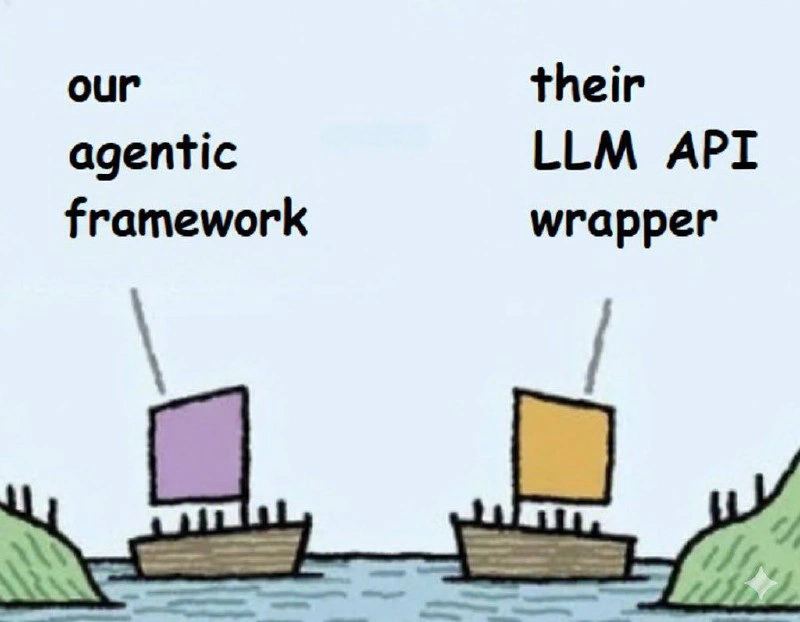
Our Agentic Framework vs Their LLM API Wrapper Are the Same Ship
Why is this AI ML meme funny?
Level 1: Different Boats, Same Destination
Imagine you and your friend both want to cross a calm lake to deliver a message. You decide to build a big fancy boat with a colorful sail, lots of gadgets, and call it the “Super Voyager 3000”. 🚢 It sounds amazing and everyone talks about how cool and advanced your boat is. Your friend, on the other hand, just grabs a simple little rowboat 🛶 and starts paddling across the lake to deliver the message. In the end, both your fancy boat and your friend’s plain rowboat get across the water to the other side. The funny part? You went through all that extra trouble to build something extravagant, but your friend arrived just fine with a basic approach. This meme is like that story: it’s joking that sometimes people make things sound very special and complicated (like your fancy boat or an “agentic framework”), when in reality a plain and simple method (like a rowboat or a basic script calling the AI) does the job just as well. It makes us smile because it reminds us not to over-complicate things for no reason – two different boats can take you to the same destination, so the simpler one might be the smarter choice if the waters are calm.
Level 2: Fancy Framework vs Simple Script
At its core, this meme is comparing two ways to build something with Large Language Models (LLMs): a fancy framework approach versus a simple script. An LLM is an AI model (like OpenAI’s GPT-4 or similar) that generates text and answers by predicting words. Developers can use LLMs in their applications in a couple of different styles:
The “agentic framework” approach (purple sail): This is when a team uses a whole framework or stack of tools to manage the LLM. Think of a framework as a big pre-built structure or library that you plug your code into. In our case, an agentic framework tries to make the LLM act like an agent with a bit of autonomy. That means it might plan multiple steps, remember previous information, or use extra tools to complete a task. For example, a framework might let the AI call itself multiple times to break a complex problem into smaller questions, or to use an external tool like a web search in between steps. The word “agentic” comes from agency, implying the AI has some independence in how it reaches a solution. It’s a trendy term – around 2023, a lot of libraries and startups started branding their LLM-based systems as agents or agentic AI. They often had names like AutoGPT, BabyAGI, or LangChain Agents, and promised to do more than just answer a single prompt. They would, for instance, take a goal and then internally decide: “First I should do X, then ask Y, then combine results, etc.” This sounds powerful! But it also introduces a lot of moving parts. You have to set up the framework, learn its APIs, possibly configure a memory store or tool interfaces, and then manage the complexity of multiple LLM calls. The purple-sailed ship in the meme represents this big, feature-rich approach. It’s near a green shoreline – perhaps hinting it launched from a busy port (lots of setup and fanfare).
The “LLM API wrapper” approach (yellow sail): This is the simple script or minimal solution. An API wrapper is basically some lightweight code you write (or a tiny library) that just calls the LLM’s API to get an answer. An API (Application Programming Interface) is like a doorway to a service; here, the service is the LLM hosted by some provider. When developers “wrap” an API, they might write a function that takes in a prompt string and returns the LLM’s response – essentially hiding the raw HTTP request details and making it easy to call. But importantly, this approach does nothing fancy on top of the LLM call. It doesn’t try to orchestrate multiple steps or give the AI memory beyond what you explicitly program. It’s straightforward: you ask, the model answers. The yellow-sailed ship represents this no-frills method. It’s closer to the opposite shore in the image, possibly indicating it’s simply ferrying across directly. There’s no extra fanfare – the caption “their LLM API wrapper” is almost self-deprecating, as if saying, “Yeah, we just wrote a little wrapper, nothing special.”
Now, why is it funny (especially to developers)? The joke is that the team with the agentic framework is presumably very proud of their complex system (they call it a whole “stack” or framework to emphasize how robust it is), while the other team just quietly made a basic solution. Yet, both solutions achieve a similar outcome – like two boats each crossing a calm sea to reach the other side. The text “sails past” implies one is passing by the other, suggesting they’re on parallel tracks. The humor (and a bit of sting) comes from the realization that for all the extra work and hype of the fancy approach, it isn’t fundamentally more effective at completing the journey than the simple approach. In plain terms, the fancy purple framework isn’t delivering something wildly beyond what the yellow wrapper does; they both get you across the water of the problem space. It’s a bit like if one person proudly announces they’ve built an entire rocket ship to deliver a message to a friend across town, and another person just rides their bicycle to deliver the same message. When the rocket and the bike cross paths, you’d smirk because… well, both got the job done, but one clearly over-complicated the task.
For a junior developer or someone new to this area, there are some lessons and familiar experiences here:
Beware of hype vs reality: New AI tools and frameworks (especially in the LLM boom around 2023-2024) often come with a lot of buzzwords. Terms like “agentic”, “autonomous AI agent”, “framework” might sound like they’ll solve all your problems magically. In reality, many of these are just building on top of existing APIs. They can add value in big projects (by organizing code or handling complex sequences), but sometimes they’re overkill. If your task is simple (say, answer a question or summarize text), using a heavy framework might be like using a cruise ship to cross a small pond. FrameworkChurn is real: one month everyone is excited about Library X for LLMs, the next month Library Y is the new hotness. As a newcomer, it can be dizzying. This meme is a light-hearted reminder to not get too swept up in branding. Always ask, “What is this actually doing under the hood?”
Understanding “wrapper” isn’t a bad thing: Calling something “just a wrapper” might sound dismissive, but writing a clean wrapper around an API is often a good, simple solution! For instance, if you wanted to add a chatbot to your website, you might use a few lines of Python (as shown in the code above) to call an LLM API whenever a user asks a question. That’s an API wrapper in action. It’s straightforward, easier to debug, and has fewer layers that can break. In contrast, if you pulled in an entire agent framework, you’d have to understand how that framework expects you to define the “Agent”, maybe set up prompts in a certain format, deal with its built-in memory or tool plugins – all for perhaps the same end result (the answer to the user’s question). A beginner might initially think, “Framework = better, because it’s more stuff,” but this meme gently nudges us to consider that sometimes simpler is better. The boat imagery (two little ships on a calm sea) reinforces that this particular journey isn’t so complex that you need a battleship.
The visual metaphor: Two ships passing each other peacefully. There’s an English idiom “like ships passing in the night,” which means two parties who cross paths but don’t really engage or recognize each other. In the image, these two ships (the two solutions) don’t clash; they just glide by. It’s almost as if each crew is in its own world, thinking they have the superior journey. The team with the purple “agentic framework” might be oblivious that the other ship (simple wrapper) is even solving the same problem, or they might dismiss it as naive. Meanwhile, the simple-wrapper team sees the purple-sail ship and might chuckle, “Why are they carrying all that extra weight for the same trip?” It’s a classic overengineered_vs_minimalist scenario illustrated in a friendly cartoon way.
AI tools landscape context: In the time around 2023 (and even in 2025 when this meme was posted), the AI developer community saw a flood of new libraries and frameworks. There was AIHypeCycle energy everywhere – each new tool claimed to be the way to build AI apps. Many juniors (and seniors!) would try these out, often to realize that the underlying mechanics weren’t as magical as advertised. For example, a library might claim “We provide an agent that can do research and coding for you autonomously!” but after playing with it, you’d discover it’s basically calling the same GPT model repeatedly with a specific prompt pattern. The difference between using that library and just writing your own loop was sometimes minimal. This meme likely resonated with developers who had that “Aha!” (or “😒 aha…”) moment when they peeled back the curtain on a hyped project.
In summary, level 2 understanding of this meme is that it’s pointing out how two different development approaches (complex framework vs simple code) can end up doing very similar things. The categories listed – AI_ML, API, Frameworks – are exactly the areas of relevance. It’s about AI tools (like those used for LLMs), how we call APIs, and the use (or sometimes overuse) of frameworks. The meme encourages a bit of healthy skepticism: just because something is labeled in a grand way (“agentic framework”) doesn’t mean it’s fundamentally superior to a straightforward solution (“LLM API wrapper”). For a new developer, it’s a reminder to focus on understanding the actual problem and solution, not just the fancy names of the tools. And it’s also okay to laugh at the situation – even experienced devs find themselves in these “could’ve just kept it simple” predicaments!
Level 3: Sailing the Hype Cycle
The meme humorously captures a well-known pattern in the AI/ML developer world: an overhyped agentic framework versus a straightforward LLM API wrapper, both ultimately doing the same job. In the cartoon, two sailboats pass each other on calm waters. The left boat is proudly labeled “our agentic framework” on a purple sail, while the right boat’s yellow sail reads “their LLM API wrapper”. This juxtaposition satirizes how a fancy, over-engineered AI tool (the “agentic” stack) and a simple direct approach (just calling the LLM via an API) often sail in parallel, reaching similar destinations. Seasoned engineers recognize this as a commentary on framework over-branding versus pragmatic minimalism in modern LLM tooling.
What’s an “agentic” framework? It’s a buzzword-laden stack claiming to give a Large Language Model some form of agency – the ability to autonomously plan actions, use tools, or chain multiple reasoning steps. In 2023’s AI hype cycle, for example, projects like AutoGPT boasted of “AI agents” that could iterate on tasks by themselves. Under the hood, though, these frameworks typically just orchestrate multiple GPT-4 calls, keep track of intermediate results (perhaps in a pseudo-memory), and loop until a goal is met. It’s cool in concept (who wouldn’t want a personal Jarvis-esque AI agent?), but many such frameworks ended up as over-engineered contraptions doing what a simpler script could do with some loop logic. The meme’s purple-sailed ship symbolizes this kind of elaborate solution – it might have a grand name and a lot of complexity below decks (custom planners, vector databases for memory, tool integration, etc.), but it’s still floating on the same ocean of API calls as the plain boat.
On the other side, “their LLM API wrapper” is depicted as a no-nonsense vessel with a yellow sail – smaller in ego if not in actual size. This represents the minimalist approach: just call the OpenAI or Hugging Face API directly from your code to solve the task. No grandiose framework, no multi-layered architecture, just a function that sends a prompt to an LLM and gets an answer. Engineers often describe such simple solutions as “just a wrapper around the API” – essentially a thin piece of code around an existing service. Here, the meme implies that one team built a whole “agentic” product (probably to sound innovative or justify a startup valuation), while another team delivered results with a lean implementation. The two ships passing each other wordlessly is a perfect metaphor: both approaches coexist in the wild, sometimes barely acknowledging that they’re traversing the same waters of AI capability. It’s a sly nod to the idea that while one side is busy marketing their “PurpleSail Agentic Suite™” (complete with slides about synergy and paradigm shifts), the other side quietly got the job done with a for loop and an API key.
The humor lands especially well with experienced developers because it echoes countless real-world scenarios of tech overengineering. We’ve seen this movie before: a team spends months building a Titanic-sized framework, boasting how it’s “not just an app, it’s a platform with an agentic architecture!” Meanwhile, a competitor or a lone hacker uses a few well-placed API calls in a Python script and achieves the same outcome in weeks. Both solutions sail off to production, and it becomes obvious the “fancy” one didn’t necessarily earn its grand title. This reflects a form of résumé-driven development (building something overly complex just to flex new tech) that industry veterans love to poke fun at. The meme captures that moment of realization: the expensive framework we built with all the bells and whistles is effectively doing the same voyage as their lightweight wrapper. It’s like two ships proudly setting sail for the same destination, one with a huge flag declaring its uniqueness, and the other with a modest flag that simply says what it is. As they glide past each other, one can almost hear the crew of the purple-sailed ship awkwardly thinking, “Wait… you mean we both just cross the bay and deliver cargo? And you didn’t even need an AI Captain or a fancy autopilot?”
This scenario is LLMHumor with a pinch of truth: in the rapidly evolving LLM tools landscape, new AI frameworks pop up weekly (classic FrameworkChurn). Each promises to revolutionize how we build AI applications – a bit of AI hype-cycle theater where renaming a helper library as an “Agentic Pipeline” can attract attention (and venture capital 💸). But engineers who’ve been around the block can be cynical; they’ve weathered waves of APIs and frameworks in the past. One month it’s all about a monolithic AI platform, next month it’s micro-models with serverless deployment, then back to monoliths – like fashion, the trends keep rotating. APIDevelopmentAndWebServices veterans especially know the feeling of complex frameworks versus simple wrappers. This meme nails that “Emperor’s New Clothes” vibe: sometimes the sophisticated AI framework is basically a well-dressed API client. It’s both funny and a bit cathartic – we laugh, remembering hackathons or meetings where someone insisted on using the latest glossy framework when a few lines of code calling an API would have worked just fine. In short, the meme cleverly navigates the sea of AI tool choices, showing that the difference between a gung-ho “agentic” stack and a plain API wrapper can be mostly marketing smoke on the water.
To drive the point home, consider a quick pseudo-code comparison. Here’s what a simple LLM API wrapper might look like versus an agentic framework approach:
# Simple LLM API wrapper (minimalist approach)
import openai
prompt = "Summarize the key points of today's meeting."
response = openai.ChatCompletion.create(
model="gpt-4",
messages=[{"role": "user", "content": prompt}]
)
summary = response.choices[0].message.content
print("Summary:", summary)
In contrast, the “agentic” framework might introduce extra layers for the same end goal:
# Hypothetical agentic framework usage (over-engineered approach)
from fancy_agentic_ai import Agent, Planner, Memory
prompt = "Summarize the key points of today's meeting."
agent = Agent(
llm_model="gpt-4",
planner=Planner(strategy="stepwise"), # breaks tasks into sub-tasks
memory=Memory(persistent=True) # stores conversation context
)
agent_result = agent.run(prompt)
summary = agent_result.output
print("Summary:", summary)
In the second snippet, we’ve packaged the task into an Agent with a Planner and some Memory. It sounds sophisticated (and indeed the framework might handle multi-step reasoning or tool use if needed), but if all you wanted was a meeting summary, both snippets will sail to that result in calm waters. The agentic version just carries a lot more cargo and crew for the trip. Notably, deep in the hull of that agent, it’s still making the same OpenAI API call (maybe several) to a large language model to get the summary. The meme’s charm lies in illustrating this with two virtually identical little ships: aside from the color of the sails (i.e., the branding), there’s no obvious difference in their ability to cross the sea. For all the talk of “autonomous agents” and “framework magic”, at the end of the day the LLM is doing the heavy lifting in both cases.
Ultimately, the joke highlights a shared industry wink: many “new” AI frameworks are essentially repackaging the same underlying capabilities. It’s a gentle roast of our tendency to rebrand simple solutions as grand inventions. As AI developers, we chuckle because we’ve felt that mix of amusement and frustration when a heavily marketed AITools platform turns out to be something we could have built in a weekend. “Two ships passing” is a perfect metaphor – each team is on its own journey, perhaps blissfully unaware (or in denial) that they’re traversing parallel paths. The senior perspective recognizes the overengineered_vs_minimalist theme and maybe sighs, thinking: if only we had kept it simple, we’d have shipped by now. But hey, next time someone proposes an “agentic, blockchain-infused, microservice-oriented LLM platform,” we’ll remember these two ships and ask: do we really need a purple sail for this trip?
Description
A hand-drawn cartoon showing two nearly identical wooden sailboats on a river between green hillsides. The left boat is labeled 'our agentic framework' and the right boat is labeled 'their LLM API wrapper.' Both boats are essentially the same -- small wooden vessels with colored cube-shaped cargo (purple on the left, orange on the right) and simple sails. The humor lies in the fact that despite the fancy terminology difference between an 'agentic framework' (implying sophisticated autonomous AI orchestration) and an 'LLM API wrapper' (implying a thin layer over an API), they're fundamentally the same thing. The illustration style is whimsical and resembles a children's book drawing
Comments
8Comment deleted
The only difference between an 'agentic framework' and an 'LLM API wrapper' is a $50M Series A and a blog post about autonomous reasoning
Call it “agentic orchestration” all you want - as long as the only node in the DAG is `chat_completion()`, we’re still just rowing the same boat
After 20 years of watching teams build 'revolutionary' ORMs that are just ActiveRecord with extra steps, we've now graduated to building 'innovative agentic frameworks' that are just prompt templates with retry logic and a vector store. At least the Viking ships are honest about being the same boat
When your 'revolutionary agentic framework' is just `requests.post('https://api.openai.com/v1/chat/completions')` with extra steps and a Series A valuation. At least the boats are honest about being identical - they just changed the sail color for the pitch deck
If replacing your 'agent layer' with requests.post('chat/completions') still works, it's not an architecture - it's branding
In 2024, “agentic” usually means your POST /v1/chat/completions grew retries, tool-calls, and a pitch deck
Our agentic framework: 50k LOC to reinvent 'curl'. Their wrapper: one pip install to rule them all
Our AGI Their word predictor Our efficient supercomputer Their massive heater Our smart agentic workflows Their prompt engineering Comment deleted