Le Contrat Artificiel: How Claude AI Serves Different Users Across Industries
Why is this AI ML meme funny?
Level 1: Magic Helper for Everyone
Imagine a magical helper who can do just about anything you ask, for anyone. It’s as if there’s a super-smart talking robot that’s only about two years old, but can still help a college kid write a school essay, then turn around and help a business person write a big work report, then even help someone else by writing some computer code, and also crank out a quick article for a blog — all at the same time! This picture is funny because we usually think only people can do those things, and certainly not a little child. It’s like if a toddler suddenly started doing your homework, fixing your computer program, and writing stories for adults. Everyone in the picture is asking this one tiny helper to do their tough tasks, and the little helper (which is actually an AI on a computer) is happily doing all of them. The idea of one small robot friend solving everyone’s problems — from schoolwork to office work — feels both amazing and a bit silly. That’s why it makes us laugh: it’s showing in a playful way how a single smart machine is becoming the go-to helper for all sorts of people. It’s like having a friendly genie who can grant endless wishes, except this genie is a cute baby-aged AI who can juggle all kinds of jobs!
Level 2: Swiss Army AI
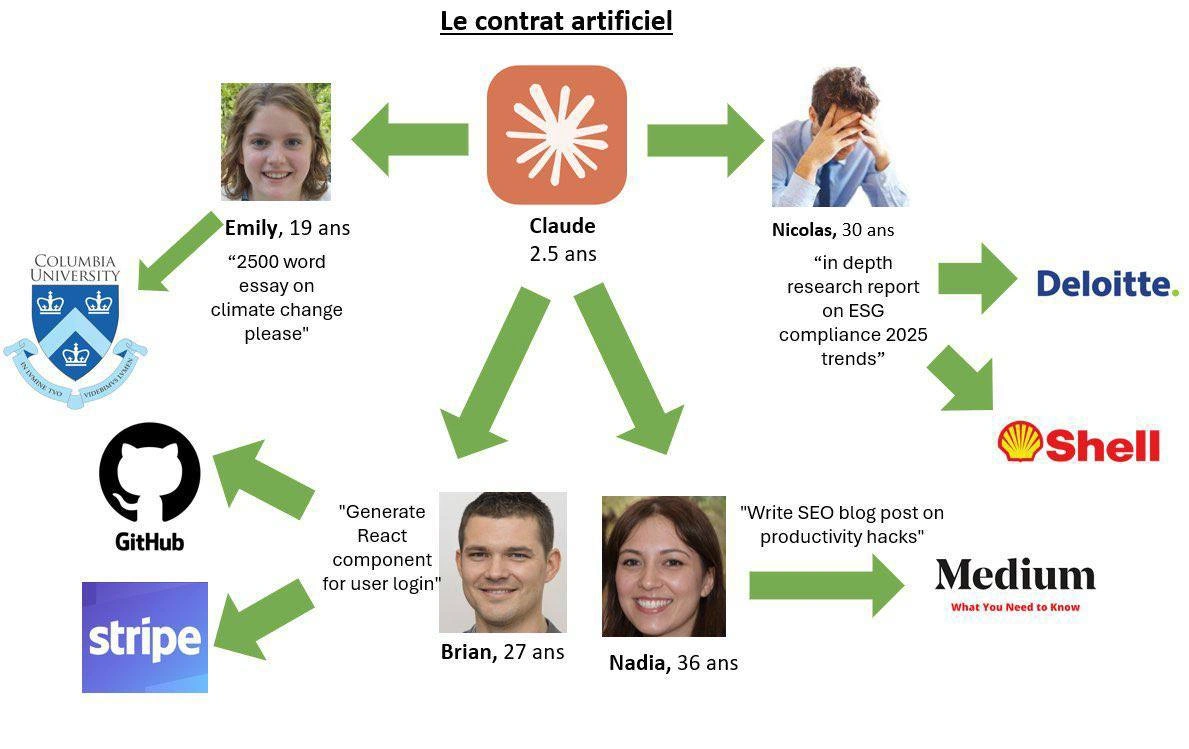
This meme shows how Claude, an AI language model, is being used by different people to do a whole bunch of tasks — almost like a digital Swiss Army knife for content and code. Let’s break down the scene. In the middle, there’s the Claude logo labeled “Claude 2.5 ans”. Claude is the name of an AI developed by Anthropic (similar to OpenAI’s ChatGPT). The “2.5 ans” is French for “2.5 years old,” which is a cheeky way to indicate either the version (Claude v2.5) or the “age” of this AI. Essentially, it’s implying Claude is like a toddler-aged AI that amazingly can work like an adult assistant. From Claude, we see green arrows going out to various logos, and arrows coming in from four people around it. Each person represents someone using Claude for a specific request, and those arrows show the flow of requests in and results out.
Top-left (Emily, 19 ans): Emily is a 19-year-old student. Her caption says, “2500 word essay on climate change please.” She’s basically asking Claude to write a lengthy college essay about climate change for her. The arrow from Emily goes into Claude, meaning she sends that request (called a prompt). On the output side, there’s an arrow from Claude to the Columbia University crest. This suggests the essay Claude writes is going to be submitted to Columbia University (perhaps as Emily’s homework). In simple terms, Emily is using Claude as an essay generation machine to do her schoolwork. This highlights a real thing that started happening once AI text models became good: students began having AI write their papers. It’s controversial (schools worry about plagiarism), but from Emily’s perspective, Claude is like an on-demand ghostwriter for her assignment.
Top-right (Nicolas, 30 ans): Nicolas is 30 years old and looks stressed in the picture. His request is, “in depth research report on ESG compliance 2025 trends.” Let’s unpack that: ESG stands for Environmental, Social, and Governance, which are criteria companies use to measure their ethical and sustainability practices. Companies often need reports on ESG compliance trends — basically, summaries of how regulations and best practices are evolving so they can stay up to date. Normally, someone like Nicolas might spend days researching and writing such a report, or a firm like Deloitte (a big consulting company) might be hired to produce it, possibly for a client like Shell (the oil company). In the meme, Nicolas instead feeds that request into Claude. The arrow shows Nicolas’s prompt going into the AI, and then arrows from Claude pointing to the Deloitte and Shell logos. This implies Claude outputs a report that perhaps Nicolas will present to Deloitte or Shell, or that it meets the standards those companies expect. So, effectively, Nicolas is leveraging Claude to act as an AI research analyst. Instead of manually compiling data and writing the analysis himself, he’s getting a draft from the AI. For a junior developer or someone new to this concept: imagine you could ask your computer, “Hey, write me a detailed report on what’s new in environmental laws for oil companies,” and it just gives you a well-structured report ready to go. That’s what’s being depicted. Of course, whether the report is accurate or not is another story — these AI models try their best but can sometimes make things up if they’re not sure (a phenomenon called hallucination in AI). But the meme’s point is that people are indeed using AI as a shortcut to generate professional reports.
Bottom-left (Brian, 27 ans): Brian is 27 and his bubble of text is next to some tech logos. The text says, “Generate React component for user login”. Brian wants a piece of front-end code: a React component that handles user login functionality. React is a popular JavaScript library for building user interfaces on the web (especially for frontend developers). A React component for user login would typically be a chunk of code (HTML/JSX + JavaScript) that renders a login form (with fields for username/email and password, and a login button) and perhaps does something like authenticate the user when the form is submitted. In the image, the GitHub logo and the Stripe logo are shown near Brian’s request. GitHub is a platform for hosting code (so maybe Brian intends to put the generated code in a GitHub repository). Stripe is a company that provides payment processing APIs — not directly related to login, but Stripe is a very developer-centric company (and maybe there’s context that the login ties into a payment system or it’s just a recognizable developer tool logo). The idea here is that Brian is using Claude as a code generator. This is a nod to how developers today use AI assistants like GitHub Copilot or ChatGPT to write code snippets. Brian provides a prompt (essentially a specification: “I need a login component that does X, Y, Z”), and Claude will return some code that fulfills those requirements. For example, Claude might output a block of React code with a form, input fields, and a submit handler that calls a Stripe authentication API. Brian, being a developer, would then take that code and integrate it into his project. The humor or notable thing for a junior dev is: writing a login component is normally something you’d do yourself or copy from a tutorial, but here an AI is doing it. It’s showcasing AI-driven developer productivity – using an LLM as a coding assistant.
To illustrate, if Brian were to interact with Claude, it might look like this:
// Brian's prompt to Claude (implied): /* "Please generate a React component for a user login form using Stripe API for authentication." */ // Claude's hypothetical output (React code): import React, { useState } from 'react'; import { authenticate } from 'stripe-auth-lib'; // (Pretend Stripe auth library) function LoginForm() { const [email, setEmail] = useState(""); const [password, setPassword] = useState(""); const handleSubmit = async (e) => { e.preventDefault(); try { const result = await authenticate(email, password); console.log("Login success:", result); } catch (error) { console.error("Login failed:", error); } }; return ( <form onSubmit={handleSubmit}> <h2>Sign In</h2> <input type="email" placeholder="Email" value={email} onChange={e => setEmail(e.target.value)} /> <input type="password" placeholder="Password" value={password} onChange={e => setPassword(e.target.value)} /> <button type="submit">Login</button> </form> ); } export default LoginForm;// The above is an example of the kind of code Claude might produce. It’s a basic login form in React. A developer like Brian would still need to double-check it (e.g., ensure the fake
authenticatefunction matches a real Stripe SDK call), but it’s a decent starting point that saves time.Bottom-right (Nadia, 36 ans): Nadia, age 36, requests “Write [an] SEO blog post on productivity hacks”. SEO stands for Search Engine Optimization, which basically means writing content in a way that it ranks high on Google search results by including popular keywords and structuring it well. A “productivity hacks” blog post is the kind of article you see all over the internet (titles like “10 Productivity Hacks to Supercharge Your Day” are common). Nadia likely needs this for marketing purposes or personal branding, and she wants it published on Medium (a popular online publishing platform, especially for such listicle or advice articles). The arrow from Claude goes to the Medium logo, showing that the content will end up as a Medium article. So what’s happening? Nadia is using Claude as a content writer. She provides the topic and angle (productivity hacks, written with SEO in mind), and Claude will generate a full blog post for her, probably complete with an introduction, a list of numbered tips, and a conclusion. In simpler terms, she doesn’t want to write the article herself — she’s letting the AI do it, because A) it’s faster, and B) the AI is well-versed in the kind of generic but smooth language that does well in blog posts. For a junior developer or someone early in their career, this is an example of AI being used outside pure coding: even content creators are using AI to speed up their work. You give the model a prompt like “Draft a 5-minute read Medium blog post about the top 7 productivity hacks for remote workers, using an upbeat and informative tone,” and you’ll get a nicely structured draft that you can tweak and publish.
In all these cases, Claude is depicted as doing the work that normally a human would do. The phrase “juggling essays, React widgets, and ESG decks for everyone” (from the meme title) summarizes that Claude is handling a variety of tasks — like a performer juggling very different items, except in this case the items are types of content (an essay, a React widget = a piece of a web app, and an ESG deck/report). Senior engineers joke that now they’re competing with “prompt-driven content pipelines” rather than junior staff. What that means is: Instead of a team hiring a new junior developer or an intern writer to handle extra tasks, they might just use an AI (where tasks are done via prompts and automated pipeline). It’s a shift in how work gets done. Developer Experience (DX) is touched here because tools like Claude are becoming part of the developer’s toolkit – improving productivity if used well. Likewise, in education, business, and marketing, the experience of doing those jobs is changing because of AI assistance.
To put it simply, think of Claude as an extremely advanced autocomplete or assistant. It has read a lot (trained on massive text data), so it can produce new text that sounds pretty legit in a given context. Each person in the meme is taking advantage of that in their own field: student, consultant, coder, blogger. This “AI intern” can create content on demand. Of course, real life usage comes with caveats (the AI might be wrong or require editing), but the meme focuses on the novelty and breadth of it. It’s both humorous and telling about our current tech era: one AI model acting like a Swiss Army knife for tasks that span multiple professions.
Level 3: One Bot, Many Hats
This flowchart is funny to seasoned developers and techies because it nails a current trend: instead of delegating grunt work to junior employees or specialists, people now shove all sorts of tasks onto a single AI model. The center of the graphic is Claude 2.5, portrayed as if it were a 2.5-year-old toddler (the French label “2.5 ans” literally means 2.5 years old). The joke here is multi-layered. On one hand, Claude 2.5 is presumably an AI model version (like v2.5), but phrasing it as an age is a tongue-in-cheek way to say this infant AI is doing the jobs of a college student, a consultant, a software developer, and a content writer all at once. It’s a playful jab at how quickly AI has matured – in just a couple of years, it’s competent (or at least confident) enough to handle tasks across industries.
Each character in the meme represents a different client of this AI, effectively treating Claude as a universal subcontractor. Emily, 19, wants a 2500-word essay on climate change. In the real world, that’s the kind of assignment a college student might procrastinate on and then desperately outsource – and indeed, students have started turning to AI-generated content instead of paying upperclassmen or essay mills. For an experienced observer, this raises the eyebrow of academic dishonesty and recalls recent headlines about universities scrambling to detect AI-written homework. The Columbia University logo next to Emily’s request implies she plans to submit the AI-written essay as her own work. The humor (tinged with cynicism) is that a Large Language Model can now plausibly ace that assignment, making the age-old “did you really write this?” problem even trickier. Senior folks remember when plagiarism involved copying from Wikipedia; now it involves an AI ghostwriter.
Next, Nicolas, 30, asks Claude for “an in-depth research report on ESG compliance 2025 trends.” This is the kind of dry, heavy-lift task often handed to entry-level analysts or consultant teams burning the midnight oil over Excel and PowerPoint. The meme shows arrows from Claude’s output to the Deloitte and Shell logos – hinting that this report is destined for big consulting firm slides or an oil company’s boardroom briefing. A senior developer or consultant chuckles here because it’s so relatable: corporate higher-ups always want a shiny report on the latest trends (like ESG – Environmental, Social, and Governance – compliance). Instead of drafting in junior analysts, Nicolas just prompts an AI. It satirizes the corporate shortcut: why pay an associate to compile research when a bot can spit out a nicely formatted analysis in seconds? Of course, in reality, anyone who’s been around knows the pitfalls: an AI might fabricate sources or misunderstand subtle industry nuances. The meme doesn’t spell it out, but the seasoned crowd knows there’s an unspoken risk behind Nicolas’s relieved look – if that AI-generated report contains nonsense, it’s his neck on the line in front of Deloitte’s partners or Shell’s executives. The gag lands because it captures that mix of excitement and dread around AI in office work: it’s impressively productive, yet dangerously unvetted.
On the bottom-left, we have Brian, 27, flanked by the GitHub Octocat and a Stripe logo, asking Claude to “Generate [a] React component for user login.” This represents the software developer scenario. Frontend devs normally spend time coding reusable UI pieces (like a login form) and integrating payment or auth APIs (Stripe is known for payments). The meme implies Brian can offload even coding to the AI – essentially treating Claude as a pair programmer or a coding intern. To an experienced developer, there’s both humor and familiarity in this. The humorous part: a dev in 2025 might rely on an AI for boilerplate code instead of, say, searching Stack Overflow or writing it from scratch. Many seniors have already dabbled with tools like GitHub Copilot or ChatGPT for code generation, so the scene resonates. There’s a bit of “Yep, been there, done that” when we see Brian handing off a mundane task to the machine. The inclusion of GitHub suggests the code might go straight into a repository, and Stripe hints at using third-party services – something juniors often struggle with, but an AI can produce demo-worthy integration code for. The underlying industry pattern here is the rise of AI-assisted development: why grind through writing a login UI or payment form when an AI can draft it for you? However, the seasoned perspective also catches potential irony: what if the AI-made code has a security flaw or just doesn’t compile? Senior devs know that even when an AI writes code, you often end up debugging it like a frazzled mentor fixing an overzealous intern’s work. The meme doesn’t show it, but Brian might still spend the afternoon cleaning up what Claude generated – a scenario all too familiar to anyone who’s tried letting an AI handle the “easy” parts of a project.
Finally, Nadia, 36, is asking Claude to “Write [an] SEO blog post on productivity hacks.” The arrow from Claude points to the Medium logo, implying this polished article will be published on Medium.com, a popular blogging platform. To someone experienced, this hits on the content marketing explosion that’s happened in tech and startups – everyone and their manager wants blog posts that rank on Google and drive traffic. SEO (Search Engine Optimization) blog posts are often formulaic: catchy title, numbered list of tips, a friendly yet authoritative tone, and a sprinkling of keywords. The meme humorously suggests Nadia can just have the AI churn out that article instead of hiring a content writer or sweating over it herself. This is a reality in 2025: many “thought leader” posts and listicles are indeed AI-generated drafts edited by humans. The comedic sting for veterans is that we’ve gone from manually crafting clickbait articles to using automation, flooding the internet with cookie-cutter advice pieces at scale. It’s funny in a rueful way – we replaced armies of junior copywriters with a single eager-to-please language model. A senior engineer or tech content creator might smirk at this because they’ve likely read some oddly generic blog and suspected an AI wrote it. The Medium logo is the cherry on top: Medium is infamous for productivity and self-improvement blogs, so of course our AI intern is ghostwriting one more “10 Life-Changing Productivity Hacks” post for the world to scroll past.
Tying it all together, the meme’s title “Le contrat artificiel” (a play on French “Le contrat de travail” meaning “employment contract”, or perhaps a riff on “Le Contrat Social”) frames Claude as an artificial contractor or employee. It mocks the emerging dynamic where instead of signing on a real intern or junior staffer, companies figuratively sign a contract with an AI service. The “contract” here is just a paid API subscription or a prompt, but the visual style treats Claude like another member of the team (albeit a toddler-aged one!). For veteran developers, this encapsulates a new workplace reality: teams now mix human colleagues with AI services that effectively occupy a role. Senior engineers find themselves managing these AI outputs similarly to how they’d mentor a newbie — except the newbie in this case works 24/7, never complains, but has zero understanding or accountability. The line “senior engineers now compete with prompt-driven content pipelines rather than junior staff” (from the meme’s description) hits home: it suggests that the challenge for experienced folks is adapting to a world where the support pipeline (those junior helpers) has been replaced by AI automation. It’s a bit of dark humor about career dynamics. Yesterday, a senior might delegate trivial tasks to a junior dev or a new analyst; today, those tasks are handled by Claude. So seniors either learn to use the AI as a tool or risk being as redundant as the interns who aren’t being hired. It’s a satirical reflection on tech workplace evolution – simultaneously impressive and unsettling. In summary, the meme lands with tech-savvy audiences because it exaggerates a truth we recognize: LLMs like Claude have become the ultimate multi-purpose tool in the modern workflow, for better or worse. Everyone’s treating the AI as the one-stop solution for content creation, coding, and research, and that mix of awe and “uh oh, is this really the future?” is both funny and thought-provoking.
Level 4: Jack of All Tokens
At its core, this meme spotlights a large language model (Anthropic’s Claude 2.5) acting as an all-purpose content generator across domains. Under the hood, Claude is built on a Transformer-based architecture – the same kind of neural network that powers GPT-style models. This architecture treats everything as a sequence of tokens, whether it’s natural language or source code. In other words, writing a climate essay, a JavaScript snippet, or a business report all boils down to one skill: next-token prediction. Claude has been pre-trained on an enormous corpus of text that spans academic papers, corporate documents, code repositories, and web content. Thanks to this broad training, the model has developed a polymathic proficiency: it can emulate the style and jargon of many fields without specialized modules for each.
In machine learning terms, Claude is a foundation model – a single giant network (with tens of billions of parameters) that has absorbed diverse knowledge and can be adapted to countless tasks via prompts. Each arrow in the flowchart represents a prompt -> completion cycle: a user’s request enters, and the model unfurls an output by statistically sampling the most probable sequence of tokens that fit the request. The humor is that an apparently “2.5-year-old” AI can seamlessly switch contexts between a university essay, an ESG trend report, a React login component, or an SEO blog. But technically, Claude doesn’t “know” what universities, audits, or front-end frameworks are in a human sense – it has learned patterns from data:
- Academic writing style: It’s ingested countless essays and research articles on topics like climate change, allowing it to produce a credible 2500-word essay complete with formal tone and references.
- Corporate reports and ESG data: It has parsed through news articles, executive summaries, and compliance reports. This means it can output a jargon-heavy ESG report analyzing “2025 trends” with the polished language a consultant at Deloitte might use (complete with buzzwords and maybe a statistic or two).
- Source code and APIs: Having trained on open-source code from sites like GitHub, plus documentation for libraries (possibly even Stripe’s API docs), Claude can generate a React component that looks plausibly hand-written by a developer. It “knows” common frameworks and usage patterns simply because those appear frequently in its training data.
- Web articles and SEO content: It’s seen millions of blog posts and listicles (think “Top 10 productivity hacks” on Medium). Thus, it can crank out an SEO-optimized blog post for Nadia with catchy headings, popular keywords, and a friendly, semi-professional tone that drives engagement.
This jack-of-all-trades capability is possible because the model’s training compresses all these domains into a unified representation space. In the high-dimensional geometry of Claude’s neural network, a climate policy essay, a login form function, or a marketing blog are just different trajectories through the same weight matrix, guided by the prompt. The LLM effectively acts like a polymath or a single algorithmic brain that has read and memorized a bit of everything humans have written. It’s a significant achievement in AI research: one generative model handling tasks that traditionally belonged to separate specialized systems or experts. In AI parlance, it hints at generalization: Claude isn’t explicitly programmed for each of these requests, but it can still perform them after a generic training process. This fulfills a long-standing dream in computing – an automated general problem solver. Early AI systems were brittle outside narrow domains, but modern LLMs leverage massive data and compute to achieve a breadth of competency. Claude 2.5 juggling essays, code, and corporate decks exemplifies how far generative AI workflows have come, blurring lines between roles. The meme exaggerates it humorously, but from a technical standpoint it’s grounded in the real advance of foundation models: one model serving as a universal AI contractor for text-based tasks.
Description
A French-language infographic titled 'Le contrat artificiel' (The Artificial Contract) showing the Claude AI logo (Anthropic's red/orange asterisk icon) at the center with green arrows pointing to four different personas who use it, and their outputs going to various companies/institutions. Emily (19 ans) asks for a '2500 word essay on climate change please' which goes to Columbia University. Nicolas (30 ans) requests an 'in depth research report on ESG compliance 2025 trends' which goes to Deloitte and Shell. Brian (27 ans) asks to 'Generate React component for user login' which goes to GitHub and Stripe. Nadia (36 ans) requests to 'Write SEO blog post on productivity hacks' which goes to Medium. The diagram illustrates how a single AI tool (Claude, age 2.5 ans) enables people across different ages and professions to produce professional-grade content for major institutions and companies

Comments
24Comment deleted
Claude is 2.5 years old and already doing the work of four professionals across three industries. At this rate, it'll be making partner at Deloitte before it can legally drive
Remember when the procurement checklist asked for vendor age and liability insurance? It now reads “LLM ≥ 2.5 years, prompt-injection coverage optional” - apparently Claude just replaced the entire analyst internship program in one sprint
Remember when we used to joke about outsourcing to offshore teams? Now we're all just middlemen between stakeholders and Claude, carefully crafting prompts like we're negotiating with a genie who has a computer science degree but no context about why the legacy system uses SOAP
Ah yes, Claude 2.5 years old - the perfect age for an AI to simultaneously write your college thesis, generate production React components, and craft ESG compliance reports for Fortune 500s. It's like having a precocious toddler who can code, except this one actually ships to prod and nobody questions whether it truly understands what 'ESG compliance 2025 trends' even means. The real artificial contract here isn't between humans and AI - it's the unspoken agreement that we'll all pretend the 2500-word essay on climate change has the same intellectual rigor as the one Emily would've pulled an all-nighter to write, while Brian's login component quietly inherits every anti-pattern from Stack Overflow circa 2019
We finally achieved platform engineering: one shared LLM microservice where students, consultants, and devs all send requests - the SLO is measured in tokens, not truth, and delivery is ‘paste to Columbia/Deloitte/GitHub/Medium.’
Claude 3.5 ans: Proof a toddler LLM outproduces seniors, until it hallucinates your OAuth flow
Procurement keeps asking for the contractor’s SOC2 and insurance; I sent a token-usage invoice and a model card - turns out our vendor-of-record is “Claude, 2.5,” and Legal wants to know who signs the NDA
Emmanuel, 23 ans -> "fix bugs in this code" -> anthropic And it all explodes Comment deleted
Rahja 27 -> "make better alignment tests" Comment deleted
No, Rahja 27 would be writin -> "Add more AI to start menu button" Comment deleted
No he'll ask for bobs and vagene😁 Comment deleted
As a french, this meme is excellent ! Comment deleted
insert obligatory french people bad joke Comment deleted
ok, here's a bad one for you : "Quel est le comble pour un mathématicien ? De se coucher avec une inconnue et de se réveiller avec un problème !" Comment deleted
something something baguette Comment deleted
hi foxy 🙂 Comment deleted
Could you please explain what the punchline is? I feel like I'm missing the point Comment deleted
The punchline is they're all clankerfuckers substituting their brain for a spicy autocomplete. Parts of the meme are also in French for some reason. Comment deleted
in the joke : the mathematician hook up with an unknlw value and wake up with a math problem, that's ironic Comment deleted
and i like fox-related stuff, even if it became mainstream because of the normies Comment deleted
Foxes rock. They look cute, act cute, and make cute noises. They're like one of two things propping up my mental health nowadays. Comment deleted
Same for me with capybaras Comment deleted
i got scared that you tagged me Comment deleted
i wouldn't, but capybaras are great animals that i love so much, i want to see them for real Comment deleted