Skip to content
DevMeme
2194 of 7435
Onboarding to the 'simple' new build system
BuildSystems CICD Post #2447, on Dec 11, 2020 in TG

Onboarding to the 'simple' new build system

Why is this BuildSystems CICD meme funny?

Level 1: Trickier Than It Seems

Imagine your friend says, “Building this treehouse will be super easy, you’ll be done in no time!” But when you actually try, you discover the instructions are written in 128 different languages – first a step in English, then the next step in Spanish, then French, and so on, cycling through 128 languages. To finish the treehouse, you’d have to translate each instruction one after another 128 times until you somehow get back to an English step at the end. Pretty crazy, right? Something that was supposed to be simple now feels overwhelmingly complicated. You’d probably stare at your friend like, “Are you serious? This is overkill!”

That’s exactly the joke of the meme. The team says their build process is “easy,” but in reality it’s as if they gave the poor newcomer a task with 128 bizarre stages. It’s funny because of how extreme and unexpected the situation is – they promised a quick win, but delivered a colossal headache. Even if you don’t know anything about programming, you can understand that saying something is easy when it’s actually incredibly complex is going to be both frustrating and comical. The meme just uses a wild programming example (the 128-language loop) to make that point in a nerdy way. In simple terms: they pretended it was a piece of cake, but it turned out to be an entire bakery’s worth of trouble.

Level 2: So Much for "Simple"

In plainer terms, this meme is pointing out the difference between what a team says about their build setup and what it’s actually like. A build system is the collection of tools and scripts that take the code developers write and turn it into a running application (or library, or executable). For example, if you have a C++ program, the build system compiles the .cpp files into a binary. If it’s a JavaScript web app, the build process might bundle all the files and assets together. Ideally, a build system is straightforward: you run one command (like npm run build or make) and it does everything needed automatically. “Easy,” in this context, means a new developer can set up and run the build without much hassle.

However, in this meme, the supposed “easy” build is compared to something ridiculously complex: a 128-language build pipeline. Most software projects use one or a few languages. For instance, a web project might use JavaScript for the frontend and Python for the backend – that’s two languages. It’s a bit more work to handle two, but it’s manageable. Now imagine a project somehow using 128 different programming languages in tandem – that’s unheard of in practice! The meme exaggerates to make a point about software complexity. It’s saying the build is so convoluted, it might as well be doing something as insane as jumping between 128 languages to get the job done.

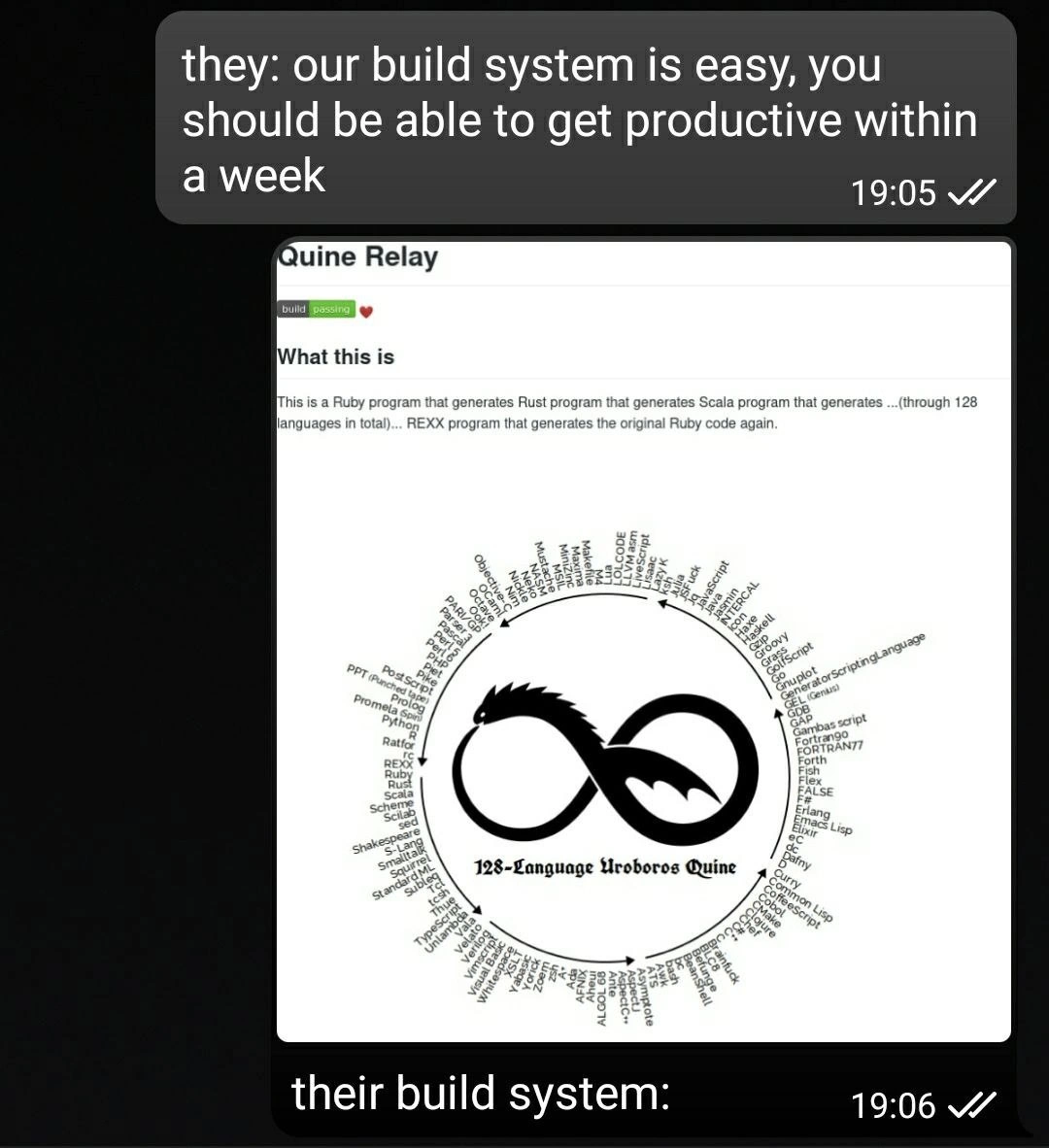
The image preview titled "Quine Relay" is a clue to what they’re joking about. A Quine Relay is a specific geeky programming challenge: you start with code in one language (here Ruby), which outputs code in a second language (Rust), which outputs code in a third language (Scala), and so on… after going through lots of languages, the final output is back in the first language (Ruby) and exactly the same as the original program. The circular dragon-infinity symbol (the Ouroboros) in the picture represents this idea of looping back to the start. So essentially, it’s a huge cycle where each programming language "talks" to the next one. This isn’t normal software development – it’s more like a stunt to show off knowledge of many languages or to prove it can be done.

Now, the joke is comparing their build system to this quine relay. The text at 19:06 in the image says "their build system:" right above the Quine Relay link preview. That implies: “Surprise! This crazy multi-language thing is their ‘simple’ build.” Of course, it’s an analogy – we don’t literally think their company uses 128 languages in the build. But it feels as difficult as if they did. In real life, a complicated build might involve, say, a frontend build (Node.js), a backend compile (Java or Go), some code generation step (maybe a script in Python or Ruby), a database migration tool, etc. If each of those is a different technology, a new developer has to understand and install each part. Even five different systems can feel overwhelming when you’re new. So you can imagine the frustration if someone claimed that was “easy” when you’ve never seen half of those tools before.

Let’s break down a few terms and pain points referenced:

  • Onboarding: This is the process of a new developer getting set up and familiar with a project. Good onboarding means the newcomer can get the project running and start contributing code quickly. In the meme, they told the newbie they’d be productive in a week – that’s an onboarding estimate. The joke is that estimate was way off, because the build system turned out to be extremely complicated.

  • Build Pipeline: A sequence of steps that the build system runs. For a simple example, think of a pipeline as: Step 1 – compile code, Step 2 – run tests, Step 3 – package the app. In a complex project, the pipeline can have many more steps (generate code, convert formats, optimize assets, etc.). A multi-language build pipeline means some of those steps are done in different programming languages or with different tools. It’s like a relay race where each runner speaks a different language – passing the baton (code) requires translating it each time. In the Quine Relay example, the baton is being passed through 128 runners, each speaking a new language!

  • Quine (just for clarity): as mentioned, a quine is a program that prints its own code. It’s a nerdy programming trick, not something you usually do in day-to-day development. The meme uses it as an extreme example of complexity and self-referential processes. No normal build needs to print its own source code, let alone through dozens of languages. But seeing the term "128-Language Ouroboros Quine" instantly tells experienced folks that this is about an insanely self-referential, over-complicated sequence.

  • Ouroboros symbol (the infinity dragon graphic): this is just a visual representation of something looping back into itself. It’s there to underline that the process goes full circle. If someone didn’t know what that symbol means, just think of it as a fancy way to say “this thing repeats forever” or “comes back to the start.”

  • "build passing ❤" badge: On services like GitHub or CI/CD dashboards, you often see badges that say things like "build: passing" in green, meaning the latest tests/build succeeded. The little heart here is probably the project author being playful. In context, it’s ironic — like saying “Look, even this absurd 128-step contraption builds successfully (heart!)”. It’s a tongue-in-cheek detail, because usually we “❤” simplicity, not convoluted pipelines. The meme includes it to emphasize, hey, they even got this monstrosity to run without errors. It’s both funny and a bit traumatic to imagine.

  • Over-engineering: This means designing a solution that is far more complicated than it needs to be. If a build system is over-engineered, it might use an excessive number of tools or steps when a simpler approach would do. In the meme, using so many languages (or any unnecessarily complex setup) is an example of over-engineering. A straightforward build might just call a compiler and run; an over-engineered one might, say, regenerate code, run through multiple translators, and perform a dance before producing the same result. Developers often groan about over-engineered systems because they’re hard to understand and maintain.

  • Developer pain points: These are the common frustrations developers face. A big one is “the build doesn’t work on my machine” or “I can’t get the project to run”. The meme highlights this pain. The new developer in our story is dealing with a massive pain point: the build process itself is a beast to conquer, before they can even start writing new code. It’s funny in the meme, but in reality it leads to wasted time and a lot of Googling error messages.

So, putting it all together in a narrative: The team told the newbie, “Our build is simple, don’t worry.” The next moment, it’s as if the newbie discovered the build is actually a crazy maze that might involve every programming language ever created. That shock is the punchline. It resonates with anyone who’s been in a similar spot – promised an easy start, but handed a confusing, tangled setup. The contrast is what makes it comedic: easy vs. impossibly complex. And even if you’re new to programming, you can understand the exaggeration: imagine being told something is a piece of cake, then finding out it’s 128 pieces of cake glued together in a circle. You’d laugh (or cry). The meme just translates that feeling into developer terms. It’s a lighthearted warning that sometimes in tech, “simple” is not so simple at all.

Level 3: Rube Goldberg Pipeline

they: "our build system is easy, you should be able to get productive within a week."

Seasoned developers know those words tend to precede an adventure in build system hell. This meme presents an onboarding story where expectation clashes with reality. The first chat bubble is the friendly promise; the second reveals what the new dev actually encounters – a link preview of the infamous Quine Relay. In other words, the supposedly easy build turns out to be as complex as a 128-language code-to-code relay. The humor lands because anyone who’s suffered through convoluted build setups immediately recognizes the pattern: “simple” is often anything but.

From a senior engineer’s perspective, this scenario screams over-engineering and accumulated technical debt. Corporate and legacy systems tend to accrete layers of tools and languages over time. What might have started as a clean build process – maybe a single Makefile or a straightforward Maven project – snowballed into a monstrous multi-language build pipeline that nobody fully understands. It’s a classic case of a Rube Goldberg machine in software form. For the uninitiated, a Rube Goldberg machine performs a simple task in the most ridiculously roundabout way. Here, the task is "build the software," and the roundabout way is chaining compilers and scripts in 128 different programming languages. It’s like using a series of pulleys, dominoes, and fireworks to brew a cup of coffee – amusing in a comic strip, horrifying when you have to work with it in real life.

Why would a build system ever get this convoluted? In real projects, it usually isn’t 128 languages (thankfully), but it’s not uncommon to see a half-dozen different technologies strung together. For example, imagine a big enterprise application: the core might be in Java, but there’s also some JavaScript for a web UI, maybe Python scripts for tooling, a bit of Bash for deployment, and perhaps a legacy module in C or an oddball language like REXX for historical reasons. Over years, new requirements pop up and each time the path of least resistance is to bolt on another tool or language. Need faster performance? Someone slips in a Rust component. Need a special report? Someone writes a quick Ruby or Perl script and hooks it into the build. Each individual addition seems reasonable at the time, but nobody refactors the overall process. Before long, you have a sprawling Frankenstein’s monster of a build pipeline. It’s held together by tribal knowledge, duct tape, and wishful thinking. The meme simply pushes this to absurdity: imagine that tendency multiplied to the extreme, and you get a build process that metaphorically goes through every programming language under the sun.

For a veteran developer, the sight of that Quine Relay link (with its 128-Language Ouroboros diagram) as "their build system" is darkly comedic. It’s the ultimate DeveloperExperience nightmare packaged as a joke. The meme even shows a "build passing ❤" badge, poking fun at how such a convoluted pipeline might technically work (the continuous integration server somehow runs all 128 steps without error). But just because the build passes in CI doesn’t mean it’s actually easy to work with. The poor soul setting up their environment will have to install and configure a zoo of compilers and interpreters. Picture a new hire discovering that to build the project, they need Java, Node.js, Python, Rust, Scala, and 20 other things configured just right. They’ll be slogging through cryptic error messages in languages they’ve never seen before. DeveloperFrustration kicks in quick. That promise of “productive within a week” is now a cruel joke – they might spend a week just chasing dependency issues and tweaking PATH variables.

To visualize the insanity, here’s a tongue-in-cheek pseudocode sketch of what such a build might be doing behind the scenes:

# A satirical peek at their "simple" build pipeline (pseudocode):
source_code = open("app.rb").read()

# Step 1: Ruby -> Rust
rust_code = generate_rust_from_ruby(source_code)

# Step 2: Rust -> Scala
scala_code = generate_scala_from_rust(rust_code)

# ... imagine this pattern repeating through dozens of languages ...

# Final Step: REXX -> Ruby (completing the cycle)
final_ruby_code = generate_ruby_from_rexx(scala_code)

assert final_ruby_code == source_code  # We came full circle back to the original code!

Each step generate_X_from_Y represents a build stage where code in one language is transformed into another. In a sane build system, you’d never have something this elaborate, but it humorously illustrates what the meme implies: their actual build might as well be doing all that! The assert at the end checks that after all the crazy transformations, you return to the starting Ruby code – just like the quine relay does. It’s a perfect loop, an Ouroboros, and an absolute maintenance nightmare.

For experienced devs, there’s also a whiff of truth in this exaggeration. We’ve all seen builds that feel circular or mysterious. Maybe it’s a web of microservices that must be generated and regened. Maybe it’s a codegen step that outputs code that another tool compiles. One infamous real-world example: some projects use XML or Protocol Buffer definitions to generate code in multiple languages – not 128, but say 3 or 4 (Java, C++, Python stubs, etc.). If you don’t understand those steps, it feels like magic. Now dial that confusion up to 128 and you get the joke. It’s pointing at the absurdity of a build process so convoluted that it wraps around on itself.

This is a programmer’s nightmare and comedy wrapped in one. The team telling you “it’s easy!” either has a twisted sense of humor or has forgotten what “easy” means outside their bubble. The onboarding_estimate_vs_reality gap here is Grand Canyon-wide. The new developer expected a quick ramp-up, but instead they’re Indiana Jones, venturing through a booby-trapped temple of a build system. The punchline is that screenshot of the Quine Relay: essentially saying, "Haha, this is what their build truly is." Every seasoned dev who’s struggled through npm install hell or tried to compile a large open-source project with endless dependencies is nodding and laughing (maybe with a tear in their eye). It’s funny because it’s true — not true literally (no sane project uses 128 languages), but true to the feeling of wrestling with an over-engineered beast of a build.

In short, the meme uses an extreme example to lampoon a real problem. It’s a cautionary tale against letting your BuildProcess turn into an uncontrollable beast. And it’s a bit of communal schadenfreude among developers: “Remember that time we joined a project and nothing would build? Yeah… been there.” The next time someone says, “Oh, setting up the project is a breeze,” experienced devs might smirk and think of this meme, secretly bracing themselves for whatever Rube Goldberg contraption lies beneath the calm assurances.

Level 4: Ouroboros of Code

At the deepest level, this meme evokes the concept of a quine and an Ouroboros of programming languages. In computer science, a quine is a program that outputs its own source code – essentially code that reproduces itself. The "128-Language Ouroboros Quine" referenced here is a notorious example: it's a Ruby program that generates a Rust program, which generates a Scala program, and so on through 128 different languages, eventually looping back to reproduce the original Ruby code. In theoretical terms, this contraption is demonstrating a kind of fixed-point in the space of programming languages. There’s even a theorem (Kleene’s Recursion Theorem) which guarantees that for any effective code transformation, you can find a program that is a fixed point of that transformation (i.e. it reproduces itself after the transformation). The quine relay is like a flamboyant proof-by-construction of that principle: treat “code in Language A -> code in Language B” as the transformation, chain 128 of them, and amazingly end up back where you started. It’s a grand showcase that all those languages – from modern Rust and Scala to ancient COBOL and REXX – are fundamentally capable of expressing the same computations, given enough contortions.

The infinity-loop dragon symbol in the preview is an apt emblem: it’s an Ouroboros, a mythic snake eating its own tail, often used to represent self-reference or an infinite cycle. Here it symbolizes code feeding back into itself across dozens of languages. The fact that this works across 128 different programming languages leans on a deep notion in computability theory: all Turing-complete languages are, in essence, equivalent in what they can compute. The Church–Turing thesis underpins this – it tells us any sufficiently powerful programming language can simulate any other. The quine relay takes that theoretical equivalence and turns it into an extreme sport, explicitly constructing translators from one language to the next, forming a huge transcompilation chain. It’s like a software Tower of Babel that miraculously doesn’t collapse: each language speaks to the next, ultimately completing a perfect circle. This is highly esoteric and certainly not something done in practical software engineering – it’s more of a computational art installation or a coding dare.

What’s remarkable (and absurd) is how brittle such a chain is. Each link in this 128-language relay is essentially a mini-compiler or code generator that must produce perfectly valid source for the next language’s compiler. If any step fails — say the C code generator slightly misformats something for the C++ stage — the whole pipeline breaks. Yet the snippet proudly shows a "build passing ❤", implying all 128 stages compile and run correctly. To a veteran engineer, that’s equal parts impressive and terrifying. It’s akin to juggling 128 flaming torches: a heroic feat of coordination that nobody would attempt outside of a stunt. In a theoretical sense, it’s beautiful because it demonstrates a profound truth about computing universality and self-reference. But in practical terms, it’s a nightmare scenario — a tongue-in-cheek illustration of how overcomplicated a system could become when you push cross-language interoperability to its limit.

Description

A two-part meme presented as a chat screenshot. The first message says, "they: our build system is easy, you should be able to get productive within a week". The second message, "their build system:", points to an image detailing a "Quine Relay". This image shows an Ouroboros (a dragon eating its tail) formed into an infinity symbol, encircled by the names of 128 programming languages. The text explains this is a polyglot program where a Ruby program generates a Rust program, which generates a Scala program, and so on, through 128 languages, until the final program generates the original Ruby code. The meme humorously critiques the common corporate tendency to downplay the complexity of internal tooling. It uses a "Quine Relay" - an esoteric computer science concept for a self-replicating chain of programs - as a metaphor for an impossibly convoluted build system. For senior developers, this is a deeply relatable joke about legacy systems, over-engineering, and the frustrating gap between documentation (or verbal promises) and reality


Comments

10
Anonymous ★ Top Pick That's not a build system, that's a self-hosting compiler that achieved sentience and is now holding the entire CI/CD pipeline hostage for more esoteric languages
  1. Anonymous ★ Top Pick

    That's not a build system, that's a self-hosting compiler that achieved sentience and is now holding the entire CI/CD pipeline hostage for more esoteric languages

  2. Anonymous

    “Apparently ‘one-click build’ means Ruby emits Rust that emits Scala that emits 125 more dialects until REXX regenerates the Ruby - and Bazel still cache-misses the whole ouroboros. Yeah, I’ll be productive by Friday.”

  3. Anonymous

    After 20 years in the industry, I've learned that any build system described as 'easy' is inversely proportional to its actual complexity - and this one appears to have achieved quantum entanglement across 128 language runtimes just to compile 'Hello World'

  4. Anonymous

    Ah yes, the classic onboarding experience: 'Our build system is simple!' they said, conveniently omitting that 'simple' means a 128-language quine relay where Ruby generates Rust generates Scala... and eventually circles back to Ruby. Nothing says 'productive within a week' quite like needing to install toolchains for languages that haven't been relevant since the Clinton administration. At least the CI badge is green - though I suspect it's been cached since 2015 and nobody dares touch it for fear of awakening the ancient build gods

  5. Anonymous

    Productive in a week? Only after quining through 128 languages to bootstrap 'hello world'

  6. Anonymous

    “Our build is simple” - it’s a 128‑language quine relay: Ruby generates Rust that compiles Scala to emit REXX that recreates Ruby. CI calls it hermetic; I call it a perfectly engineered loop of dependency hell

  7. Anonymous

    Nothing says “easy build” like a 128-language quine relay - your dependency graph stops being a DAG and starts requiring a termination proof

  8. @serghei_k 5y

    https://github.com/mame/quine-relay/issues/11

    1. @obuyadude 5y

      Thanks!

    2. Deleted Account 5y

      What the fuck

Use J and K for navigation