Docker's Quiet Exit from the Kubernetes Party
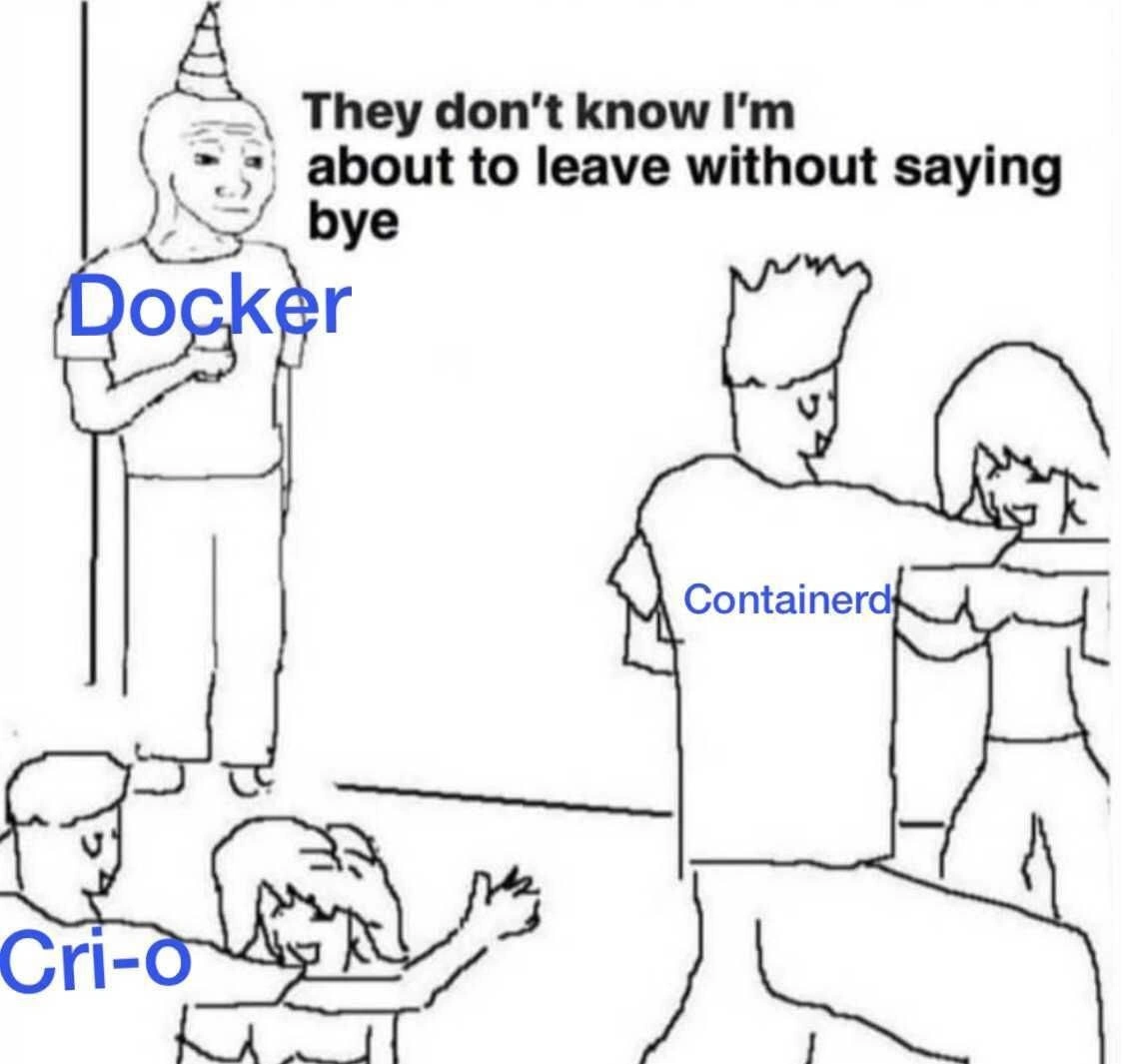
Why is this Containerization meme funny?
Level 1: Leaving the Party Quietly
Imagine you’re at a school dance, and one of the older kids, who helped start the whole dancing trend, decides to go home early without telling anyone. Let’s call that kid Docker. Docker was the one who brought the music playlist everyone’s dancing to. But now there are two new DJs, let’s call them containerd and CRI-O, who know how to keep the music playing. Docker realizes these two have everything under control, so he thinks, “Okay, they’ve got this. I can slip out.” He doesn’t make an announcement or a big scene about leaving; he just quietly walks out the door while everyone else is busy having fun.
In this little story:
- Docker is like the friend who started the fun but is now quietly leaving the party.
- Containerd and CRI-O are like the friends who are still dancing and keeping the fun going — maybe they even took over playing the music.
The funny part is that Docker leaves without saying goodbye, and containerd and CRI-O don’t even notice because the party (the Kubernetes cluster) is still going strong. It’s like when someone sneaks out of a party and nobody realizes they’re gone because the party keeps rocking. In real tech terms, it means the system (Kubernetes) keeps running containers just fine even after Docker isn’t being used for that job anymore. Everyone at the “party” is too busy enjoying the smooth running system to pause and say, “Hey, where did Docker go?”
So, the meme is joking that Docker is doing an “Irish goodbye” — slipping away quietly — while the rest of the container gang carries on. It makes us smile because we picture these computer tools as people at a party. It shows that sometimes in technology, a big important friend (like Docker) can leave, and surprisingly everything keeps working and the party goes on.
Level 2: Who’s Who at the Container Party
Let’s break down the meme in simpler terms, especially if you’re newer to Kubernetes or containers. The meme uses the familiar “wallflower at a party” comic to personify three technologies: Docker, containerd, and CRI-O. Each one has a role in the story of how containers run inside Kubernetes. Here’s who they are and why it’s funny:
Docker (the lonely guy by the wall with a party hat): Docker is a very popular container platform. Think of Docker as a tool that lets you package up an application along with everything it needs (like the OS libraries and dependencies) into a neat container image, and then run that image anywhere. Docker was so good at this that Kubernetes (a system for managing lots of containers across computers) originally used Docker as its go-to way to run containers on each machine in the cluster. In the meme, Docker is shown as the guy about to slip out of the party quietly. The text above Docker’s head says, “They don’t know I’m about to leave without saying bye.” That’s referencing how Docker’s special connection to Kubernetes (often called dockershim in Kubernetes code) is being phased out. Docker is essentially saying, “I’m leaving this Kubernetes party, and nobody here realizes it yet.”
containerd (the dancing stick figure in the center): Containerd is a container runtime – basically, a slimmer tool whose only job is to run containers and keep them running. If Docker is like a full restaurant (where you can order food, and it cooks and serves it), containerd is just the kitchen in the back that actually cooks the meals. In fact, Docker internally uses containerd to run containers! Kubernetes learned that instead of talking to the whole Docker restaurant, it could just walk straight into the kitchen (containerd) and ask it to cook up containers directly. Containerd happily does this and follows all of Kubernetes’ CRI (Container Runtime Interface) rules for how it should operate. In the meme, containerd is dancing and having a great time. This represents that containerd is now a first-class guest at the Kubernetes party – it’s doing the container-running work and enjoying being in the spotlight, especially with Docker quietly stepping away.
CRI-O (the other dancing figure labeled at the bottom left): CRI-O is another container runtime, like containerd’s cousin. Where containerd came from the Docker world, CRI-O was built by the Kubernetes community (with a lot of input from Red Hat) specifically to be a lightweight way to run containers in Kubernetes. You can think of CRI-O as another kitchen built exactly to Kubernetes’ specifications, without any extra frills. It implements the same CRI rules so Kubernetes can talk to it directly. CRI-O is at the party dancing too, showing that it’s also part of this new generation of container runtimes that Kubernetes can use. In many setups (especially in Red Hat’s OpenShift Kubernetes distribution), CRI-O is the preferred runtime instead of Docker. The meme shows CRI-O literally on the floor dancing, maybe doing something crazy like a breakdance move – it’s really in the groove, indicating that CRI-O is fully embraced and having fun in the Kubernetes world.
Now, why is Docker leaving? In Kubernetes version 1.20 (around the time this meme came out), the project announced it would deprecate Docker support in a future release. This doesn’t mean “Docker is dead” or “you can’t use Docker anymore.” It just means that Kubernetes won’t rely on the Docker program internally. Kubernetes will expect a CRI-compliant runtime, like containerd or CRI-O, to be present on each node to start and manage containers. Docker, by default, wasn’t built to speak CRI; it needed that extra shim (dockershim) to translate. The Kubernetes maintainers decided: “We have a standard (CRI) and great runtimes that follow it, so maintaining a special adapter for Docker is no longer worth it.” Essentially, Docker was one way to run containers, but now Kubernetes prefers others that fit more neatly into its ecosystem.
The meme is funny to DevOps folks because of how it anthropomorphizes this tech change:
- Docker quietly leaving the party = Docker being removed from Kubernetes support subtly.
- Containerd and CRI-O dancing = these newer runtimes are not just ready to take over, they’re thriving doing the job Docker used to do, and they might not even notice Docker is gone because everything still works fine.
If you’re a junior developer or just getting into containers, you might recall learning Docker first. Docker’s tooling (like docker build, docker run) is still super useful for building images and running containers in development. You can still use Docker on your laptop to create container images and such. But when it comes to running those containers in a large Kubernetes cluster, Kubernetes itself no longer needs the whole Docker system on each server. It will use containerd or CRI-O behind the scenes to actually run the containers. Your Docker images (the files you build) are still the same standard format (OCI images), so containerd and CRI-O can run them. Nothing changes for how you write a Dockerfile or how you think about containers – it’s just a change in the plumbing under Kubernetes’ hood.
Think of it like this: Imagine Kubernetes as the party organizer. In the early days, Docker was the reliable friend who brought the music and the speakers (containers and runtime) to every party. Over time, the organizer found out they could hire a dedicated DJ (containerd or CRI-O) who already had the music library set up in the format the organizer likes. So at the latest party, Kubernetes told Docker, “You can relax now, I’ve got professional DJs who know my playlist.” Docker quietly steps out, and the party continues jamming because the new DJs (containerd, CRI-O) are spinning the records perfectly. The other party-goers (the applications in the cluster) don’t even notice the difference, as long as the music (containers) keep playing. That’s exactly what happened in Kubernetes 1.20+: Docker left the building (as a runtime), containerd/CRI-O took over the turntables, and the Kubernetes party kept rocking.
In summary, this meme is an inside joke about Kubernetes container runtimes. It’s making light of the transition where Docker’s special status was removed, and how the newer runtimes containerd and CRI-O are joyfully taking Docker’s spot on the dance floor. It’s funny because it anthropomorphizes a pretty dry technical change – turning it into a social scene where one guest leaves a party unnoticed while the others dance on. For anyone who has been following Kubernetes, it’s a nod to the times: Docker was huge, but the cloud-native crowd has moved on to built-for-Kubernetes solutions… and they’re not even saying a dramatic goodbye; they just sneak out, knowing everything will be fine.
Level 3: Dockershim’s Last Dance
For seasoned DevOps and SRE folks, this meme hits on the “runtime transition” saga with a knowing chuckle. The image portrays a party scene: Docker is that wallflower against the wall, wearing a forlorn party hat, thinking to itself: “They don’t know I’m about to leave without saying bye.” Out on the dance floor, containerd and CRI-O are boogying happily, oblivious. This references the real-world Kubernetes decision to deprecate Docker as a container runtime (specifically, to remove the built-in “dockershim” support). In plainer terms, Kubernetes is quietly phasing Docker out of its system’s internals, while the newer container runtimes (containerd and CRI-O) carry on managing containers in the cluster. The humor lies in how unceremonious this major change is: Docker—formerly the star of the container show—is leaving the Kubernetes party like a shy guest doing an Irish goodbye, and honestly, not everyone on the dance floor even notices or cares.
From an industry perspective, this is funny because it’s so relatable. Tech moves fast, and yesterday’s hero can become today’s afterthought just like that. Seasoned engineers have seen core technologies get deprecated many times, often with minimal fanfare:
- The whole team might be partying on with new tools, while the old tool quietly vanishes.
- One day you’re proudly telling everyone “we run Kubernetes on Docker,” the next day Kubernetes says “Docker who? We prefer containerd now,” and it barely makes a ripple in production (if you’ve kept up to date).
- It’s reminiscent of other “surprise, but not really” deprecations. Remember when Python 2 quietly EOL’d or when AngularJS was finally sunset? In each case, those in the know had seen it coming for years, but to the uninitiated it felt sudden.
In this specific case, the Dockershim deprecation was announced around Kubernetes v1.20 (December 2020). Many of us had that “wait, Kubernetes is dropping Docker?!” moment. It sounded scandalous: Docker was the container brand; it’s literally the tool that sparked the modern container revolution. How could Kubernetes, the flagship container orchestrator, ditch Docker? Wasn’t that like firing the life of the party? But the reality, understood by experienced Kubernetes admins, was that Docker had become an extra layer in Kubernetes deployments that wasn’t strictly necessary. Kubernetes doesn’t need Docker’s container building or swarm mode or fancy CLI – it just needs to run containers efficiently. Docker was the default runtime early on, so Kubernetes kind of bolted Docker support onto itself via Dockershim. Over time, better-integrated alternatives arose (containerd came out of Docker’s own effort to componentize, and CRI-O came from the community’s desire for a Kubernetes-specific runtime). By the time of the meme, most cloud-managed K8s clusters (e.g., on EKS, GKE, AKS) were already using containerd under the hood. Docker’s presence in Kubernetes was largely historical baggage.
The meme nails the social dynamic of this transition:
- Docker stands alone thinking “they don’t know I’m about to leave”. This is Docker knowing it’s about to be deprecated from Kubernetes, but the “party” (the Kubernetes user base) doesn’t seem aware or concerned yet. It’s a tongue-in-cheek jab at how deprecations often catch people off-guard. In reality, the Kubernetes maintainers did warn everyone, but it still felt like a quiet exit since nothing immediately broke. Docker is essentially saying, “I’ll just slip out, and they’ll barely notice I’m gone.”
- Containerd (the figure dancing enthusiastically) represents how containerd has effectively taken Docker’s place as the primary container runtime for Kubernetes. Containerd is literally part of Docker’s lineage (Docker uses it internally), but here it’s enjoying its independent moment in the spotlight. Seasoned engineers see containerd as a more streamlined, purpose-built runtime. The meme shows containerd dancing because, well, containerd is thriving in the Kubernetes world – it’s now the default in many setups and doesn’t need Docker’s babysitting anymore.
- CRI-O (the other figure on the dance floor, possibly breakdancing on the ground) is another runtime alternative, backed by Red Hat and others. CRI-O was designed to be Kubernetes-native from the get-go, implementing only what Kubernetes needs to run containers and nothing more. In the party, CRI-O is also having fun, which tells us the Kubernetes community has multiple options and they’re all doing just fine without Docker’s direct involvement. It’s like two new DJs mixing tracks at the Kubernetes party, and they’re absolutely killing it on the dance floor.
What really makes seasoned DevOps folks smirk is the phrase “leave without saying bye.” It captures the Irish exit vibe of the Docker deprecation. In many organizations, deprecating a major component can be dramatic – big meetings, migration plans, farewell cakes for the old tech (okay maybe not actual cakes, but big send-offs). Here, though, Kubernetes is effectively saying “So long, Docker” in a footnote, and continuing the party. If you weren’t paying attention to release notes or the Kubernetes blog, you might not even realize anything changed until you see a warning or a deprecation notice scrolling by in your cluster logs, like:
Warning: using dockershim is deprecated, please migrate to a CRI-compliant runtime.
For ops veterans, this scenario resonates with the reality of production deprecations – they often happen quietly, on a predictable schedule (like “X will be removed in 2 releases, please migrate”), but there’s no sudden explosion. The cluster doesn’t crash; you just wake up one day and notice Docker isn’t invited to the Kubernetes 1.24 party at all. And guess what? Everything still works, because containerd (or CRI-O) was waiting in the wings to take over the duties. This mix of hugely important change and comically low-key execution is what gives the meme its punch. It’s an inside joke: unless you’re familiar with Kubernetes’ container runtime saga, the image might just seem like some weird stick-figure party. But to insiders, it’s a perfect depiction of how the cloud-native community handles business – pragmatic, a bit cold, and undeniably effective. Docker helped start the party (we wouldn’t be here without it), but now it’s excusing itself quietly, and Kubernetes doesn’t mind as much as you’d think. In fact, the party might even run smoother now. 🍻 (Cheers to evolving infrastructure!)
Level 4: CRI Coup d'État
At the deepest technical level, this meme highlights a fundamental architectural shift in how Kubernetes interacts with container runtimes. Kubernetes introduced the Container Runtime Interface (CRI) as a plugin-like abstraction so it could manage pods without being tied to any single container engine. Originally, Kubernetes talked directly to the Docker Engine through a built-in adapter called Dockershim. This was essentially an Adapter Pattern in action: Dockershim translated Kubernetes’ standardized CRI calls into Docker’s API calls. However, maintaining this special-case code became a burden as the ecosystem evolved. The joke of Docker “Irish-exiting” (silently leaving) refers to Kubernetes deprecating Dockershim in favor of runtimes that implement CRI natively (like containerd and CRI-O). It’s a coup d'état in the container world: the once-dominant Docker Engine is being quietly unseated by leaner, CRI-compliant daemons.
Under the hood, Docker itself wasn’t just one thing – it was a full suite (client, server, builder, swarm, etc.) bundling what are now separate concerns. Notably, Docker Inc. spun out the core container runtime, containerd, donating it to the CNCF (Cloud Native Computing Foundation) to foster an open ecosystem. Containerd is a slim, focused process that manages containers on a host (pulling images, starting/stopping containers via lower-level tools like runc). Docker actually uses containerd internally to do the heavy lifting of running containers. Meanwhile, CRI-O (short for “CRI Open” or sometimes jokingly “Container Runtime Interface – Oh?”) was created by Red Hat as a lightweight alternative designed to run Open Container Initiative (OCI) containers directly under Kubernetes’ CRI. Both containerd and CRI-O embrace the OCI standards for container images and runtime, meaning they share a common image format and run lifecycle with Docker, but drop the fluff that Kubernetes doesn’t need (like Docker’s CLI, Dockerfile build system, volume management, etc.).
From a systems design perspective, this transition reduces complexity and improves performance: removing Docker as an extra hop streamlines the chain from Kubernetes to the kernel. Instead of Kubernetes calling Dockershim, which calls Docker Engine, which then calls containerd and runC... now Kubernetes can cut out the middleman and speak directly to containerd or CRI-O. Fewer layers mean fewer failure points and a smaller resource footprint on each node. To illustrate the difference:
| Kubernetes <=1.19 (Dockershim path) | Kubernetes >=1.20 (CRI path) |
|---|---|
| Kubelet → Dockershim (in-process adapter) → Docker Engine (daemon) → containerd → runC | Kubelet → CRI gRPC API → containerd (CRI plugin) → runC |
| Multiple translation layers and a full Docker daemon | Direct CRI compliance, no Docker daemon needed |
In the left column (old way), the Kubelet (node agent) had to include that special Dockershim glue. The Docker Engine process ran on each node, doing things like image builds and network setup — capabilities that Kubernetes either doesn’t use or does differently (via CNI for networking, CSI for storage, etc.). In the right column (new way), Kubelet just calls a standardized CRI gRPC interface to whichever runtime is present. If it’s containerd, containerd directly handles pulling the image and spawning a container via runC. If it’s CRI-O, same story: CRI-O pulls the image and launches the container with OCI tools. Both containerd and CRI-O implement the CRI endpoints (like RunPodSandbox, CreateContainer, ListContainers, etc.), so from Kubernetes’ perspective they’re interchangeable. This level of indirection (paradoxically) simplifies Kubernetes code and gives cluster operators freedom to choose or upgrade the container runtime without patching Kubernetes itself.
The “Irish exit” aspect comes from the fact that this was a relatively silent change at runtime. Kubernetes didn’t need to throw a tantrum or shut down the party when Docker support was removed – thanks to CRI, the other runtimes seamlessly take over. It’s a testament to good interface design: the system keeps running containers as usual, even though the underlying implementation changed dramatically. Dockershim’s deprecation in late 2020 was announced in release notes and a blog post, but in true engineering fashion it wasn’t some fiery revolution – more like a planned retirement. Yet, for those deeply involved in container orchestration, it felt like the end of an era: Docker had been the poster child of containers, and now Kubernetes was effectively saying, “Thanks for your service, but we’ll be fine without you.” The cloud-native community had spent years standardizing container tech via OCI and CRI, so this outcome was academically inevitable even if it felt a bit surreal. The meme captures that inevitability and irony: Docker slips out the backdoor of the Kubernetes party it once headlined, while the new stars (containerd and CRI-O) keep the cluster dancing without missing a beat.
Description
This meme uses the 'They don't know' or 'I wish I was at home' party format. A Wojak character wearing a party hat stands alone in a corner, labeled 'Docker', thinking, 'They don't know I'm about to leave without saying bye'. In the foreground, other partygoers, labeled 'Containerd' and 'Cri-o', are happily socializing and dancing, completely oblivious. This meme perfectly captures the situation in the Kubernetes ecosystem around December 2020 when the deprecation of the Docker runtime shim was announced. While Docker was a well-known, popular technology (the one everyone knows at the party), Kubernetes was moving towards standardized container runtimes (CRI). 'Containerd' and 'Cri-o' were already compliant and becoming the center of attention, while Docker's special integration (dockershim) was being phased out, forcing it to 'leave the party' without much fanfare
Comments
12Comment deleted
Docker at the Kubernetes party is like a dev who wrote a popular library but refused to use standard interfaces. The community just built an adapter, and now they're removing the adapter
Docker’s doing the Irish-exit from kubelet while everyone vibes with containerd - until the 3 AM deploy script still expects /var/run/docker.sock and PagerDuty becomes the after-party cleanup crew
Docker's the only one at the party who brought a 300MB Alpine image as a plus-one, meanwhile containerd and CRI-O are comparing how many syscalls they saved by not wrapping everything in seventeen abstraction layers
Docker showing up to the Kubernetes party only to realize everyone's already moved on to containerd and CRI-O - a perfect metaphor for when your monolithic architecture gets quietly replaced by microservices while you're still explaining why 'docker run' is all anyone needs. The real irony? Docker literally donated containerd to CNCF, essentially training its own replacement. It's the tech equivalent of mentoring your successor and then awkwardly realizing they're better at your job
Dockershim deprecated: Docker's flawless CRI exit(0) - no SIGTERM, no socket drama
Kubernetes party etiquette: Docker Irish-goodbyes, containerd and CRI‑O keep kubelet dancing; the only one panicking is your CI that assumed the runtime was the CLI
When K8s dropped dockershim in 1.24, Docker Irish-exited and the only alert we got was a failing node health check still grepping 'docker ps'
NOT XD Comment deleted
explain pls i'm not a reboot engineer Comment deleted
Kubernetes is deprecating Docker as a container runtime after v1.20. Comment deleted
And replacing with what? Comment deleted
https://www.theregister.com/2020/12/03/docker_deprecated_in_kubernetes_this/ Comment deleted