When CS Fundamentals Collide with Business Requirements
Why is this CS Fundamentals meme funny?
Level 1: One Sentence Essay
Imagine your teacher asks you to write a detailed report about all the animals in a zoo, but you only write one sentence: “A dog is an animal.” That’s it – that’s your whole report! 😃 It would be pretty funny because you’ve obviously skipped almost everything you were supposed to talk about. In this meme, the manager wants a big plan for running a vet’s office (kind of like the teacher wanting a big report), and the developer just writes a tiny bit of code saying “Dog is an Animal” (like writing one sentence and thinking the assignment is done). It’s funny for the same reason: the task was huge and complex, but the answer was way too simple. The developer basically did the equivalent of handing in a one-sentence essay for a big project – and that mismatch makes us laugh.
Level 2: Remember Your Training
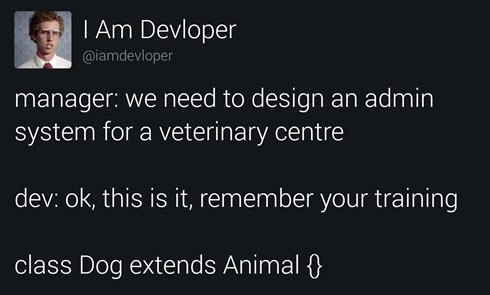
Let’s break down the meme in simpler terms. The format is a mock conversation posted on Twitter (from the parody account @iamdevloper, known for making fun of programmer life). The manager says: “we need to design an admin system for a veterinary centre”. An admin system here means a software application that a vet clinic’s staff (administrators, receptionists, veterinarians) would use to manage their work – things like keeping track of animals (pets), their owners, appointments, medical records, billing, etc. It’s a pretty complex project if you think about it! There are lots of pieces that need to work together.
Now, the developer’s reply: “ok, this is it, remember your training”, followed by a line of code in a monospaced font: class Dog extends Animal {}. This is written in a style similar to Java or C#. What does that code mean? In Object-Oriented Programming (OOP), a class is like a blueprint for an object (something in the program that represents a real-world entity or concept). Here, Animal could be a class that defines general features all animals have (say, name, species, age, etc., or behaviors like eat() or sleep()). When we write class Dog extends Animal, we’re using inheritance: that means we’re creating a new class Dog that inherits all the properties and behaviors of Animal. Essentially, we’re saying “a Dog is a kind of Animal” in code. The curly braces {} being empty indicates that the Dog class doesn’t add anything new – it’s just exactly an Animal in this simplistic example.
Now, why is that funny in context? Because the manager asked for a full system design, and the developer responded with what looks like the absolute bare minimum piece of that design. It’s as if the developer only heard “veterinary centre” and immediately thought, “Ah, animals! I know OOP, I’ll make an Animal class and a Dog subclass. Done!” It’s a huge oversimplification. Imagine an admin system: you would need ways to handle multiple animals (not just dogs!), owners’ information, scheduling vet appointments, maybe inventory for medications, user login for the staff, etc. But none of that appears in the response – just a single class definition connecting Dog to Animal. The code snippet is written in a code font to emphasize that this is the developer’s actual design output. It visually contrasts with the manager’s request text, highlighting how little the dev’s contribution is compared to what was asked.
“Remember your training” is the developer’s internal monologue (or maybe the manager encouraging them – but likely it’s the dev psyching themselves up). It implies the developer is calling upon what they learned in school or bootcamp to tackle this task. And what do they do with that training? They produce the most trivial example from an OOP lesson: Dog extends Animal. This phrase is something many new programmers literally see in their first OOP class – it’s like the Hello World of class inheritance examples. In a course exercise, you might be asked to model animals with classes, making Dog, Cat, etc. as subclasses of Animal. However, in a real admin system, that’s maybe 1% of the design! So the humor is a mix of DeveloperHumor and pointing out MisalignedExpectations: The stakeholder (manager) expects a serious, comprehensive plan, and the dev (perhaps jokingly or naively) gives a toy example as if it’s the whole solution.
For a junior developer or someone new to programming, this meme is a lighthearted warning: don’t confuse a part of the solution (like a simple class relationship) with the entire challenge. It’s making fun of the idea that you can solve a complex requirement by just applying something you memorized without deeper thinking. Everyone who has gone through basic programming classes recognizes class Dog extends Animal {} – seeing it used as the entire system design is what makes it funny. It’s a classic case of requirements vs. reality: the requirement was huge, but the “reality” of what was delivered is comically underwhelming.
Level 3: One Class to Rule Them All
The humor in this meme comes from an Object-Oriented Programming (OOP) exaggeration that seasoned engineers recognize instantly. The manager asks for a full admin system for a veterinary center – a complex software application with user roles, pet records, appointment scheduling, billing, etc. In response, the developer (tongue firmly in cheek) produces a single inheritance declaration: class Dog extends Animal {}. This one-liner is a textbook OOP example (literally, “a Dog is an Animal” is the kind of basic inheritance example you see in beginner programming courses). By reducing an entire system spec to a trivial class definition, the meme highlights a drastic oversimplification. Experienced developers see the absurdity: it’s as if the dev’s entire architecture design is just modeling one domain relationship and calling it a day. The contrast between stakeholder expectations and the actual deliverable is glaring and deeply funny to anyone who’s faced RequirementsVsReality in a project.
On a deeper level, this exaggeration pokes fun at the gap between ManagerExpectations and engineering reality. The manager says, “design an admin system,” presumably expecting an outline of databases, services, user interfaces, and business logic. Instead, the developer delivers the most minimalist thing imaginable – a single class inheritance. It’s a wink to all the times a misaligned expectation turned into a comical result. Senior engineers have seen this pattern: a non-technical manager describes a big idea in one sentence, and a junior dev (or a jaded one joking around) interprets it in the narrowest way possible. Here the dev “remembers their training,” applying OOP inheritance as if it’s the magic solution to everything. The phrase “remember your training” is pure parody – it implies the developer is hyping themselves up to tackle a grand architectural challenge, only to default to a trivial Dog subclass because that’s the most basic thing their training covered. It’s a nod to how formal training or academic examples can be hilariously inadequate for real-world system design.
From an architecture standpoint, boiling down an entire admin system to a single class is a nonsense solution, and that’s why it’s funny. Real systems for a veterinary clinic would involve multiple classes and components: perhaps an Animal base class with subclasses like Dog and Cat (if we’re modeling species), but also classes for Owner, VetStaff, Appointment, MedicalRecord, and so on. There would be databases or data structures to store information, user interface screens for the admins to input data, and business logic to enforce rules (e.g. “you can’t schedule a dog’s appointment in the past”). By contrast, class Dog extends Animal {} doesn’t implement any of that – it’s literally an empty shell. In fact, if a developer genuinely attempted to handle everything in one class, they’d end up with a monstrous God class (an anti-pattern where one object does everything, violating all good design principles). The meme’s imaginary dev hasn’t even done that – they’ve essentially done next to nothing, which satirically implies either infinite optimism or outright sarcasm. DeveloperHumor often plays on these extremes. This joke also hints at the old saying: “If all you have is a hammer, everything looks like a nail.” Here, the “hammer” is OOP inheritance. The dev applies it blindly to a huge problem, resulting in a hilariously inadequate solution.
What makes seasoned programmers smirk is the kernel of truth: early in our careers (fresh out of college or a coding bootcamp), many of us were armed with OOP theory and examples like Dog extends Animal. It was tempting to start any design by sketching a class hierarchy without thinking about actual requirements. This meme exaggerates that impulse to an absurd degree. It’s basically saying: “Remember how they taught us OOP with cute animal examples? Let’s solve everything with that!” The senior perspective recognizes the satire of misapplied training. In professional practice, we learn that design patterns & architecture require much more thought — you might favor composition over inheritance, design your classes around real behaviors and data needs, and certainly plan beyond one class. So when we see a critical system spec answered with a lone Dog class, it triggers a knowing laugh. It’s a send-up of under-scoping a problem and the perennial RequirementsVsReality joke: the requirement was huge, the solution delivered is comically tiny.
Description
A screenshot of a tweet from the popular satirical Twitter account "I Am Devloper" (@iamdevloper), which features a profile picture of the character Napoleon Dynamite. The tweet text describes a short dialogue: 'manager: we need to design an admin system for a veterinary centre', followed by the developer's internal monologue, 'dev: ok, this is it, remember your training', and their first line of code: 'class Dog extends Animal {}'. The background is a dark, solid color. This meme humorously critiques the tendency of developers, particularly those early in their careers, to immediately jump to abstract, textbook object-oriented programming (OOP) concepts when faced with a practical business problem. The joke lies in the developer's earnest application of a classic inheritance example, which, while technically correct in a vacuum, is a comical oversimplification and a far cry from the actual requirements of an admin system, such as managing appointments, billing, or client records. It resonates with senior engineers who recognize this pattern of prioritizing theoretical purity over practical application
Comments
7Comment deleted
The senior dev sees this and immediately starts a two-hour debate on whether `Animal` should be an abstract class or an interface, completely ignoring the client's need for a billing module
“class Dog extends Animal {}” is the gateway drug - six sprints later you’ve got class Platypus extends Mammal implements Oviparous, Venomous, Billable, GDPRSubject, Comparable<Patient>… and a 300-table join to print an invoice
After 20 years in the industry, you realize the real inheritance hierarchy should have been: class VeterinaryBillingSystem extends LegacyNightmare implements NeverEndingRequirements, BrokenByDesign {}
Ah yes, the classic 'Dog extends Animal' solution - because nothing says 'enterprise veterinary management system' quite like a single line of inheritance. I'm sure the stakeholders will be thrilled when they ask about appointment scheduling, billing integration, and medical records management, and you confidently respond with 'class Cat extends Animal {}'. At least when the system inevitably needs to handle edge cases like 'exotic pets' or 'livestock', you can just keep extending Animal and call it 'scalable architecture.' Remember: if your entire domain model fits in a tweet, you're either a genius or dangerously underestimating the problem space
Manager asks for scheduling and billing; architect ships Animal→Dog and calls it domain modeling - six sprints later we still can’t book a vaccination
Composition over inheritance? Nah, this vet CRUD demands a full superclass menagerie
Ask for a vet admin system, get 'class Dog extends Animal {}' - with inheritance as the hammer, everything looks like a taxonomy while RBAC and scheduling wait in triage