Skip to content
DevMeme
1673 of 7435
The Ultimate Programmer's Lie, Endorsed by Paul Graham
Bugs Post #1869, on Aug 6, 2020 in TG

The Ultimate Programmer's Lie, Endorsed by Paul Graham

Why is this Bugs meme funny?

Level 1: I Cleaned My Room

Imagine a child who is told to clean up a very messy room. Instead of sorting everything properly, they quickly shove toys under the bed, stuff clothes into the closet, and then proudly announce, “It should be clean now!” At first glance the room looks tidy, so everyone hopes the mess is gone. But as soon as someone opens the closet or looks under the bed, out tumbles all the hidden clutter. The child truly thought they fixed the problem and wants the parents to believe everything is fine. That proud declaration “It should be clean now” ends up being a well-meaning lie – the room isn’t completely clean after all. It’s just like how a quick, hopeful fix in a computer program doesn’t always completely solve a bigger underlying problem.

Level 2: Works on My Machine

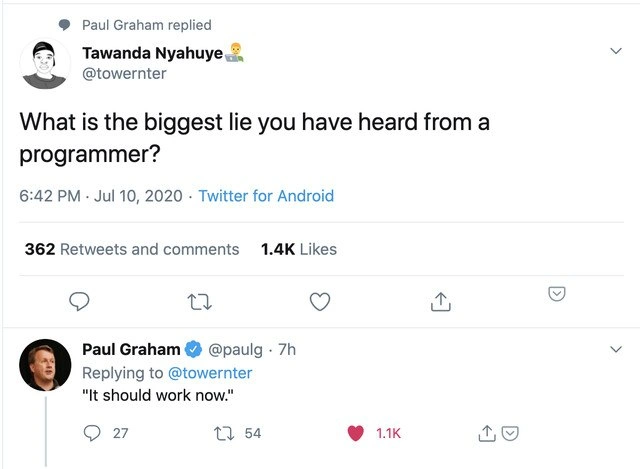
In programming, a bug is a mistake or flaw in the code that causes a program to behave in unexpected or wrong ways. Debugging is the process of finding and fixing those bugs. This meme is a screenshot of a Twitter conversation: someone asks, “What is the biggest lie you have heard from a programmer?” and the reply is “It should work now.” If you’re a newer developer, you might have already heard or even said this line yourself. It’s practically a rite of passage in coding.

When a programmer says “It should work now,” they mean they think they’ve fixed the problem. The code has been changed, and on their end everything seems to run without errors. It’s a way of communicating to the team or the user, “I did something to address the issue, and I’m expecting that the issue is resolved.” But notice the word “should.” Even the programmer isn’t 100% certain. They’re hopeful (maybe even a bit anxious) that the software bug is gone, but there’s a built-in doubt. It’s like saying, “I believe it’s fixed... but I haven’t completely proven it yet.”

Why is this considered the “biggest lie”? Well, because in reality, especially early in your career, you find out that just because the bug appears fixed in one scenario doesn’t mean it’s truly gone everywhere. Perhaps you ran the program on your own computer and the error disappeared – this leads to the classic phrase “works on my machine.” That line is a running joke among developers. It means the developer verified the fix in their own environment, but hasn’t checked if it works for others or in the production environment (the real-world server or user’s device). Often, a newbie programmer will excitedly declare a fix, only to have a colleague or a QA (Quality Assurance) tester come back and say, “Actually, it’s still crashing when I do X,” or “Now another thing is broken.” It’s a humbling learning moment.

The humor in that Twitter exchange comes from how relatable this scenario is. Communication-wise, “It should work now” is almost code for “I really hope I fixed it, but I’m not totally sure.” The reason it’s funny is that virtually every coder has been in that position: you apply what you think is a clever fix to a bug, you tell everyone the app is all good, and then you discover you missed something. It highlights a common challenge in software development – even when you think you’ve covered all bases, there might be a case you didn’t test or a part of the code you didn’t realize was connected. So, the phrase ends up being an unintended fib that we tell out of optimism. New developers quickly learn not to celebrate too early. Testing and double-checking in different scenarios (and on different machines!) become crucial habits over time. That way, one day you can confidently say “It works now” without the “should.”

Level 3: Deployment Déjà Vu

The meme captures a universal truth in software development: those infamous four words “It should work now.” This phrase is practically a battle-scarred mantra in debugging circles. A Twitter user asks for the “biggest lie you have heard from a programmer,” and the consensus answer from industry veterans (even from Paul Graham, a famous hacker & investor) is exactly that optimistic declaration. Why is this so hilariously relatable? Because every experienced developer knows that uttering “It should work now” is often followed by an eerie silence... and then by another error alert.

Seasoned engineers recognize this scenario as a kind of deployment déjà vu. You’ve chased a bug through tangled code for hours, deployed a quick patch, and confidently announce to your team chat or the issue tracker, “Fixed – it should work now.” Cue the dramatic irony: moments later, an all-too-familiar crash report or a new test fails. It’s like a twisted game of Whac-A-Mole: you squash one bug, only for two more to pop up. The frustration of this endless loop is so universal that all we can do is laugh (albeit darkly) at our own perpetual optimism in the face of Murphy’s Law. Famous last words, indeed.

The technical reality is that saying it should work doesn’t make it so. Maybe the code compiled and the specific case you tested passed, but software bugs are craftier. Often there are hidden edge cases or deeper issues lurking beneath the surface. Fixing one symptom might not have actually fixed the root cause. For example, you might patch a function to handle a null-pointer exception, telling yourself it’s solved. But perhaps there’s also an off-by-one error or a race condition elsewhere that you didn’t catch – meaning the application will still blow up under slightly different conditions. Heisenbugs (those elusive bugs that disappear when you try to observe them) and stubborn Bohrbugs (straightforward but persistent flaws) have a tendency to survive our “final” fixes. So the confident pronouncement “It should work now” often becomes the ultimate patch-and-pray move: deploy the fix, cross your fingers, and hope the system doesn’t break again.

There’s also the classic it works on my machine factor. A developer might run the app locally and everything seems fine – hence proclaiming success – but in the real production environment or on a colleague’s computer, something is different. Perhaps the configuration, environment variables, or input data differ in a way that reintroduces the issue. Suddenly that “should” in “It should work now” is doing a lot of heavy lifting. This meme highlights that shaky programmer promise. When a developer says those words, they’re often trying to reassure others (and themselves) that the nightmare debugging session is over. But every coder in earshot knows to brace themselves because experience has taught us: when someone says “It should work now,” the operative word is “should,” not “will.”

Description

A screenshot of a Twitter exchange on a light-themed interface. The initial tweet is from Tawanda Nyahuye (@towernter), asking the question: "What is the biggest lie you have heard from a programmer?". Below this, a prominent reply from Paul Graham (@paulg), the co-founder of Y Combinator, states simply: "'It should work now.'". The original tweet has 1.4K likes, and Paul Graham's reply has 1.1K likes, indicating significant agreement from the tech community. This meme captures a universal and painful truth in software development. The phrase 'It should work now' is the optimistic, often desperate, declaration made after a supposed bug fix. It's considered a 'lie' because of the inherent complexity of software; a fix in one area can have unforeseen consequences elsewhere, and what works on a local machine might fail in staging or production. For senior developers, it's a humorous acknowledgment of their own past hubris and a reminder that confidence should always be backed by comprehensive testing

Comments

7
Anonymous ★ Top Pick 'It should work now' is the developer's Schrödinger's cat. The code is both fixed and broken until you run the CI/CD pipeline and open the box
  1. Anonymous ★ Top Pick

    'It should work now' is the developer's Schrödinger's cat. The code is both fixed and broken until you run the CI/CD pipeline and open the box

  2. Anonymous

    “It should work now” - translation: my laptop, the CI pipeline, and the feature flag are in consensus; DNS, cache invalidation, and time-zone math haven’t voted yet

  3. Anonymous

    "It should work now" - the four words that trigger every senior engineer's PTSD from that one time they said it confidently before a critical demo, only to discover their fix had introduced three new race conditions and somehow made the original bug non-deterministic

  4. Anonymous

    Every senior engineer knows 'It should work now' is the technical equivalent of 'Have you tried turning it off and on again?' - a phrase uttered with unearned confidence after changing absolutely nothing, yet somehow it works 30% of the time. It's the Heisenbug whisperer's mantra, the cargo cult debugger's prayer, and the production hotfix engineer's favorite lie to tell themselves at 3 AM. The real magic isn't that it sometimes works; it's that we keep saying it with a straight face despite decades of evidence that the universe doesn't care about our optimism, only our stack traces

  5. Anonymous

    'It should work' - the incantation that reliably summons Heisenbugs and postmortem meetings

  6. Anonymous

    "It should work now" is just a canary deploy with Schrödinger observability - until the dashboards refresh, it’s both fixed and paging you

  7. Anonymous

    “It should work now” - translation: merged to main, invalidated the caches I can name, and delegated the rest to eventual consistency and my pager

Use J and K for navigation