Fork in the Outlet: curl | sudo sh, the 'Official' Install Method
Why is this Security meme funny?
Level 1: The Fork and the Outlet
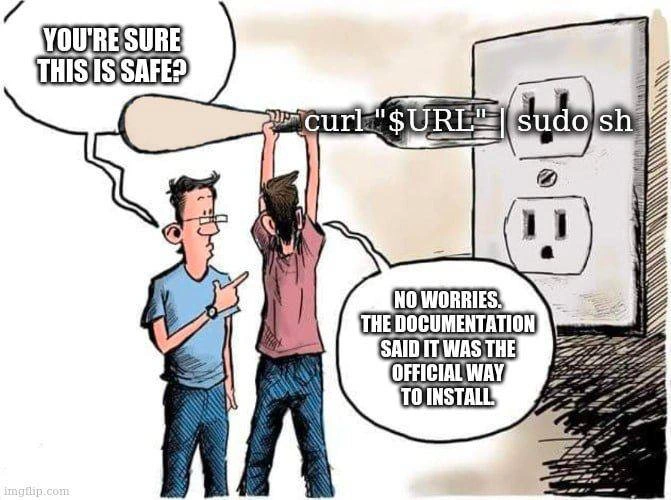
One friend nervously asks, "Are you sure this is safe?" while the other raises a giant metal fork toward an electrical socket and cheerfully replies that it must be fine — the instruction manual said this is the official way to plug things in. That's the whole joke: doing something obviously dangerous, not because you checked it was safe, but because a piece of paper told you everyone does it this way. It's funny because we all recognize the feeling of trusting the manual instead of our own eyes — right up until the sparks fly.
Level 2: What That One-Liner Actually Does
Breaking down the command etched on the fork:
curl "$URL"— curl is a command-line tool that downloads content from a URL and prints it to standard output. Here it fetches a shell script as plain text.|— the pipe operator. It feeds the output of the left command directly into the input of the right command, with no file saved in between and no pause to look at it.sudo sh— starts a shell (sh) as the root superuser viasudo. Whatever text arrives through the pipe is executed line by line with full administrative privileges.
So the one-liner means: download arbitrary code from the internet and run it as the most powerful user on the system, sight unseen. You've probably already done this — installing Homebrew, rustup, nvm, or Docker's convenience script all use this exact shape. Most of the time it's fine, which is precisely the problem: nothing trains you faster to ignore risk than a hazard that usually doesn't fire.
The safer habit costs you about thirty seconds: download first (curl -o install.sh "$URL"), skim the script, then run it — ideally without sudo unless it genuinely needs system-wide access. Bonus lesson for your first job: when the docs say "official," that describes who wrote the instructions, not how safe they are.
Level 3: Root Shell Roulette
The cartoon repurposes the classic "kid jamming a fork into an outlet" editorial comic, except the fork is labeled curl "$URL" | sudo sh and the person holding it confidently announces:
NO WORRIES. THE DOCUMENTATION SAID IT WAS THE OFFICIAL WAY TO INSTALL.
That punchline is the entire modern software supply chain in one panel. We run SAST scanners, demand SBOMs, pin dependency hashes, sit through security training about phishing links — and then bootstrap our toolchains by piping an unauthenticated stranger's shell script straight into a root shell, because the README put it in a copy-paste box and called it official.
The pattern is worse than it looks, and it looks bad:
- No integrity verification. There's no checksum, no signature. You're trusting TLS, the project's domain registrar, their CDN, and whoever has push access to that URL — forever, on every install.
- Server-side targeting. The server can detect
curl's user agent (or even detect that output is being piped, via response timing tricks) and serve a different, malicious script to piped requests than to a human inspecting it in a browser. You literally cannot review what you ran by visiting the link afterward. - Partial execution. If the connection drops mid-transfer,
shhappily executes the truncated script. A script that ends mid-rm -rf "$TMPDIR/becomes a story you tell in therapy. Well-written installers wrap everything in amain()called on the last line; most don't. sudomakes it unrecoverable. Without root, a malicious script ruins your home directory. With root, it owns the machine, installs persistence, and your incident response begins.
Why does it persist? Incentives. Project maintainers optimize for conversion rate: one frictionless line beats a paragraph about GPG keys that loses half the funnel. Homebrew, Rust, and countless dev tools made it the de facto standard, so every smaller project copies the pattern, and "official" becomes a synonym for "load-bearing copy-paste." Meanwhile the realistic alternative — distro packages with signed repositories — lags months behind upstream, so developers route around it. Everyone knows it's a fork in the outlet; the outlet is just where the electricity is.
The blue-shirt character's anxious "YOU'RE SURE THIS IS SAFE?" is the security team. The red-shirt character is every engineer with a deadline. The fork has two prongs because, honestly, so does the trade-off.
Description
A colored cartoon riff on the classic 'kid jamming a fork into an electrical outlet' editorial comic. One person in a blue shirt points anxiously and asks via speech bubble 'YOU'RE SURE THIS IS SAFE?' while another in a red shirt raises a giant two-pronged fork labeled 'curl "$URL" | sudo sh' toward a wall power outlet. The fork-wielder replies in a speech bubble: 'NO WORRIES. THE DOCUMENTATION SAID IT WAS THE OFFICIAL WAY TO INSTALL.' An imgflip.com watermark sits at bottom-left. The meme skewers the ubiquitous and notoriously risky installation pattern of piping a remote shell script from the internet directly into a root shell, normalized because project READMEs present it as the official one-liner install
Comments
8Comment deleted
We threat-model every dependency, then install the toolchain by handing a stranger's bash script root - but it's fine, the README used the word 'official'
У меня это буквально написано в claude.md Comment deleted
brew users on macs Comment deleted
I always first download, read, then execute. I'm shitting my pants to execute shell scripts like this. Comment deleted
no, curl | bash is shitting one's pants, what you do is taking your pants off before shitting Comment deleted
"It's getting scary... I better take off my pants... just in case..." © Comment deleted
Well i always do the same, in reverse. First shitting my pants, execute the script then read the script. Comment deleted
And only theeeen download it☝️ Comment deleted