The Ultimate Naming Conflict: Child vs. Variable
Why is this DevCommunities meme funny?
Level 1: Small Name, Big Decision
Imagine you just got a new puppy or a toy and you need to give it a name. You want the name to be really good, right? You might think a long time about it because you want it to fit perfectly. Now, think about someone who writes computer programs all day. Part of their job is giving names to things in the program (kind of like naming your puppy or toy). This person jokes that if he finds it hard to come up with good names for the little things in his code, how is he ever going to choose a name for his new baby? He even laughs that maybe he'll just call the baby "i" — which would be like naming your puppy just "P" or your doll just "Doll." It's a silly idea because nobody names their child just a single letter! The joke is funny and cute because you can feel how nervous and excited he is. He's basically saying, "I care so much about picking the right name that even naming a baby makes me sweat!" In other words, naming someone (or something) is a big decision, and he's playfully comparing his coding habit to real life. Even if you don't program, you can understand that giving a good name can be hard, especially when it's for someone you really love.
Level 2: The Name Game
In coding, a variable is like a labeled box that holds some information. You choose a name for that box, and good programmers try to pick a name that makes sense (for example, age, score, or userName). That way, anyone reading the code can tell what's inside just from the name. This is part of code readability and overall CodeQuality – basically how easy your code is to understand and work with. If you use a confusing name or just a single letter like x or i for a variable in many places, other developers (or even you, later on) might scratch their heads wondering what it stands for. You might have experienced this yourself: perhaps in a school project or a coding exercise, you used variables named a, b, or data and then struggled to remember or explain what they meant. That's why naming things in code is so important, and why it can surprisingly be one of the trickiest parts of programming for beginners and pros alike.
Naming conventions are like agreed-upon rules or patterns for naming stuff in code, used to keep everything consistent. For instance, in JavaScript or Java you might use camelCase (like totalCount or firstName), while in Python it's common to use snake_case (like total_count or first_name). These conventions also encourage using meaningful words for names. If you have a variable that counts users online, calling it userCount is much clearer than just naming it u or c. Following a consistent naming style is a bit like using proper grammar in sentences – it makes your code easier to read and understand for everyone on the team.
Now, the tweet in this meme shows a developer joking that if he has such a hard time naming his variables at work, how is he ever going to decide on a name for his baby? This is a form of DeveloperHumor that many programmers immediately get. There's a long-running joke in programming circles that "naming things is one of the hardest problems in programming." It might sound exaggerated, but once you start coding more, you’ll find there's some truth to it – you can easily spend 15 minutes debating whether to call something fileName or filePath or something else. In the tweet, he quips that the baby might end up being named "i". Why "i"? In programming, especially in loops, i is often used as a simple, single-letter variable name. It's short for index, and it's kind of a tradition to use i for loop counters (j and k often follow if you have multiple nested loops). For example, you might see code like:
// A typical loop using i as a counter
for (int i = 0; i < 5; i++) {
cout << "Hello #" << i << endl; // prints Hello #0, Hello #1, ... Hello #4
}
Here, i is just a throwaway name for the loop count, which goes from 0 to 4. Outside of that loop, i doesn't carry any special meaning – it's just a placeholder. Programmers use tiny names like this in very limited situations because it's quick and everyone knows that pattern.
The tweet's punchline is "Poor little i;". The developer is imagining, with humor, the outcome if he actually gave his child such a short, programmer-style name. He even added a semicolon after the i, since in many programming languages every statement ends with ;. So he's jokingly writing the baby's name as if it were a line of code. The reason this is funny is because calling a baby just "i" would be really strange in real life! It's the equivalent of giving someone a name that doesn't tell you anything about them – kind of how a single-letter variable name doesn't tell you what it's for. The "Poor little i" part shows the dad-to-be mock-sympathizing with his future kid: imagine growing up with a name that was chosen the way we pick quick variable names! Of course, in reality no one is going to name their child a single letter (one would hope!), but the joke perfectly captures how seriously developers take naming even the smallest things. It’s poking fun at the coder’s tendency to overthink names by applying it to a baby, which is both adorable and absurd. If you're a new developer, it’s a good reminder that even experienced coders sweat over naming variables – you're definitely not alone!
Level 3: Little i, Big Problem
In software development, NamingThings properly is often unexpectedly hard. There's a well-worn saying among programmers: “There are only two hard things in Computer Science: cache invalidation and naming things.” (Some jokers even add a third hard thing, “off-by-one errors,” turning the quote itself into an off-by-one mistake!) This meme nails that truth with relatable humor. The struggle to find good names for code elements is real: it's not just nitpicking, it's a serious CodeQuality concern. A variable name in code is like a tiny piece of documentation – ideally it should tell you at a glance what the variable represents. When names are unclear or too short, code can become cryptic. Seasoned devs have seen how much confusion poorly named variables (like the infamous single_letter_variables or overly generic terms) can cause in a large codebase. We've all opened someone else's code (or our own from six months ago) and thought, “What on earth is x or tempValue supposed to be?” Working with well-chosen names makes for cleaner code and a better overall DeveloperExperience_DX (developer experience), while poor naming forces everyone to play detective, increasing the chance of misunderstandings and bugs down the line.
To avoid these pitfalls, teams establish NamingConventions – agreed-upon rules and patterns for naming variables, functions, classes, etc. These conventions might dictate using meaningful words, consistent letter casing (like camelCase vs. snake_case), and avoiding abbreviations that others might not understand. Entire code review threads often focus on naming: seniors will debate if a variable should be called count vs total vs index because those nuances carry meaning. It's almost comedic how much time we spend on this; many of us have paused coding to Google synonyms or even consult a thesaurus for the perfect name. (Yes, we sometimes treat naming like an art form, as if we're branding a new product rather than just labeling a loop counter!) We fuss over names because once a name is part of the code, changing it later means refactoring everywhere it's used. So picking the right name upfront feels important. In a way, naming a variable is a small but significant design decision – you're defining an identity for a piece of data or logic. No wonder it can make a developer break into a sweat, the same way one might over any big decision.
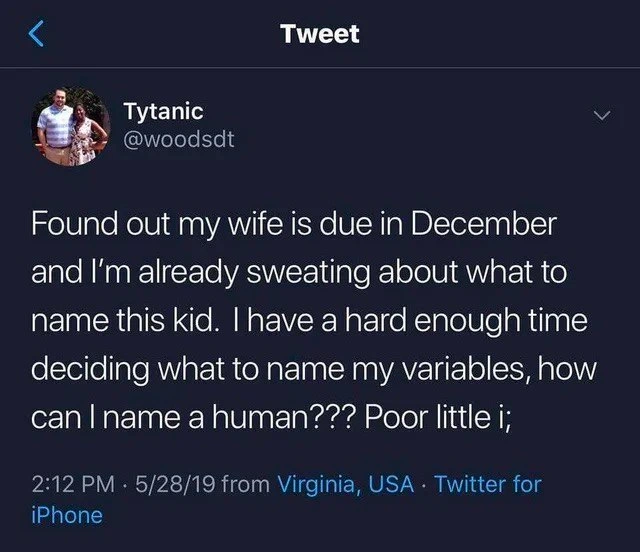
Now, let's connect to the meme’s scenario. The image is a tweet_screenshot of a real Twitter post by a developer (user Tytanic @woodsdt). It’s a prime example of developer_parenting humor: applying a programmer's lens to a family situation. The author quips that his wife is due in December and he's already stressing about what to name their child – clearly facing a baby_naming_dilemma. Why so anxious? Because, as he jokes, he has a hard enough time deciding what to name his variables at work, so how can he possibly name an entire human? If picking a good identifier in code can tie his brain in knots, imagine the pressure of choosing a name for a newborn. This is peak DeveloperHumor, mixing a niche coding problem with a universally high-stakes scenario. The joke lands so well with fellow programmers because it takes a RelatableDeveloperExperience – those everyday variable_naming_struggles in coding – and blows it up to the scale of naming one’s own baby.
The punchline of the tweet is "Poor little i;". In many programming languages, i is the classic name for a loop index – basically the quintessential throwaway label in the single_letter_variables category. It's short for "index," and we use it when the variable’s role is simple or short-lived. By jestingly suggesting that might end up as the baby's name, the author cranks the absurdity up to eleven. He even tacks on a semicolon at the end, as if he's writing a line of code. For developers, that tiny i; carries a lot of subtext: i is the generic fallback name you use when you can't think of anything better (or don't need to). Imagining a child going through life with a name as vague and utilitarian as i is both hilarious and a tad horrifying – hence his sympathetic phrasing, "Poor little i." The semicolon is the cherry on top, mimicking code syntax to really drive home the programmer flavor of the joke. It’s as if he's saying, "Worst case, I'll just call the kid i and be done with it; end of statement." This dramatic exaggeration gets a laugh because every coder understands the feeling of giving up on the perfect name and resorting to something like i or foo. Applying that to a baby name is comically absurd. (One can only imagine: if they have more kids, will the siblings be named j, k, and so on, like cascading loop counters?) In short, the meme humorously highlights how seriously developers take naming – to the point where our anxiety about good names spills over into real life decisions.
Description
A screenshot of a tweet from the user Tytanic (@woodsdt). The tweet reads: "Found out my wife is due in December and I'm already sweating about what to name this kid. I have a hard enough time deciding what to name my variables, how can I name a human??? Poor little i;". This meme captures a classic and highly relatable developer struggle: the difficulty of naming things. The humor lies in elevating the common programming frustration of choosing clear and meaningful variable names to the monumental, real-life decision of naming a child. The punchline, "Poor little i;", is a direct reference to the ubiquitous use of 'i' as a generic, short-lived loop counter variable, humorously implying the child is at risk of receiving an equally uninspired name
Comments
7Comment deleted
The two hardest problems in computer science are cache invalidation, naming things, and telling your spouse that 'DataTransferObject' is a perfectly fine middle name
Just tag the newborn BabyDTO, open a naming RFC, and after six sprints of bikeshedding the architects will land on FirstName_v5_FINAL - right in time for kindergarten
At least with variables you can refactor them later without explaining to HR why you renamed the junior developer from CustomerDataProcessor to LegacyNightmareHandler
The real tragedy here isn't the naming crisis - it's that after 15 years of code reviews insisting on descriptive variable names, this developer's muscle memory will inevitably kick in at the hospital: 'We're naming him `childFirstNameString` for clarity, and his middle name will be `_temp` until we refactor the birth certificate.'
Naming a kid is a prod DB write with no rollback while every stakeholder’s cache has infinite TTL; I suggested “i,” but then we’d celebrate a 0th birthday
Variables are refactorable tech debt; baby names are immutable legacy code
Enterprise workaround: assign the newborn a UUID and file an ADR for a human-readable alias once the domain language stabilizes - until then, i is a deprecated index