Skip to content
DevMeme
3880 of 7435
The Dangers of 'Harmless' Refactoring
Refactoring Post #4226, on Feb 18, 2022 in TG

The Dangers of 'Harmless' Refactoring

Why is this Refactoring meme funny?

Level 1: Pulling the Wrong Block

Imagine you have a tall tower made of wooden blocks (like in the game Jenga). The tower represents a working app – it’s standing up straight and everything is balanced. Now, you spot one block in the tower that doesn’t seem to be doing much. Maybe it’s off to the side, and you think, "Why is this even here? The tower will surely stand without it." So, hoping to tidy up, you pull that block out. 🚧 Crash! The entire tower wobbles and then collapses into a pile of blocks. Turns out that little piece was actually pretty important for keeping the whole structure stable, even if it wasn’t obvious.

In the meme, the developers basically did the same thing to their software. The blue car being fine at first is like the steady tower. The devs removing "unused code" is like pulling out the block they thought was extra. And the car bursting into flames is the tower of blocks tumbling down – a total catastrophe! It’s funny (in a facepalm kind of way) because we don’t expect such a small change to cause such a big disaster. It’s as if you removed what you thought was a useless screw from a bicycle, and suddenly the whole bike fell apart. The lesson is simple: sometimes things that look unimportant actually play a big role, and messing with them can make everything come crashing down. The meme makes us laugh because we’ve all had moments where a tiny change led to a huge "uh-oh" – and seeing it depicted as a dramatic car fire is an over-the-top way to remember to be a bit more careful next time!

Level 2: Works on My Machine

This meme highlights a scenario where developers do a bit of refactoring – which means changing the code’s structure or cleaning it up without altering what it actually does (in theory, nothing should change for the user). Specifically, they targeted unused code. "Unused code" refers to parts of the program (like functions or modules) that seem to not be called or needed by any other part. It’s like having a spare part in a machine that, as far as anyone can tell, isn’t connected to anything. Removing such code is generally considered good code quality practice. It makes the codebase smaller, easier to read, and potentially less confusing. After all, why keep something around if it isn’t used? Getting rid of dead weight in a program can also slightly reduce things like build times or app size. So the developers here likely thought they were doing a nice tidy-up job – a bit of spring cleaning in the code.

Where things go wrong is with hidden dependencies. In software, a dependency means one piece of code relies on another to function. An unexpected dependency is when there’s a reliance that isn’t obvious at first glance. It’s as if you had a lamp that apparently isn’t plugged in – you think it’s safe to put away – but actually it was getting power through a hidden extension cord you didn’t see. In the context of the meme, the code labeled "unused" might have been indirectly important. Perhaps another module called it only in specific circumstances, or it performed some initialization when the app started up. If that’s the case, deleting it would remove something critical that was happening behind the scenes. This is how a well-meaning removal can introduce a bug. A bug, simply put, is an error or flaw that makes the software behave in an unintended way. Here the unintended behavior was pretty extreme – the whole app went down (the car caught fire in the meme’s metaphor).

The phrase "works on my machine" is a tongue-in-cheek way developers say, "It seemed fine when I tried it locally." In our scenario, the devs likely ran the application after removing the code and it still ran for them personally. Maybe they even ran a test suite, and all tests passed. So, from their perspective, nothing broke – it truly worked on their machine. The catch is that a developer’s local environment or testing environment might not replicate everything that happens in the real world (production). There could be configuration differences, environment variables, or usage patterns that only appear in production. For example, maybe that "unused" code is only invoked when a real user’s data triggers a certain condition, or only when the app has been running for several hours continuously. Those scenarios might not happen during a quick local test. So, the code removal went unnoticed until it hit production, at which point that hidden dependency reared its head and caused a failure. The meme jokingly captures this by showing the car perfectly fine in one moment (on the dev’s machine) and then completely wrecked in the next (in production).

Let’s break it down more straightforwardly. The developers removed some code believing it wasn’t needed. Initially, everything seemed okay – the program still ran in their development setup. This gave them confidence. However, that code turned out to be more important than they realized. When the software was deployed to the actual environment where users are (or a more complex system), something crucial was missing – like a missing puzzle piece – causing the program to malfunction. In software development, when a change unintentionally causes a feature to stop working (or causes a crash), we call it a regression because the software has "regressed" to a broken state. Regressions are exactly what tests are meant to catch. But if the tests weren’t covering that particular case (maybe because nobody knew that code was important!), then the regression slipped through.

The imagery of the meme uses a car to drive the point home. A working project is like a shiny, well-running car. Removing a bit of supposedly unused code is like taking out a component of the car that you thought wasn’t needed. Maybe it’s a small gear or a bolt that looked extra. On the surface, everything might still run for a bit; the car starts, and you feel confident. But later, perhaps when you hit a bump, that missing piece causes the engine to fall out or the car to catch fire. In software terms, hitting the bump is analogous to encountering the specific condition where that code was necessary. The result is catastrophic failure.

For a new developer (or anyone learning), the lesson here is: be careful with assumptions about unused parts of a system. Always double-check why something exists before deleting it. Often, reading documentation or asking a teammate can reveal a history like, "Oh, that function looks weird, but it's there because otherwise X, Y, Z breaks." If you do remove code, do it in a controlled way: run thorough tests and be prepared to revert the change if something unexpected happens. The meme exaggerates the outcome for comic effect (most code removals won’t literally set things on fire!), but it’s rooted in a real feeling of dread when a "tiny fix" causes big problems. It’s a rite of passage in development to accidentally break something with an innocent change – and then learn to respect the interconnected nature of software systems.

Level 3: Load-Bearing Code

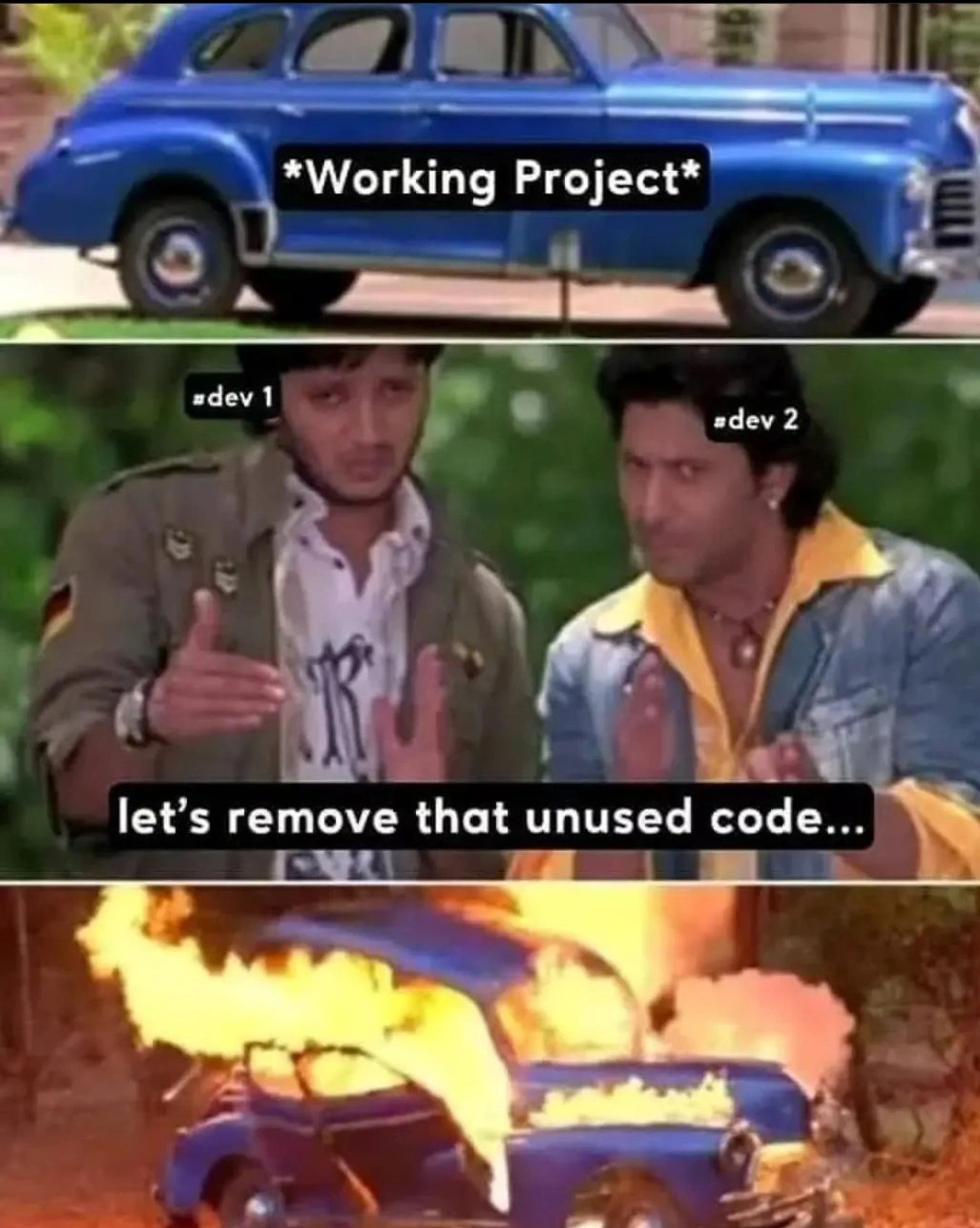
In the first panel of the meme, we see a pristine blue vintage car labeled "Working Project". This represents a software project that’s running smoothly. By the final panel, that same car is a twisted heap engulfed in flames – the project after a well-intentioned change has gone horribly wrong. And what was that change? In panel two, two developers (#dev 1 and #dev 2) confidently declare, "let’s remove that unused code…", as if tidying up some harmless clutter.

"Let's remove that unused code..." – famous last words in many a codebase.

The humor here lands with a knowing wince: that innocuous line of dialogue is basically a trigger for disaster that any experienced developer recognizes. Why is this so funny (and painful)? Because we've all seen the scenario: a tiny refactoring meant to improve code quality ends up bringing the whole system down. It’s like watching someone pull out one Jenga block they thought was safe, and the entire tower collapses in an instant. In software terms, a minor code cleanup turns into a major production bug – a classic regression (something that used to work suddenly breaks after a change).

Seasoned developers often refer to this phenomenon as finding "load-bearing code". That’s code which might look unnecessary or unused, but is in fact quietly holding the entire application up. Maybe that function was never directly called, but it ran implicitly and set up critical data. Maybe it was a fallback that only runs during rare errors, effectively acting as a safety net. Or it could have been a hacky workaround for a timing issue: there's legendary lore of a seemingly pointless sleep() call or print statement that, once removed, unleashes a race condition or a memory leak. In other words, the code was “dead” only in appearance; in reality it was a structural support beam. Remove it, and boom – the app’s stability goes up in flames, just like the car in the meme.

This meme also pokes fun at the optimism (or hubris) of developers who utter "what could go wrong?" right before all hell breaks loose. The two devs in panel 2 are essentially celebrating a cleaner codebase, unaware that they’ve yanked out a critical piece. It’s a scenario dripping with RefactoringPain. Refactoring, by definition, is supposed to improve the internal structure of code without changing its external behavior. It's something we do to manage technical debt and keep the system healthy. However, when refactoring is done without full understanding, it can introduce nasty surprises. The intent was noble – removing cruft, eliminating an apparently unused module – but the outcome is a nightmare: an outage or a malfunction that wasn't there before. The contrast between expectation and reality is at the core of the joke.

A big cause of such surprises is unexpected dependencies. In large codebases (especially legacy systems or big monoliths), there are often hidden relationships between components. Perhaps that "dead code" method was only called via reflection by an external plugin, or only on Tuesdays when the moon is full (i.e., under some rare condition). One infamous guideline in software is that if something has been in production for a long time, someone, somewhere, relies on it – even if they weren't supposed to. This is basically an interpretation of Hyrum's Law: any observable behavior of the system, even a quirky one, ends up getting depended on. So that bizarre function that prints "Hello" to nowhere? There's a non-zero chance a script out there is parsing the log for "Hello" to signal that everything is okay. Ridiculous? Yes. Far-fetched? Not as much as we’d like. The meme exaggerates it with a car explosion, but the core is true: remove something seemingly harmless, and you might break something you never knew was connected.

Another relatable aspect here is the classic “works on my machine” vibe. The devs likely ran all the tests after removing the code – and everything passed. Deploy to production, though, and suddenly the app is burning. This implies that their local environment or test suite didn’t mimic a certain condition that occurs in the real world. Maybe the code they removed was only executed with a production configuration, or when real user data flowed through. In the safe bubble of a developer’s laptop, the project still ran fine (hence their confidence). But production is a different beast with more variables. That gap – between it works for me and “it actually works for everyone” – is where a lot of bugs live. When something goes wrong only outside the developer’s environment, we jokingly say, “Well, it works on my machine.” Here, that energy is front and center: the devs presumed a cleanup would be trivial since nothing broke in their minimal testing, but in reality, they just hadn’t hit the right (wrong) scenario.

This meme resonates with developers because it's a shared cautionary tale. It highlights the fine line we walk when balancing code quality improvements against the risk of bugs in software. Everyone wants to delete bloat and have clean, efficient code. But veteran engineers have scar tissue from seemingly harmless changes that caused 3 AM emergencies. There's a reason why phrases like "If it ain't broke, don't fix it" or "no deployments on Friday" exist in tech folklore. 😅 Often they've emerged from exactly the kind of fiasco depicted here. In many teams, a diff that only deletes code is celebrated – fewer lines, fewer problems, right? Except when those lines were acting as the glue (or duct tape) holding things together. The irony is strong: the developers improved the codebase by all visible metrics (fewer lines, fewer unused functions), yet the outcome was worse performance – or total failure.

Ultimately, panel 3’s fiery wreck is an exaggeration of the aftermath: panic, rollbacks, and bug-hunt scramble. It’s funny in retrospect precisely because it’s horrifying when it happens to you. The meme takes a mundane refactoring task and blows it up – literally – to remind us that in software, nothing is ever truly harmless. The next time someone cheerfully says, "Let's just clean up this leftover code," you'll remember that shiny blue Working Project car and picture the flames. And maybe double-check those “unused” references one more time (or at least ensure you have a good backup!). In the world of development, even a clean-up can turn into a cautionary tale told around the campfire (or in this case, the car fire).

Level 4: The Undecidability of Unused Code

From a theoretical lens, removing "unused" code is reminiscent of a compiler optimization called dead code elimination. On paper, it's simple: if code has no effect on program output, you can drop it. In practice, determining with certainty that a piece of code has no effect is surprisingly complex – verging on the impossible in the general case. This ties into fundamental computer science limits. Deciding whether an arbitrary function will ever be called (or if its removal changes the program's behavior) can reduce to the Halting Problem. In other words, there's no guaranteed algorithm to universally detect truly unused code in every scenario. Compilers and static analysis tools use conservative approximations (like liveness analysis): they construct control-flow graphs and mark reachable code. If they aren't sure a function is unused, they treat it as used – because misjudging could change the program’s semantics. Formal methods would require proving the program’s semantic equivalence before and after removal, which is as hard as it sounds. One stray side effect or edge-case invocation, and the math goes out the window.

Real-world systems add even more complications. Enter Hyrum's Law: "With a sufficient number of users, every observable behavior of your system will be depended on by somebody." This means even code that appears optional might be unknowingly critical. Perhaps that “unused” function logs something that a monitoring tool watches, or toggles an internal flag that only matters when memory is low on a Tuesday. Large, interconnected systems evolve weird couplings over time, often invisible to any single developer. From a high-level perspective, the meme’s joke highlights a mini version of this law: the moment you assume a piece of code isn’t doing anything important, it reveals itself to be holding two universe shards together.

Another angle is how dynamic languages and frameworks can hide usage. In languages like Python or JavaScript (or environments that use plugins and reflection), code can be invoked indirectly by name or at runtime. A static code search might not find any direct calls to doCriticalThing(), but perhaps somewhere a string "doCriticalThing" is used to call it via reflection or a registry. It’s like Schrödinger's code – it’s both "unused" and "in use" until you inspect every runtime path. Consider a quick pseudo-code illustration:

# Define a seemingly unused helper:
def cleanup_helper():
    perform_critical_task()

# Dynamic registry where functions are called by string keys
functions = {"cleanup": cleanup_helper}

# Later, invocation happens indirectly:
action = "cleanup"
functions[action]()  # This calls cleanup_helper without a direct reference

In this snippet, cleanup_helper() might look unused to a naive scanner since there's no explicit call in code. Yet at runtime, it is called via a dictionary lookup. A human cleaner might delete cleanup_helper thinking it's safe, only to have the program break when that indirect call finds nothing. This demonstrates the theoretical pitfall: without understanding all the implicit connections (some of which are as hard to trace as general program flow), removing code can violate assumptions. The deeper truth underpinning the meme’s humor is that reasoning about software correctness – even for something as simple as deleting code – brushes up against formal limits and requires very cautious analysis. In summary, a "harmless cleanup" can inadvertently breach the delicate logical constraints that keep a complex system stable, thanks to the spooky action-at-a-distance of hidden dependencies and the inherent uncertainty of what truly is unused.

Description

A three-panel meme illustrating the perils of modifying a legacy system. The first panel shows a classic blue car, representing a '*Working Project*'. The second panel features two developers, labeled '#dev 1' and '#dev 2', from what appears to be a movie scene, with one saying, 'let's remove that unused code...'. The final panel shows the same blue car completely engulfed in flames. This meme humorously captures a common and painful experience for developers: attempting a seemingly safe cleanup or refactoring task, like removing dead code, which then causes the entire application to fail catastrophically due to hidden dependencies or unforeseen side effects. It's a relatable scenario for any engineer who has ever been afraid to touch a piece of old, undocumented, but functional code
Comments

12
Anonymous ★ Top Pick The code wasn't unused, it was a load-bearing comment. The compiler was just honoring its last wishes
  1. Anonymous ★ Top Pick

    The code wasn't unused, it was a load-bearing comment. The compiler was just honoring its last wishes

  2. Anonymous

    Sonar called the DAO “unused” - turns out it’s just nocturnal, summoned at 03:00 by a legacy batch job through reflection and a decade-old XML Spring bean

  3. Anonymous

    After 15 years in the industry, you learn that 'unused' code is just code whose purpose hasn't revealed itself yet - usually through a 3am PagerDuty alert after someone finally removes it

  4. Anonymous

    Chesterton's fence, corollary: the code with zero references is the code being invoked via reflection from a config file last touched in 2014

  5. Anonymous

    Every senior engineer has learned this lesson the hard way: that 'unused' code with zero references in your IDE's search? It's actually the load-bearing comment keeping your entire distributed system from achieving Byzantine fault intolerance. The code wasn't dead - it was just sleeping, waiting for you to delete it so it could wake up at 3 AM on a Friday and remind you why the previous architect left those cryptic TODO comments about 'DO NOT REMOVE - FIXES RACE CONDITION IN PROD.'

  6. Anonymous

    In a 20-year monolith, unused code isn't bloat - it's the duct tape propping up the Jenga tower of dependencies

  7. Anonymous

    Turns out the “unused” module was the DI container’s secret handshake; delete it and the component scan forgets the app exists

  8. Anonymous

    “Let’s remove that unused code” - translation: delete the reflection-only registration a 3am cron in another repo depends on; unused to the linter, mission-critical to prod

  9. @beton_kruglosu_totchno 4y

    never happens to me

  10. @beton_kruglosu_totchno 4y

    but kinda happens to my colleagues when they adopt my code

  11. Deleted Account 4y

    Every day happens to my code

  12. @Agent1378 4y

    Rookies with unbeatable need to optimize everything? I call them "destroyers of code".

Use J and K for navigation