Skip to content
DevMeme
3881 of 7435
FizzBuzz, Now With Defensive Semicolons
Languages Post #4227, on Feb 19, 2022 in TG

FizzBuzz, Now With Defensive Semicolons

Why is this Languages meme funny?

Level 1: Too Many Periods

Imagine writing a simple sentence like "I like cake," but putting twenty periods before every word. The sentence still has the same meaning, but it becomes silly and hard to read. This code does the same thing with semicolons: it solves an easy problem, but hides it under way too much punctuation.

Level 2: FizzBuzz With Static

JavaScript uses semicolons to end many statements, although it can sometimes infer them automatically. A normal line might look like:

console.log("Fizz");

In this meme, the programmer has added many semicolons before real code lines. Most of those semicolons do nothing. They are like blank commands. The program can still run, but it becomes annoying to read.

FizzBuzz is a beginner-friendly programming challenge. You count numbers, but replace some numbers with words based on divisibility. If a number is divisible by 3, print Fizz. If divisible by 5, print Buzz. If divisible by both, print FizzBuzz.

The joke connects to code quality, syntax abuse, and formatting. Code can be logically correct and still ugly. A junior developer may first learn that "working" is not the same as "good." This screenshot is a perfect example: the logic is fine, but the presentation creates needless friction for anyone trying to understand it.

Level 3: Defensive Punctuation

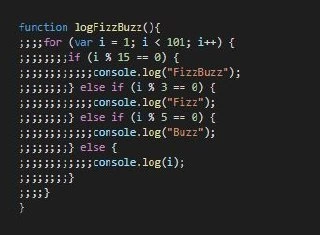
The visible algorithm is the classic FizzBuzz exercise: loop from 1 to 100, print FizzBuzz for multiples of 15, Fizz for multiples of 3, Buzz for multiples of 5, otherwise print the number. The screenshot includes exactly that structure:

if (i % 15 == 0) {
  console.log("FizzBuzz");
} else if (i % 3 == 0) {
  console.log("Fizz");
} else if (i % 5 == 0) {
  console.log("Buzz");
}

FizzBuzz is usually used as a deliberately simple coding challenge. Its whole point is to reveal whether someone can write a loop, conditionals, and modulo arithmetic without turning the interview into a distributed systems symposium. This image corrupts that simplicity by adding punctuation noise to almost every line. It takes a toy problem and makes it look like a minified file had a panic attack.

The post caption says it is for people tired of memes about missing semicolons. That is why the exaggeration works. JavaScript semicolon debates are old developer folklore: some teams require them, some omit them, some let formatters decide, and everyone has a story about a line break that changed behavior at the worst possible time. This meme pushes the "always use semicolons" rule past reason and into code-style self-parody.

The senior pain point is that technically valid code can still be unacceptable code. A linter may allow empty statements in some contexts. The runtime may produce correct output. But maintainability is not just execution. Code readability matters because future humans must debug, review, and modify the file. When the simplest interview problem looks hostile, the style guide has stopped being a guide and started wearing a tiny crown.

There is also a nice little jab at defensive programming. Extra checks and explicit syntax can be useful when they clarify intent. Here, the extra semicolons do not reduce risk; they only perform anxiety. The code says, "No missing semicolons here," the way a production incident says, "No single point of failure," five minutes before the shared database falls over.

Level 4: EmptyStatement Overload

The screenshot shows a JavaScript function logFizzBuzz(){...} where ordinary FizzBuzz logic is buried under long runs of semicolons:

function logFizzBuzz(){
;;;;for (var i = 1; i < 101; i++) {
;;;;;;;if (i % 15 == 0) {
;;;;;;;;;;;console.log("FizzBuzz");

The reason this is syntactically valid is that JavaScript grammar permits an empty statement: a bare ; that does nothing. Parsers do not treat every semicolon as a separator between meaningful operations. A semicolon can terminate a statement, but a semicolon by itself can also represent a statement whose body is empty. So ;;;;for (...) is essentially several no-op statements followed by a for loop.

That is the technical knife twist. The code is not broken in the way beginners expect. The parser can tokenize it, build a valid syntax tree, and execute the loop. Each extra semicolon becomes dead air in the program, not a syntax error. The runtime strolls past them like a bored compiler front end muttering, "Yes, yes, very defensive."

This also pokes at Automatic Semicolon Insertion in JavaScript. ASI is the language feature that sometimes inserts semicolons where the grammar requires statement termination and the line break makes insertion legal. Developers argue about whether to always write semicolons, omit them, or use tooling to enforce one style. The meme answers that anxiety with malicious compliance: if missing semicolons are scary, put enough semicolons everywhere that absence is impossible.

From an interpreter/compiler perspective, it is funny because this is a case where syntax validity and program readability violently diverge. The AST still represents a straightforward for loop with if, else if, and else branches. But the source text has become visual static. Machines can ignore meaningless tokens that map to empty statements; humans still have to review the crime scene.

Description

The image is a dark code editor screenshot showing a JavaScript function named `logFizzBuzz()` that implements the classic FizzBuzz loop from 1 to 100. The code includes `for (var i = 1; i < 101; i++)`, checks `i % 15 == 0`, `i % 3 == 0`, and `i % 5 == 0`, and prints "FizzBuzz", "Fizz", "Buzz", or the number. The joke is that nearly every line is prefixed with long runs of semicolons, turning harmless empty statements into visual noise around otherwise straightforward code. It pokes at JavaScript semicolon habits, code style anxiety, and how technically valid syntax can still be deeply hostile to readability.

Comments

9
Anonymous ★ Top Pick Automatic semicolon insertion saw this file and decided to take the rest of the sprint off.
  1. Anonymous ★ Top Pick

    Automatic semicolon insertion saw this file and decided to take the rest of the sprint off.

  2. @ZgGPuo8dZef58K6hxxGVj3Z2 4y

    Best

  3. @kandiesky 4y

    What the actual fuck Why

  4. @QutePoet 4y

    Please tell me about this algorithm, I can't get it.

    1. @Vo_6V 4y

      It's fizz buzz beer game, classic interview task

    2. @beton_kruglosu_totchno 4y

      the semicolons or fizbuz?

  5. @codycode 4y

    You use 4 semicolons per indentation level?? What is wrong with you REAL developers use 2 semicolons per level

    1. @dsmagikswsa 4y

      I am fake dev then. I am using 4 space for indentation.

      1. @prirai 4y

        OGs use 8 Got the reference?

Use J and K for navigation